What to Look for When Buying Used Engine Parts

Used engine parts can be a great deal, if you know what you are looking for. They can also kill your engine. Here’s what to look for in used engine parts. Most of the places that you’d go engine parts hunting are swap meets. Bring a cheat sheet of engine codes and casting numbers with you, or you might end up with a completely different part than you need.

  • Intake Manifolds: Most factory performance air intakes are fairly easy to identify because there is a casting number and date code on them. Cast iron intakes are virtually indestructible, but are fairly heavy. Aluminum intakes offer better performance, but are more susceptible to problems. Look at the thermostat’s counterbore, as it is common for that area to get rusted and corroded on aluminum intakes only. If it’s not too badly eaten away, any good machinist can repair it. If it’s badly eaten away, look for another one. If you really want it, however, the bad area can be cut out, and a new piece can be welded on and machined to the original shape. It’s common to see other problems, and if it looks like it’s been modified, make sure that it was done well!
  • Pistons: Careful with these. Most new pistons are relatively inexpensive, but you can score a good deal on them at a swap meet if you know what you’re looking for. If there’s a full set of them and they’re still in the box, you’ve got a great deal. Get them if they fit your car. If they are used, be sure to clean off all of the carbon deposits from the tops and inspect them thoroughly. Also, check for ring lands and grooves on them – this means that something was wrong with the engine that they came out of, and that they are damaged. DON’T buy those! If they don’t fit your engine, they make great pencil or screw holders.
  • Connecting Rods: Used connecting rods are very difficult to evaluate without the proper equipment. Yes, it’s easy to bead-blast and hone an old pair, but you need to take them to a good machinist to make sure that they are good to put into your engine.
  • Camshafts: If it’s unused, in it’s original box, and has full documentation from day one, you can definitely consider it. When buying used camshafts, it’s very difficult to tell whether it’s a stock, weak camshaft or a high-performance camshaft. Plus, modern camshaft technology has advanced so much in the past 50 years that it’s worth it to just buy a brand-new camshaft. It’ll be easier to get one that’s essentially tailored for your driving style.
  • Exhaust Manifolds and Headers: Exhaust manifolds are sturdy parts, but can be abused and broken. It’s not uncommon to find a broken stud in an exhaust manifold. Luckily, they are fairly easy to remove. Used headers can be a great deal or a massive head ache. Ask the seller what they fit, rather than, “will they fit on my Challenger?” Check the welds and flanges on the headers – if the flanges are warped, they will not seal against the head, resulting in exhaust leaks. You don’t want to be like Freiburger and Finnegan from Roadkill. Also inspect headers for dents and scratches that could have come from bottoming out or from hammering them into place.
  • Carburetors: Have a carburetor cheat sheet on hand when you go looking for carbs. You can determine it’s original application and CFM rating. The overall appearance of a carburetor is a good indicator of it’s health. Rebuild kits are available for nearly every carburetor under the sun, so it makes it a good deal less risky to buy a used carburetor.
These are aluminum intakes for Chevy big-block V-8s.
People will try to sell you pistons in conditions far worse than this. They don't even make good pencil holders!
People will try to sell you pistons in conditions far worse than this. They don’t even make good pencil holders!
These are brand-new connecting rods for a Chevy small-block V-8. You can luck out if you know what you are looking for at a swap meet.
This guy lucked out and found a camshaft for his Dodge pickup with the Cummins diesel engine at the Pomona swap meet.
This is what you'll see when you go in search of headers at a swap meet.
This is what you’ll see when you go in search of headers at a swap meet.
This is the sight you'll see when you go to a swap meet to find carburetors.
This is the sight you’ll see when you go to a swap meet to find carburetors.

Can You Text and Drive in This Great New Game?

I’d like to say sorry for this post coming out today.  As I had to attend a friend’s graduation yesterday, I was unable to post.  I do think however, that this post will make up for the delay.

Before we get down to business, let’s get one thing clear: texting and driving do not mix well.  If you get caught by the police, you get a big ticket, and could possibly lose your license, depending on if you’re a repeat cell phone law violator.  It’s incredibly dangerous, and can kill or injure a lot of people because you just couldn’t wait to respond.  Never, ever pick your phone up while driving!  Let’s all get one thing clear: texting and driving in the real world is much different than texting and driving in this hilarious new game called SMS Racing.

It’s a total remake of the 2013 browser game that had the same name.  The 2015 version uses all new material, and it shares only a name and a concept with the original game.

It was built for the 2015 Oculus Mobile VR Jam, where many app and game developers are teamed up to create the most captivating VR experience possible.

We’ve all seen or heard of the dozens of texting and driving games out there, many of which are dry, boring attempts to teach teens the dangers of texting and driving at the same time.  Enter SMS Racing.  It’s a whole lot of fun.  Let me tell you why.

When you start the race, you’re told to finish a lap as fast as you can while responding to text messages without crashing, all within a limited time frame.

An instructor talks to you during the race.  She encourages you to keep up with all of your social connections, and to focus less on the road.  This is when all of the sarcasm that the developers have kicks in.  She tells you that texting is an important part of driving, and that it would be rude not to respond to your friends.

Should you fail to respond to a message within ten seconds, you are told to “…restart, or keep driving and reflect on how it feels to have no friends.”  That’s cold.

The game has several features that were not in it previously.  It has a Time Trial and a Race mode, a head tracking feature to change your view based on movement, artificial intelligence rivals who also text and drive, and city and suburb maps.

This review is based on various user reviews, plus video recordings of the game.  I haven’t played it…yet, but if and when I have a chance, I will do a full review of it!

Users of the game say that the constant need to text can become frustrating at times, which only further demonstrates the sole purpose of the game.

They also say that when you finally get a lap in, you’ve probably cursed the game to hell and back, but you’ve probably crashed just as many times.  In the end, it’s all smiles and a good chance to laugh at how ridiculous it is to put texting before driving.

Please don’t. Driving requires a lot of attention, and you could kill yourself or others because you just had to glance down at your phone.  It can always wait.  If you can’t wait, pull over in a safe spot and read the text or social media alert.

Here’s some video from the VR Jam.  https://youtu.be/07hY2JenhMQ

You can check out the game, and even download it at http://vrjam.challengepost.com/submissions/36780-sms-racing

However, you need the proper VR gear, but if you do, it seems like it’s worth a shot.

What the OPTIMA Search for the Ultimate Street Car is Really About

It all began at the SEMA show in 2004 or 2005.  OPTIMA’s Director of Product Development and Marketing, Cam Douglass, was in awe of all of the pro-built cars being shown, and couldn’t help but wonder if there was more to these cars than just having brand name parts and looking cool.

It took him a few years of talking to people and a whole lot of planning, but then Douglass met Jimi Day, and the idea became a reality.  It went from the SEMA show floor to the nearby track, Spring Mountain Motorsports Ranch.

As expected, Pro-Touring cars were all over the headlines.  I mean, how could they not be when iconic cars like RJ Gottlieb’s Big Red Camaro and Steven Rupp’s Bad Penny Camaro were competing?  In fact, they continued to grab headlines because Gottlieb and Rupp were more than willing to push both themselves and their cars to the absolute limit.

In the first year alone of OUSCI (OPTIMA Ultimate Street Car Invitational), there were some well-performing cars in the field.  There was a 2004 Porsche 911, a brand-new Pontiac G8, a Lincoln MKX of all things, a new Dodge Challenger, and several late-model Corvettes.

Why such a diverse field of cars?  Because otherwise, how would you determine what the “ultimate” street car really was?  The whole point of OUSCI is to see if SEMA show cars could perform as well on the track as they could look good at a show.  There never were, and never will be limitations on the year, make, model, or build style of the cars. Otherwise there would be no real valid way to determine whether the winner was the ultimate street car.

The OUSCI field is the most diverse it has ever been, with cars like Jonathan Ward’s 1948 Buick ICON Special to Dieter Heinz-Kijora’s 2014 Mercedes-Benz CLA45 AMG, and more than 100 cars in between those extremes.  Yes, Pro-Touring cars are still a big part of the mix, but anybody who owns a street-legal car or truck has a chance at getting to the invitational.  Just ask Thomas Smith about his 120,000 mile daily-driven 2005 Subaru WRX STI.

If you’re interested in going to a qualifying event to just watch, or to try and get to the invitational, they happen all over the country.  I’ve attached a link for you, where you can register for a qualifying event if you’re interested at http://driveusca.com/events/

Every vehicle that makes the cut is placed on display at SEMA for a week, before heading out to the OUSCI at Las Vegas Motor Speedway.

This is 2010 OUSCI competitor Mike Musto's 1969 Dodge Charger Daytona replica.  He's a host for the /DRIVE network on YouTube, which I highly recommend, and this is one of the coolest cars I've ever seen.
This is 2010 OUSCI competitor Mike Musto’s 1969 Dodge Charger Daytona replica. He’s a host for the /DRIVE network on YouTube, which I highly recommend, and this is one of the coolest cars I’ve ever seen.
This is just a beautiful picture from Las Vegas Motor Speedway.  It was taken at the end of the 2014 OUSCI.
This is just a beautiful picture from Las Vegas Motor Speedway. It was taken at the end of the 2014 OUSCI.
This is Bob Benson's totally cool 1972 De Tomaso Pantera from the  2013 OUSCI.  It's just epic looking, isn't it?
This is Bob Benson’s totally cool 1972 De Tomaso Pantera from the 2013 OUSCI. It’s just epic looking, isn’t it?


How Porsche DNA is in Your Car

Porsche and the rear window wiper are forever linked in the annals of automotive history, and for good reason.

While rear window wipers were accessories as far back as the early 1940s, they never became commonplace for a variety of reasons that I’ll talk about in a bit.  Italy became slightly interested in them in the mid-1950s.  Ferrari installed a pair of them on a 1955 Ferrari 250 GT Europa by Pinin Farina.

Interest had picked up sufficiently that, in 1957, rear wipers made their next public appearance at the 1957 Salon de Genève on the new Lancia Flaminia Berlina, another Pinin Farina creation.  While they were highly praised for their functionality by the press, nobody quite caught onto the idea.  This should come as no surprise: outside mirrors, which greatly aid rear visibility were considered superfluous to Italians.

Eight years later, a wealthy German industrialist contacted Porsche with a request.  He wanted a wiper installed on the rear window.  Porsche set about developing a rear window wiper.

You can only imagine what other Porsche enthusiasts thought when they saw this fine gentleman cruising the boulevards with his fancy new car and it’s rear window wiper.  The factory began to receive an increasingly large number of requests for similar installations. The demand was so great that Porsche offered a dealer-installed or DIY retrofit kit. This wasn’t even enough – Porsche decided to make it a factory option in 1966.

The early rear wipers were rudimentary at best, but they did the job.  The early wiper arm pivot shafts had bushings angled inward and outward, which enabled it to be mounted to the edge of the air intake recess on the existing engine lid.

In 1967, as the rear wiper option gained massive popularity, engine lid pressing dies were slightly modified to incorporate integral mounting pieces for the rear wiper installation. This eliminated the need for the angled adapter bushings.  These were included on both sides of the engine lid to accommodate both left-hand-drive and right-hand-drive applications.

Volvo took note of Porsche’s little invention, and added one to the 145 in 1969.  The time for rear window wipers had finally arrived.

By the time the OPEC oil crisis arrived in the mid-1970s, rear wipers had become commonplace on hatchbacks, station wagons, and off-road machines like the Chevy Blazer and Ford Bronco.  These body styles were perfect applications for the rear window wiper: because of the lack of a rear deck (a trunk), a rear window is bound to collect more dirt and grime than a sedan or pickup truck’s.

Since 1965, Porsche has remained a devout follower of the rear window wiper, offering it on every single fixed-roof production car after the 911, with the exception of the 914, as it had a recessed rear window and long rear deck, which eliminated the necessity of a rear window wiper.

It doesn’t matter how old the Porsche is to make this option desirable.  It goes far beyond a functionality statement.  It’s a perfect visual metaphor of the classic Porsche essence and character that has carried through today.

You can still feel the original Porsche character today.  The 356 and 911 (through the 993 generation), with their air-cooled reliability (their engines were souped-up VW Beetle engines), rear-engine traction, fully-independent suspension with incredibly long travel, and generous ground clearance meant that these were not cars to be taken lightly.  They were not smooth-road sports cars like the Triumphs of the same era.  They were truly all-weather, go-anywhere-on-any-road cars.  This set them far apart from the other sports cars of the era, which generally had low ground clearance, borderline-at-best weather sealing, limited traction, horrifically unreliable everything, and marginal-at-best cooling systems.

It should come as no surprise to you that early Porsches were even better for all-weather capabilities than most standard sedans when the weather got yucky.  Those early Porsches don’t care about the meteorological conditions or terrain.  They will get a driver and their passenger to almost any destination in comfort.  They truly have the functionality of a Swiss Army knife.  The stark functionality of a rear window wiper expresses this.

Almost every Porsche that went rallying was fitted with a rear window wiper until high-speed rallying and weight reduction made them somewhat obsolete.  Anybody who has ever gone rallying or bombing up and down a fire road knows just how important a rear window wiper is, especially after a big slide.

Most Ferraris, Jaguars, and Corvettes are taken out when the weather is nice.  It’s always been that way.  Porsche owners have never been afraid of taking their Porsche out when it’s rainy or snowing.  A rear window wiper, in addition to it’s functionality, signals to the casual observer that they are gazing upon a car that earns it’s keep.  While it’s great to have a car that wins trophies, how often is that car driven?

To the uninitiated Porsche enthusiast, a rear window wiper would seemingly ruin the looks of the car.  Let me explain it this way: a Porsche with a rear window wiper is like seeing Sean Connery as James Bond in black tie slipping a steel Rolex Submariner onto his wrist.  It’s a seemingly incongruous functional instrument that seems out of place, but it hints at capabilities at his beck and call.

1955 Ferrari 250 GT Europa


1957 Lancia Flaminia Berlina

1965 Porsche 911

1967 Porsche 911


1969 Volvo 145


VLUU L200  / Samsung L200

1976 Chevy Blazer


Porsche 914-6

James Bond

What Makes the Monaco Grand Prix So Special?

Monaco has been called the casino capital of the world.  It’s got a lot of wealth squeezed into just 499 acres.  For reference, that’s almost five times the size of Disneyland.  It’s also the oldest circuit of Formula 1, having been a track since 1929.  The route is essentially the same as it was in 1929, which gives you a unique opportunity to see cars with nearly 1000 horsepower blasting around for first place.  It’s also one of the few tracks where race cars get to run through the tight streets of a city.

For those of you who watch motorsports, you’re likely going to agree with me that the reason that people are drifting away from watching various races is that it doesn’t seem as exciting anymore.  I think it has to do with the fact that the tracks are wide (they can usually take well over three cars at even the narrowest corner), and that the cameramen are getting pushed further away from the action.  This last fact might seem trivial and stupid to you, but think about it for a second.  Thanks to GoPros (I have nothing against them), automotive enthusiasts are getting used to punching in a search term into YouTube (again, nothing against it) and seeing POV videos of some motorcyclist or crazy driver blasting their way through traffic.  You can put a GoPro on just about any surface on a car or motorcycle so that everybody can see the action.  That’s all fine and dandy, but we need to do this in the professional racing world.

Many Formula 1 races are actually quite exciting, but they don’t seem like it on your TV. The tracks are so wide that it’s nearly impossible to get a cameraman close to the action.  It just doesn’t seem quite as exhilarating as hearing that unearthly shriek coming towards you, the whirs and pops from the turbocharger, and the crackling downshifts sending flames shooting out of the back of the car.  There’s only so much action a camera can capture when it’s 100 feet away from the action, instead of ten feet away.

I look forward to Monaco for this reason: it’s one of the few races left where I can feel like I’m right there, even if I’m several thousand miles away from the action.  It’s the closest we can get to seeing a modern car whip around one of the most historic tracks in the world.

I feel that Formula 1 has turned into what NASCAR used to be.  Think of NASCAR as the WWE Raw TV show, while Formula 1 is like watching a street fight.  I know this might seem ridiculous, but if you were into watching wrestling, would you want to see a scripted and pre-ordained fight, or would you want to watch a fight where nothing is scripted or agreed to other than the fight itself?

NASCAR used to hold a special magic for me, and I only watch it at Watkins Glen and Sonoma Raceway now, as most of the drivers are inexperienced on road courses.  I’ve talked to several friends about the boring, pre-ordained spectacle that NASCAR has become, even though it’s got just enough reality to make it somewhat worth following.

Formula 1 now holds that magic for me.  NASCAR and Formula 1 used to be the bleeding edge of technology, and now it’s up to Formula 1 to do that.  NASCAR today is this: you have a larger-than-life personality, put the pedal to the metal, and let Dale Earnhardt., Jr. or Jimmie Johnson take the win.  It was a shocker to me when Kevin Harvick became the 2014 NASCAR Sprint Cup Series champion.  It was completely unexpected, and it helped me somewhat re-kindle my interest in NASCAR.  Formula 1 is now truly a test of a driver, his team, and their car.  If you want to make a big splash in the racing world, become a Formula 1 driver.  I know that what I’ve said has been repeated by many automotive journalists, but it’s worth rehashing.

One last thought (promise!): Monaco is a place that should be high on the bucket list of every automotive and racing fan.  It’s incredibly high on mine.  I’ve always wanted to do a road trip through Europe of all of the great European tracks (Brands Hatch, Silverstone, Goodwood, Le Mans, Nurburgring, Hockenheim, Monaco, Monza and Imola) in a Pagani Huayra.

I’d love to hear your experiences of NASCAR/Formula 1, and why you agree or disagree with me on this.  If you watch another form of motorsport that holds this kind of magic for you, please tell me in the comments section.  I enjoy watching all of the off road racing in Baja and the desert.  It’s entertaining, and it’s truly a test of a driver.

One of my friends from school wrote an excellent article about the loss of magic in NASCAR for him, and it’s worth a read, as well as this article. http://www.theoakleafnews.com/sports/2015/05/12/is-nascar-fading/

Monaco 2011

Monaco-GP-05

The Best Car Show Ever

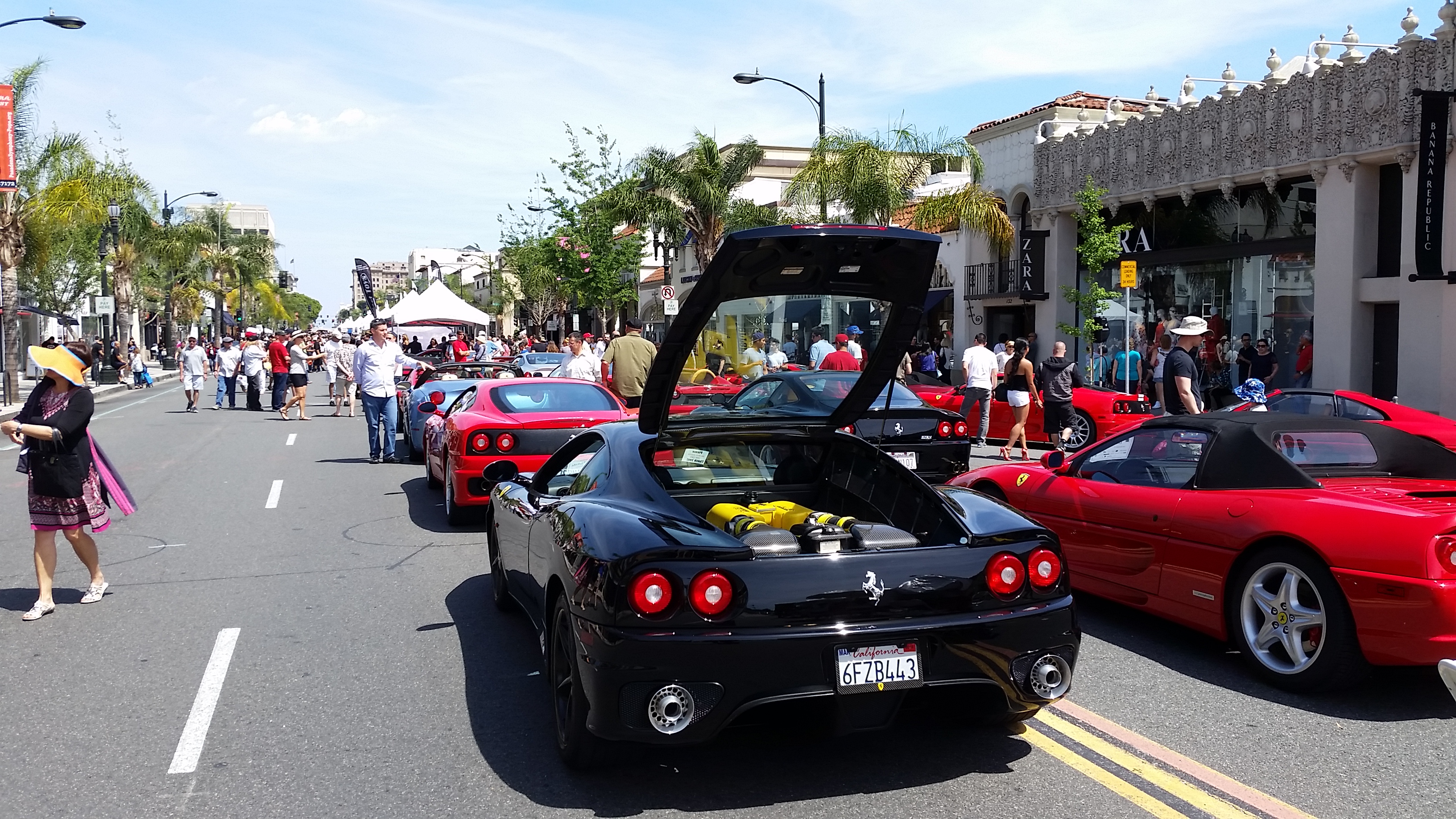
I recently attended what may be the best car show I’ve been to yet.  It was called Concorso Ferrari, and it was held in sunny Pasadena, California.  My uncle’s friend is a judge for Concorso Ferrari, and was kind enough to let me shadow him as he judged the Ferrari 360 Modena class.

There were 160 cars in attendance, and my uncle’s friend and two other incredibly nice judges were there to judge eight cars.

Some of the cars that I was able to watch being judged were beyond flawless, while two were daily drivers.  The owners of the daily drivers were fine to tell the judges that.  Their theory is that a Ferrari is meant to be driven, and it would be a waste of money to let it sit in the garage to only come out for shows.

While 160 cars doesn’t sound like a lot, you have to remember that they took up three blocks, with cars parked at the curb and in the lanes.  I’m not sure exactly how many people were in attendance, but it was well over three thousand.  To say that it was crowded would be an understatement.

If you told me to pick just one highlight from the show, I couldn’t.  It was a truly amazing experience, and I urge you to come down to Pasadena next year to experience it for yourself.  You probably won’t be invited to shadow a judge, but you’ll be able to see truly beautiful cars, meet nice people, and get expensive merchandise (the hat and mug I got cost around $80).

Enjoy the pictures I took.

This is my uncle's friend's 2008 Ferrari F430. It's a deeper red than you'd see on a typical Ferrari, but it looks absolutely stunning.
This is my uncle’s friend’s 2008 Ferrari F430. It’s a deeper red than you’d see on a typical Ferrari, but it looks absolutely stunning.
I hope this gives you some idea as to how large the event is.  This was taken from the top end of the show, and I couldn't even fit the rest of it into the frame!
I hope this gives you some idea as to how large the event is. This was taken from the top end of the show, and I couldn’t even fit the rest of it into the frame!
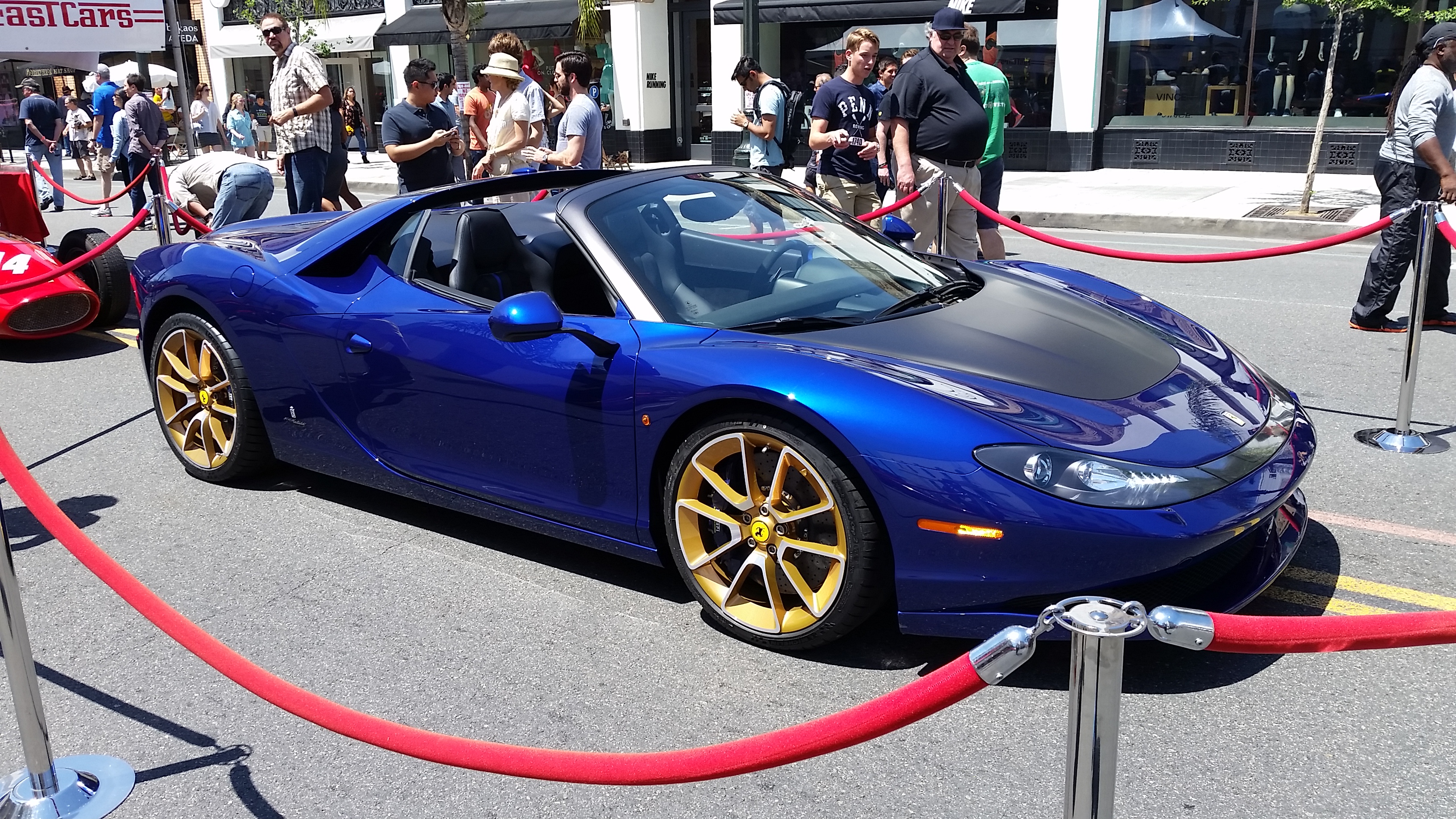
This car is the incredibly rare Ferrari Sergio. It's named after Sergio Pininfarina, the man who led the legendary Italian design firm for 40 years. It's a truly beautiful car, and it was apparently a mess when it came to Beverly Hills Ferrari. It supposedly needed a repaint. That can't be cheap!
This car is the incredibly rare Ferrari Sergio. It’s named after Sergio Pininfarina, the man who led the legendary Italian design firm for 40 years. It’s a truly beautiful car, and it was apparently a mess when it came to Beverly Hills Ferrari. It supposedly needed a repaint. That can’t be cheap!
I'm pretty sure that this is a recreation of a vintage Ferrari Formula 1 car, as cars from that era didn't have coil-over shocks (not visible in this picture). Either way, it's still cool.
I’m pretty sure that this is a recreation of a vintage Ferrari Formula 1 car, as cars from that era didn’t have coil-over shocks (not visible in this picture). Either way, it’s still cool.
This was the only Ferrari F40 at the show, which surprised me. Anyways, the F40 was the last car that Enzo Ferrari had personal control over in development. It's an incredible car, and I've always wanted one. Seeing one in person was an incredible experience that I will never forget. Hearing it fire up, and hearing that gurgling V-8 with the whistling turbochargers still sends shivers down my spine.
This was the only Ferrari F40 at the show, which surprised me. Anyways, the F40 was the last car that Enzo Ferrari had personal control over in development. It’s an incredible car, and I’ve always wanted one. Seeing one in person was an incredible experience that I will never forget. Hearing it fire up, and hearing that gurgling V-8 with the whistling turbochargers still sends shivers down my spine.

I have more pictures, but they’re basically all of the cars shown above.  I have attached the album link on Facebook for you all to drool over.  https://www.facebook.com/media/set/?set=a.917013121670207.1073741830.692811890756999&type=3

Also, if you are on Facebook and haven’t already liked my blog, please do so!  I’m really pushing to get more likes on the page(I will post pictures, you can comment, etc.).  You can be part of a movement!

The Evolution of Crazy

Pro Street is a popular form of hot rodding nowadays.  It’s also incredibly easy to define, unlike rat rods or Pro Touring.  Pro Street is classic cars with the rear wheeltubs dramatically enlarged for insanely wide tires.  However, defining Pro Street gets a bit more difficult from there.  Is it a fairgrounds car with big dirt tires?  A street-optimized race car? A race-optimized street car?  Or is it a full-on race car?  It can be any and all of those.  Pro Street has evolved throughout the years from essentially fairgrounds cars to street-optimized race cars.  I’ve taken the pleasure of outlining important years and cars in the evolution of Pro Street.  While your idea of Pro Street might differ, or not be there, I hope this helps.

1972: Grumpy Jenkins Pro Stock Vega:  Bill “Grumpy” Jenkins essentially ushered in Pro Street with the advent of his groundbreaking NHRA Pro Stock tube-chassis Chevy Vega in 1972.  Nobody had ever seen massive tires tucked under a production body before. Yes, the extreme Funny Cars had been using the look for a few years prior, but they had fiberglass body shells, so let’s not count those.  Grumpy went all-out groundbreaking by using a completely tubular frame, which allowed him to run those massive 14-inch-wide and 32-inch-tall drag slicks previously reserved for Top Fuel.  Every single Pro Stock car borrows heavily from that groundbreaking Vega in 1972.

Grumpy Jenkins Chevy Vega

1979: Scott Sullivan’s 1967 Chevy Nova:  No, this beautiful 1967 Chevy Nova was not the first Pro Street car.  Not by a long shot.  However, it was the first car to get massive attention past a small magazine feature on it.  It thundered onto the scene in 1979, just a year after the Car Craft Street Machine Nationals were launched to tire-burning success.  It created the perfect test-and-tune environment for Pro Street.  Sullivan has been known for setting hot rodding trends with just about every car that he builds.  His 1967 Nova was no exception.  It may not have been as innovative as his other cars, but it doesn’t make it any less beautiful, thanks to it’s highlight stripe and color-matched bumpers.  It even had the perfect stance.  Sullivan sold the car in 1984 to Pro Mod racer Ron Iannotti.

Scott Sullivan 1967 Chey Nova

1980: Some Tubbed Street Machines: Many street rod builders of the late 1970s became brainwashed by Scott Sullivan’s beautiful 1967 Chevy Nova (see above), and completely redid their cars.  Just about every car from this era had the back half of their chassis tubbed, and many builders simply moved the leaf springs far inside the chassis to fit the massive drag slicks.  Seeing a car with a Roots blower sticking out of the hood was a must well into the 1990s.

Pro Street Pontiac GTO

1985: Fully Tubbed Street Rods: The cover of the July 1985 ‘Hot Rod’ magazine announced the “Fat Attack” of fully tubbed street rods.  One of the cars on the cover was “Fat Jack” Robinson’s 1946 Ford coupe, painted in a vivid Coast Guard orange.  The car was tubbed like a true Pro Street car, but it was intended to thunder down the drag strips of America.  His car was the result of the first round of the nostalgia drag racing scene of the time.  His car inspired several other pre-1948 fully-tubbed cars.  Those cars on the cover of ‘Hot Rod’ showed how the Pro Street look merging into the vast world of street rods.  It wasn’t long before you’d look around at a hot rod show and see a bunch of 1940s Ford coupes sporting massive rubber.  Unfortunately for Fat Jack Robinson, his car ended up being totaled in a crash at Fremont Drag Strip.

Fat Jack Robinson 1946 Ford Coupe

1992: Trailer/Fairgrounds Queens: Dick Dobbertin’s nutso Pontiac J2000 Pro Street car arrived on the scene in 1986.  You’re probably wondering why I said 1992.  That’s because the trend of taking a lowly late-model FWD car being converted to a fully-tubbed, RWD car started then.  It made it OK to build an over-the-top Pro Street car that only looked good, which have now been dubbed Pro Fairgrounds.  Why Pro Fairgrounds?  The show venue was the only place where these cars could really shine.  I mean, who would really want to drive a car with more than 1,000 horsepower and a short wheelbase down a dragstrip?  If you want that kind of crazy, buy a vintage Fuel Altered car.  This radical Pontiac J2000 started the Dare to be Different movement in the automotive world, by starting battles to see who was able to build a bonkers Pro Fairgrounds car that nobody else had built yet.  Soon thereafter, builders came to their senses and started the Dare to be the Same movement, which leads us to our next section.

Dick Dobbertin Pontiac J2000

1992: C.A.R.S. Camaro: Many of the builders of Pro Fairgrounds resented building cars they couldn’t drive.  They wanted truly functional rides, not simple street rods with a big block, but cars that had gigantic rubber, big wheelies, and low drag strip times.  Detroit and Ohio even started a large movement to build cars that were all-steel-bodied, fully tubbed, go eight seconds in the quarter mile, dress them up with bumpers and various trim pieces, cruise them up and down the iconic Woodward Avenue in Detroit with license plates, and then race them head-to-head all weekend.  One of the first cars featured in magazines was the C.A.R.S. Inc.-sponsored Chevy Camaro of Rick Dyer and Danny Scott.  That iconic Camaro served as the main inspiration for the ‘Hot Rod’ 1992 Fastest Street Car Shootout.

Rick Dyer Chevy Camaro

1993: Mark Tate’s Chevy Camaro: That little Fastest Street Car Shootout gained so much popularity so quickly that it couldn’t sustain itself.  The heavyweight champs, the Pro Street cars, were losing to flat-out Pro Stock-chassis cars.  Those Pro Stock chassis cars were never meant to be driven on the street, unlike the Pro Street cars.  Mark Tate joined the fray in 1993 with his stock-bodied Pro Stock-chassis 1967 Chevy Camaro.  Then it was Tony Christian’s 1957 Chevy 210.  After Christian, it was Bob Reiger and his radical Pro Stock Chevy S-10.  Appeal for Pro Stock/Pro Street cars started to wane.  These weren’t cars you could build in the garage for $10,000 anymore.  These were cars racking up bills well over $100,000.  People wanted fast cars that they could drive on the street for not much money.

Mark Tate 1967 Chevy Camaro

2011: “Modern Pro Street:” This is a total niche created in the Pro Street world by those wanting a fast car with all of the modern mechanicals.  Cars of this look have a Pro Fairgrounds look, street machine behavior, and sometimes a late-model body.  These cars usually have the newest engines, turbos, EFI, and the wheels are usually gigantic with incredible tread.  The beautiful Mustang shown here is the 2007 Ford Mustang from Fastlane Motorsports.  It has a 2010 5.4-liter V-8 with an old-school Weiand 6-71 blower showing out of the hood.

Fastlane Motorsports 2007 Mustang

2012:  Larry Larson’s Chevy Nova: This is where Pro Street is now.  Larry Larson owns a stunning 1966 Chevrolet Nova that has truly incredible performance.  He’s run 6.90 seconds at well over 200 mph in the quarter mile after driving 80 mph on the highway all day.  How does he do it?  Modern technology.  He’s got a bored and stroked Chevy big-block motor with twin turbochargers, EFI, and lots of other amazing technology.  He’s able to drive it all day to a drag strip, run incredible times, turn around and go home without killing his car.  He’s had a LOT of experience in the drag racing world, so he only uses the best parts.  If Grumpy Jenkins were alive today, his mind would be absolutely blown.  Mine is.

Larry Larson 1966 Chevy Nova

That’s where Pro Street is, and where it’s come from.  These cars have state-of-the-art technology, and they are actually quite streetable cars.

The Epic Lamborghini Miura From the Italian Job is Still Alive!

The stunning orange Italian exotic car races through the Italian Alps, the wailing V-12 never failing to disappoint Michael Cane, a cigarette loosely dangling from his mouth.  It disappears into a tunnel, and a ball of flames ensues.  The wreckage of the car is dragged out by heavy machinery by the Italian Mafia. It’s then pushed into a ravine, and a wreath for the driver follows.  It’s one of the most stunning and heartbreaking introduction scenes in cinema for gearheads.

There must have been millions of viewers of The Italian Job (the 1969 original version) who assumed that the creamsicle orange Lamborghini Miura was a write-off.  They are ALL wrong!  I must say that I was never one of them!  I had long suspected that Lamborghini would never permit a brand-new Miura to be wrecked in that fashion.  I was right.  That car disappeared into the tunnel, the cameras stopped, the car came out, and in went the wreckage of an already-wrecked Miura.  Bam smash boom.  The mangled orange wreckage comes out, gets shoved down the ravine.  Done.

The orange Miura powering through the Alps is in pristine condition, and worth well over 1 million Euros.

It’s been described as “the Holy Grail of supercars,” and two British businessmen tracked it down and bought it.  Good boys.

The car’s new co-owner, Iain Tyrrell, was tipped off around Christmas that the car still existed.  As many are, he was skeptical, yet he decided to check it out.  He said in an interview with The Daily Mail, “I was initially sceptical because no one had seen it for 46 years. But my source was a credible one so I started to pursue it.”

The car’s owner invited him to see it, but he had to act like James Bond.  No, there were no crazy bad guys with military-grade toys trying to kill him.  However, he was only given a mere three hours to verify the car as the real thing.  “It was all very James Bond-ish – I had to go to Paris to inspect the car in a secret underground car park,” he said.

Tyrrell explained the confusion surrounding the car:  “The Italian Job Lamborghini is the holy grail of supercars precisely because no one knew what happened to it after the film. I have a life-long passion for these cars but I just assumed this particular vehicle was out of reach.”  Well, not any more.  Lucky man.

The car is essentially brand-new.  It’s been well-maintained by all of it’s previous owners, and very little to nothing on the car was changed, as far as Tyrrell knows.

“There are certain quirks within the interior of the car, such as the trim and the stitching. They are like a fingerprint or a birth mark. They can’t be replaced.”

Tyrrell found out that the filmmaker, Paramount Pictures, bought the car from Lamborghini for the filming of the scene, and then sold it to a car dealer.

The dealer then sold the car to an unidentified buyer, who owned it until 2005, when it changed hands several times before ending up with Norbetto Ferretti, a luxury yacht manufacturer.  What is so interesting about Ferretti is that he is the son of the dealer who originally bought the car from Paramount.  What blows my mind is that every single previous owner of the car had no clue that the car was in such a legendary movie.

Tyrrell and his friend/co-owner, Keith Ashworth, plan to show the car around the world. However, selling it is still a possibility. The value of this car will only rise exponentially.

The mystery of the other car is still unsolved.  The smashed-up Miura pushed over the hillside vanished without a trace after it tumbled down the mountainside.

Tyrrell said, “When the production team went back to salvage the remains of the crashed car the next day it had gone. The whole car had disappeared and had obviously been stolen.”  Who knows what happened to the wreckage of it?Lamborghini-Miura

Lambo Miura

Why You Should Buy a Classic Station Wagon

Most Americans over the age of 40 grew up waging hell in the backseat of a station wagon. Most of those station wagons were Buicks, Fords, Oldsmobiles, Chevys, and Mercurys. Some might have even been Pontiacs.  Here’s why they could turn into the next collector cars.  Those Americans who grew up turning the backseat into a war zone fondly remember them.  That same generation fondly remembers the Smokey and the Bandit Pontiac Firebirds (the one with the “screaming chicken” on the hood), so they buy them.  Station wagons from the 1970s and 1980s are now being bought more.  Prices are going up for these massive beasts.

The collector car market is going crazy right now.  People have more money to spend, and they want to enjoy an older car with their family.  They tend to buy cars that they remember fondly.  That’s why Chevy Blazers, “screaming chicken” Firebirds, and station wagons are starting to creep up in price.  Now is the time to buy them.

For all those people who say that station wagons are dorky and stupid, here’s a response:  station wagons have as much, if not more utility than most modern crossovers, and some SUVs, look better, and are far more fuel efficient.

Some station wagons are already highly sought-after collector cars.  They include the Chevrolet Nomad, antique woodies, and high-performance Pontiacs from the 1960s. However, there are still plenty of station wagons that can be enjoyed.  Here are some classic, and new wagons that you should consider buying.

  • 1991 Audi 200 20V Turbo Quattro Avant:  There is no point in going into the details of the 1986 60 Minutes debacle that came close to killing Audi.  There were some good cars that came out in the company’s darkest days, and one of them is the marvelous 1991 200 20V Turbo Quattro Avant.  This one-year-only package is incredibly rare.  Only 1,000 four-door sedans and about 200 station wagons got this package, and it was standard equipment on the two-door hatchback.  It’s a close cousin to the 1986 sedans that Audi used to dominate SCCA Trans-Am racing.  The twin-cam, 20-valve engine has five cylinders and goes through a five-speed manual to all four BBS wheels.  Maintenance is going to be a wee bit tricky, but enjoying this car won’t.
  • 1950-1991 Ford Country Squire:  This behemoth of a station wagon is what many Americans grew up in.  Early Country Squires are the expensive, sought-after woodies from the early 1950s.  Avoid them unless you have serious money and plans to upgrade just about everything on them.  However, starting in 1960, the Country Squire became the familiar family hauler.  They’ve covered millions of miles, millions of Americans remember them fondly, and they have starred in multiple movies.  They came with a Ford small-block V-8 (usually the 351 Windsor V-8 found in most Fords of the 1970s through the 1990s) and a mushy automatic transmission.  If you get a pre-1976 model in California, you can upgrade it to make the ultimate family hauler.  Just put in a modern Ford Coyote motor (the same engine as the Mustang), a Ford T-5 five-speed manual transmission, and some better suspension pieces and you’ll have the ultimate road trip/family hauler.  They are fairly reliable cars to begin with, and Ford made a lot of them, so finding one isn’t the challenge of the century like the Audi mentioned above.
  • Volvo V60 Polestar:  OK, who wouldn’t want a 345-horsepower station wagon that looks really cool?  Speak now or forever hold your peace.  While a mere 120 cars scheduled to come to the US over this summer isn’t a lot, it’s enough to make it a true collector car.  It’s a fast car, and Volvo has a rich history of deceptively fast station wagons.  It looks really cool with the big wheels, low-profile tires, blue paint, and it’s somewhat-bulbous styling.  Get one while you can, and enjoy it!  This is a car that’s meant to be driven, so drive the wheels off of it.
  • Saab 9-2X:  Why buy a re-badged Subaru WRX because GM said so?  Because it’s a more comfortable, tame early Subaru WRX.  For Saab faithful, it was too Subaru, even though it wasn’t nearly as blasphemous as the 9-7X “Trollbazer” which was just a Chevrolet Trailblazer with different wheels and badges.  For the rest of us automotive folks, it’s a more refined version of the spunky Subaru WRX.  Unlike the WRX, it doesn’t turn the wheels 90 degrees when you floor it.  Unlike other Saabs, you can get same-day service on it by simply going to a Subaru dealer.  It’s a far better car than the sales charts show.  Owners love it, and others snap them up.  They aren’t very big, and are more of a hatchback than a station wagon, but they are fun, reliable little cars that can really take a beating.  That’s something that most other Saabs can’t claim.
  • Morris Minor Traveller:  This cute little station wagon is based off of the popular Morris Minor.  Sir Alec Issigonis started his automotive success career with this car. The Morris Minor coupe and convertible debuted in 1948, and the Traveller station wagon followed suit in 1953.  It came to our shores through 1967. When other station wagons were ditching real wood for fiberglass and vinyl, the Traveller had real ash wood from the tailgate all the way to the B-pillars.  Not only does it look great, but it’s also the superstructure for the back half of the car.  That means you’ll have to sand and re-varnish periodically, but that’s going to be the extent of your automotive woes with this car.  Parts are cheap and easily sourced, and it’s an incredibly reliable car.  Not something you can say about most British cars.
  • Buick Roadmaster/Chevy Caprice:  Yes, they may have been the final gasp of GM’s RWD land barges, but who doesn’t want something that seats eight people, has a (slightly detuned) Corvette engine, and is gigantic?  These behemoths were the final iterations of the big American station wagons that so many Americans grew up in. They are still available and cheap for us to thrash around and haul kids around with.  You don’t need to do much to unlock the true potential of these engines – you just get the Corvette’s ECU, as the engines in these cars were the same as the Corvette’s LT1.
  • Cadillac CTS-V:  OK, most of us would LOVE to own a 556-horsepower station wagon that comes with a six-speed manual.  Look no further than the previous-generation Cadillac CTS-V wagon.  I know that this implies that there is another one coming, which we can only hope for, but this is probably the ultimate family burnout/drift/autocross/trackday/hoonmobile.  Period.  My friend Jonny Lieberman of Motor Trend had one as a long-term car for a year, and I’m still feeling the pangs of jealousy.  It has a detuned Corvette engine, but 556 horsepower is still plenty to rage through the quarter mile.  It would make the ultimate backup car for your local autocross/track day, and it would be a fun daily driver to boot.

I’m sure that many of my readers have some fun memories of being in station wagons as kids…let’s here them!


1991 Audi 200 Avant


1967 Ford Country SquireVolvo V60 PolestarSaab 9-2XMorris Minor Traveller1992 Buick Roadmaster WagonChevy Caprice WagonCadillac CTS-V Wagon Drifting

Robert De Niro is Going to Play Enzo Ferrari!

The legendary Hollywood actor, Robert De Niro, star of several blockbuster films, is going to play Enzo Ferrari in an upcoming biopic of one of the most legendary people in the automotive industry.

De Niro announced that this film will take top priority.  Production is expected to begin soon.  De Niro said, “It is an honor and a joy to tell the life of an extraordinary man who revolutionized the automotive world.”

De Niro will play the legendary Italian, whose team has been actively competing since 1929 as Scuderia Ferrari.  Scuderia Ferrari started off running Alfa Romeos, then started building their own cars in 1947.  They have gone on to win an incredible 16 Formula 1 Constructor’s titles since 1950.  They have also won 15 Driver’s titles, 222 races, and you get the point.  They know their stuff.

The film is going to be produced by former photographer Gianni Bozzacchi, owner of Triworld Cinema, and will work with De Niro’s Tribeca Enterprises company.

According to Bozzacchi in an interview with the Italian newspaper, Il Messaggero, “The film will be titled Ferrari and will be based on an epic story.  It will have a high budget and will cover a wide span – from 1945 to the eighties in a twisted game of eras and episodes.”

Robert De Niro isn’t the only big name working on this film, as Clint Eastwood has been approached to direct the film.  Bozzacchi claims that Eastwood was “very interested” but wanted to read the script.  It is unclear as to whether Eastwood read the script or not.

The writers of Oliver Stone’s Nixon, Steven Rivele and Christopher Wilkinson, also have links to the movie.

The film is expected to hit theaters in 2016.  I can’t wait to see it!  Look for a review of it as soon as it hits the big screen!