What it Takes to Build a Private Race Track

Any desert traveler should be relieved to see palm trees.  A large grove of palm trees along 62nd Ave. in Thermal, CA, signals the automotive kind of oasis.

A brand-new state-of-the-art race track spanning 4 and a half acres with three different courses, not including go-kart and autocross courses sits behind

This track is so nice and new that BMW recently signed a multi-year contract to hold driving schools here.  If you’ve got several hundred thousand dollars gathering dust in the bank, you can play race car driver here.

While building my own private race track would be pretty damn cool, I didn’t have much of an idea as to how I would pull that off.  Then I heard about Tim Rogers, whose personal $85 million has gone into making this track, the Thermal Club, a reality.

You could safely say that building a race track is much harder than building a strip mall.  Rogers said in an interview with Hot Rod Magazine (where I got all of his quotes from, so credit is given fully to Hot Rod) that even in the middle of the California desert, he still had to do a lot of paperwork and grading before he could even start pouring concrete and asphalt.  He told Hot Rod, “We had to build the highway out here.  We had to put in the structure for all the utilities.  The hardest part was that the water table was eight feet down, so we had to raise the ground before we could dig.  Who would have thought there would be a water-table problem in the desert?”

He estimates that the final cost of building the Thermal Club will be about $120 million, and so far all of the money put towards the track has been used to satisfy all of the city requirements, relocate the palm tree grove that originally was on the land, grade and pour the main tracks, build a 24-hour gas station (that sells race fuel), and put up a “clubhouse” complete with a restaurant, locker rooms, a car wash (in the middle of a drought?  Seriously?), and multiple garages.

One of the requirements of being a member at the Thermal Club is that you have to purchase land and put up a structure that meets rigorous and various aesthetic criteria. No, a quonset hut does not count!  Rogers said, “The property starts at about $375,000 and goes up to a little over a million.”  My dreams of two shipping containers and a travel trailer as a structure are on hold until I can raise sufficient funds to build a house that meets the criteria (hint hint!).  Should you donate money to my cause, you will get unlimited visitation rights!

But seriously, if you had a nice car collection and a desire to go fast, chances are this kind of money is just waiting to be spent.  Membership at the Thermal Club could pay off.  The track was designed to be both fast, safe and fun, with famed track designer Alan Wilson giving feedback about the curves and Roger Penske consulting on the exact chemistry so the asphalt could survive the grueling summer heat (the town was named Thermal for a reason).

If the rest of your family isn’t interested in bombing around a race track, maybe the thought of a nice restaurant, a spa, a pool, and various other luxuries will entice them.  An added bonus is the track is close enough to an airport that you can simply fly in whenever the racing bug bites.  It’s the ultimate rich Californian dream.  Thermal is close enough to Coachella that the kids can go there.  Plus, Thermal is about two hours from Los Angeles, so it’s really not that far from a big city.  Rogers told Hot Rod that most of his 40 available lots.  Since I don’t have enough money to buy a lot and build a house there, I can only hope that I’ll be invited to a private event there.  The sample house is used to house journalists and VIP guests, so the Thermal Club doesn’t have to worry about hotels and logistics.

If you’re really keen on getting a look at the track, the BMW Driving School is a good start. You can visit the BMW Driving School website at http://www.bmwusa.com/performancecenter.  It’s much cheaper than membership, but you don’t get 365-day track access.  However, several large Los Angeles-area car clubs do book the track for meetings and events periodically.

You can visit the Thermal Club’s website at http://www.thethermalclub.com/

There you have it.  That’s how one very rich and determined man built a race track.  Or, you could just become a member of your local track, which might be cheaper.

The Thermal Club is located at 86030 62nd Ave, Thermal, CA 92274.  Their phone number is 760.674.0088.

What Makes the Monaco Grand Prix So Special?

Monaco has been called the casino capital of the world.  It’s got a lot of wealth squeezed into just 499 acres.  For reference, that’s almost five times the size of Disneyland.  It’s also the oldest circuit of Formula 1, having been a track since 1929.  The route is essentially the same as it was in 1929, which gives you a unique opportunity to see cars with nearly 1000 horsepower blasting around for first place.  It’s also one of the few tracks where race cars get to run through the tight streets of a city.

For those of you who watch motorsports, you’re likely going to agree with me that the reason that people are drifting away from watching various races is that it doesn’t seem as exciting anymore.  I think it has to do with the fact that the tracks are wide (they can usually take well over three cars at even the narrowest corner), and that the cameramen are getting pushed further away from the action.  This last fact might seem trivial and stupid to you, but think about it for a second.  Thanks to GoPros (I have nothing against them), automotive enthusiasts are getting used to punching in a search term into YouTube (again, nothing against it) and seeing POV videos of some motorcyclist or crazy driver blasting their way through traffic.  You can put a GoPro on just about any surface on a car or motorcycle so that everybody can see the action.  That’s all fine and dandy, but we need to do this in the professional racing world.

Many Formula 1 races are actually quite exciting, but they don’t seem like it on your TV. The tracks are so wide that it’s nearly impossible to get a cameraman close to the action.  It just doesn’t seem quite as exhilarating as hearing that unearthly shriek coming towards you, the whirs and pops from the turbocharger, and the crackling downshifts sending flames shooting out of the back of the car.  There’s only so much action a camera can capture when it’s 100 feet away from the action, instead of ten feet away.

I look forward to Monaco for this reason: it’s one of the few races left where I can feel like I’m right there, even if I’m several thousand miles away from the action.  It’s the closest we can get to seeing a modern car whip around one of the most historic tracks in the world.

I feel that Formula 1 has turned into what NASCAR used to be.  Think of NASCAR as the WWE Raw TV show, while Formula 1 is like watching a street fight.  I know this might seem ridiculous, but if you were into watching wrestling, would you want to see a scripted and pre-ordained fight, or would you want to watch a fight where nothing is scripted or agreed to other than the fight itself?

NASCAR used to hold a special magic for me, and I only watch it at Watkins Glen and Sonoma Raceway now, as most of the drivers are inexperienced on road courses.  I’ve talked to several friends about the boring, pre-ordained spectacle that NASCAR has become, even though it’s got just enough reality to make it somewhat worth following.

Formula 1 now holds that magic for me.  NASCAR and Formula 1 used to be the bleeding edge of technology, and now it’s up to Formula 1 to do that.  NASCAR today is this: you have a larger-than-life personality, put the pedal to the metal, and let Dale Earnhardt., Jr. or Jimmie Johnson take the win.  It was a shocker to me when Kevin Harvick became the 2014 NASCAR Sprint Cup Series champion.  It was completely unexpected, and it helped me somewhat re-kindle my interest in NASCAR.  Formula 1 is now truly a test of a driver, his team, and their car.  If you want to make a big splash in the racing world, become a Formula 1 driver.  I know that what I’ve said has been repeated by many automotive journalists, but it’s worth rehashing.

One last thought (promise!): Monaco is a place that should be high on the bucket list of every automotive and racing fan.  It’s incredibly high on mine.  I’ve always wanted to do a road trip through Europe of all of the great European tracks (Brands Hatch, Silverstone, Goodwood, Le Mans, Nurburgring, Hockenheim, Monaco, Monza and Imola) in a Pagani Huayra.

I’d love to hear your experiences of NASCAR/Formula 1, and why you agree or disagree with me on this.  If you watch another form of motorsport that holds this kind of magic for you, please tell me in the comments section.  I enjoy watching all of the off road racing in Baja and the desert.  It’s entertaining, and it’s truly a test of a driver.

One of my friends from school wrote an excellent article about the loss of magic in NASCAR for him, and it’s worth a read, as well as this article. http://www.theoakleafnews.com/sports/2015/05/12/is-nascar-fading/

Monaco 2011

Monaco-GP-05

The Best Car Show Ever

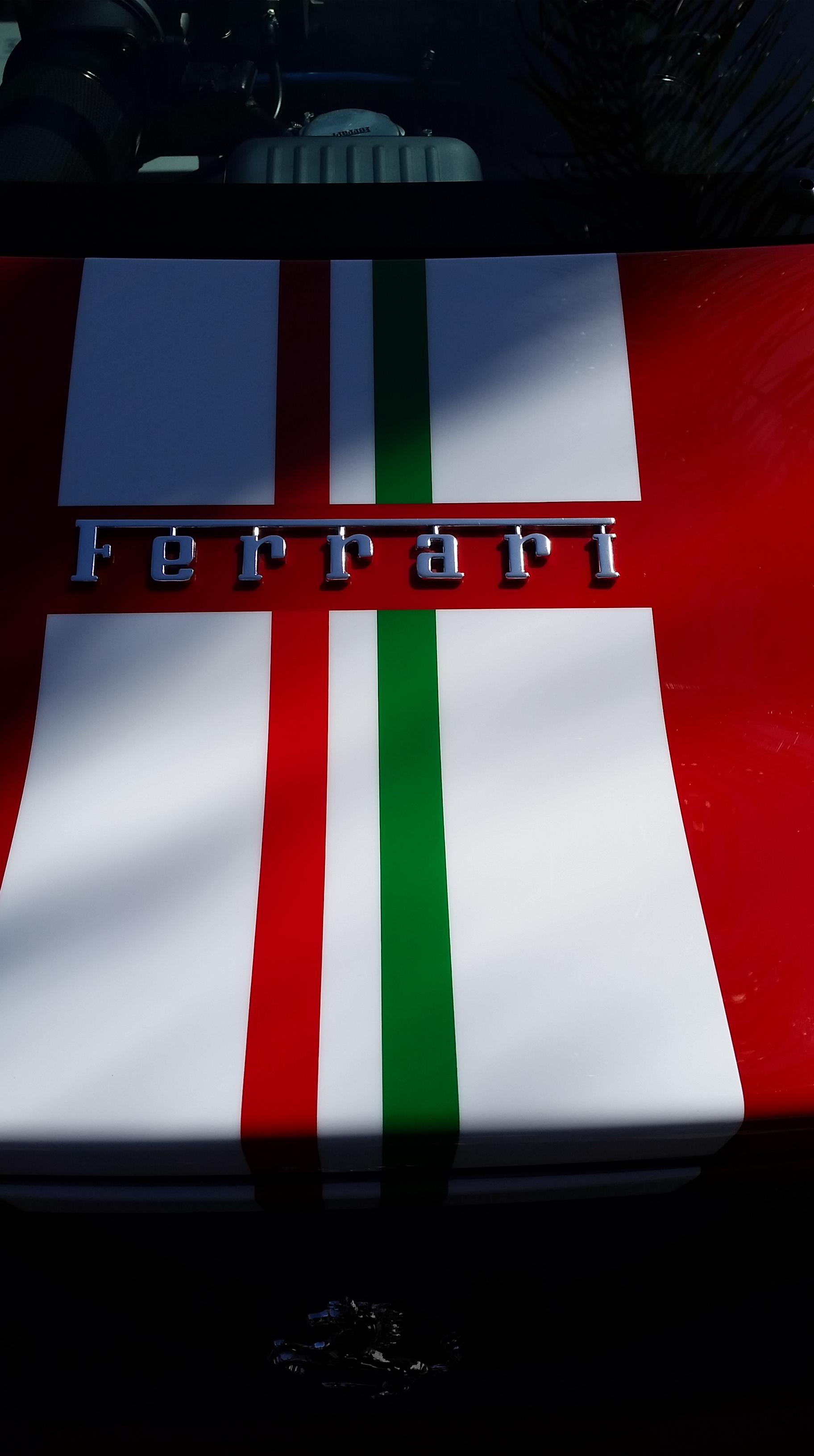
I recently attended what may be the best car show I’ve been to yet.  It was called Concorso Ferrari, and it was held in sunny Pasadena, California.  My uncle’s friend is a judge for Concorso Ferrari, and was kind enough to let me shadow him as he judged the Ferrari 360 Modena class.

There were 160 cars in attendance, and my uncle’s friend and two other incredibly nice judges were there to judge eight cars.

Some of the cars that I was able to watch being judged were beyond flawless, while two were daily drivers.  The owners of the daily drivers were fine to tell the judges that.  Their theory is that a Ferrari is meant to be driven, and it would be a waste of money to let it sit in the garage to only come out for shows.

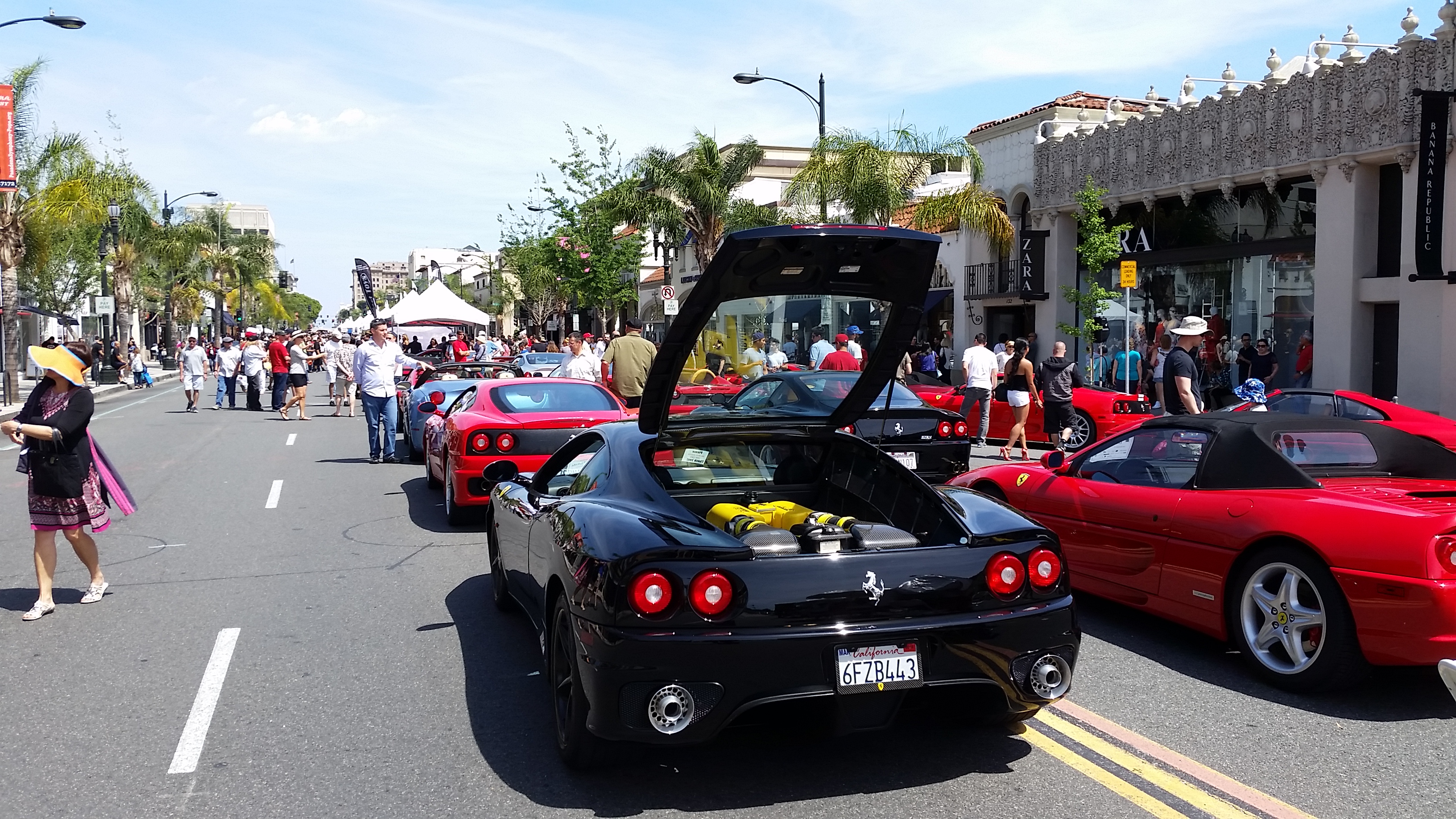
While 160 cars doesn’t sound like a lot, you have to remember that they took up three blocks, with cars parked at the curb and in the lanes.  I’m not sure exactly how many people were in attendance, but it was well over three thousand.  To say that it was crowded would be an understatement.

If you told me to pick just one highlight from the show, I couldn’t.  It was a truly amazing experience, and I urge you to come down to Pasadena next year to experience it for yourself.  You probably won’t be invited to shadow a judge, but you’ll be able to see truly beautiful cars, meet nice people, and get expensive merchandise (the hat and mug I got cost around $80).

Enjoy the pictures I took.

This is my uncle's friend's 2008 Ferrari F430. It's a deeper red than you'd see on a typical Ferrari, but it looks absolutely stunning.
This is my uncle’s friend’s 2008 Ferrari F430. It’s a deeper red than you’d see on a typical Ferrari, but it looks absolutely stunning.
I hope this gives you some idea as to how large the event is.  This was taken from the top end of the show, and I couldn't even fit the rest of it into the frame!
I hope this gives you some idea as to how large the event is. This was taken from the top end of the show, and I couldn’t even fit the rest of it into the frame!
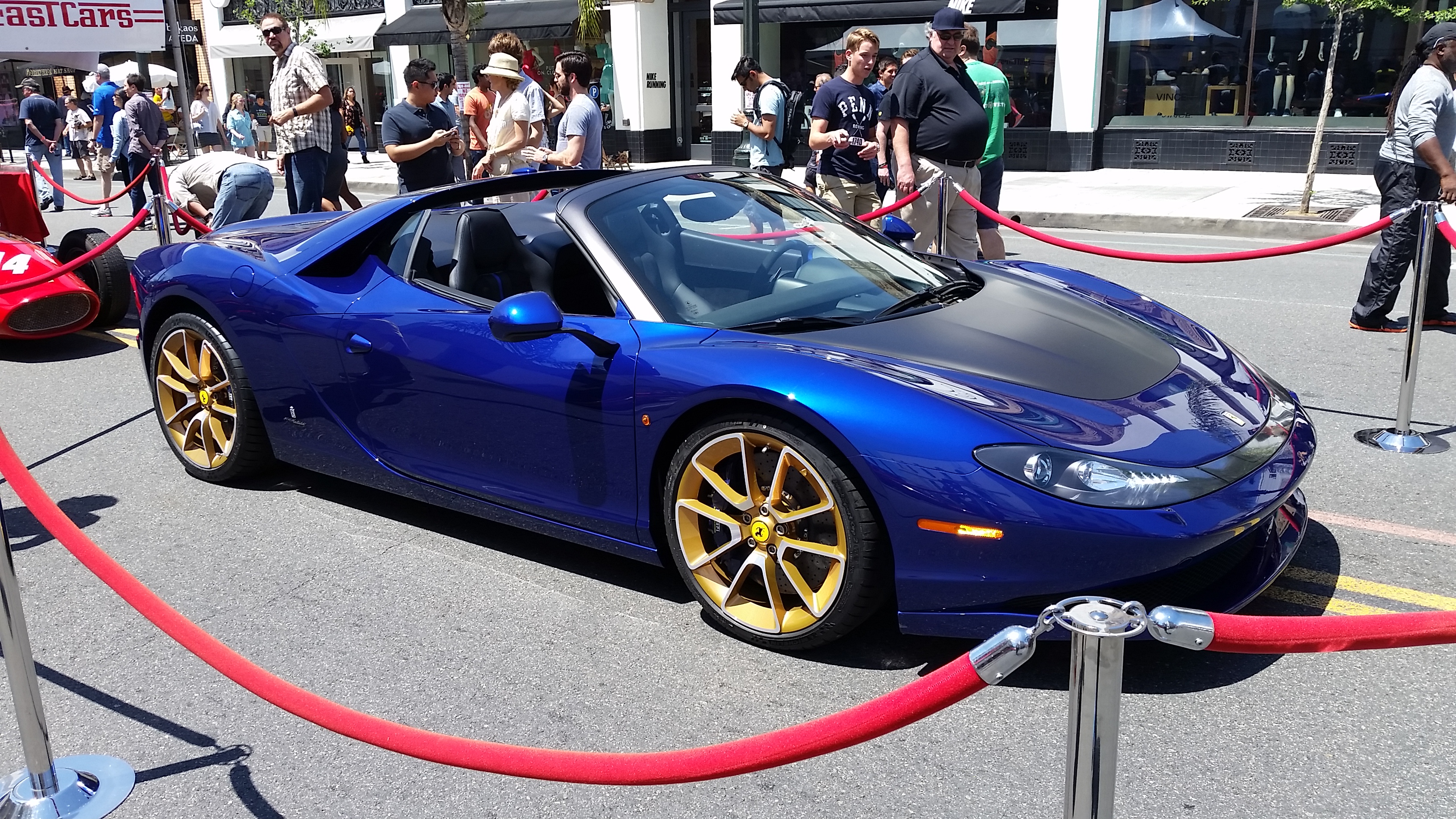
This car is the incredibly rare Ferrari Sergio. It's named after Sergio Pininfarina, the man who led the legendary Italian design firm for 40 years. It's a truly beautiful car, and it was apparently a mess when it came to Beverly Hills Ferrari. It supposedly needed a repaint. That can't be cheap!
This car is the incredibly rare Ferrari Sergio. It’s named after Sergio Pininfarina, the man who led the legendary Italian design firm for 40 years. It’s a truly beautiful car, and it was apparently a mess when it came to Beverly Hills Ferrari. It supposedly needed a repaint. That can’t be cheap!
I'm pretty sure that this is a recreation of a vintage Ferrari Formula 1 car, as cars from that era didn't have coil-over shocks (not visible in this picture). Either way, it's still cool.
I’m pretty sure that this is a recreation of a vintage Ferrari Formula 1 car, as cars from that era didn’t have coil-over shocks (not visible in this picture). Either way, it’s still cool.
This was the only Ferrari F40 at the show, which surprised me. Anyways, the F40 was the last car that Enzo Ferrari had personal control over in development. It's an incredible car, and I've always wanted one. Seeing one in person was an incredible experience that I will never forget. Hearing it fire up, and hearing that gurgling V-8 with the whistling turbochargers still sends shivers down my spine.
This was the only Ferrari F40 at the show, which surprised me. Anyways, the F40 was the last car that Enzo Ferrari had personal control over in development. It’s an incredible car, and I’ve always wanted one. Seeing one in person was an incredible experience that I will never forget. Hearing it fire up, and hearing that gurgling V-8 with the whistling turbochargers still sends shivers down my spine.

I have more pictures, but they’re basically all of the cars shown above.  I have attached the album link on Facebook for you all to drool over.  https://www.facebook.com/media/set/?set=a.917013121670207.1073741830.692811890756999&type=3

Also, if you are on Facebook and haven’t already liked my blog, please do so!  I’m really pushing to get more likes on the page(I will post pictures, you can comment, etc.).  You can be part of a movement!

The Evolution of Crazy

Pro Street is a popular form of hot rodding nowadays.  It’s also incredibly easy to define, unlike rat rods or Pro Touring.  Pro Street is classic cars with the rear wheeltubs dramatically enlarged for insanely wide tires.  However, defining Pro Street gets a bit more difficult from there.  Is it a fairgrounds car with big dirt tires?  A street-optimized race car? A race-optimized street car?  Or is it a full-on race car?  It can be any and all of those.  Pro Street has evolved throughout the years from essentially fairgrounds cars to street-optimized race cars.  I’ve taken the pleasure of outlining important years and cars in the evolution of Pro Street.  While your idea of Pro Street might differ, or not be there, I hope this helps.

1972: Grumpy Jenkins Pro Stock Vega:  Bill “Grumpy” Jenkins essentially ushered in Pro Street with the advent of his groundbreaking NHRA Pro Stock tube-chassis Chevy Vega in 1972.  Nobody had ever seen massive tires tucked under a production body before. Yes, the extreme Funny Cars had been using the look for a few years prior, but they had fiberglass body shells, so let’s not count those.  Grumpy went all-out groundbreaking by using a completely tubular frame, which allowed him to run those massive 14-inch-wide and 32-inch-tall drag slicks previously reserved for Top Fuel.  Every single Pro Stock car borrows heavily from that groundbreaking Vega in 1972.

Grumpy Jenkins Chevy Vega

1979: Scott Sullivan’s 1967 Chevy Nova:  No, this beautiful 1967 Chevy Nova was not the first Pro Street car.  Not by a long shot.  However, it was the first car to get massive attention past a small magazine feature on it.  It thundered onto the scene in 1979, just a year after the Car Craft Street Machine Nationals were launched to tire-burning success.  It created the perfect test-and-tune environment for Pro Street.  Sullivan has been known for setting hot rodding trends with just about every car that he builds.  His 1967 Nova was no exception.  It may not have been as innovative as his other cars, but it doesn’t make it any less beautiful, thanks to it’s highlight stripe and color-matched bumpers.  It even had the perfect stance.  Sullivan sold the car in 1984 to Pro Mod racer Ron Iannotti.

Scott Sullivan 1967 Chey Nova

1980: Some Tubbed Street Machines: Many street rod builders of the late 1970s became brainwashed by Scott Sullivan’s beautiful 1967 Chevy Nova (see above), and completely redid their cars.  Just about every car from this era had the back half of their chassis tubbed, and many builders simply moved the leaf springs far inside the chassis to fit the massive drag slicks.  Seeing a car with a Roots blower sticking out of the hood was a must well into the 1990s.

Pro Street Pontiac GTO

1985: Fully Tubbed Street Rods: The cover of the July 1985 ‘Hot Rod’ magazine announced the “Fat Attack” of fully tubbed street rods.  One of the cars on the cover was “Fat Jack” Robinson’s 1946 Ford coupe, painted in a vivid Coast Guard orange.  The car was tubbed like a true Pro Street car, but it was intended to thunder down the drag strips of America.  His car was the result of the first round of the nostalgia drag racing scene of the time.  His car inspired several other pre-1948 fully-tubbed cars.  Those cars on the cover of ‘Hot Rod’ showed how the Pro Street look merging into the vast world of street rods.  It wasn’t long before you’d look around at a hot rod show and see a bunch of 1940s Ford coupes sporting massive rubber.  Unfortunately for Fat Jack Robinson, his car ended up being totaled in a crash at Fremont Drag Strip.

Fat Jack Robinson 1946 Ford Coupe

1992: Trailer/Fairgrounds Queens: Dick Dobbertin’s nutso Pontiac J2000 Pro Street car arrived on the scene in 1986.  You’re probably wondering why I said 1992.  That’s because the trend of taking a lowly late-model FWD car being converted to a fully-tubbed, RWD car started then.  It made it OK to build an over-the-top Pro Street car that only looked good, which have now been dubbed Pro Fairgrounds.  Why Pro Fairgrounds?  The show venue was the only place where these cars could really shine.  I mean, who would really want to drive a car with more than 1,000 horsepower and a short wheelbase down a dragstrip?  If you want that kind of crazy, buy a vintage Fuel Altered car.  This radical Pontiac J2000 started the Dare to be Different movement in the automotive world, by starting battles to see who was able to build a bonkers Pro Fairgrounds car that nobody else had built yet.  Soon thereafter, builders came to their senses and started the Dare to be the Same movement, which leads us to our next section.

Dick Dobbertin Pontiac J2000

1992: C.A.R.S. Camaro: Many of the builders of Pro Fairgrounds resented building cars they couldn’t drive.  They wanted truly functional rides, not simple street rods with a big block, but cars that had gigantic rubber, big wheelies, and low drag strip times.  Detroit and Ohio even started a large movement to build cars that were all-steel-bodied, fully tubbed, go eight seconds in the quarter mile, dress them up with bumpers and various trim pieces, cruise them up and down the iconic Woodward Avenue in Detroit with license plates, and then race them head-to-head all weekend.  One of the first cars featured in magazines was the C.A.R.S. Inc.-sponsored Chevy Camaro of Rick Dyer and Danny Scott.  That iconic Camaro served as the main inspiration for the ‘Hot Rod’ 1992 Fastest Street Car Shootout.

Rick Dyer Chevy Camaro

1993: Mark Tate’s Chevy Camaro: That little Fastest Street Car Shootout gained so much popularity so quickly that it couldn’t sustain itself.  The heavyweight champs, the Pro Street cars, were losing to flat-out Pro Stock-chassis cars.  Those Pro Stock chassis cars were never meant to be driven on the street, unlike the Pro Street cars.  Mark Tate joined the fray in 1993 with his stock-bodied Pro Stock-chassis 1967 Chevy Camaro.  Then it was Tony Christian’s 1957 Chevy 210.  After Christian, it was Bob Reiger and his radical Pro Stock Chevy S-10.  Appeal for Pro Stock/Pro Street cars started to wane.  These weren’t cars you could build in the garage for $10,000 anymore.  These were cars racking up bills well over $100,000.  People wanted fast cars that they could drive on the street for not much money.

Mark Tate 1967 Chevy Camaro

2011: “Modern Pro Street:” This is a total niche created in the Pro Street world by those wanting a fast car with all of the modern mechanicals.  Cars of this look have a Pro Fairgrounds look, street machine behavior, and sometimes a late-model body.  These cars usually have the newest engines, turbos, EFI, and the wheels are usually gigantic with incredible tread.  The beautiful Mustang shown here is the 2007 Ford Mustang from Fastlane Motorsports.  It has a 2010 5.4-liter V-8 with an old-school Weiand 6-71 blower showing out of the hood.

Fastlane Motorsports 2007 Mustang

2012:  Larry Larson’s Chevy Nova: This is where Pro Street is now.  Larry Larson owns a stunning 1966 Chevrolet Nova that has truly incredible performance.  He’s run 6.90 seconds at well over 200 mph in the quarter mile after driving 80 mph on the highway all day.  How does he do it?  Modern technology.  He’s got a bored and stroked Chevy big-block motor with twin turbochargers, EFI, and lots of other amazing technology.  He’s able to drive it all day to a drag strip, run incredible times, turn around and go home without killing his car.  He’s had a LOT of experience in the drag racing world, so he only uses the best parts.  If Grumpy Jenkins were alive today, his mind would be absolutely blown.  Mine is.

Larry Larson 1966 Chevy Nova

That’s where Pro Street is, and where it’s come from.  These cars have state-of-the-art technology, and they are actually quite streetable cars.

The Epic Lamborghini Miura From the Italian Job is Still Alive!

The stunning orange Italian exotic car races through the Italian Alps, the wailing V-12 never failing to disappoint Michael Cane, a cigarette loosely dangling from his mouth.  It disappears into a tunnel, and a ball of flames ensues.  The wreckage of the car is dragged out by heavy machinery by the Italian Mafia. It’s then pushed into a ravine, and a wreath for the driver follows.  It’s one of the most stunning and heartbreaking introduction scenes in cinema for gearheads.

There must have been millions of viewers of The Italian Job (the 1969 original version) who assumed that the creamsicle orange Lamborghini Miura was a write-off.  They are ALL wrong!  I must say that I was never one of them!  I had long suspected that Lamborghini would never permit a brand-new Miura to be wrecked in that fashion.  I was right.  That car disappeared into the tunnel, the cameras stopped, the car came out, and in went the wreckage of an already-wrecked Miura.  Bam smash boom.  The mangled orange wreckage comes out, gets shoved down the ravine.  Done.

The orange Miura powering through the Alps is in pristine condition, and worth well over 1 million Euros.

It’s been described as “the Holy Grail of supercars,” and two British businessmen tracked it down and bought it.  Good boys.

The car’s new co-owner, Iain Tyrrell, was tipped off around Christmas that the car still existed.  As many are, he was skeptical, yet he decided to check it out.  He said in an interview with The Daily Mail, “I was initially sceptical because no one had seen it for 46 years. But my source was a credible one so I started to pursue it.”

The car’s owner invited him to see it, but he had to act like James Bond.  No, there were no crazy bad guys with military-grade toys trying to kill him.  However, he was only given a mere three hours to verify the car as the real thing.  “It was all very James Bond-ish – I had to go to Paris to inspect the car in a secret underground car park,” he said.

Tyrrell explained the confusion surrounding the car:  “The Italian Job Lamborghini is the holy grail of supercars precisely because no one knew what happened to it after the film. I have a life-long passion for these cars but I just assumed this particular vehicle was out of reach.”  Well, not any more.  Lucky man.

The car is essentially brand-new.  It’s been well-maintained by all of it’s previous owners, and very little to nothing on the car was changed, as far as Tyrrell knows.

“There are certain quirks within the interior of the car, such as the trim and the stitching. They are like a fingerprint or a birth mark. They can’t be replaced.”

Tyrrell found out that the filmmaker, Paramount Pictures, bought the car from Lamborghini for the filming of the scene, and then sold it to a car dealer.

The dealer then sold the car to an unidentified buyer, who owned it until 2005, when it changed hands several times before ending up with Norbetto Ferretti, a luxury yacht manufacturer.  What is so interesting about Ferretti is that he is the son of the dealer who originally bought the car from Paramount.  What blows my mind is that every single previous owner of the car had no clue that the car was in such a legendary movie.

Tyrrell and his friend/co-owner, Keith Ashworth, plan to show the car around the world. However, selling it is still a possibility. The value of this car will only rise exponentially.

The mystery of the other car is still unsolved.  The smashed-up Miura pushed over the hillside vanished without a trace after it tumbled down the mountainside.

Tyrrell said, “When the production team went back to salvage the remains of the crashed car the next day it had gone. The whole car had disappeared and had obviously been stolen.”  Who knows what happened to the wreckage of it?Lamborghini-Miura

Lambo Miura

Why You Should Buy a Classic Station Wagon

Most Americans over the age of 40 grew up waging hell in the backseat of a station wagon. Most of those station wagons were Buicks, Fords, Oldsmobiles, Chevys, and Mercurys. Some might have even been Pontiacs.  Here’s why they could turn into the next collector cars.  Those Americans who grew up turning the backseat into a war zone fondly remember them.  That same generation fondly remembers the Smokey and the Bandit Pontiac Firebirds (the one with the “screaming chicken” on the hood), so they buy them.  Station wagons from the 1970s and 1980s are now being bought more.  Prices are going up for these massive beasts.

The collector car market is going crazy right now.  People have more money to spend, and they want to enjoy an older car with their family.  They tend to buy cars that they remember fondly.  That’s why Chevy Blazers, “screaming chicken” Firebirds, and station wagons are starting to creep up in price.  Now is the time to buy them.

For all those people who say that station wagons are dorky and stupid, here’s a response:  station wagons have as much, if not more utility than most modern crossovers, and some SUVs, look better, and are far more fuel efficient.

Some station wagons are already highly sought-after collector cars.  They include the Chevrolet Nomad, antique woodies, and high-performance Pontiacs from the 1960s. However, there are still plenty of station wagons that can be enjoyed.  Here are some classic, and new wagons that you should consider buying.

  • 1991 Audi 200 20V Turbo Quattro Avant:  There is no point in going into the details of the 1986 60 Minutes debacle that came close to killing Audi.  There were some good cars that came out in the company’s darkest days, and one of them is the marvelous 1991 200 20V Turbo Quattro Avant.  This one-year-only package is incredibly rare.  Only 1,000 four-door sedans and about 200 station wagons got this package, and it was standard equipment on the two-door hatchback.  It’s a close cousin to the 1986 sedans that Audi used to dominate SCCA Trans-Am racing.  The twin-cam, 20-valve engine has five cylinders and goes through a five-speed manual to all four BBS wheels.  Maintenance is going to be a wee bit tricky, but enjoying this car won’t.
  • 1950-1991 Ford Country Squire:  This behemoth of a station wagon is what many Americans grew up in.  Early Country Squires are the expensive, sought-after woodies from the early 1950s.  Avoid them unless you have serious money and plans to upgrade just about everything on them.  However, starting in 1960, the Country Squire became the familiar family hauler.  They’ve covered millions of miles, millions of Americans remember them fondly, and they have starred in multiple movies.  They came with a Ford small-block V-8 (usually the 351 Windsor V-8 found in most Fords of the 1970s through the 1990s) and a mushy automatic transmission.  If you get a pre-1976 model in California, you can upgrade it to make the ultimate family hauler.  Just put in a modern Ford Coyote motor (the same engine as the Mustang), a Ford T-5 five-speed manual transmission, and some better suspension pieces and you’ll have the ultimate road trip/family hauler.  They are fairly reliable cars to begin with, and Ford made a lot of them, so finding one isn’t the challenge of the century like the Audi mentioned above.
  • Volvo V60 Polestar:  OK, who wouldn’t want a 345-horsepower station wagon that looks really cool?  Speak now or forever hold your peace.  While a mere 120 cars scheduled to come to the US over this summer isn’t a lot, it’s enough to make it a true collector car.  It’s a fast car, and Volvo has a rich history of deceptively fast station wagons.  It looks really cool with the big wheels, low-profile tires, blue paint, and it’s somewhat-bulbous styling.  Get one while you can, and enjoy it!  This is a car that’s meant to be driven, so drive the wheels off of it.
  • Saab 9-2X:  Why buy a re-badged Subaru WRX because GM said so?  Because it’s a more comfortable, tame early Subaru WRX.  For Saab faithful, it was too Subaru, even though it wasn’t nearly as blasphemous as the 9-7X “Trollbazer” which was just a Chevrolet Trailblazer with different wheels and badges.  For the rest of us automotive folks, it’s a more refined version of the spunky Subaru WRX.  Unlike the WRX, it doesn’t turn the wheels 90 degrees when you floor it.  Unlike other Saabs, you can get same-day service on it by simply going to a Subaru dealer.  It’s a far better car than the sales charts show.  Owners love it, and others snap them up.  They aren’t very big, and are more of a hatchback than a station wagon, but they are fun, reliable little cars that can really take a beating.  That’s something that most other Saabs can’t claim.
  • Morris Minor Traveller:  This cute little station wagon is based off of the popular Morris Minor.  Sir Alec Issigonis started his automotive success career with this car. The Morris Minor coupe and convertible debuted in 1948, and the Traveller station wagon followed suit in 1953.  It came to our shores through 1967. When other station wagons were ditching real wood for fiberglass and vinyl, the Traveller had real ash wood from the tailgate all the way to the B-pillars.  Not only does it look great, but it’s also the superstructure for the back half of the car.  That means you’ll have to sand and re-varnish periodically, but that’s going to be the extent of your automotive woes with this car.  Parts are cheap and easily sourced, and it’s an incredibly reliable car.  Not something you can say about most British cars.
  • Buick Roadmaster/Chevy Caprice:  Yes, they may have been the final gasp of GM’s RWD land barges, but who doesn’t want something that seats eight people, has a (slightly detuned) Corvette engine, and is gigantic?  These behemoths were the final iterations of the big American station wagons that so many Americans grew up in. They are still available and cheap for us to thrash around and haul kids around with.  You don’t need to do much to unlock the true potential of these engines – you just get the Corvette’s ECU, as the engines in these cars were the same as the Corvette’s LT1.
  • Cadillac CTS-V:  OK, most of us would LOVE to own a 556-horsepower station wagon that comes with a six-speed manual.  Look no further than the previous-generation Cadillac CTS-V wagon.  I know that this implies that there is another one coming, which we can only hope for, but this is probably the ultimate family burnout/drift/autocross/trackday/hoonmobile.  Period.  My friend Jonny Lieberman of Motor Trend had one as a long-term car for a year, and I’m still feeling the pangs of jealousy.  It has a detuned Corvette engine, but 556 horsepower is still plenty to rage through the quarter mile.  It would make the ultimate backup car for your local autocross/track day, and it would be a fun daily driver to boot.

I’m sure that many of my readers have some fun memories of being in station wagons as kids…let’s here them!


1991 Audi 200 Avant


1967 Ford Country SquireVolvo V60 PolestarSaab 9-2XMorris Minor Traveller1992 Buick Roadmaster WagonChevy Caprice WagonCadillac CTS-V Wagon Drifting

Robert De Niro is Going to Play Enzo Ferrari!

The legendary Hollywood actor, Robert De Niro, star of several blockbuster films, is going to play Enzo Ferrari in an upcoming biopic of one of the most legendary people in the automotive industry.

De Niro announced that this film will take top priority.  Production is expected to begin soon.  De Niro said, “It is an honor and a joy to tell the life of an extraordinary man who revolutionized the automotive world.”

De Niro will play the legendary Italian, whose team has been actively competing since 1929 as Scuderia Ferrari.  Scuderia Ferrari started off running Alfa Romeos, then started building their own cars in 1947.  They have gone on to win an incredible 16 Formula 1 Constructor’s titles since 1950.  They have also won 15 Driver’s titles, 222 races, and you get the point.  They know their stuff.

The film is going to be produced by former photographer Gianni Bozzacchi, owner of Triworld Cinema, and will work with De Niro’s Tribeca Enterprises company.

According to Bozzacchi in an interview with the Italian newspaper, Il Messaggero, “The film will be titled Ferrari and will be based on an epic story.  It will have a high budget and will cover a wide span – from 1945 to the eighties in a twisted game of eras and episodes.”

Robert De Niro isn’t the only big name working on this film, as Clint Eastwood has been approached to direct the film.  Bozzacchi claims that Eastwood was “very interested” but wanted to read the script.  It is unclear as to whether Eastwood read the script or not.

The writers of Oliver Stone’s Nixon, Steven Rivele and Christopher Wilkinson, also have links to the movie.

The film is expected to hit theaters in 2016.  I can’t wait to see it!  Look for a review of it as soon as it hits the big screen!


What are Bore, Stroke, Porting, and Relieving?

You hear car guys throw around the terms, “bore” and “stroke” all the time.  Most of us don’t know what that means.  I do.  Here’s what they mean, and how to identify them.

Bore:  Cylinder bore is the measurement of the diameter of the cylinders in an engine.

Stroke:  Stroke is the amount of movement a piston can move up and down.

A bored engine happens when you machine out the block.  For example, taking a 400 cubic-inch Chevy V-8 and boring out the cylinder walls to make the engine displace, say 500 cubic inches.

A stroked engine is simple to build.  You just pull out the current internal moving parts, and put in bigger ones.  Because bigger is better.  An infamous example of this is Chevy’s 302 cubic-inch V-8 from 1967-1969.  Chevy took their garden-variety 283 cubic-inch V-8 engine block, and put the bigger 327 cubic-inch V-8 internals in.  Voila.

An easy way to put into perspective just how thirsty an engine can be is to remember that a 302 cubic-inch engine will theoretically inhale and exhale 302 cubic inches of air and fuel in two revolutions of the crankshaft.  If you punch that engine out (slang for stroking it) to 347 cubic inches, then you’re going to have a more powerful engine.  That 347 stroker engine is popular with drifters – it’s based off of Ford’s capable 302 cubic-inch V-8.  A 347 cubic-inch engine is 14.9% larger than a 302.  So, that 350 horse 302 will have 402 horsepower.

Just stroking an engine for more power won’t solve your problems entirely.  A cam (or more nowadays) pushes on the intake and exhaust valves.  If you’ve got a bigger crankshaft and pistons, upgrade the cam!  You’ll have a far more reliable engine.  Upgrading the cylinder heads is also smart.

The nice part about stroking an engine is that the engine remains the same size externally.

Porting:  A ported engine refers to enlarging the intake and exhaust ports of an engine.  This makes for better and more airflow.

Porting is common in drag racing, especially with the use of nitrous oxide (yes, the same stuff that is used to push out whipped cream from the can).  It just makes more room for the air to go in and out.

Relieving:  No, the engine is NOT using the bathroom!  That would be relieving itself.  A valve seat is where the valve is attached to.  It’s usually a small mound of metal, but it doesn’t need to be.  Relieving just removes the extra metal to make more room for bigger valves.

Here are some pictures of the different kinds of engine enlarging.

This is a bored Chevy big-block V-8 engine block.  It’s been bored out from 454 cubic inches to 489 cubic inches.  That’s 35 cubic inches more air and fuel this engine will hork down.

This is a stroked Chevy small-block V-8 engine.  It displaces 383 cubic inches, rather than 350.  Instead of 350 horsepower, it makes 425 horsepower.  You can buy this engine from Summit Racing.

This is a close-up of a beautifully-ported Ford 302 cubic-inch V-8 from a 1987 Mustang GT LX 5.0.  The larger port is the exhaust port.  The small hole is the valve seat.

This is a relieved Ford 221 cubic-inch flathead V-8.


Why Legislation A.B. 550 Matters to Car People

California has recently proposeda new legislation.  While that might not mean all that much to us, it should.  Legislation A.B. 550 would allow for the owner of a motor vehicle subjected to the rigorous California smog check program to pay a $200 smog abatement fee instead of having to go to the trouble of smogging the car.

This bill would require the payment to go to the Air Quality Improvement Fund.  The measure will be considered by the Assembly Transportation Committee.

Currently, the smog check program requires an inspection of all motor vehicles when the car is initially registered, then biennially upon registration renewal, transfer of ownership, and various other circumstances.  You can find all of that on the DMV’s website.

The law currently exempts all cars manufactured prior to 1976, and certain other vehicles.

What’s so special about A.B. 550 is that it would allow the owner(s) of a motor vehicle that is required to take a smog test to pay a 200 dollar smog abatement fee IF the car meets the following criteria:

  • The motor vehicle is 30 model years or older
  • The motor vehicle was manufactured during or after the 1976 model year
  • The motor vehicle fails a smog test
  • The motor vehicle fails a subsequent smog test after necessary repairs were performed

This could mean a lot to hot rodding.  Newer cars are easier and cheaper to insure, parts are more plentiful and cheaper, and, since newer cars have the necessary smog equipment, hot rodders can start to build killer smog-legal street cars.

It’s extremely important to me and many others in the automotive industry that we (as in auto enthusiasts) contact the California Assembly Transportation Committee to voice your opinion of A.B. 550.

Here’s how to do it.  Email Steve McDonald at stevem@sema.org a copy of your letter. Also, send this to your automotive enthusiast friends! The more people who voice their opinions, the more likely the bill is to pass.

Here is a (very) long list of the committee members’ contact information:

Assemblymember Jim Frazier (Chair)
Phone: (916) 319-2011
Email: assemblymember.frazier@assembly.ca.gov

Assemblymember Katcho Achadjian (Vice Chair)
Phone: (916) 319-2035
Email: assemblymember.achadjian@assembly.ca.gov

Assemblymember Catharine B. Baker
Phone: (916) 319-2016
Email: assemblymember.baker@assembly.ca.gov

Assemblymember Richard Bloom
Phone: (916) 319-2050
Email: assemblymember.bloom@assembly.ca.gov

Assemblymember Nora Campos
Phone: (916) 319-2027
Email: assemblymember.campos@assembly.ca.gov

Assemblymember Kansen Chu
Phone: (916) 319-2025
Email: assemblymember.chu@assembly.ca.gov

Assemblymember Tom Daly
Phone: (916) 319-2069
Email: assemblymember.daly@assembly.ca.gov

Assemblymember Bill Dodd
Phone: (916) 319-2004
Email: assemblymember.dodd@assembly.ca.gov

Assemblymember Eduardo Garcia
Phone: (916) 319-2056
Email: assemblymember.eduardo.garcia@assembly.ca.gov

Assemblymember Jimmy Gomez
Phone: (916) 319-2051
Email: assemblymember.gomez@assembly.ca.gov

Assemblymember Young O. Kim
Phone: (916) 319-2065
Email: assemblymember.kim@assembly.ca.gov

Assemblymember Eric Linder
Phone: (916) 319-2060
Email: assemblymember.linder@assembly.ca.gov

Assemblymember Jose Medina
Phone: (916) 319-2061
Email: assemblymember.medina@assembly.ca.gov

Assemblymember Melissa A. Melendez
Phone: (916) 319-2067
Email: assemblymember.melendez@assembly.ca.gov

Assemblymember Adrin Nazarian
Phone: (916) 319-2046
Email: assemblymember.nazarian@assembly.ca.gov

Assemblymember Patrick O’Donnell
Phone: (916) 319-2070
Email: assemblymember.odonnell@assembly.ca.gov

Thanks for listening to my rambling about how this could turn the hot rodding hobby around.  If the bill passes, there will be people who abuse the system, but they already do that.  I wouldn’t worry that much about it.

I think these cars that are only slightly customized could greatly benefit from A.B. 550:

This bone-stock 1976 Camaro could benefit from an LS-motor swap.  Chevy Performance even offers an LS3 E-Rod engine that is smog-legal in all 50 states.  You just install the engine and slap on a couple of stickers that let the smog guys know.  These second-generation Camaros are popular among hot rodders, and one could throw on aftermarket suspension pieces and nobody would notice.

This is a simply tasteful C-10 stepside.  The wheels go well with the dark blue/black paint on the truck.  The big visor over the windshield is a cool touch from the 1950s.  It would be even better if the owner could put a thundering big-block with EFI on it.

This 1985 Fox-Body Mustang is an early Saleen Mustang.  It looks better than the flashier late-model Saleens.  It was a performer in the day, but my Mazda3 could beat it to 60, through the quarter mile, and in just about everything but looks.  If somebody bought a Fox-Body, got a body kit (Saleen rip-off body kits are common in drifting), put in an EcoBoost V-6 found in the Taurus SHO, this would look amazing, and go like stink.  If there was an aftermarket suspension kit on it, even better.  This would be a holy terror at autocross and track day events.  Plus, it would be a fun daily driver.  OK, I’m going to rein myself in now…

The last car on this little list is one I really want.  It’s a Chevy C3 Corvette.  Let me explain. It has stunning good looks, and would be quite the performer with a modern LS engine under the hood.  It’s already been done, and that’s the car in the picture.  It’s got an LS3 E-Rod under the hood, and even though it’s a 1972, one could very easily do the same thing to a 1976 or later model.

A Real Life Mario Kart Crash!

This crash is the definition of insane.  It happened fairly recently too.

The Derek Bell Cup at the 73rd Goodwood Member’s Meeting, which is essentially a place where really rich car guys get together and race their vintage race cars for a trophy.  It sounds like a whole lot of fun.  There was one moment that I still can’t get over.  It was one of those “Oh my G-d HOW the hell did that happen?” moments.

For the record, the Derek Bell Cup is for Formula 3 cars.  It is not for every other class of car!

This bonkers crash happened on the second flat-out lap of the qualifying session.  Paul Waine’s beautiful red De Sanctis-Ford hit Michael Scott’s equally beautiful 1969 Brabham-Ford BT28 at the legendary Madwick corner.

Waine’s airborne #10 Ford was credited with a still-impressive 17th place for qualifying, but had to retire from the rest of the event.  Scott’s Ford somehow got through another six laps before qualifying in 20th place.  Scott then went on to finish 13th in the actual race.

The De Sanctis-Ford was an Italian effort that took much inspiration from the Brabham cars of the late 1960s, and was powered by a Ford engine.  What seems illogical to me is the fact that the De Sanctis family ran a Fiat dealership.  Nonetheless, 1969 was a disappointing year for them.

The Brabham-Ford cars were extremely successful F3 (Formula 3) cars throughout the 1960s and 1970s.

Here’s a link to the video of the crash.  https://www.youtube.com/watch?v=EWVPL8oEFJs

Another saddening crash was Jochen Mass, who slammed a priceless Mercedes-Benz 300 SLS into a Lister.  Both cars were racing in the Salvadori Cup, and from footage I’ve seen, it looked like the Lister wanted to enter the pits when Mass tried to help.  It looks like Mass locked up the brakes in the 300 SLS, and by the time he let up on the brakes, it was simply too late.  Cars of that era aren’t known for their braking prowess (they were in the day), so it is a sad surprise.  Like any race car worth it’s racing slicks, I’m sure that both cars will be repaired and racing again in no time at all.

Jochen Mass Took Out A Lister With A Mercedes 300 SLS

Here’s an action shot: