Car Review Time!

I usually don’t do posts reviewing cars (at least I haven’t in a while), but I recently test-drove a 2017 Kia Soul. My sister enlisted my help in finding a good car for her, and like any good car-loving brother, I obliged. Somehow, there were no strings attached. We made a stop at the local Kia dealer, and looked at a few Souls. Next up was a test drive. Here are my thoughts on the 2017 Soul:

It’s a great little car. Decent power for it’s size and class. Yeah, I might want a bit more power when passing at higher speeds, or when it’s loaded down with people and gear, but that’s what the new turbocharged version is for! That being said, for everyday driving, it’s perfectly adequate. I’ll talk more about the driving dynamics in a bit.

Now onto how it looks. They’re certainly not for everybody, but I think it looks cool. It’s very roomy inside because of the styling, and the tail lights are cool. Yeah, the front end could look better, but that’s just me. Other people like it. Because of its boxier styling, it’s got great visibility. The windshield is big, and when you’re backing up, you’ve got great visibility. Because it’s a compact car with a very good turning radius, it’s great for big cities where space is at a premium. In white, it looks like an enlarged stormtrooper helmet.
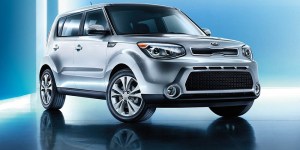
This is the Soul "+" (Plus) model shown.
This is the Soul “+” (Plus) model shown.

The salesman was telling us that his first client was a big, tattooed, Harley-Davidson-riding guy, who really wanted a white Kia Soul because it “looked like a stormtrooper helmet.” It turned out that he was tired of nearly getting hit by cars all the time, so he decided to get a car and keep the Harley for nicer weather.

Yes, those are all of the available colors for the 2017 Soul!

Inside the Soul, you’ll find a nice interior. By no means is it a Mercedes-Benz interior, but for what you pay for, it’s great. If you’re tall and find yourself in the backseat, don’t worry! I’m 6 feet tall, and had plenty of room behind the driver’s seat set to my liking! I could easily share the backseat with 2 other people. It’s also very quiet, thanks to Kia’s use of expansion foam in the body cavities. There’s a convenient USB charging port on the front console. There are also available fast-charging ports located inside and on the back of the center console. The overhead LED reading lamps work well. It also has fully automatic climate control.
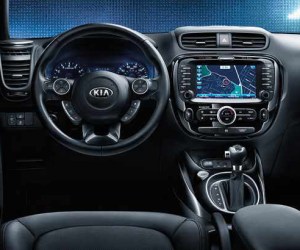
Pretty swanky for a compact hatchback, don't you think?
Pretty swanky for a compact hatchback, don’t you think?

If you want a backup camera, you’ll get a bigger screen than the cars without  one. Spring for the navigation system and you’ll have a much larger screen (8 inches). You’ll also a 3-month SiriusXM All Access trial subscription, which gives you access to over 160 channels. The available UVO infotainment system (Kia’s intuitive infotainment system) has some neat features that are integrated onto your smartphone: it can keep track of where you parked your Soul, download Kia recommended apps through their App Download Center, monitor your driving habits and provide suggestions on how to improve fuel economy, etc., access 911 Connect or Enhanced Roadside Assistance, and check any maintenance requirements through Vehicle Diagnostics, all on the touch screen. What sweetens the UVO pot is the fact that there are no suscription fees for the first 10 years of access to the UVO system! It’s also Apple CarPlay and Android Auto compatible!

It’s also got a suite of safety features, some available and some standard. You can get a rearview camera, a forward collision warning system, a lane departure warning system, and one of the more appreciated features is the blind-spot detection with rear cross-traffic alert. It’s especially helpful when you have to back out into traffic.
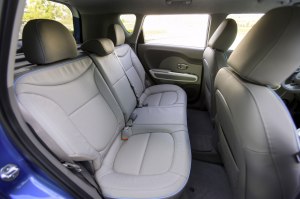
This is a picture of the backseat of a Soul EV, but it's the same thing for all essential purposes.
This is a picture of the backseat of a Soul EV, but it’s the same thing for all essential purposes.

Now, onto how it drives. As I said previously, it drives well for something in it’s class. It won’t keep up with a Porsche 911 by any means, but you can have some fun with it, too. You can also change drive modes on the fly with the Drive Mode Select System, which has a button conveniently located on the perfectly sized steering wheel. There’s an Eco mode, which works well in heavier traffic, and a Sport Mode, which is great for merging onto a freeway, or just having some fun. Yeah, the engine gets buzzy at higher rpms, but it’s not a high performance engine. The transmission is smooth; maybe even a bit too smooth for me. It does what you ask of it, but it won’t ever be as quick as a dual-clutch transmission. There’s even a nice EV model that is supposed to drive even better (I didn’t drive it, so I can’t say).

Kia offers industry-leading warranties. You get a 10-year/100,000 mile powertrain warranty, a 5-year/60,000 mile basic warranty, a 5-year/100,000 mile anti-perforation warranty, and a 5-year/60,000 mile 24-hour roadside assistance warranty.

Here’s my takeaway:

Now, would I recommend it? Absolutely, no questions asked. I would even consider buying one for myself. Plus, they’re inexpensive, very reliable, safe, and pretty darn fun cars. Yeah, they would be pretty impractical for somebody who has kids in booster seats, but you could absolutely make it work. They have a lot of space, are safe, and last forever. Oh, and they look neat, especially in white. Kia has some pretty wild colors, which some people like (makes it easier for cops to spot them!).

Why Europe Should Be Worried About the Runaway Success of the Ford Mustang

The 2016 Ford Mustang is a great car, especially in the supercar-slaying GT350/GT350R form. It’s relatively fast, affordable, and can be easily modified. It turns out that the Yankee muscle car is now the most popular sports car in Germany. Why should they be worried?

In March, the Ford Mustang outsold the Porsche 911, Porsche Cayman and Boxster, and the Audi TT. It’s not that it’s inexpensive in Germany – a Mustang GT with no options costs about 50,000 Euros, while it costs $32,395 here in the U.S.

The Internet loves to trash talk the typical Mustang owner. A spike in high-profile crashes at car club meets doesn’t help with the Mustang’s PR either.

One of the problems that I have found about the Mustang is that the 1979 “Fox body” Mustang and it’s immediate successors were immensely popular and somehow durable. What does that mean? There’s a ton of them around, and used Mustangs are cheap horsepower. In 1979, there was a Dodge Challenger, which was a re-badged Mitsubishi Galant Coupe intended for the Japanese domestic market. The Challenger/Galant had a lifespan of five years at most, so it’s safe to say that your microwave has some Mitsubishi DNA in it!

Because the Mustang is so inexpensive, various misconceptions about the Mustang are out there. There’s nothing like a Porsche 911 or BMW M3 owner looking down on your ragged-looking Mustang GT with a set of Bilstein coilover shocks on it. Those owners have nothing better to do than look down at the lowly Mustang owner. Show up to a track day in a brand-new Mustang GT, and you’ll hear this kind of trash talk: the Mustang is heavy, it wallows, it doesn’t turn or stop very well, the rear end is uncontrollable, and you’re going to end up taking somebody else out when you spin. None of that is really true.

While the Mustang isn’t exactly light, the GT350R comes within 100 pounds of the BMW M4, a direct competitor to the GT350R. The steering in the GT350R is, according to pro race car drivers, worlds better than the M4. Don’t like the way it stops, even with the available massive Brembo brakes? That’s OK; the aftermarket will give you brakes that are IMSA (endurance racing) spec for less than half the cost of a single Porsche 911 GT3’s brake disc. You can walk into any Ford dealer, walk out with a Mustang in 45 minutes, and have a ton of fun. The GT350 (non-R model) is in a league of it’s own among four-seat performance cars. What about the Mustang being a tail-happy crash magnet? Well, the previous generation is notorious for that. It has a live rear axle, which wouldn’t be out of place on a Conestoga wagon, and couple that with 400+ horsepower, a driver who doesn’t know how to handle that much horsepower, and you know where I’m going. It’s mostly due to user error that there are so many Mustangs crashing. There have been a good deal of BMW M4 crashes as well. Trust me, it’s the same thing with Porsches.

If you haven’t driven a Mustang in a while, or your opinions are based on the old Mustangs with the live rear axle, I strongly encourage you to go down to the local Ford dealer and take a Mustang for a test drive. Any Mustang will do. Your expectations will be shattered.

Inside the Mustang, you’ll be pleasantly surprised. The fit and finish holds up against whatever Germany and Japan have to offer. The interior is both classic and modern. The seats hold you in a bear hug, but are incredibly comfortable for any person. The infotainment systems are easy-to-use, and you’ll never really want more out of them. You’ll get plenty of feedback from the steering wheel, and all of the controls feel like Ford pulled them out of an Audi.

While the Mustang might be a large car, it feels perfectly comfortable on small back roads. You know exactly where the car is, what it’s doing, and how much gas you can give it. The overall driving experience feels like something Mercedes-Benz and Audi would co-develop. The only real differences between any current Mustang and a BMW 4-Series are the high door sills in the Mustang…and the availability of a manual transmission with every engine!

But, don’t take my word for any of this. I’m just an 18-year-old car enthusiast who does all of his automotive homework. Just ask any German car enthusiast. Clearly there’s something amazing about the Mustang, or there’d be a spike in Audi TT sales. Don’t get me wrong – all of the major automotive magazines have given rave reviews of the TT. It’s just you get a whole lot more car for the money out of the Mustang. Even in it’s home country, the Porsche 911, Cayman, Boxster, or BMW M4 is a rare sight. Why? Because they’re really expensive to buy and maintain. While it’s true that the Porsche 911 GT3RS will leave the Mustang (and most cars) far behind at any race track, the 911 GT3RS is a very rare and expensive sighting.

Of course, most German car enthusiasts will say that this article is a load of garbage. Why? Because the March sales are an “isolated incident.” It’s just inventory availability, rebates, and the same occasional fascination with American novelty that sends so many European tourists to the U.S. to ride rental Harley-Davidson motorcycles along Route 66. But, what if it’s not an isolated incident? What if it’s a perfectly reliable indicator of things to come?

After all, BMW, Mercedes-Benz, and Audi have spent the past 15 years engineering any semblance of character and authentic heritage out of their vehicles. The same industry that introduced so many to wonderful cars like the air-cooled Porsche 911, the Mercedes-Benz 450SEL 6.9, the E39 BMW M5, the Audi Quattro, the E30 BMW M3, the AMG Hammer, and the Porsche 944, has abandoned those wonderful examples for 5000-pound SUVs making gobs of horsepower from high-tech twin-turbocharged engines, put down to the ground through fragile AWD drivetrains, all controlled by hundreds of pounds of self-destructive electronics meant to save them from doing just that.

Let’s imagine that this isn’t just an isolated incident. Maybe the Germans are tired of driving expensive, self-destructive, massive transportation pods. They want something that reminds them of their dad’s AMG Hammer, their grandpa’s Mercedes-Benz 450SEL 6.9, their uncle’s Audi Quattro. They want something different. Something real. The Mustang will continue to sell in droves. Soon, the mighty roar and scream of the Dodge Challenger Hellcat will be heard across the Atlantic on the last unrestricted sections of the Autobahn. Trails once populated by Nissan Patrols and Mercedes-Benz G-Classes will be filled to capacity with Jeep Wrangler Rubicons. You’ll hear the bellowing shriek of the Corvette Z06 at the Nurburgring and the Hockenheimring. What’s that massive hulking truck taking up the tiny country road? Is it really a Ford F-250?

OK, I’m going to start to wrap this up. What does this all mean? No matter what happens, there is a very important lesson to be heard. American automakers got lazy during the late 1970s through the late 1980s. This in turn allowed German automakers to bring us incredible cars. Can you imagine picking a Lincoln Versailles over a BMW 528i, or picking a Cadillac DeVille over a Cosworth-powered Mercedes-Benz 190E 2.3-16 (2.3 is the engine size in liters, 16 is the number of valves)?

If German car enthusiasts are buying a Ford Mustang over a BMW M4 or a Porsche Cayman, that should be a message ringing loud and clear in automotive executive boardrooms all over Europe. The last time something like this happened, it was in 1989 with the Lexus LS400. That sent BMW, Mercedes-Benz, Audi, and Lincoln scrambling back to their drawing boards. In turn, that gave us such gems as the BMW 740i, a wonderful crisp, clean cruiser plagued by electronic maladies, and the Lincoln Town Car, which was a great car held back by the fact that it had a horrific drivetrain. The Lexus LS400 also inspired hideous cars like the early 1990s version of the Mercedes-Benz S-Class, which had so many electrical problems it was a miracle if the door opened.

It seems like it might be America’s turn. The German Big Three put peanut butter on their homework and gave it to their dog. America did the same thing 30 years ago, but they have made massive strides with their cars.

All of this is not to say that the BMW M4, Porsche 911, Cayman, Boxster, and Audi TT are horrible cars. In fact, it’s quite the opposite. They are all incredible performance cars that many of us would love to own, or at least go for a spirited drive in. This is a golden age of automotive performance, and the performance cars put out by various manufacturers (American or otherwise) are fantastic.