Ferruccio Lamborghini – a Biography of the Man Who Wanted a Better Ferrari

When you see a Lamborghini for the first time, you are probably wondering if an alien owns it.  It looks otherworldly.  This blog post is going to delve into the story behind the man who created Lamborghini Automobili, Ferruccio Lamborghini.  I hope you find his life as interesting as I do.

Ferruccio Lamborghini was born on April 28, 1916 to Antonio and Evelina Lamborghini in the beautiful region of Northern Italy.  Not much is known about his childhood, other than the fact that his parents were viticulturists.  What we do know is that Ferruccio Lamborghini was fascinated with farming machinery, rather than the farming lifestyle.  Following his passion for mechanics, Ferruccio went to the Fratelli Taddia technical institute in Bologna.  In 1940, Ferruccio was drafted into the Italian Royal Air Force for WWII.  He started off as a vehicle mechanic at the Italian garrison on the island of Rhodes.  He eventually became supervisor of the vehicle maintenance unit there.  When the island fell to the British in 1945, Ferruccio was taken prisoner.  He was unable to return home until 1946.  Upon his return, he married, but his wife died in 1947 while giving birth to their son, Antonio Lamborghini.

After that, Ferruccio opened a small garage near Bologna.  In his spare time, Ferruccio modified an old Fiat Topolino that he had purchased, one of the many that he would own over the years.  He took his extensive mechanical abilities to the tiny city car and turned it into a thundering, two-seat, open-top, 750-cc, roadster.  He entered the car in the 1948 Mille Miglia.  His participation in the tiny Topolino ended after 700 miles, when he ran the car into the side of a restaurant in the town of Fiano, in the province of Turin.  As a result of the crash, Lamborghini lost all enthusiasm for racing, a bitter sentiment that would last until the late 1960s.

In 1949, Ferruccio started Lamborghini Trattori, a small tractor company that would eventually become the European equivalent of John Deere.  His increasing wealth allowed him to buy more expensive, faster cars than the tiny Fiats that had provided with reliable, albeit slow, transportation for many years.  In the early 1950’s, he owned such cars as Lancia’s and Alfa Romeo’s, and at one point, he owned enough cars to drive a different one for every day of the week.  He added a Mercedes-Benz 300SL Gullwing, a Jaguar E-Type coupe, and two Maserati 3500GT’s.  He once said of the latter, “Adolfo Orsi, then the owner of Maserati, was a man I had a lot of respect for: he had started life as a poor boy, like myself.  But I did not like his cars much.  They felt heavy and did not really go fast.”

In 1958, Lamborghini traveled to Modena to buy a Ferrari 250GT, an early Ferrari with a Pininfarina body.  He went on to own several more 250GT’s, including a Scaglietti-designed 250 SWB Berlinetta and a 250GT 2+2.  He thought that Enzo Ferrari’s cars were good, they were too noisy and rough to be proper road cars.  He categorized the 250GT’s as repurposed track cars with poorly done interiors.  Ouch.

He found that Ferrari’s had bad clutches, requiring frequent, expensive trips to Modena to replace them.  Ferrari technicians would squirrel the cars away for hours on end to perform the service, which immensely dissatisfied Lamborghini.  He had expressed his dissatisfaction about Ferrari’s after sales service multiple times before, which he perceived to be extremely substandard compared to other auto manufacturers.  He brought this to Enzo Ferrari’s attention, but was rudely dismissed by the pride-filled Ferrari.  He eventually successfully modified one of his personal 250GT’s to outperform stock 250GT’s, he decided that he was going to start an automobile manufacturing venture of his own, with an aim to create the perfect touring car that he felt nobody could build for him.  His belief was that a grand touring car should have attributes lacking in Ferrari’s, namely high performance without compromising tractability, ride quality, or interior appointments.  Being a clever businessman, Lamborghini knew that he could triple the profits if he used tractor parts from his tractor company.

The 1970’s OPEC Oil Crisis caused a large financial crisis for Lamborghini.  Lamborghini Trattori, which exported about half of it’s tractors, ran into trouble when the South African importer cancelled all of their orders.  The Bolivian military government cancelled a large shipment of tractors ready to ship from Genoa.  Since all of the Lamborghini Trattori employees were unionized, they could not be fired or laid off, which put immense financial strain on the company.  Lamborghini sold his entire share of the company (72%) to SAME, a rival tractor company, in 1972.

Not long after that, the entire Lamborghini franchise found itself in dire straights.  Development at Lamborghini Automobili slowed as costs were cut.  So, Ferruccio started negotiations with Georges-Henri Rossetti, a wealthy Swiss businessman and close friend.  Ferruccio sold Rossetti a 51% share in the company for US$600,000, which was enough to keep Lamborghini Automobili alive.  He continued to work at the factory even though he had no official controlling share in the company.  Rossetti rarely involved himself in Lamborghini Automobili’s affairs.

The 1973 OPEC Oil Crisis didn’t improve financial matters, either.  Consumers flocked in droves to smaller, more practical cars with better fuel economy.  By 1974, Ferruccio had become so disenchanted with the automobile manufacturing business that he severed all connections with the automobile manufacturer that bore his name.  He sold his remaining 49% share of the company to Rene Leimer, a friend of Rossetti.

After departing the automotive world, Lamborghini started an industrial valve and equipment manufacturer, as well as a heating and air conditioning company, Lamborghini Calor.

In 1974, Lamborghini exited the industrial world and retired to a 740-acre estate named La Fiorita on the shores of Lake Trasimeno, in Central Italy.  Returning to his farming roots, Lamborghini took delight in hunting and making his own wines.  He even designed a personal golf course.  At age 58, he fathered Patrizia Lamborghini.

At age 76, Lamborghini died on February 20, 1993 at Silvestrini Hospital after suffering a heart attack 15 days earlier.  He is buried at the Monumental Cemetery of the Certosa di Bologna monastery.

Bullfighting is an integral part of the Lamborghini identity.  In 1962, Lamborghini visited the Seville ranch of Don Eduardo Muira, a renowned breeder of fighting bulls.  He was so impressed with the raging bulls that he decided to adopt a raging bull as the emblem of Lamborghini Automobili.

After producing two cars with alphanumeric designations, Lamborghini once again turned to bullfighting for inspiration.  Don Eduardo was filled with pride when he learned that Lamborghini had named a car after his family and their legendary line of bulls.  The fourth Lamborghini Muira was unveiled to him at his ranch.

The Lamborghini Islero was named for the bull that killed the legendary bullfighter Manolete in 1947.

The Lamborghini Espada was named after the Spanish word for sword, and sometimes used to refer to the bullfighter himself.

The Lamborghini Jarama had a special double meaning – it was intended to refer to the historic bullfighting region of Spain, but Ferruccio was worried that there would be confusion with the also-historic Jarama motor racing track.

After naming the Lamborghini Urraco after a bull breed, Lamborghini broke from tradition and named the Countach, not for a bull, but for a rather rude expression used by Piedmontese men to describe a beautiful woman.  I don’t know why either.  Legend has it that designer Nuccio Bertone uttered the word in surprise when he saw the Countach prototype.  The Lamborghini LM002 SUV and Lamborghini Silhouette were the other exceptions.

The 1982 Lamborghini Jalpa was named for a bull breed.

The Lamborghini Diablo was named for the Duke of Veragua’s bull that fought an epic battle against El Chicorro in 1869.  It also means “devil” in Spanish.

The Lamborghini Murcielago was named for the legendary bull whose life was spared by El Lagartijo for his ferocious performance in 1879.  It also means “bat” in Spanish.

The Lamborghini Reventon was named for the bull that killed the young Mexican bullfighter Felix Guzman in 1943.

The 2008 Lamborghini Estoque concept car was named for the estoc, the sword traditionally used by matadors.

The Lamborghini Aventador was named for a bull that was bred by the sons of Don Celestino Cuadri Vides.  The bull was killed in a particularly gruesome fight, and after the fight, the left ear was cut off of the bull and given to the matador for good luck.

The Lamborghini Gallardo was named for one of the five ancestral castes of the Spanish bullfighting breed.

The Lamborghini Huracan is named for a bull that fought in 1879.  Huracan also means “hurricane” in Spanish.

All of Lamborghini’s companies are still around in some form or another today.  Lamborghini Trattori is still a subsidiary of SAME.  His son, Tonino (Antonio) Lamborghini designs a line of clothing and accessories under the Tonino Lamborghini brand.  His daughter, Patrizia Lamborghini, runs the private winery on his estate.

A museum near the factory honoring Lamborghini, the Centro Studi e Richerche Ferruccio Lamborghini, opened in 2001.  The museum is located just 25 km (15.2 miles) from the factory in Sant’Agata Bolognese.  Tonino may even be there to greet you, as you have to write ahead to get in, as conferences often happen and the museum is closed to the public.
The Top Movie/TV Show Cars

Many movies have cars that we love.  Famous cars with famous actors – it goes together.  Le Mans had a Porsche 917 and a Ferrari 512LM with Steve McQueen doing all of the driving in the 917.  It also had a Porsche 911 Carrera S that went for $1.75 Million dollars at auction last year.  The Ronin remake had Robert De Niro, a Mercedes-Benz 450SEL 6.9, a BMW M5, and a nitrous-huffing Audi S8.  Vanishing Point had Barry Newman, a 440-powered Dodge Challenger R/T Magnum, and a Jaguar E-Type V12 Convertible.  Well, you get the idea.

While I know that last weekend was Oscars weekend, I still thought that the cars from famous movies deserve a proper recognition.  Enjoy my list.  I have also attached videos of the cars in the movies that they were in.  I hope you enjoy the list and the videos!

  1. 1968 Dodge Charger “Bullitt”:  While it’s a shame that I haven’t seen Bullitt yet (one of these days!), I’ve seen the epic car chase scene on YouTube countless times.  I know.  It’s not the same.  The 1968 Dodge Charger from Bullitt is undeniably one of the most iconic cars ever to be used in a movie.  Anybody, I repeat, ANYBODY, can watch the chase scene and then see a 1968 Charger in real life, and say, “I saw a car that looks similar to that one in Bullitt!”  The two cars that really defined the words “muscle car” tore up the streets of San Francisco for real (no CGI, just a couple of sped-up shots).  Both the Ford Mustang GT with the 390 cubic-inch V8 and the Dodge Charger R/T with the 440 cubic-inch V8 needed some modifications for the chase scene.  Ex race-car builder Max Balchowsky modified both cars for film use.  The Highland Green Mustang needed a TON of mods for the chase scene.  The Charger, however, only needed heavy-duty shocks and springs to cope with the jumps.  Both cars used prototype Firestone tires, but it’s possible to see different width tires multiple times on the Charger.  According to Balchowsky, the Charger with it’s big 375-horsepower 440 cubic-inch V8 outgunned the 325-horse 390 cubic-inch V8 Mustang (pun not intended) so much that it required the stunt driver to slow down the car so that McQueen’s ‘Stang could keep up.  Score for Mopar!  While (spoiler alert!) one of the cars met a fiery demise at the end of the movie and was subsequently scrapped, some say that the other Charger is still around…somewhere.  I’d sure like to think so!  http://www.youtube.com/watch?v=-Lbs_nYW3-o
  2. 1955 Chevrolet 150 “American Graffiti”:  Arguably one of the most iconic cars for hot rodding, let alone movies, the 1955 Chevrolet 150 from American Graffiti remains the benchmark for modified ’55 Chevy’s.  Three 1955 Chevrolet 150’s were used for the filming of the movie.  Two of said cars were used in 1971’s Two Lane Blacktop.  Transportation supervisor Henry Travers picked the two cars up from the Universal Studios lot and painted them black.  One car was a fiberglass shell, and it was used to film exterior shots and the actors inside the car.  The other car, the stunt car, was used for the climatic drag race crash.  Travers, who drove the car stunt Chevy for the Paradise Road finale couldn’t roll the car as directed by George Lucas – the car had to be heaved onto it’s roof by the crew.  A third, non-running 1955 Chevy was picked up, spray-painted black, and a fake B-pillar was welded on to resemble to other two cars.  It was burned to film the crash’s aftermath.  The burn car was returned to the junkyard – it would have been impossible to get the car in running condition!  Only the main camera car remains today.  It has traded hands a few times and some dubious modifications have been made to it.  In 2012, it was sold privately to a private buyer who plans to restore the car to it’s original American Graffiti appearance.  Prior to the deal, the buyer apparently barely avoided acquiring his own burn car, built by George Barris.  http://www.youtube.com/watch?v=QOgqUHk-zDY
  3. 1976 Mercedes-Benz 450SEL 6.9 “Ronin”:  While the chase scene from Bullitt deserves lots of ink, the multiple chase scenes from the 1998 remake of Ronin make the leaping American stallions chase scene look about as exciting as a segway tour of Los Angeles.  John Frankenheimer, the same speed junkie who directed the 1966 movie Grand Prix, directed Ronin.  He hired a gaggle of stunt drivers, including F1 champion Jean-Pierre Jarier and sports car champion Jean-Claude Lagniez, and let them loose throwing muscular German sedans around Paris, Monaco, and parts of Souther France at opposite lock drift angles and mind-blowing speeds – on closed-off public roads.  An Audi S8 and BMW rightfully grab a lot of attention in the movie, with Frankenheimer cleverly using right-hand-drive cars with fake left-side steering wheels so that the actors including Robert De Niro and Natascha McElhone could “drive” while one of the Frenchmen terrified them just a couple of feet away.  Not to be outdone are the guys from Mercedes-Benz who sent a 1976 Mercedes-Benz 450SEL 6.9, arguably the first German muscle car.  Robert De Niro “drives” for a while, while French actor Jean Reno actually drove.  The absolute mayhem begins with a Rockford pulled off in the Benz, and then De Niro and Reno chase down the bad boys who happen to be driving a Peugeot 406.  The Peugeot and and Benz hurtle through the French countryside at speeds well over 100 mph, and then De Niro stands up in the sunroof and blows the 406 to smithereens.  Post-explosion, the 450SEL 6.9 hurtles into the seaside village of Villefranche-sur-Mer, an outskirt of Monaco, where a good half of the movie was filmed, where it hurtles through tiny city streets trashing market stalls and cafe tables in search of whatever is locked inside of that mysterious locked case everybody wants.  http://www.youtube.com/watch?v=YMaG5WAmHvY
  4. 1980 Lamborghini Countach “The Cannonball Run”:  If you can, keep your eyes ON the car, not IN the car!  It sounds easy, but Tara Buckman and Adrienne Barbeau are inside.  When Hal Needham and Brock Yates (arguably one of the most iconic auto journalists ever) thought up the plot for The Cannonball Run, a highly fictionalized version of the illegal cross-country Cannonball Run races of the 1970s, they knew that only one car could keep a teenager’s eyes off of Buckman and Barbeau – a 1980 Lamborghini Countach.  The entire opening sequence of the movie focuses entirely on the Countach.  The V12 shrieks up and down through the gearbox, and the two ladies stopping just long enough paint an “X” across a 55 mph speed limit sign before the car screams off onto the American prairie highway again.  The car taunts a police cruiser by coming up extremely close in the rear view mirror, pulling alongside, and then disappearing into the horizon.  No wonder this movie, which Yates himself calls “a pretty lousy picture!” grossed more than $72 million dollars – in the U.S. alone!  Of course, Burt Reynolds and Victor Prinzim are the official stars of the movie with their fake ambulance, but don’t tell that to any teenage boy who saw the movie in the 1980’s.  After filming, the car was used by Hawaiian Tropic as a promotional vehicle for 28 years.  Then, a private collector in Florida bought the car in 2009, and restored the car to factory condition.  http://www.youtube.com/watch?v=nh9L6LrpmTQ
  5. 1970 Porsche 911S “Le Mans”:  Most of Le Mans focuses on a frenzy of screaming prototypes, howling sports cars, furious air wrenches, and cheering crowds of adoring fans.  Not for the opening sequence, though.  Before reaching the Le Mans circuit, McQueen’s character, troubled racer Michael Delaney, gently pushes his 911S across the French countryside and a quiet village.  Soon, he will strap into a howling Porsche 917 for 24 hours of 240+ mph battle against a Ferrari 512LM.  But, for now, it’s just the man and his steed.  The Slate Gray 911S stands out in it’s timeless, understated elegance.  Kind of like McQueen himself.  It’s no wonder that he took the machine back with him to California to join his rapidly growing sports car and motorcycle collection.  Since he owned a nearly identical 1969 model, the 1970 911S was soon sold to a Los Angeles-based attorney who kept the car hidden away for the better part of 30 years.  The car changed hands two more times before going up for auction at RM Auctions Monterey, where it fetched a tidy $1.375 Million dollars, the most EVER paid for a 911 at auction.  http://www.youtube.com/watch?v=_JlyQsWXrqA
  6. 1966 Jaguar XKE V12 Convertible “Vanishing Point”:  Most people my age today probably wouldn’t understand the tagline from Vanishing Point: “Tighten your seatbelt.  You never had a trip like this before.”  But in 1971, the phrase fell on plenty of knowing ears and cars.  Enter Barry Newman as Kowalski, Congressional Medal of Honor Winner, ex-cop, ex-istentialist, as well as ex-race-driver.  His mission is the stuff of any Hollywood movie legend, or any car buff’s legend – drive the car from Denver to San Francisco in record time.  Hollywood being Hollywood, Kowalski encounters everything from rattlesnakes to sun-hardened old-timers, pre-“Bette Davis Eyes” Kim Carnes music, and deranged religious prophets.  But, his most memorable meeting was against a goggles-wearing, giggling desert rat hell-bent on some hoonage in his Jaguar XK-E V12 Convertible.  Said Jag driver literally begs for it – he even bangs his car into the Challenger to get Kowalski’s attention.  Since this is Hollywood, Kowalski takes the bait.  Big time.  It’s wire rims against mag wheels, Dover Sole versus Alaska Salmon, tea cakes versus beefcake.  A one-lane bridge looms ahead.  Kowalski gives the big 440 full throttle, fender swipes the Jag, and the Jag flies off the road in a splendid, um, horrifying fashion.  After several barrel rolls and a gigantic drop, the Jag ends up on it’s side in a mud-caked riverbed.  Since the driver of the Jag was a stunt driver, he’s OK.  Kowalski gives him a quick check, and is back on his way.  I can’t say the same for the Jag – it ended up as a total write-off.  http://www.youtube.com/watch?v=bBTup5WH0a0
  7. 1963 Apollo 3500 GT Thorndyke Special “The Love Bug”:  When was the last time you saw The Love Bug?  It’s a cute movie, and the support vehicles are, well, spectacular.  In any given racing scene, cute little Herbie the Love Bug is surrounded by all sorts of cars you’d expect to see at a period SCCA road race, from Triumph TR6’s to Shelby Cobra’s to MG TC’s.  The most memorable supporting vehicle is the black and yellow car driven by that crook Peter Thorndyke in the final El Dorado race.  Thorndyke drives everything from a Jaguar E-Type to a Ferrari 250GT (a replica car that long ago disappeared) Tour de France on his way to campaigning the Thorndyke Special.  The Thorndyke Special is, for all of it’s Italian looks, is an Apollo 3500GT.  It may have Italian styling, but it was made in Oakland California.  The Apollo cars started life in Italy, where the bodies and chassis’ were made by Intermeccanica.  They would then be shipped to Oakland, where the engines and transmissions would be installed.  Most of the engines were 350 cubic-inch Buick V8’s mated to either a Muncie M-22 “Rock Crusher” transmission or a Buick three-speed automatic.  42 cars were built between 1962 and 1964, when the company ran out of money and closed.  Max Balchowsky specifically modified two cars for the movie with their well-known paint scheme.  At least one car still exists today, with the restoration in Toronto, Canada started many years ago.  http://www.youtube.com/watch?v=KCmUQo2r33g
  8. 1969 Lamborghini Muira “The Italian Job (1969)”:  For us car lovers, the opening scene of the 1969 The Italian Job starring legendary British actor Michael Caine is beautiful and haunting.  An orange 1969 Lamborghini Muira P400 is making its way through the beautiful Swiss Alps with the actor Rossano Brazzi behind the wheel, cigarette dangling like they are in commercials.  He’s wearing driving gloves, a perfect suit, and designer sunglasses.  Matt Monro crooning “On Days Like These” accompanies the scream of the 3.9-liter V12 of the Muira.  What could go wrong?  Everything, as the Muira enters the tunnel at high speed, and comes out crumpled in the bucket of an earth mover at the other end.  A roadblock set up by the bad guys takes the blame.  And, the once-raging Muira is dropped over 100 feet into a river.  Was the orange Lambo actually destroyed?  Yes and no.  Two Muira’s were used for the scene.  The running and driving one was not wrecked, as it was a press car for Lamborghini; that honor goes to a crash-damaged frame of a Muira with new bodywork and no engine.  Rumor has it that when the crew came down to the river the next morning, not a single piece of the wrecked Muira was to be found.  Creepy.  http://www.youtube.com/watch?v=KQIRbV_noi8
  9. 1964.5 Ford Mustang GT Convertible “Goldfinger”:  While the Aston Martin DB5 seems to get all of the credit (rightfully so – it’s AWESOME!), the first Ford Mustang ever in a movie co-starred with the Brit.  Tilly Masterson’s gold 1964.5 Ford Mustang GT Convertible was a preproduction model, and was run off of a Swiss mountain after Bond’s tire slicing hubcap sticks out.  Ford REALLY wanted the Mustang to be part of Goldfinger, and had originally specified for a fastback to be used in the film.  Unfortunately, the fastback Mustang would start production too late in 1964 for filming purposes.  Ultimately, the Goldfinger Mustang fastback was built with special gold metallic paint, and it featured a roof panel with 007-inspired switches.  It was used as a promotional vehicle for both Bond and Ford for many years, and it still survives in private ownership.  As for the Mustang GT Convertible used in the film, it is believed but unknown by either Ford or anybody that it was sold after the film and repainted and currently with somebody.  Who that somebody is beats Ford and everybody else.  I’d sure like to know.  Other Ford vehicles were used in Goldfinger:  A 1957 Ford Thunderbird was used by Secret Service agents, a 1964 Lincoln Continental was driven to the junkyard and crushed by Oddjob, Goldfinger’s lethal assistant, and a 1964 Ford Ranchero was used for Oddjob to drive away from the junkyard with the crushed Continental in the bed.  http://www.youtube.com/watch?v=lLuNstLjP1c
  10. 1967 Ford Mustang GT500 “Gone in 60 Seconds”:  The menacing-looking 1967 silver-grey Ford Mustang GT500 from the 2005 remake of Gone in 60 Seconds is a 1967 Ford Mustang GT Fastback.  It has body panels and GT500 badges to make it look like a GT500.  It had a hopped-up 390 cubic-inch V8 made up to perform and sound like the 428 cubic inch Cobra Jet V8 found in the GT500.  Three cars were made for filming, and one was scrapped.  The other two survive in private ownership.  http://www.youtube.com/watch?v=QMv-X0tG2KQ

The Best Ads of 2013 (and 2014!)

2013 was a great year for many of us auto enthusiasts, and the automakers were great in their ads.  I’d like to share my favorite ads of 2013 with you.  I also found a couple of good ads during the Super Bowl, so those are included for your viewing enjoyment!  Enjoy!

Mercedes Benz Chicken Ad:  Mercedes-Benz is right up there with Volvo in terms of how amazing their safety tech, as well as other features is.  To demonstrate just how good the Magic Body Control (don’t ask, I don’t know the answer!) system is, Mercedes-Benz used a chicken.  Yes, a real, living chicken!  For those of you who don’t know what Magic Body Control is, Magic Body Control is a fancy name for a high-tech suspension system.  http://www.youtube.com/watch?v=hfgBA8Iw9C8

Jaguar Eats Chicken Jaguar USA Ad:  In an obvious thumbing of its nose to Mercedes-Benz, Jaguar shot a laugh-out-loud ad of a chicken being moved around by a Mercedes-Benz engineer dancing around to some groovy music.  The chicken gets eaten by a real-life Jaguar.  Not the car, mind you.  The Jaguar from the jungles of South America.  If that grosses you out, there’s no blood, just a LOT of feathers, and one really unhappy Mercedes-Benz engineer…http://www.youtube.com/watch?v=iAgJVIC9QSw

I couldn’t find the Mercedes-Benz ad that made fun of Jaguar.  It’s a shame, because it was a very funny commercial.  It showed a 2014 Mercedes-Benz S550 going along a dusty jungle road at night, when the S550 brakes to a stop.  As the S550 is stopping, the camera focuses on a jaguar (the jungle animal) running across the road, directly in front of the S550.  The S550 has a night-vision feature, which shows the jaguar bounding across the road…directly into a tree.  The Mercedes-Benz punchline?  Cat-like reflexes? We prefer Pre-Safe Braking.  If you can find this ad, please post the link to the commercial in the comments section so that other readers can enjoy it.

Kia Sorento How Babies are Born Ad:  This cute ad from Super Bowl XLVIII somehow showcases the Kia Sorento.  I don’t get how either.  But, it’s a cute commercial, and I think that you’ll enjoy it.  It shows a LOT of babies, and it’s got lots of clever CGI.  http://www.youtube.com/watch?v=N4uW4lNjW4g

Volkswagen How Volkswagen Engineers Get Their Wings Ad:  Volkswagen was pretty clever with this commercial.  It makes people laugh as Volkswagen engineers get wings.  Volkswagen used to be clever…and funny in the 1960s with their commercials, and it seems like they’ve found their clever and funny bones again.  Volkswagen engineers grow wings, and at the end, one farts a rainbow.  When you’re done laughing, watch the ad. This ad is from Super Bown XLVIIII…http://www.youtube.com/watch?v=ns-p0BdUB5o

Chrysler 200 Bob Dylan Ad:  This ad from Super Bowl XLVIIII showcases Bob Dylan and the stylish 2015 Chrysler 200.  It has great footage, and some cool vintage footage of Dylan back in the day.  As Bob Dylan said in the commercial, “Let Germany brew your beer, let Switzerland build your watches, let Asia assemble your phones.  We’ll build your cars.”  http://www.youtube.com/watch?v=KlSn8Isv-3M

Hyundai Santa Fe Every Boy’s Dream Team Ad:  This commercial is a nice one.  It’s got boys of all sizes, ages, and races jammed into it, and I like the vibe of this commercial.  While I don’t get how it showcases the Santa Fe, I still like this commercial.   http://www.youtube.com/watch?v=KlSn8Isv-3M

That’s all that I have for you, but I think that this should be enough for you.  If you have any that you’d like to have others see, please post them in the comments section.  I’ll watch them!

Does the New 2014 Mercedes-Benz S550 Have What it Takes to Rule It’s Class?

Let me know in the comments section if you think that the 2014 Mercedes-Benz S550 can become the car that can rule the uber-luxury class.  I think it can, but then again, Mercedes usually does!

The Mercedes-Benz S-Class can sometimes go seven or eight years beforeinstituing a major refresh, redesign, or mechanical overhaul.  But, it usually leads in terms of sales and looks.  The 2014 Mercedes-Benz S-Class upholds that tradition, and it will likely be sold in droves – for a while.  Then, all of the competing automakers will make newer, nicer, and possibly better cars.  This segment is competitive.  Currently, the S-Class, Lexus LS460, and Cadillac XTS are the segment sales leaders.  The S-Class is likely to blow all of it’s competitors out of the water.  It is just that good.

It is loaded with features that will make your jaw drop.  This car isn’t yet another ordinary businessperson special with a cave-like interior.  It will drive itself.  Really, it will!  It won’t drive itself completely, but it is semi-autonomous!  It uses stereo cameras to guide it along the road.  The name is awesome, as well:  Traffic Jam Assist.  No, it won’t send all of the rubberneckers to the grave.  Only their own stupidity will do that.   To activate this marvelous system, simply hold the brake pedal down while stationary, flick the Distronic (MBZ speak for cruise control) lever down, and give it gas.  It will take you up to 37 mph.  The cruise control is then set for up to 37 mph.  It will follow the car ahead of you simply, smartly, and efficiently.  It will do that until your speed increases or you take control of the steering wheel and pedals.  Above 37 mph, it will still guide itself.  Kind of.  It will handle itself up to 125 mph, and it can bring itself to a complete stop at any speed if need be.  Those stereo cameras are also able to read the lines in the road, and keep the plump S-Class in between those lines without any driver input.  Above 37 mph, if you keep your hands off of the steering wheel for more than 10 seconds, then a loud BEEEEEP will sound, along with a flashing graphic instruction, until you place your hands on the wheel.  But, that’s just Mercedes-Benz’s lawyers telling you to be a good driver.  As long as you don’t take the S550 on any places where there aren’t any lines in the road (i.e. tracks and gravel roads), this car will take a person places where he/she has never gone before, all by itself.

There’s other zany technology stuffed into this car.  Take the badly named Magic Body Control that is an optional active suspension feature.  If you choose to order this, then the four-wheel air suspension goes away, and is replaced by oil-over-coil shocks.  The “magic” part of that is that those same stereo cameras scan the road ahead to see if there is a pothole, a speed bump, or some roadkill.  Given the right situation, the Magic Body Control is effective in a way that is quite simply effective, in a spooky sort of way.  The result is one of the smoothest rides out there, this side of a Citroen or an old Buick Roadmaster.  When you put the car in “Sport” mode, Magic Body Control is switched off, so you can hurtle around curves and crash and bang over the smallest road imperfections.  But, that’s what makes the car so enjoyable to drive.

In the unlikely event that you will be in an accident, you will survive just about any crash.  For those of you riding in the backseat (the place to be), there are inflatable seat belts.   When the rear door is opened, the seat belt buckle receiver visibly rises.  This is probably because most customers (think China) don’t wear their seat belts in the back seat.  Once they buckle up for safety, the buckle will retract a few inches into the seat, therefore cinching the seat belt across their hips so they do not slide under the seat belt in a crash.  Speaking of accidents, there’s a feature that will make any safety-conscious parent happy.  It’s called Pre-Safe Plus.  It actively and automatically prepares the car for a rear-end collision.  What the car does when it’s about to be rear-ended (it has seven rear-facing cameras), it tightens all of the seatbelts (even if they’re not in use), applies the brakes completely, and, BAM.  Applying the brakes for a full-ABS stop seems counter-intuitive, but it’s safer to not be moving when you’re hit.  It can also “see” pedestrians and other cars.  It reacts differently to both.  When it sees a car cutting in front of it, the brakes are applied for a full-ABS stop.  When it sees a pedestrian, the brakes are applied much earlier and gentler.

Even though it’s got enough technology in it to make a computer scientist have a heart attack, one of the best advances is in the interior.  It’s truly the first German interior to really stand out from the British luxury brands (Bentley, Rolls Royce, Jaguar).  Leather and wood gracefully snake their way throughout the stellar cabin.  The interior designer said that these designs were influenced by swan wings.  Let’s call this new technique “swanning,” okay?  If You own the outgoing generation of the S-Class, you will know about those four rectangular vents on the dashboard.  Six neat, circular vents have replaced them.  Combine that with the clock, and the seven circles (vaguely) resemble the pearls on a woman’s necklace.  I don’t ask.  The head designer of MBZ’s interiors said that from now on, all vents in a Mercedes-Benz car will be round.  I find it odd that the car that will be starting the round vent trend still has rectangular vents in the back.  One other fun interior flourish are the speaker grilles for the Burmester audio system.  They are covered in an impossibly complex pattern of tiny holes of varying sizes.  If you have trypophobia, don’t look at it.  For me, it becomes ever more fascinating when I look at the pictures.

The mechanical parts of the car are relatively unchanged.  The seven-speed automatic is still their, as is the 5.5-liter, twin turbo V8.  Power, however is better.  It has been uprated from 429 horsepower to a more powerful 455 horsepower.  Torque is the same at 516 lb-ft of torque.

Overall, the 2014 Mercedes-Benz S550 is the car to be measured against for full-size luxury.  It’s powerful, it’s loaded with technology that will take it’s competitors years to catch up with, it’s beautiful, and it’s got German engineering.  And German reliability.  I want one.  I won’t ask my readers.  I know the answer.  And it’s not yes.

The Top 25 Japanese Sports Cars That Enthusiasts Crave!

For those of you who have owned a Japanese sports car, you know that they have the perfect balance of performance, practicality, and speed.  My dad drove a 1970 Datsun 240Z, one of the most sought-after Japanese cars – ever!  It was fast, barrels of fun, reliable, and easy to drive (if one didn’t mind the light, loose rear end).  It was fast in the curves, but it could win in a straight line, as well.  He could get 1/4 mile times in the 11.5 second range.  He would pass Ferrari’s, Porsche’s, Lamborghini’s, and just about every other super car of the early 1980’s.  But, he would be smoked by the time he reached 1/2 of a mile.  He was topped out by then.  He didn’t mind.

One of our family friends owns a 1967? Datsun Fairlady Roadster.  It’s a sight to see!  It looks like a Triumph, but it’s way better!  It seats the same amount of people, yet it weighs almost 300 pounds less.  It’s also infinitely more reliable, and faster.

I have compiled a list of the top 25 Japanese sports cars that enthusiasts give the thumbs-up to.  Enjoy my list.

  1. 1969 Toyota 2000GT:  The Toyota 2000GT was Toyota’s answer to the Porsche 911 and Jaguar E-Type.  It was the unspoken answer.  James Bond drove one in You Only Live Twice.  To this day, that chase scene is one of the best in movie history.  The Toyota 2000GT looked like a Jaguar E-Type Coupe that sat two.  However, it’s high price and exclusivity prevented it from becoming the Japanese Jaguar E-Type.
  2. 1970 Datsun 240Z:  The Datsun 240Z was designed to be an affordable, faster, better-looking competitor to the Chevrolet Corvette and Porsche 911.  The Datsun 240Z was powered by a 2.4-liter inline 6-cylinder engine making somewhere close to 200 horsepower.  It weighed about 2500 pounds, so it went everywhere in a hurry.  It could keep up with Ferrari 250 GTO’s on the track all day long, and shame a Camaro Z/28 in a drag race.  This car was a rocket.  Today, 240Z’s sell for about $25,000 for a good example.  But, don’t buy one at an auction – Barrett-Jackson sold one in Monterrey for $155,000 in 2012.
  3. 1985 Toyota MR2:  The Toyota MR2 was one of the smallest sports cars of the 1980s.  It was also like looking at a race car.  It had a mid-mounted 1.6-liter 4-banger that pumped out 125 horsepower.  It revved to 9000 RPM, and had a cam for every 3000 RPM.  It had a top speed of 154 mph, and it was stable in almost every condition.  It tipped the scales at 1900 pounds.
  4. 1999 Toyota Supra:  The Toyota Supra was the last true Toyota-built sports car.  It was also a massive change in technology and direction for Japanese sports cars.  It was powered by a 3.0-liter inline six cylinder engine that was boosted by twin turbos that ramped power up to a raspy 220 horsepower.  It was fast, and it looked like it came out of rally-car racing.  It had a massive rear wing, a raspy engine note that turned into a bellowing howl at redline, and meaty tires that wouldn’t look out of place on a Dodge Viper.  This puppy wants to play.
  5. 1986 Toyota Celica AE86:  The 1980s were the peak of lightweight sports cars.  The Toyota Celica AE86 was no exception.  It was based off of the AE86-generation Corolla economy car (that generation was the only generation of Corolla that was fun to drive!).  It was light, insane, relatively powerful, good-looking, and fun to drive.  My dad wanted one (he ended up buying a Honda Accord).  So did most teens and young adults.  That’s how good the Celica AE86 was.  It left a lasting impression on everybody who drove it.
  6. 1996 Nissan Silvia S15:  The Nissan Silvia S15 was the last generation of the wildly popular Nissan Silvia.  It boasted a powerful 250-horsepower six-cylinder engine that was helped out by a massive turbocharger.  At full throttle, it sounded like a F/14 Tomcat fighter jet.  Tuners adored it.  Paul Walker, star of the Fast & Furious series movies, owns a 580-horsepower S15 Silvia.
  7. 1990 Mazda MX-5 Miata:  The 1990 Mazda MX-5 Miata turned the world around.  Safety standards in the U.S. were so strict that it was almost impossible to build a light roadster.  Mazda had the RX-7 (but it was powered by a rotary engine), but it was too heavy and large.  Mazda built the Miata out of forged aluminum, which brought the car’s weight down to 2000 pounds.  Other automakers were building cars that weighed 3500 pounds, because they thought it was more expensive to build cars out of forged aluminum.  Mazda proved them all wrong.  The 1990 Mazda MX-5 Miata is still one of the most amazing cars in the world to drive.
  8. 1993 Mazda RX-7 CSL:  The Mazda RX-7 is one of the few cars to be powered by a rotary engine.  The RX-7 CSL was a lightweight version of the popular RX-7.  It was faster, and all models were built for Japan (right hand drive).  Except for one.  The only Mazda RX-7 CSL to have left-hand drive is at Mazda USA’s headquarters in California.
  9. 2007 Toyota MR-S:  The Toyota MR-S is viewed to be the last sports car that Toyota built.  Yes, Lexus and Scion build sports cars, but Toyota doesn’t anymore.  Anyways, the Toyota MR-S paid homage to the MR2 of the 1990s, with a mid-mounted engine and front-wheel drive.  While it may look like a chick magnet, it is one fast chick magnet.
  10. 2000 Acura Integra GS-R:  The Acura Integra was one of the best-selling Acura’s ever.  It had a high-revving I4 engine, a five-speed manual transmission, it was practical, and it was fast.  All of that was put together into a tidy, sleek package.  The final iteration of the Integra introduced the world to something called VTEC.  While VTEC is standard on all four-cylinder Honda’s and Acuras, altered valve timing and valve lift was F1 stuff in 2000.
  11. 2006 Mazda Mazdaspeed 3:  The Mazda 3 was already a popular economy car, but Mazda knew that they could get far more out of the car.  They turned to their in-house tuner, Mazdaspeed.  Mazdaspeed turbocharged the engine, put big, aluminum rims, sticky tires, a big rear wing, and torque steer.  Torque steer is what Mazdaspeed is associated with nowadays.
  12. 2000 Mazda RX-8:  The Mazda RX-8 may have ended production in 2011, but that doesn’t stop it from being on this list.  It had suicide doors (now only seen in pickup trucks), a rotary engine, and good looks.  It also happened to be heavy and under powered.  Nothing stopped people from loving, however.
  13. 1998 Nissan 240SX:  The Nissan 240SX was popular here in the States.  Not only did it have stunning looks, but it had performance to match it.  Unfortunately, the only engine we got here was a 2.4-liter four-banger from the Frontier pickup truck.
  14. 1986 Nissan Pulsar GTI-R:  This car could not be built again.  It was a subcompact hatchback that could barely squeeze two adults into the tiny cabin.  The GTI-R took performance to a whole different level.  It was built to satisfy World Rally Championship homogilation rules.  Only 5,000 baby Godzilla’s were built, but they were fast.  Fast as a bat out of hell.  It had a turbocharged engine, AWD, and lots of bodykit add-ons.
  15. 2009 Nissan GT-R:  The Nissan GT-R has been around for over 40 years in some form or another.  Godzilla was Motor Trend’s 2009 Car of the Year.  It packed a twin-turbocharged 3.8-liter V6.  Nissan has come out with various iterations of this generation of the GT-R.  The most recent is the 2013 Nissan GT-R Track Pack (the fastest stock Nissan to date).
  16. 1988 Honda CRX Si:  The Honda CRX was one of the fastest econoboxes of the 1980s.  It was light, extremely fun to drive, and stylish.  Plus, it was based off of the wildly popular Civic.  The CRX Si was the final CRX.  In the U.S., it came with a less powerful I4 than Japan’s.  That ushered in the era of Honda shade-tree mechanics.
  17. 2003 Nissan 350Z:  The Nissan 350Z brought back affordable, quick, sportiness to the world.  It was about the same size of the 300SX, but it didn’t have two turbochargers.  It had a powerful naturally-aspirated V6 that garnered praise from automotive journalists around the world.  The engine was so sweet that Nissan still uses it for many of their V6 cars.
  18. 2000 Acura Integra Type-R:  Yes, I know that there are two Acura Integra’s on this list.  They deserve to be.  Especially this one.  The Integra Type-R was the last Integra made.  It got the Type-R treatment (lower weight, more power, more looks, more chassis-stiffening).  It was also the most stolen Acura to date.
  19. 2000 Honda S2000:  Most people celebrate their 50th birthday with lots of friends and family.  Honda built a very special car.  The Honda S2000 was a track-oriented beast of a car.  It had a 237-horsepower engine, rear-wheel-drive, and perfect balance.  A manual transmission helped a lot, as well.
  20. 2009 Subaru Impreza WRX STi:  Subaru took the hum-drum Impreza, turned it into a rally-rocket with a turbocharged engine, a manual transmission, and lots of bodywork.  Then, Subaru’s rally team got their hands on it.  They built the raucous Impreza WRX STi.  STi stands for Specially Tuned Impreza.  It is fast, practical, and barrels of fun.  It’s the equivalent of a bouncy ball coming out of a gumball dispenser.  Unfortunately, it’s ending production.  Buy one while you can.
  21. 2010 Mitsubishi Lancer EVO MR/GSR:  This is possibly the most radical Mitsubishi ever.  It has a 291-horsepower turbocharged I4.  It also has a dual-clutch transmission pulled from rally cars.  AWD is standard.
  22. Datsun 510:  The Datsun 510 closely resembles a BMW 2002 Tii.  Why?  Why not?  Japanese automakers used to build their cars in a similar fashion to their European competitors.  It came with fully independent suspension, a Positraction rear end, a five speed manual, and a high-revving four-banger.  It was a hoot to drive.
  23. Acura NSX:  The first widely produced Japanese exotic car sent Ferrari, Lamborghini, Porsche, and Chevy scrambling for the drawing board.  It changed the definition of super car.  In my eyes, it’s the most influential Honda ever.  If that wasn’t a big enough slap to Ferrari, Lamborghini, Porsche, and Chevy, F1 driver Ayrton Senna assisted in the development of the car.
  24. Scion FR-S/Subaru BRZ:  The Scion FR-S and Subaru BRZ may only have 200 horsepower, but they are so perfect at what they do that it’s not even funny.  They are rear-wheel-drive beasts on winding roads and tracks.  Just don’t drag race anything other than a Smart Car.  You’ll lose.  Badly.
  25. 1993 Honda Prelude:  The Honda Prelude was one step behind the Acura NSX in terms of looks, performance, and just about everything.  It had front-wheel-drive, VTEC (shhh!), seating for four, and stunning good looks.  It revved to 10,000 RPM in some versions, and power was always there.  It is still a collector’s item for Japanese car fans. I can only wonder why…

Coverage from the 11th Annual Peggy Sue All-American Cruise!

Every year, the Peggy Sue All-American Cruise and its related events take over sunny Santa Rosa, CA.  Restored cars, hot rods, low riders, raised Jeeps, and antique American cars are all part of the mix.  We have entered our 1950 GMC 100, “Betsy” twice.  It’s always been a lot of fun for me to see all of the classic cars in the parade or the massive parking lot where they are displayed!  This year, one of my good friends joined me in watching the classic American cars cruise around downtown Santa Rosa.  Revving engines?  Check.  Drunk people yelling at drivers to “Step it up, dude!”?  Check.  Squealing tires?  Check?  The smell of burnt brakes?  Check.  Annoyed and overworked event staff?  Right on.  I know that you are getting bored reading my words about what was going on.  I’ll cut to the chase:  It was a LOT of fun, and you should join me next year.  Enjoy the pictures.

DSCN1920

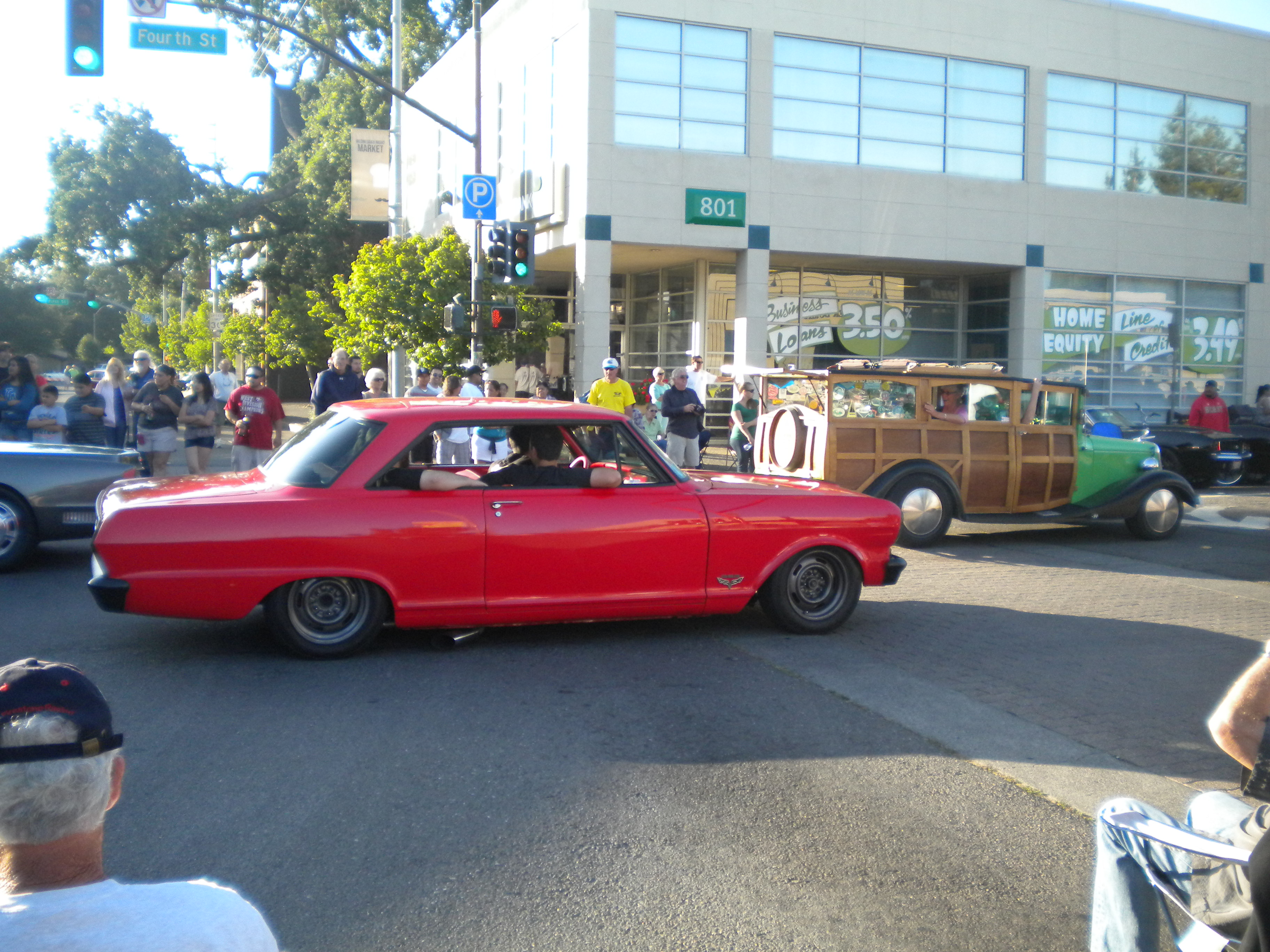
I don’t know what this Chevy Nova had under the hood, but it sounded NASTY!  Many of the cars at the parade were either restored to Concours-levels or were built for the drag strip.  This one was built to rule the streets.   DSCN1921

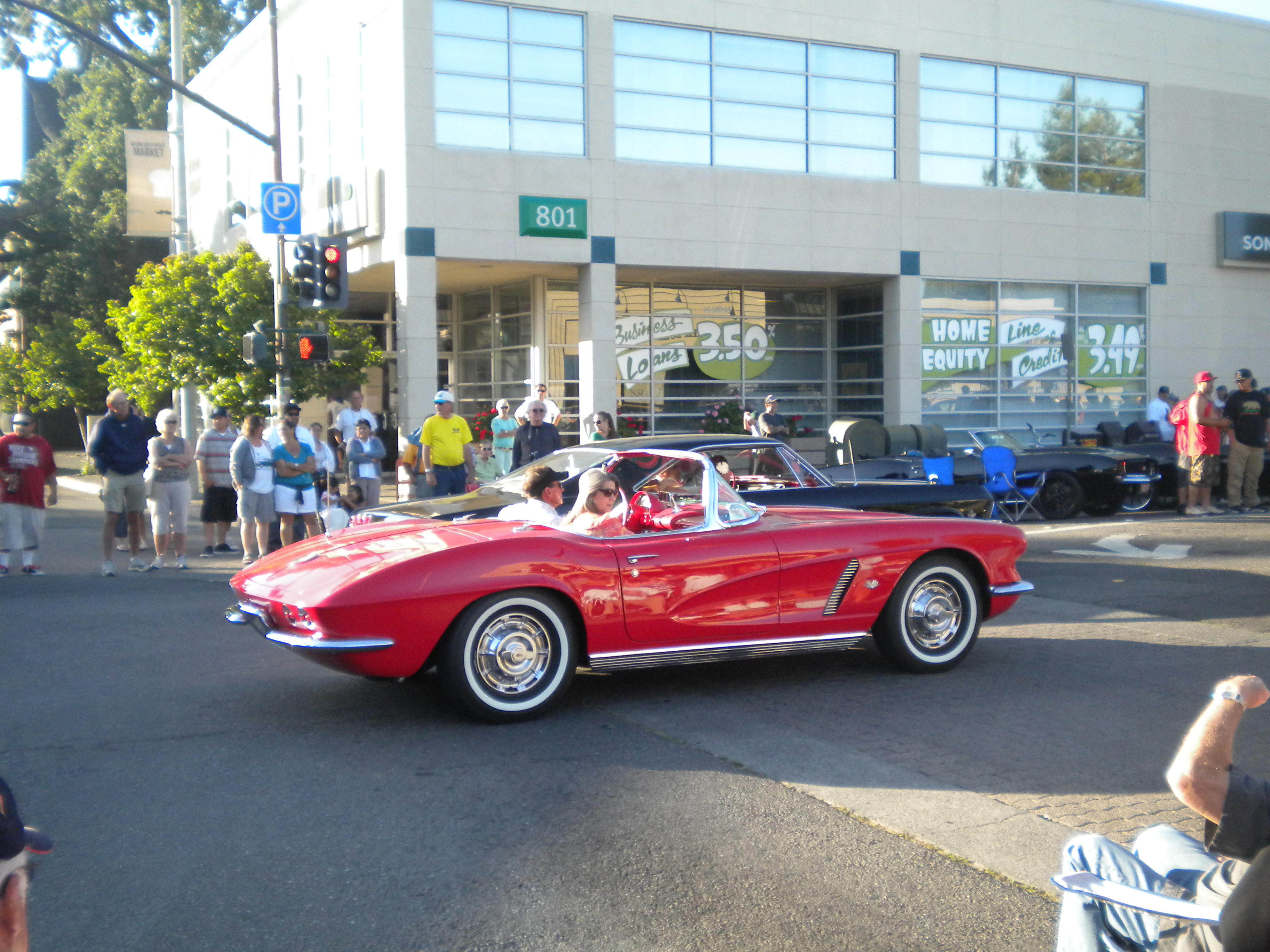
This 1959 Chevrolet Corvette is a rare “Fuelie.”  Instead of a carburetor, it has a primitive version of fuel injection.  This particular example was restored to a “Level 1.”  Level 1 means that it is virtually perfect.  That it is.

DSCN1922

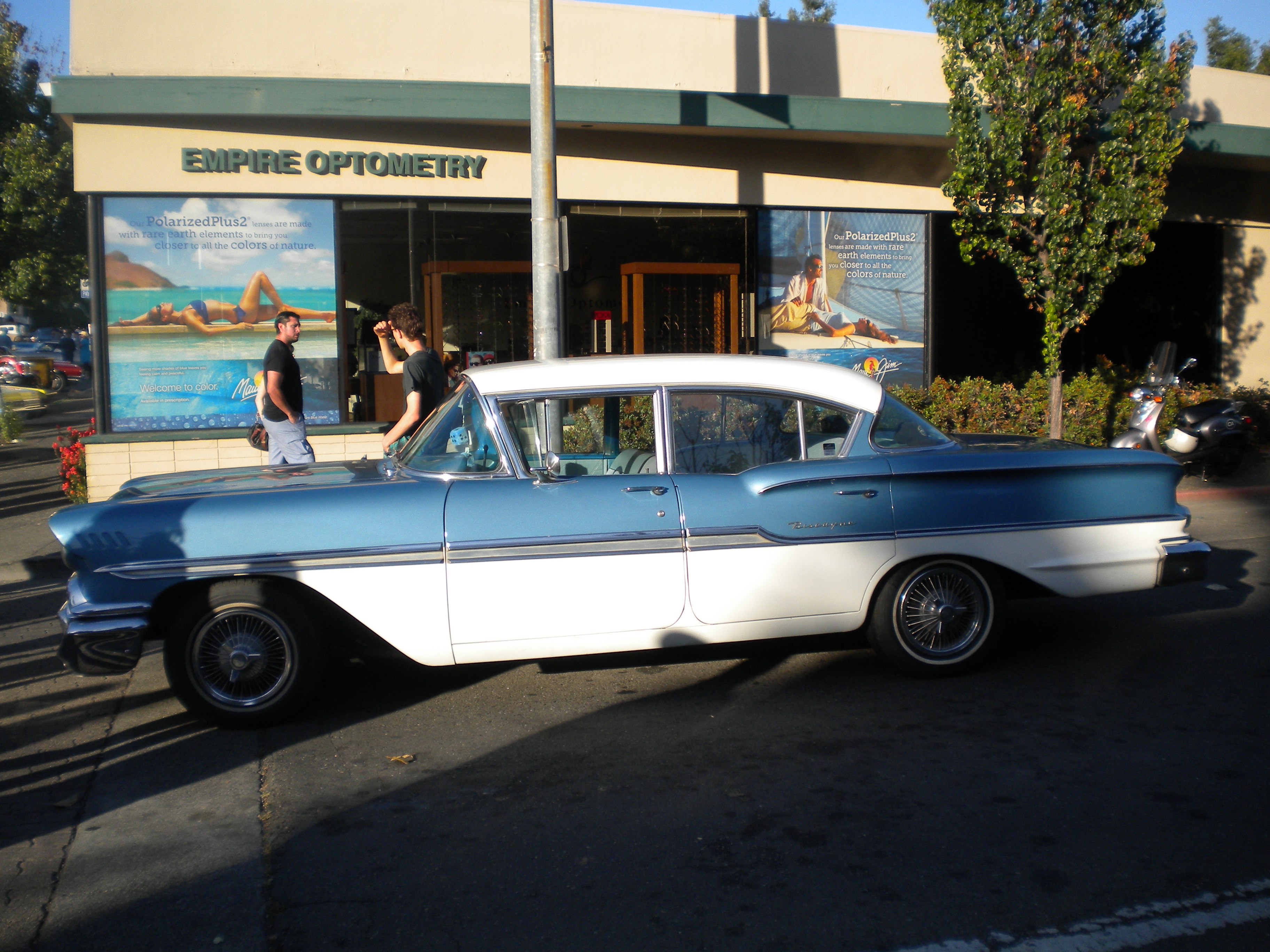
This 1966 Chevrolet Biscayne is a powerful, efficient, and stylish family sedan from the muscle car era.  It has a 327 cubic-inch V8 engine and a two-speed automatic Powerglide transmission.  It’s lovely.

DSCN1923

I find it nice that the interior of the same Biscayne matches the exterior of the car.  Even the steering wheel has chrome on it!

DSCN1924

Same car.  This is the model designation.  The car is a barn find from somewhere around Redwood City, according to the owner.  He restored it himself, and he did a very good job of it!

DSCN1925

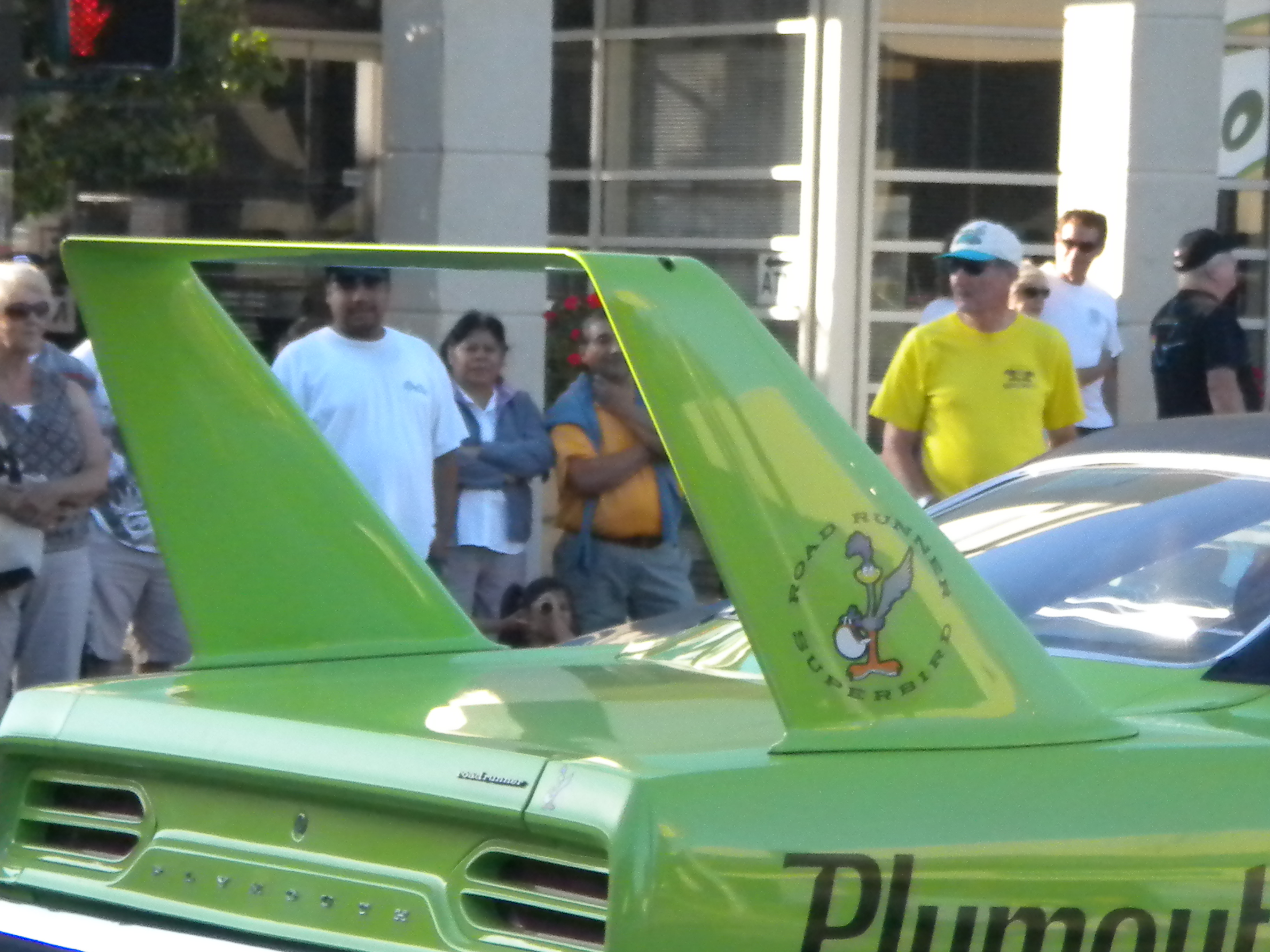
For those of you old enough, you should remember the aero-wars days, when big engines and aerodynamics were all the rage.  The 1971 Plymouth Roadrunners and Superbirds were the car of choice for many famous NASCAR drivers.  Richard Petty left Ford in 1969 to go to Plymouth.   He did so much better in a Plymouth Superbird that Ford built the Torino Talladega as a response.  This particular Roadrunner has the 440 Six Pack (a 440 cubic-inch V8 with THREE two-barrel carburetors!), which was just one step below the mighty 426 Hemi engine.  It is painted in the iconic Lime Green that is popular with automotive restorers.

DSCN1926

This Corvette is one of the nicest Corvettes that I’ve seen in a LONG time!  It is painted Aqua Blue and Snow White, with a matching interior.  It has the 283 cubic-inch V8 and a four-speed manual.  It is a 1956 Corvette.  The only shame?  That it’s far too nice to tour Route 66 in.

DSCN1927

Sorry about the fingertip on the top of the camera view.  The sun was shining and I REALLY wanted to tell you about this truck!  It’s a 1965 Chevy K10 with the optional 327 cubic-inch engine and a three-speed manual.  It is built to tackle any trail, and take anything that you want with it.  It may not be stock, but it looks like it will outrun just about any Jeep from the same era off-road.

DSCN1928

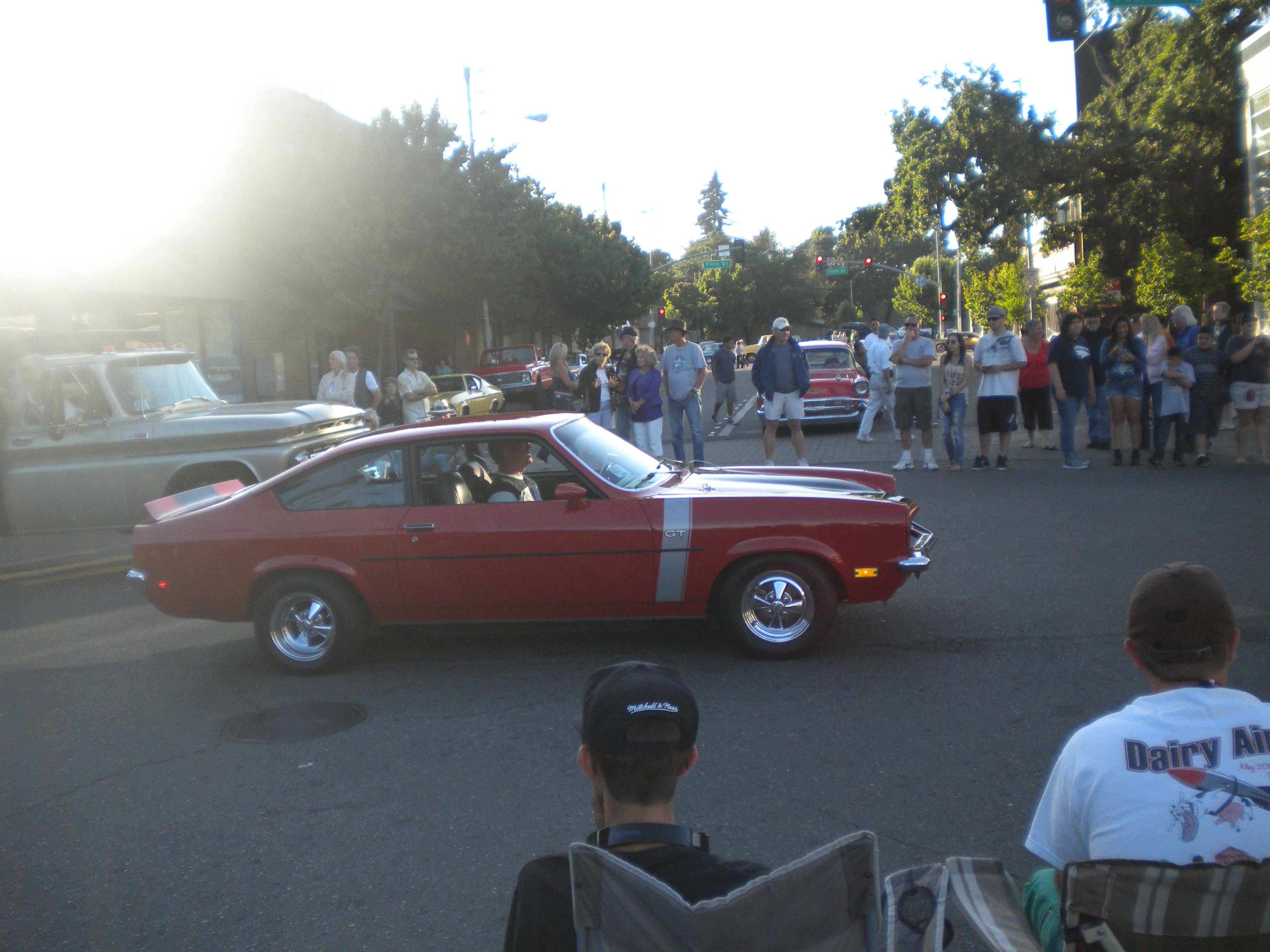
Remember the Chevy Vega?  If you don’t, it’s okay.  The Vega was powered by a 305 cubic-inch V8.  It was relatively powerful and fast, but it was a minor disaster for Chevy.  This Vega is a 1974 model.  It wasn’t the nicest car there, but it was one of the newer cars there.

DSCN1929

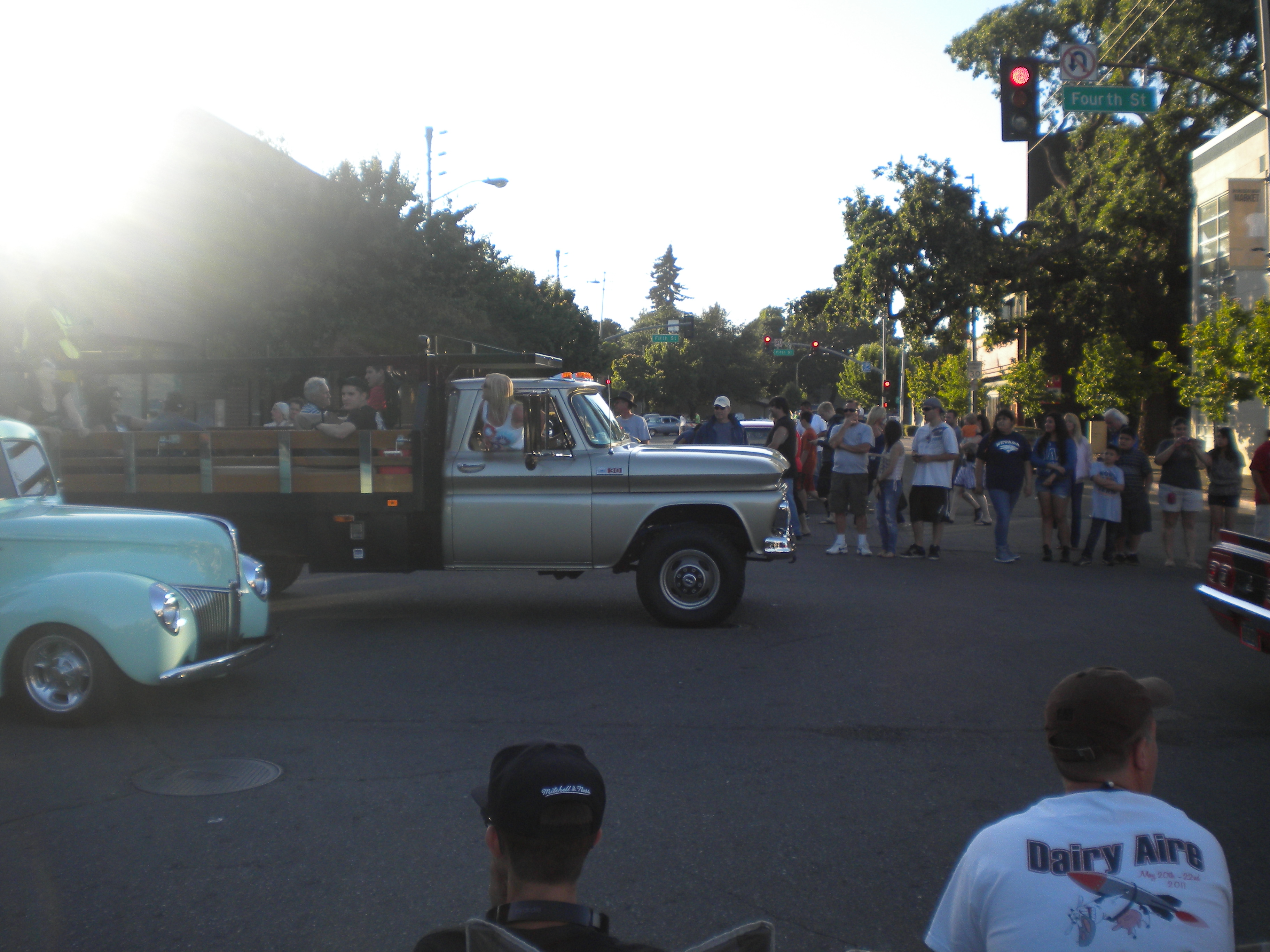
The best part about this 1969 Chevrolet C30 is that it is used a lot.  I don’t know how much, but I have seen it at Sonoma Raceway’s Wednesday Night Drags as a tow vehicle.  It’s the perfect tow vehicle.  It’s got a 350 cubic-inch engine that’s all-original.  So is most of the truck.

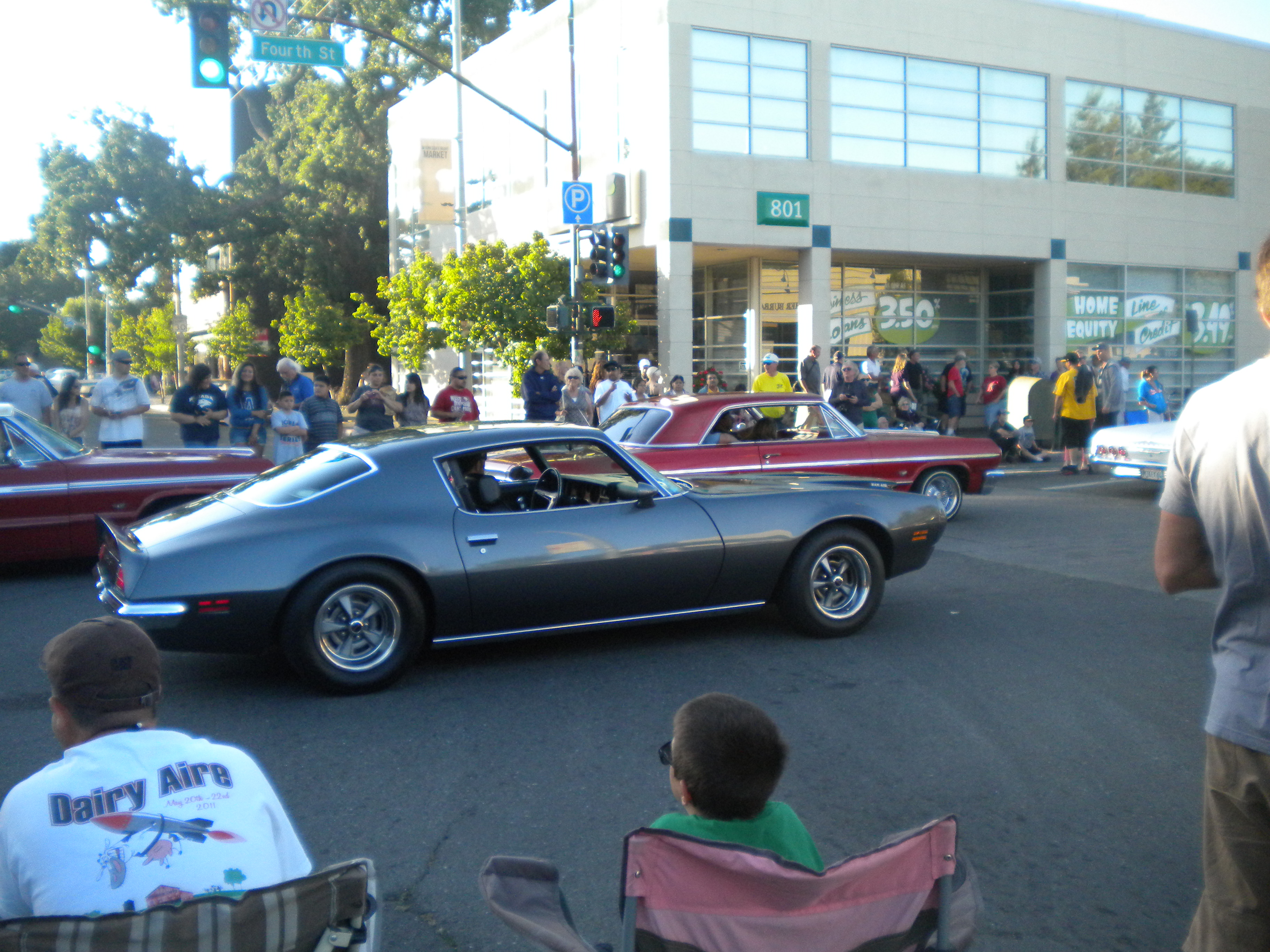
DSCN1930This rare 1971 Pontiac Firebird Trans Am is one speedy car.  It’s all stock, and plenty fast that way.  It’s got the 350 cubic-inch V8 engine found in many GM vehicles from 1969-1999.  The top speed is 130 mph.  This car means business.  The lucky driver had to keep the car in first gear.  he also kept touching the brakes because the car wants to leap forward.  Lucky him.

DSCN1931

I’m going to apologize in advance for the direction of the photo.  This 1951 Dodge cab-over semi has been so heavily customized that the only thing original about it is the cab.  That’s it.  The rest of it is custom-built.  The truck is a heavy-duty car-hauler with three axles.  The engine is a brand-new 6.7-liter Cummins Diesel engine that has two turbos instead of one.  Wow!

DSCN1932

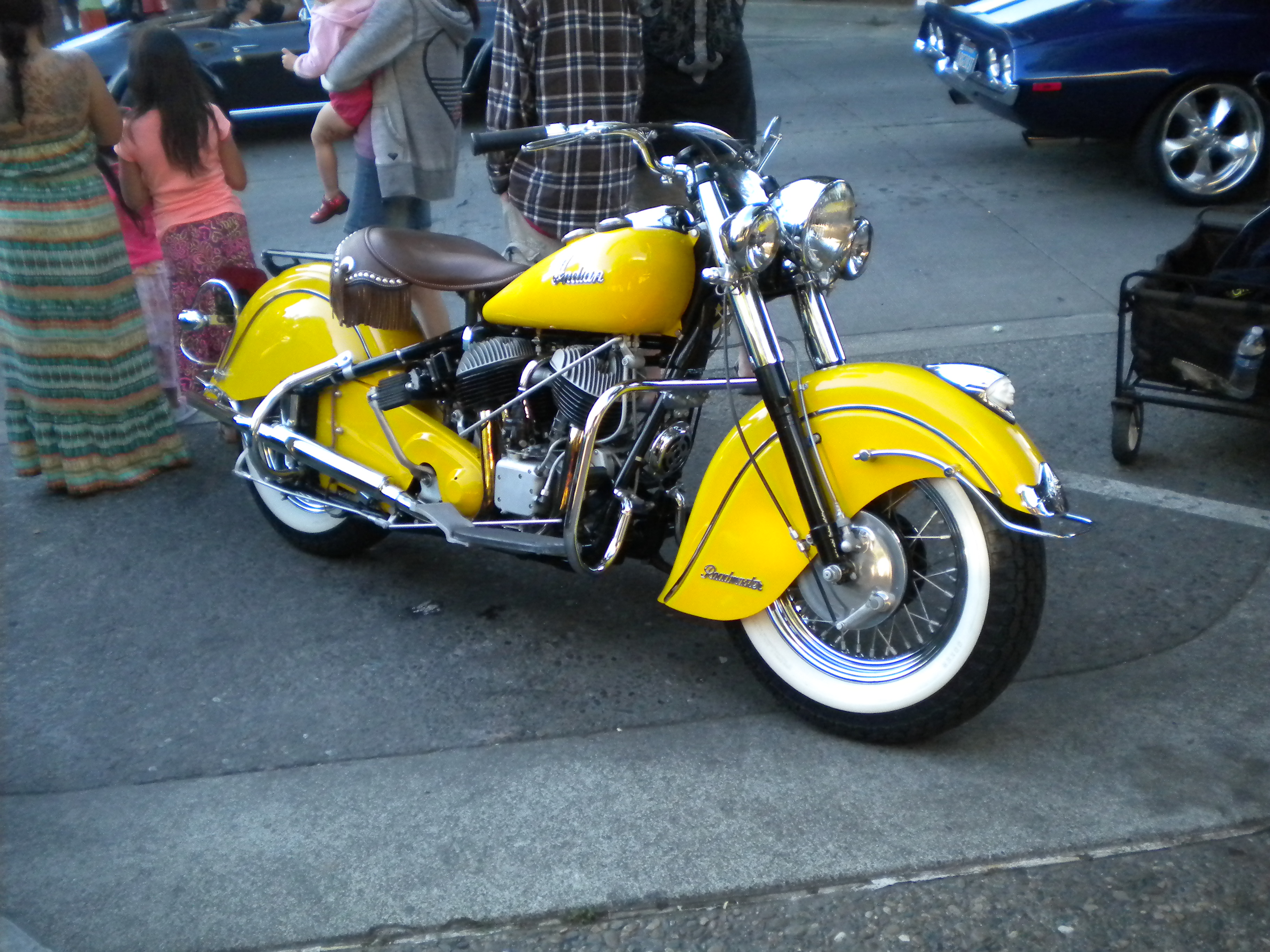
While motorcycles aren’t as common in the parade as cars, there were still a good three or four.  This 1946 Indian Roadmaster has the iconic “shovelhead” engine that many motorcycle enthusiasts favor.  This Indian Roadmaster is banana yellow with the “caramel cream” seat.  I like old motorcycles like this.  Maybe some readers will buy me one…

DSCN1933

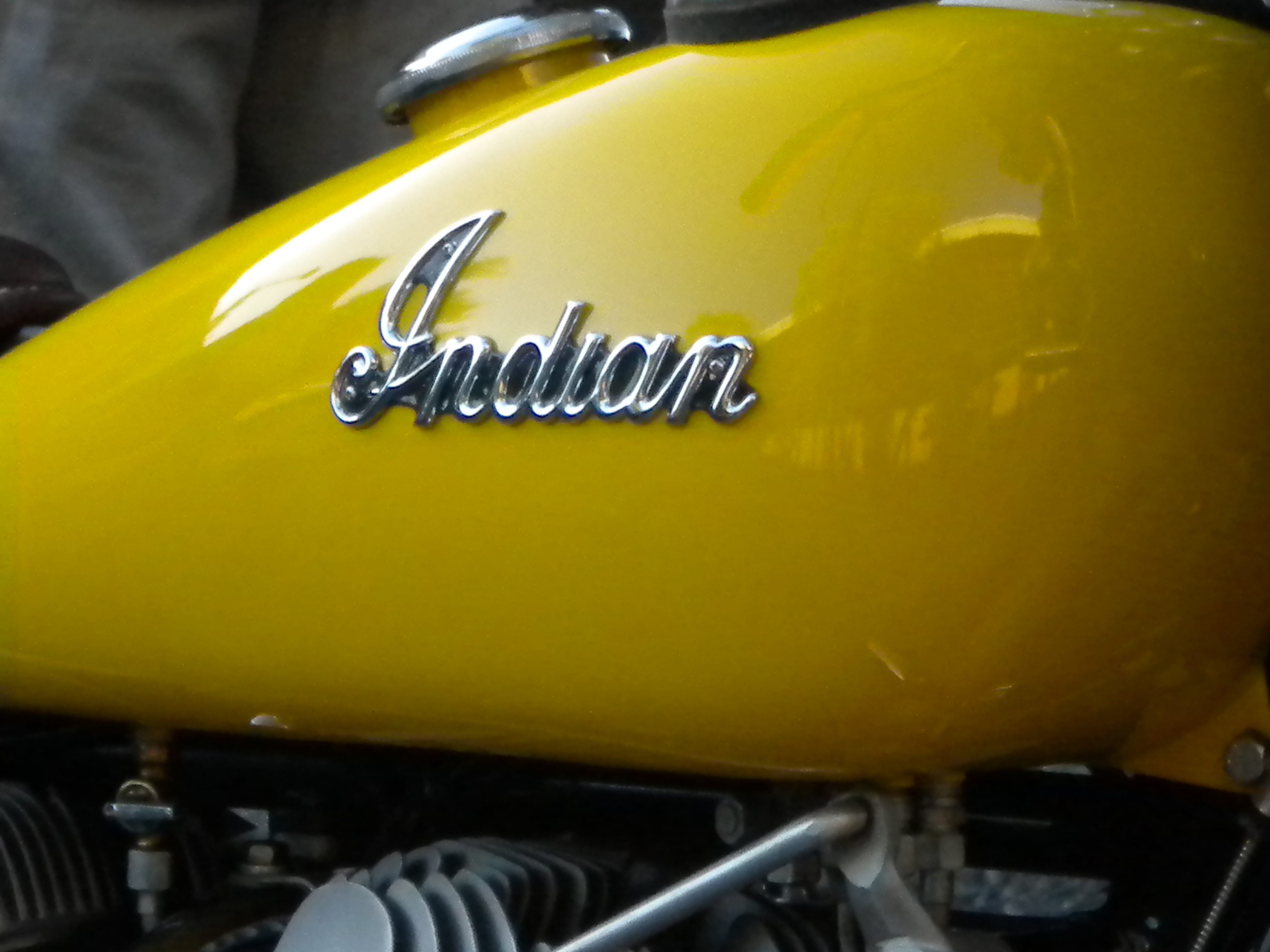
The Indian logo is still in the original chrome, almost 65 years later.  The gas tank can hold 10 gallons.  It says that on the chrome gas cap.

DSCN1934

I like the way that Indian made the front wheel cover so stylish.  I was talking to the owner for a minute, and I found out that he drove it all the way down to Santa Rosa from Healdsburg.  That’s not a lot of fun on an old motorcycle, yet Indian motorcycles are built to cruise.  I’m guessing that it was probably a comfortable ride down to Santa Rosa.

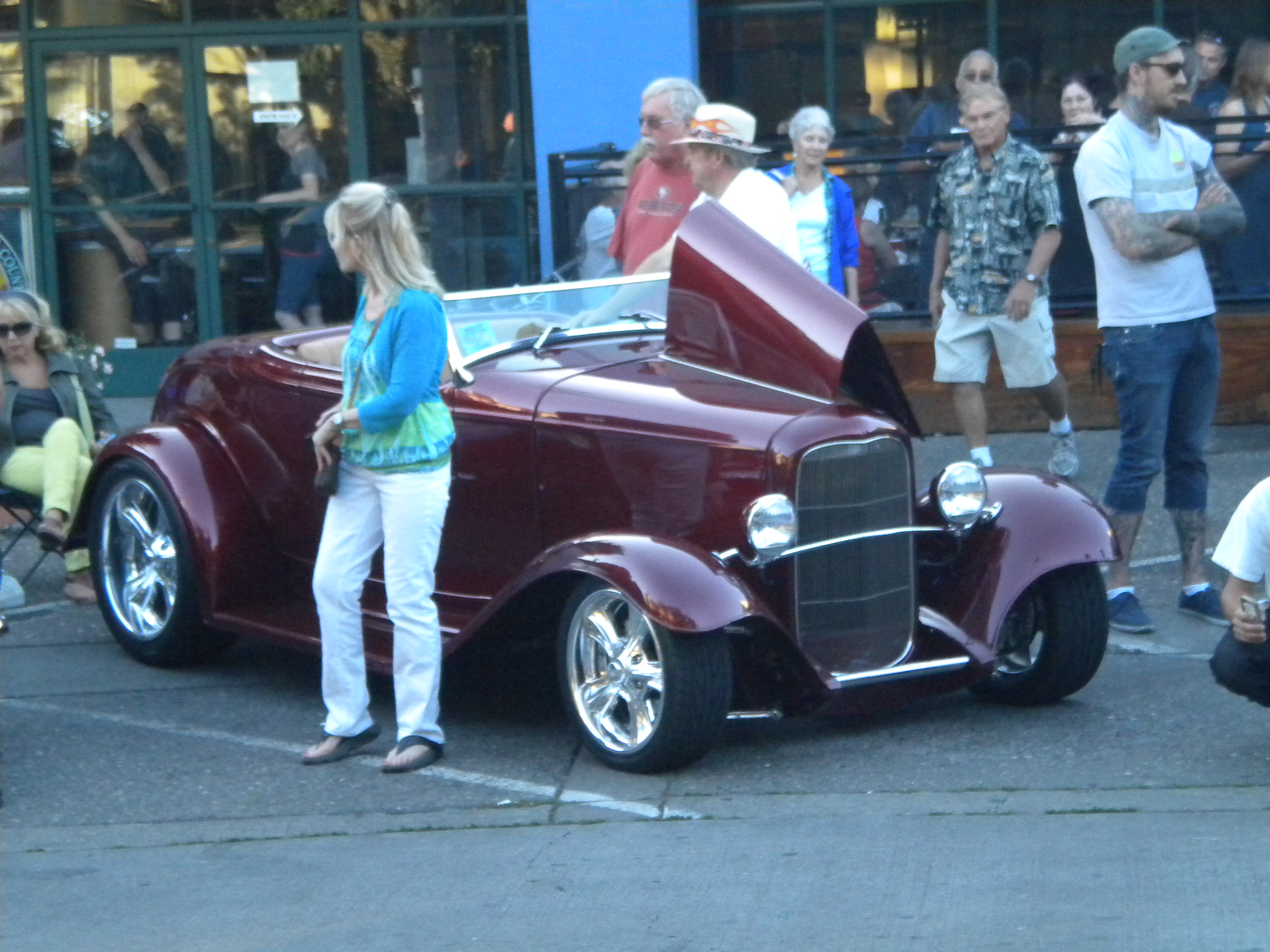
DSCN1937This 1932 Ford Roadster is a sick hot rod.  The lady standing by the car is the owner.  The car has a Ford 351 Windsor V8 engine.  It has a Jaguar rear end, and a five-speed manual.  This car means business.  I don’t know what I like more:  The mechanical parts of the car, or the exterior?  That’s a decision that YOU will let me know in the comments section…

DSCN1938

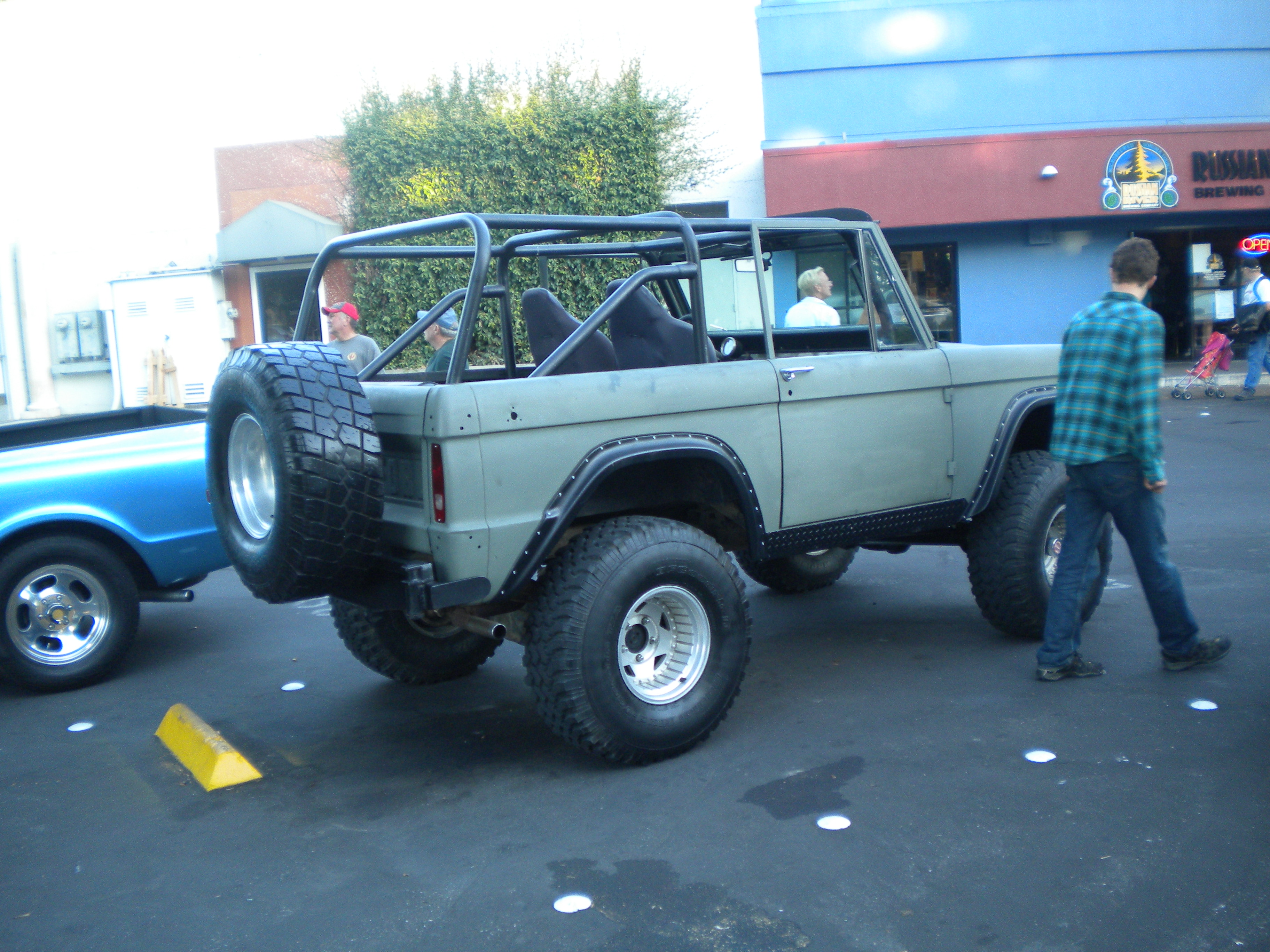
This Ford Bronco looks like it came out of some post-apocalyptic movie.  It’s got aggressive tires, a six-inch lift kit, and a 302 cubic inch V8.  I don’t know the exact year, but it looks like it’s from around 1967-8.  This is one nice Bronco.

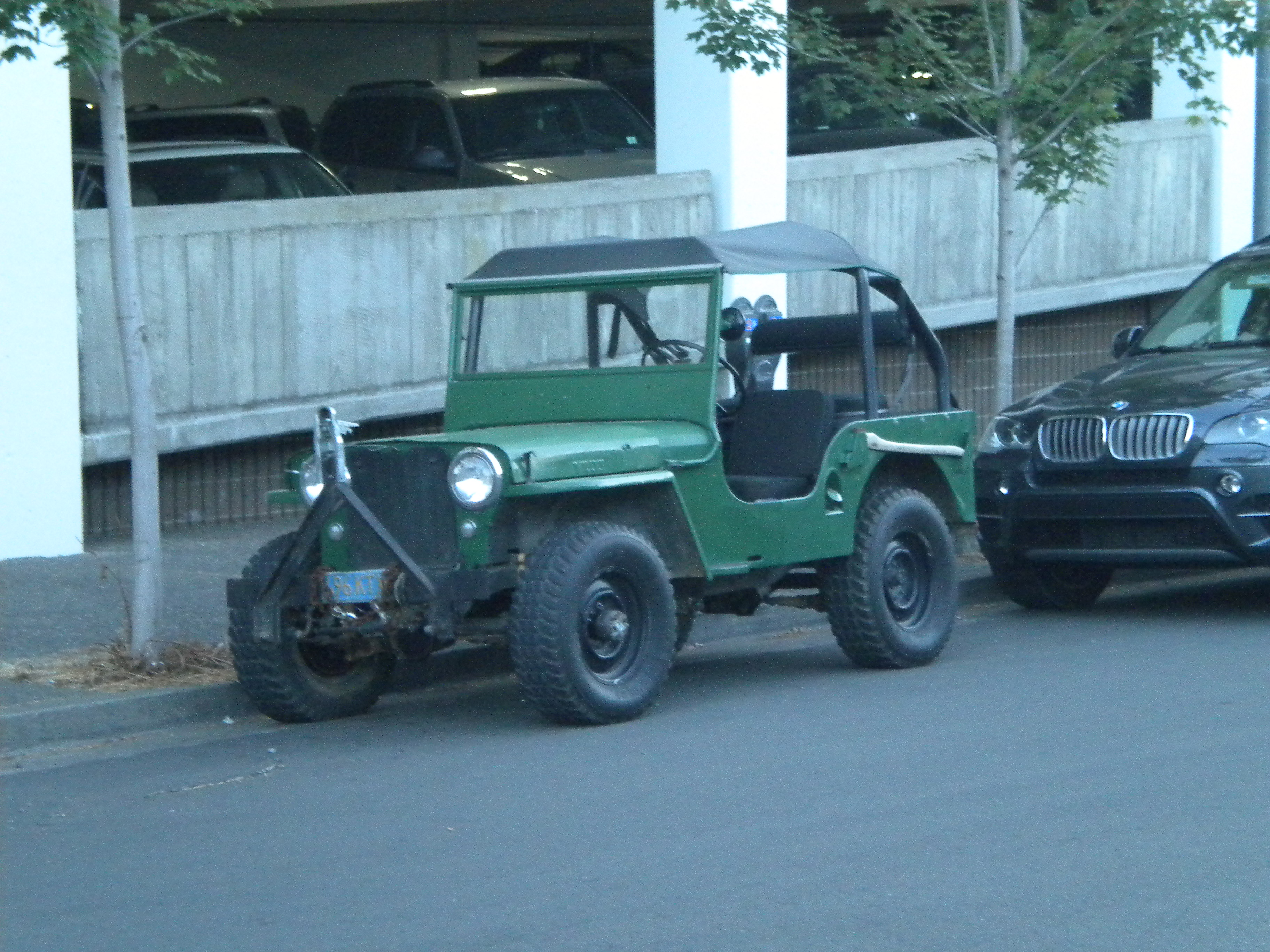
DSCN1940This is one of the coolest, most amazing Jeep CJs that I’ve ever seen.  And that’s saying a lot.  This CJ is stock, and is a 1947 model.  Between the drivers seat and the passengers seat, there is a metal rifle/shotgun holder for two high-powered guns.  Not that it would be used for that!

DSCN1942How often do you see a stock 1932 Ford roadster?  Not at all often!  This is a stock 1932 Ford roadster that could sell for upwards of $150,000 in its current condition.  It even has the rumble seat and the original interior!  It’s beautiful!

That’s all, folks!

If you would like to check out the Peggy Sue’s Cruise website, it is http://www.peggysuescruise.com/home/

Making A Grand Entrance, or Getting to Thanksgiving in Style

As you know, Thanksgiving kicks off the holiday season with a full belly.  At least 80% of all Americans travel for the holiday.  I know that those who are traveling by road will be traveling the crowded interstates.  For those taking the back roads, I’ve put together a list of ten cars that have at least 400 horsepower and seat four people comfortably.  Tell me which one you’d like to take.

  1. Audi S8:  The 2013 Audi S8 has 520 horsepower, yet it isn’t a car that is 6000 pounds and fast in a straight line like a Rolls.  Instead, it weighs 4400 pounds.  With Audi’s signature Quattro AWD system, the S8 will go where a Rolls would never think of going.  Do you know of any full-size sedans other than the S8 than can get to 60 in 3.5 seconds?  Plus, the interior will enclose you in Alacantara and leather sourced from the finest tanneries in the world.  Not a bad way to travel…
  2. Bentley Mulsanne:  Would you like to make an even grander entrance than the S8?   If you do, take the 2013 Bentley Mulsanne.  A 505 horsepower 6.75 liter, twin turbo V8 powers the massive Bentley to a heart-stopping 4.8 seconds to 60.  It might not be as fast as the S8, but it will look better at speed.  All four of you and your lucky friends will be enshrouded in pillowy, massaging seats that have leather.
  3. Cadillac CTS-V Wagon:   The Caddy is one of the more powerful cars here, yet one of the first choices for a back-road blast.  The CTS-V Wagon is fast, with a top speed of 190 mph (governed!), and it will carry turkeys, luggage, and plenty of eggnog and brew for Thanksgiving without breaking a sweat.  Plus, it will look like you are having a blast.  Which you WILL be, right?
  4. Dodge Charger SRT-8:   The Charger has long held a soft spot in my big car heart.  It’s fast, it makes a statement, and it’s loud.  What’s not to love?  Plus, the SRT-8 can be purchased for under $50,000!  60 mph comes up in a show-stopping 4.3 seconds.  This makes it the large family-oriented performance car of the century!
  5. Hyundai Genesis 5.0 R-Spec:  The Hyundai is the first Korean performance sedan.  It competes with the Mercedes-Benz E550, yet offers almost as much room as a MBZ S-Class.  It may be smaller than the gigantic Equus, but it’s MUCH more fun to drive.  Plus, it will get people asking what it is.  Some will think it’s a Lexus, others will think is a Mercedes.  Tell them it’s a Hyundai, and take some photos for me!
  6. Jaguar XJL Supercharged:  The 470 horsepower, 5.0 liter engine is powerful enough to move this big boy.  Fast.  The interior is even nicer than the engine.  There is a suede-like material that Jag used for the headliner that is very soft and nice.  The engine is so powerful that you can load up the trunk and have your friends in the back stretched out.  What’s not to love?
  7. Land Rover Range Rover Supercharged:  The Range Rover Supercharged has a 510 horsepower engine that is basically the same one you’ll find in the XJL Supercharged.  This powerful engine will take the nearly 5000-pound SUV to 60 in a mere 5.2 seconds.  Plus, it will haul all your gear wherever you want it.  You can quite literally load up the shotguns and go hunting wild turkeys in the Rockies.  Plus, it’s got  a very similar interior to the XJL Supercharged.  Not bad for an SUV that costs almost $120,000.
  8. Mercedes-Benz GL550:  The GL wowed the 2013 Motor Trend SUV of the Year judges so much that they named it SUV of the year.  It’s the first MBZ to win that title since 2001.  The GL550 doles out globs of torque and 429 horsepower.  It’s powerful, fast, quiet, AND it will follow the Range Rover Supercharged.  For a while.  The Designo interior rivals that of the luxurious S-Class, with comfortable leather seats that seat seven.  Plus, you can take all your gear in the back and still have room.  It’s bigger than an Escalade, yet smaller than a Navigator EL.
  9. Porsche Panamera GTS:  The powerful Panamera GTS will haul four people in relative comfort, thanks to it’s leather-covered Recaro seats.  It has AWD and 430 horsepower.  It’s like the Nissan GT-R Black Edition, with two more doors!  And a rumbling V8!  Plus, it will get 24.5 mpg on the highway!  VROOOOOOOOM!
  10. Tesla Model S Signature Performance Edition:  The 2013 Motor Trend Car of the Year deserves to be on this list.  Why?  It’s extremely powerful electric motor produces 416 horsepower at the wheels.  This means that it’s there as soon as you start it.  It might not have the range of the Mulsanne or the Panamera, but it will make the most amazing entrance ever.  It carries almost as much as a Chevy Equinox, plus it has 285 miles of range!  Plus, you can get to 60 in jolting 4.0 seconds!  This is one silent VROOOOOOOOOOOM!

Have fun daydreaming about what could be, when you’re stuck on the interstate wishing you’d taken the backroads. These cars may not be ‘The Family’s New Car’, but they definitely have serious style!   P.S.  Do you have any cars that have at least 400 horsepower and seat four comfortably?  I’m sure you do…