The Long and Winding Road from DAT to Nissan

“To Infiniti and Beyond!”  Those (kind of) famous words from Buzz Lightyear from Toy Story really describe the amount of work Nissan and its sister company, Infiniti put in.  As I write these words, there are probably some next-generation Infiniti G’s, Nissan Altima’s and many more that we’ll delve into another time. 

The history of Nissan and Infiniti is lengthy, but interesting.   

In 1914, in Japan, three men; Kenjiro Den, Rokuro Aoyama, and Meitaro Takehuchi founded an automobile company called DAT.  They took the first letter from their last names to make the acronym: DAT.  DAT made military trucks, but the demand for military trucks was nil.  It forced DAT to merge with another company (but I am getting ahead of myself!).  Two years before DAT was bought by Nissan, they came out with a car called the Datson (son of DAT). In 1933 DAT was bought by an auto-parts supplier; Nissan When Nissan bought DAT, the Datson was renamed the Datsun.  “Son” in Japanese means ‘loss’.  ‘Nissan’ was an abbreviation used on the Japanese stock market (the founders of Nissan Auto Parts liked the sound of Nissan). 

During WWII, Nissan Motor Co., Ltd and all its subsidiaries (including DAT) made trucks, planes and engines for the Japanese military.  DAT was temporarily moved to captured land in China.  It kept on producing military equipment until China threatened to bomb the factory in 1948.  Then DAT went back to Japan.  Cars were imported under the Mitsubishi name to South America, where there was a booming business for foreign cars.

Shortly after the DAT company was renamed Datsun, in 1951, Nissan started to make its own cars.  Using help from Datsun, they built a legendary vehicle.  It could be called one of the first SUV’s, and was Japan’s answer to the Willys and Ford Jeeps.  It had more horsepower than the Willys and Ford (85), a complex (for the day) 4×4 system, and was more capable in everything.  The vehicle was named the Patrol.  It is still sold everywhere around the world except in the U.S.  You can have one shipped over in parts and register it as a kit car. 

In 1958, the first Datsun to go on U.S. roads was a Datsun Bluebird, becoming one of Datsun’s top sellers until the 1970’s.  “Fuel-efficient, fun, fast enough, and big enough for the whole family!” was Datsun’s advertisement.  What kind of person is in the market for a “fast enough”car?

In 1960, the Datsun Motor Company (but owned by Nissan, so you can call it the Nissan Motor Company) established a firm hold on U.S. soil when they bought a headquarters building in Santa Barbara, California.  Los Angeles, forget it!  Too expensive.  Santa Barbara was perfect:  Right by the sea, pretty, and close to LA. 

In 1962, Nissan finally had to tackle the European market.  They set up headquarters in Sunderland, England.  Since then, there are Nissan HQ’s all over Europe.  Four years later, Nissan merged with the Prince Motor Co.  This meant that there was a larger pool of engineers.  Nissan added the Gloria and Skyline models within a year.  One concept for each car, and three prototypes total.  Wow.  Usually, there are about two concepts per car, and close to twenty prototypes.  Boy, the Japanese are efficient!

The legendary Datsun 240Z came roaring into production in 1969!  With 150 horsepower, it had Porsche performance at half the price!  The four-speed manual had  a beefy, yet easy to use clutch.  According to my dad (who drove one!), as the 240Z aged, the carb had to be tweaked every 150 miles! 

During the 1970’s oil crisis, the 1973 Nissan Sunny was the car to get, as it scored number 1 on EPA tests.  It achieved huge popularity in the U.S. and around the world. It got over 65 mpg!  No wonder it was so popular!  They should bring it back into production.  Say your prayers Prius!

The year 1980 was groundbreaking for Nissan.  A new plant opened up in Tennessee for trucks, thus avoiding the chicken tax. 

Three years later, the Datsun name was discontinued.  All vehicles that were previously Datsuns were then Nissans.  The Datsun 280Z was discontinued.  To make up for the loss of the amazing Z line, Nissan started to make the 300ZX.  It was the next generation Datsun Z!  Even today, Nissan still makes the Z line (with the 370Z!).

Three years later, the first Nissan Bluebirds for Europe started flying off the production line in Sunderland, England.  Bluebirds had been in production for 30 years, when they started making them for the Western European market.     

In 1988, Nissan of Europe was very well-established, and started to win a lot of awards.

Tune into my blog next Tuesday to read about what happens next to Nissan!  Happy weekend!

Are You Taxing MY Chickens?

For those of you who know me, I have chickens (but my sister tends them along with her flock).  According to the title of this post, you COULD be taxing my chickens, but let’s be positive.  Well, this isn’t a chicken blog, but a car blog.  So how does a chicken tax relate to cars?

What in the world do chickens and trucks have to do with each other?  Apparently a lot.  The chicken tax has been in action in the U.S., since 1963.  If foreign automakers sell trucks not built in North America, than the automaker will have to pay a 25% “chicken tax.”  The term originated when, in 1963, Germany imposed a heavy tax on frozen chickens coming from the U.S. to Germany.  The U.S. retorted by imposing the chicken tax on any foreign-built pickup truck, or other small truck coming into the U.S.  This also applies to vans, as they are built on truck platforms.

The chicken tax forced Honda, Toyota and Nissan to build their trucks here.  But, the chicken tax is imposed on the Ford Transit Connect (a small car-based platform, cargo van).  After figuring out a loophole, Ford decided to use it as a solution to the chicken tax problem.  The Transit Connect comes to America with the rear seats in.  This qualifies it as a station wagon.  Ford realizes that most Transit Connects will be sold in the cargo van configuration, so the rear seats are ripped out of most and sent to a company, where the steel from the seats will be recycled, and the remaining part of the seats will be sent to the dump.  How green can Ford be?  Pretty tricky….

The other truck that is in danger of the chicken tax is a Mahindra pickup truck.  The Indian firm, Mahindra & Mahindra Ltd. is in high hopes of selling their pickup stateside by December 2011.  But, there is the chicken tax.   The plans are to have complete kits of the truck sent to the U.S., and then be assembled in a plant in Ohio; thus avoiding the chicken tax.  That’s pretty smart, and green!

Even though there are very few American frozen chickens in Germany, the chicken tax is still there.  At least no one is taxing my chickens!

A Cool Vette

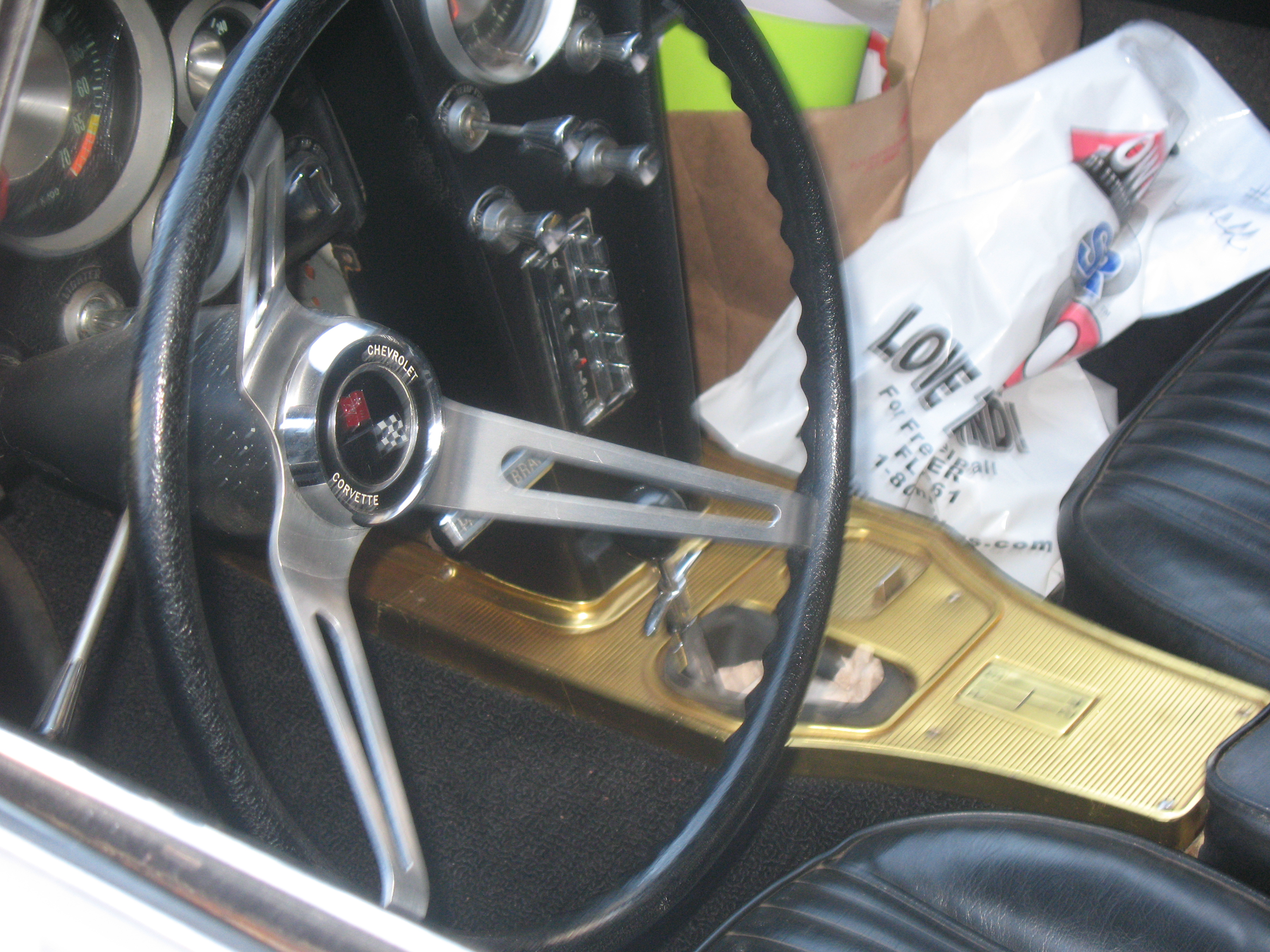
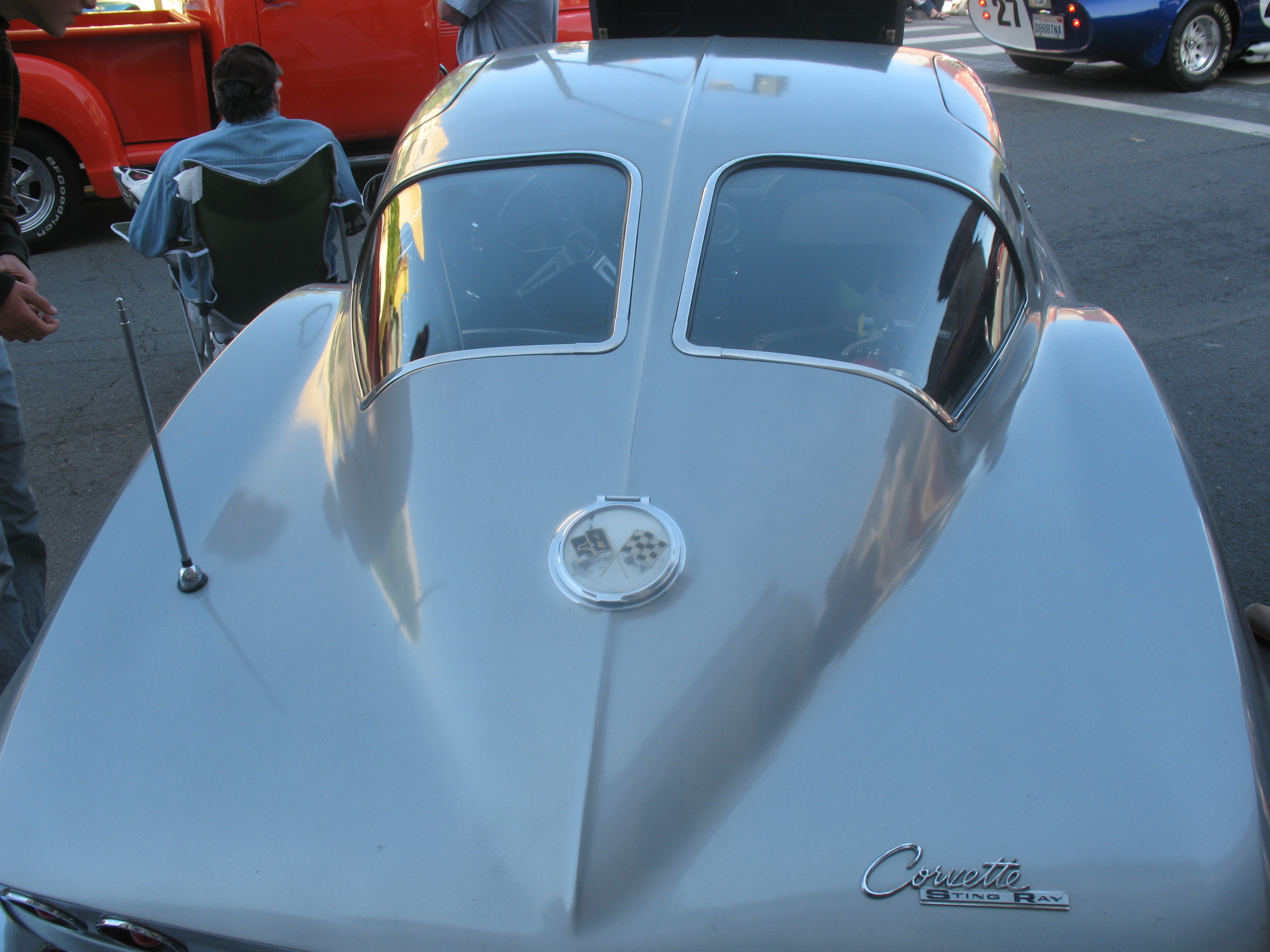
I saw the “Epic, Awesome ’63 Corvette! ” (Even better, a Fuelie!) And, yes, it was cool.

­­­­­­­­­­­­­­­­­­­­­­­In 1963, the Corvette was redesigned.  After almost 10 successful years of the first generation, the aging Chevy Corvette was in need of a redesign.  So, Chevrolet had their chief designers, Bill Mitchell and Larry Shinoda, design a new Vette.  The distinctively designed Corvette was made fun of by critics (now it is one of the most sought-after Corvettes ever made!  Ironic.). 

­­­­­­­­­­­­­­­­­­­­­­­

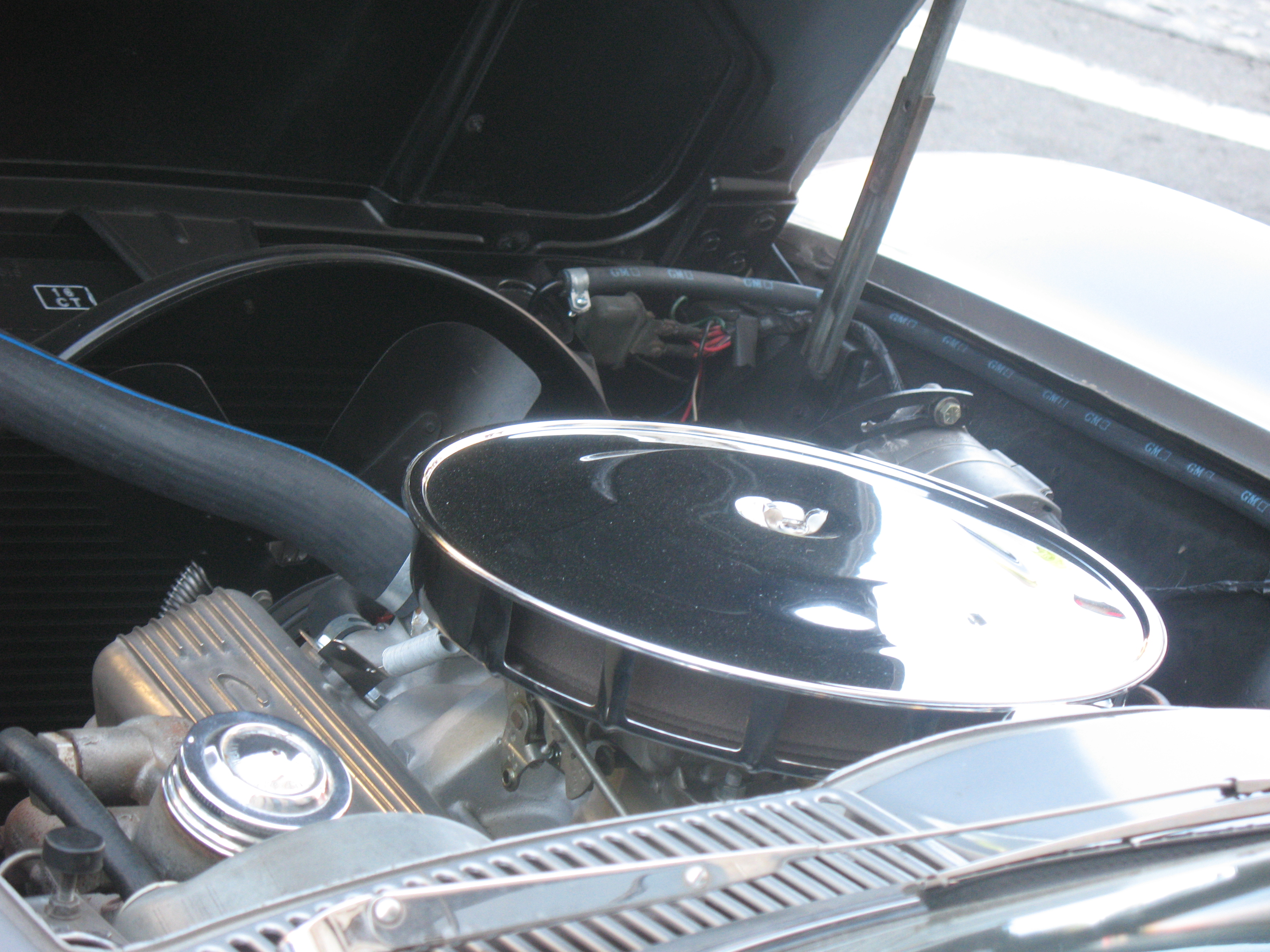
The Corvette Sting Ray had a two-seater cabin like other Vettes, but it had a two-piece rear windshield.  The 1963 Corvette Sting Ray had engine choices ranging from a 327 cubic inch V8, to a 396 cubic inch V8, and the best, a 427 cubic inch V8.  The 396 was offered from 1964-1966.  The 327 had a very rare “Fuelie” option.  Very few Fuelies were ever made, and these pictures are actual ones I took at the American Graffiti salute (look at my previous post, “Where Were You in ’62?”) of a 1963 Corvette Sting Ray Fuelie.  The second picture may look like it has a carburetor, but it is only a massive cold-air intake! 

This particular Sting Ray has the optional AM/FM radio option, along with the standard four-speed manual.  The sloping rear deck was meant to reduce drag, and increase styling.  Larry Shinoda had the rare talent of designing beautiful cars that were very aerodynamic.  The fuel-filler is behind the rear deck. (They did this because of the fuel tank being underneath the cargo area.) 

The Fuelie Sting Ray made 250 bhp (brake horsepower), a lot less than the 375 bhp carbureted version!  Even though bigger disc brakes were available on the Fuelie, many people chose the carbureted version because of its cheaper price (the Fuelie option cost $538).  The Fuelie could be optioned with any of the normal options available on Corvettes.

Talk about a beautiful car…

Trivia moment!  Did you know that the ’63 Vette Sting Ray Fuelie could go up to 152 mph!  VROOM!

Lean back for the most luxurious post yet (or ever)

LATE POST (BUT WORTH THE WAIT!) 

It all began when William Lyons was born in Blackpool, England, on September 4th, 1901 to a music store shopkeeper.  So was born the founding father of Jaguar.  In his early days, he daydreamed of motorcycles, and when he turned 18, owned an “oil-bath” Sunbeam motorcycle.  (So-called because if you revved the engine, you would get an oil-bath!)  But, what he really wanted was a Harley-Davidson or a Brough Superior (the Rolls-Royce of motorcycles).  It was almost a coincidence that the future business partner of William Lyons lived across the street.  The name of this neighbor was William Walmsley.  Walmsley had a motorcycle and Swallow sidecar. Lyons bought a Swallow sidecar to match his own Norton motorcycle. Lyons became friends with Walmsley, who was 10 years Lyons’ senior.  With some financial help from their parents, they started the Swallow Sidecar Company.  The Swallow sidecars looked very good hooked up to a Brough Superior.

 In the mid-1920’s, their business flourished, and they started a small coach-building (car making) business.  Many cars only came in black, and it was appealing to see a two-tone Swallow going down the street.  The cars became so popular that they had to move to the Midlands area ofEnglandin 1928.  They found a large supply of workers that were unemployed, so they hired them.  During this time, production went up from 12 cars a week to 50.  The Swallow’s looked much better compared to theAustin100’s that they were using.  They also re-bodied whatever cars they could get their hands on.  Many of the design themes thatLyonsused for designing Jaguars are shown in those early cars. 

 Walmsley and Lyons became well-known when they started buying chassis’ from Rubery Owen (a chassis manufacturer), and engines from Standard 16.  Of course, they manufactured their own bodywork, which was designed byLyons. 

 One funny story is of Lyons designing the roofline of their car, the S.S.1, so low that a driver of average height wouldn’t be able to fit in!  But,Lyonswent to the hospital right before the car went into production.  When he came out, he saw that Walmsley had raised the roofline a few inches. 

 Lyons remarked that the passenger compartment looked “rather like a conning tower.” 

 The Motor magazine said of the S.S. 1 “…the S.S.1 is a new type of automobile in the sense that it is a car built for the connoisseur but is relatively low priced.  All the attributes of sport models are incorporated in a refined manner, and this, coupled with a striking appearance, is bound to attract motorists of modest means.”  There has been a lot of discussion over what the S.S. means. 

 William Lyons said “There was much speculation as to whether S.S. stood for Swallow Standard or Swallow Special.” – it was never resolved. 

 Walmsley and Lyons enjoyed immense success with the S.S. 1 and 2.  But, Lyons wasn’t happy with the handling of the Standard 16, which was the base for the cars.  So, Lyons wanted a new engine.  Walmsley left S.S. cars, leaving Lyons in charge. Lyons could design cars and be a good businessman, but he couldn’t be an engineer.  So, he did the next best thing, he hired engineers.  He only hired trained and self-motivated engineers and workers. Lyonswas very impressed by what Harry Weslake was saying about engine performance.  If you put the cylinder head on the top of the engine, instead of on the side, performance from the engine would rise.  So,Lyonstried it out with an engineer, and found that horsepower rose to 103.3 horsepower, from 70! 

Lyons, having achieved success, designed the S.S.100.  It was described by Phillip Porter as “The SS 100 was the company’s first genuine sports car and to many people it remains the epitome of the stylish pre-war sports car, Lyonswas at his flamboyant best. The beautiful, flowing feline shape suggested speed and when the new 3.5 liter engine was added to the range, a car of vivid performance was the result.”  Once again, the fiendish feline ruled the roads. 

Many automakers were killed by the Great Depression, and S.S. almost went under. Lyons needed steel for his saloons (sedans), and barely managed to get by on the little resources he had. 

 During WWII, Lyons and S.S. helped out with the war efforts.  They made key aircraft components for bombers and fighters.  All engineers were on “fire-watch” (the factory was a large German target), and they would work on cars and talk.  In addition, all the workers left to go serve in the Army, leaving the engineers and Lyons to build and design by themselves.

 The war meant change for S.S. and Lyons:  The name of the line was changed to Jaguar Cars, Ltd, because there was a very unpleasant connection to the German Secret Police, with the name SS. 

During the post-war years, all British manufacturers were encouraged to export products to North America.  Jaguar found a willing market there, and Lyons once said to his Export Manager, John Morgan “ I’m not going to accept crazy marketing plans forAmerica because I don’t believe in it.  It’s a volatile market.”

 Jaguar engineer Bill Heynes assembled a team of engineers to design a new engine.  Some of the engineers in the team included:  Claude Baily and Harry Weslake. 

The 1950’s were the golden years of Jaguar.  Jaguar enjoyed great sales and racing wins.  In 1951, William Lyons agreed to start racing Jaguars.  He did that,  because, if a Jaguar won, sales would increase.  That they did.  Jaguar wonLe Mans in 1951,1953,1955, and 1957.  The 1957 win was overshadowed by a tragedy.  The Jaguar stopped on the track, and a Mercedes-Benz 300SLR crashed into the back of the Jag.  The SLR went skidding into an Austin-Healy 100, and flew into a mound, where it blew up.  The axle and engine block flew into the crowd, killing 83, and injuring 120.  Unbelievably, sales stayed the same. 

 Lyons had Heynes design a racing suspension for the XK120.  Malcolm Sayer designed the body shell.  The car that came out was called the “C-Type.”  Sayer did such a good job that he was hired by Lyons.  He then went on to design the flowing D and E-Types. 

 1955 brought a period of sadness forLyons.  His son, John, died in a car accident on the way to Le Mans. Lyonswas devastated.  Shortly after, a fire swept through the factory.  Many photos show scrapped XK120s.  Jaguar simply cleaned up the factory and went back to work.  Shortly after the fire, Queen Elizabeth toured the factory and knighted William Lyons.  He was then Sir William Lyons.  Some people found him hard to be around after the knighting. 

 In 1960, Sir William Lyons bought Daimler because of their bigger factory inCoventry.  He tried to keep producing Daimlers for a while, but failed.  A funny story happened at the 1959 New York Auto Show;  Lyons is at the ’59 Motor Show inNew York. He was approached by a Jaguar XK140 owner who told him that the heater in his car didn’t work properly. At that point, Lyons, the customer and Tony Thompson, head of US Jaguar sales, marched downstairs to the garage to settle the matter. Thompson recalls the incident: “So we went down to his car and the man said, “look, the heater doesn’t work”.

Sir William replied, “the heater does work”.

The car was started up and the car had, if you remember, a Smiths heater with two little doors on it, and a control on the dash. I smoked soLyonsasked me to light a cigarette. He held the cigarette beside the heater and the smoke very gently wafted away.

“Look,” he said, “it works perfectly”.

“But, Sir Lyons,” the man replied, “temperatures get to 15 below zero.”

“Young man,” he said, “you just put on an overcoat”.

Each and every Jaguar has a personality.  The XK6’s design can be traced back to the Mark VII of the 1950’s.  The XK can be traced to the E-Type of the 1960’s.  By the end of the ‘50’s, Jaguar needed a replacement for the aging XK150.  So, Sayers designed the E-Type.  The flowing, curvy lines made instant Jaguar lovers out of ordinary people.  This was the car that put Jaguar ahead of the competition for many years. 

 The motoring world changed for good in 1968, when Jaguar introduced the XJ6.  The XJ6 was Sir William Lyons’ last creation, and possibly his best.  Over 200,000 were sold in the first two years!  As production of the E-Type would be coming to a halt soon, Sir William Lyons had a V12 developed.  The Series III E-Type was huge success.  When the E-Type ended production, the engine served service in the XJ.  There was an XJ6 or an XJ12.  The XJ12 was very fast and loved by many.  The press promptly named it Car of the Year. 

 In 1972, Sir William Lyons officially retired, and Jaguar had to continue without him.  His house, Wappenbury Hall was half an hour from the factory, and he would often go to watch Jaguars being built. 

 His dream coupe was to be a coupe version of the XJ.  Even though it was produced 2 years after he retired, he drove many test hours in it.  His dream coupe was the XJS, it had large styling influence by Sayer, but it lacked the true Jaguar look. 

 When interviewed in 1980 by Andrew Whyte, these were some ofLyons’ reflective thoughts: “I’ve been retired officially for over eight years now, of course, but I do like to take an interest,” Sir William admits.

“It’s been my whole life after all. Many of the people who worked for me are still there. They know the standards that must be set to remain successful in the motor industry. I think there are enough determined people there, still, to keep the essential Jaguar character in the cars, yet satisfy tomorrow’s legislation worldwide. Our aim from the very start was to give the motorist pleasure. Now, more than ever, I feel that motoring should be a joy and not a chore. I still enjoy it. . . .My favorite car? Well, that’s not too difficult to answer. I was determined that the XJ specification should be right. I believe it was. I don’t think I would have changed anything much if I’d been starting again, certainly not the overall appearance-a few details here and there, maybe-but I really do feel we established something universally pleasing. It does seem to be standing the test of time, doesn’t it?”

Five years after that interview, Sir William Lyons passed away at Wappenbury Hall.  Even though he has been dead for over 20 years, his legacy remains.  If somebody tells you that their XK120 is a “true Jaguar”, then you can retort “no, it’s aLyons AND Jaguar.  Beat that.” 

As Ian Callum (the Jaguar Design Director) said of his award-winning XK, XJ, and XF, “I know that Sir William Lyons would be proud of Jaguar right now.  From what I’ve learned from Heynes and Sayer, he’d probably choose the XJ…” 

TIMELINE FOR JAGUAR.  (Look for the funny story involving carpets at the bottom!) 

 1922:  Swallow Sidecar Company was created by William Lyons and William Walmsley.

1935:  The first Jaguars are made.  They are the SS90 and SS100 sport saloons.

1943:  The Jaguar XJ6 engine is made by engineers on fire-watch during WWII.
1949:  The Jaguar XK120 is created.  It then became the XK140 and XK150.

1951:  Sir William Lyons allows Bill Henyes and Wally Hassan to complete the I6 engine.  Also, a Jaguar XK120 wins the 24 Hours ofLe Mans.

1953:  Jaguar’s winning streak continues, with yet another win atLe Mans.

1955:  Yet another win atLe Mans!   William Lyons’ son, John Lyons died heading toLe Mans.  But, William Lyons became Sir William Lyons.  He was knighted by Queen Elizabeth for his services to the British industry. 

1956:  You guessed it!  Another win!

1957:  Jaguar wonLe Mans, but there was a major crash involving a Mercedes-Benz 300SLR and Austin-Healy 100.  The accident also killed 83 people and injured 120.

1958:  Jaguar comes out with the rare and beautiful Mark IX.

1961:  The Jaguar E-Type rumbles into production.

1966:  An E-Type wins the Rally Monte Carlo.  The Jaguar XK13 is made.  It is a one-off race car designed forLe Mans.  Unfortunately, race rules change; forcing Jaguar to store the XK13.

1968:  The Jaguar XJ is produced.  It is a large luxury car with an in-line-six cylinder.  It is also the last car designed by Sir William Lyons. 

1972:  The Jaguar XJ receives V12 power, and was the fastest sedan in the world, let alone a luxury one.  Given a long stretch of straight blacktop, one can reach 140 mph! 

1975:  Malcolm Sayer designed the replacement for the iconic E-Type.  The new car was called the Jaguar XJ-S.  It was built on the same platform as the XJ sedan, it was simply a coupe version with a V12 engine. 

1985:  Sir William Lyons passes away at Wappenbury Hall (LyonsMansion).  He is remembered by many for his thriftiness, attention to detail, and shrewd businessman. 

1988:  The Jaguar XJR-9 is unstoppable at the World Sports Car Championships:  It won six out of eleven possible wins.  It also took home the driver and team trophies.  It also got Jaguar to the winners circle atLe Mans, the first time since 1957. 

1990:  Ford Motor Company steps in and buys Jaguar for $2.56 billion!  That may seem unconceivable, but one can only expect that for a luxury car manufacturer. 

1992:  Ford brought the Jaguar XJ220 to market.  The prototypes had been seen with 6.2 liter V12s under the hood, but Ford had Jaguar use a 3.5 liter V6.  The XJ220 was driven by a 542 horsepower, 3.5 liter V6.  It could go up to 217 mph!  It wasn’t even legal to drive one in theU.S. 

1996:  Jaguar used a Ford V8 in its Jaguar XK8, making that Ford V8 the first V8 in Jaguar history.  The XK8 soon exceeded sales expectations, by being the fastest-selling Jaguar in history. 

2000:  Ian Callum achieved his lifetime ambition to become a Jaguar designer.  More than 30 years before, he had seen an XJ6 in a showroom, and been intrigued. 

2008:  Elegance is Redefined:  The XK is the first new Jaguar of the millennium, bringing with it a 4.2 liter V8 and six-speed automatic transmission.  The XKR version is supercharged, and brings 420 horsepower and more speed and macho with it.  Also, the XF is introduced.  The XF is designed to compete with the BMW 5-Series.  Even though the XF’s V8 is underpowered, it is a serious competitor.  The supercharged R version is as fast, as or faster than the XKR.  Also, Tata Motors of India bought Jaguar and Land Rover. 

2010:  The Jaguar XJ is redesigned, bringing stealthiness and power with it.  It has a 5.0 liter, 385 horsepower V8 and six-speed automatic.  The XJL Supersport has a supercharged 5.0 liter, 510 horsepower V8.  It also has a six-speed automatic.  All Jaguars are updated to a 5.0 liter V8 with 385 horsepower.  There are supercharged versions with 470 and 510 horsepower, respectively.  Also, the Jaguar XKR GT2 RSR is a one-off race car for ALMS GT2.  It has a 4.7 liter, 525 horsepower V8 with a six-speed automatic. 

2011 and beyond:  Jaguar unveiled the C-X75 concept car at the 2010 Paris Auto Show.  It shows a glimpse of what future Jaguar sports cars may look like.  It is powered by an electric motor and four small turbines. 

There are some funny stories involving Sir William Lyons and/or Jaguars.  Here is a funny story:

One time, Sir William Lyons was visiting the Piccadilly showroom, when the sales manager came up to him.  ‘Excuse me, Sir William.  The carpets in the showroom are becoming very worn, and threadbare in places.  May I order new carpets?’ 

 ‘Certainly not,’ repliedLyons, ‘there is plenty of wear left in those.’ 

 That was the end of the conversation.  On a subsequent visit a month or two later, however,Lyonshappened to look down and noticed – new carpet! The unfortunate fellow was summoned.

‘I thought I told you not to replace the carpet. I thought I told you that the existing ones were perfectly satisfactory. When I give an order, I expect it to be obeyed . . .’

Lyons carried on in this vein until the fellow managed to interrupt long enough to explain that they weren’t new carpets.

‘What I have done, Sir William is to turn them round. Half of each strip was under the show cabinets at the side of the room, and therefore not worn. So now that I have reversed them the worn area is under the cabinets.’

Lyonswas silent for a few moments, as he looked around him. The young man held his breath.

‘Remarkable,’ mutteredLyons. ‘Remarkable.’

There was another pause.

‘Right, my man. I want you at Wappenbury Hall (Lyonsmansion), nine o’clock on Monday morning. You can do the same thing for me at home.”
Hold Onto Your Socks for the Most Exciting Post Yet!

GMC has had a very interesting history.  GMC has been making high-quality trucks for the past 110 years, and has been a supplier of trucks to the U.S. Government.  GM is a large automotive corporation with companies underneath GM.  The companies are:  GMC, Chevrolet, Buick, Isuzu, and Opel.  Pontiac, Saturn and HUMMER all are in the history books now. 

On December 22nd, 1901, Max Grabowsky started the “Rapid Motor Vehicle Company”, which made some of the earliest commercial trucks ever built.  Those trucks used one-cylinder engines!  Fuel efficient, yes, 0-60, 6 hours…   I’d rather push a wheelbarrow…  My lawn tractor has a bigger engine!  In 1909, General Motors bought the company, and renamed it “General Motors Truck & Coach Builder.”  In 1912, there were 22,000 trucks made by GM, 372 of them were GMC Trucks.  Out of those 372 GMC Trucks, 6 of them were chosen to be part of the GM display at the New York International Auto Show. 

In 1916, a GMC Truck crossed theUS in only thirty days. Quite a feat for a truck in 1916.  Ten years later, a two-ton GMC Truck drove fromNew York CitytoSan Franciscoin five days, thirty minutes!  WOW!  Those trips were taken as publicity stunts for GMC!  GMC hired people to drive those trucks across theU.S.

During WWII, GMC produced over 600,000 trucks for the U.S.military.  During the war years of WWII, GMC bought a controlling part of Yellow Coach; a bus maker.  In 1943, GMC purchased the remaining bit of Yellow Coach for about $100,000.   Because of increased competition in the bus market, GMC has been out of the bus business for over20 years. 

Being virtually identical to Chevy trucks, the only differences are: different grilles, more features, and better options.  Even though GMC’s are typically sold at Buick dealers, you can also find many GMC’s at a Chevrolet dealership near you.  Even though Chevy trucks usually sell better, GMC’s do sell in very large numbers. 

GMC’s lineup currently includes:

Sierra 1500

Sierra 2500

Sierra 3500

Canyon

Acadia

Yukon

YukonXL

Terrain

Savanna.

The Sierra 1500, when equipped with the right options, can tow up to 10,000 pounds.  It can also haul up to 1 ton.  There is a luxury version of the 1500 that is called “Sierra 1500Denali.”  It comes with: GM’s Quadrasteer (a system that uses all four wheels to steer), AWD, Navigation, Six-Speed Automatic, and a 6.2 liter, 403 horsepower V8. 

The Sierra 2500 shares only the GM 6-Speed Automatic with the 1500.  The 2500 has the option of GM’s “Duramax” Diesel engine, mated to an Allison Six-Speed Automatic Transmission with an overdrive.  The 2500 also can be equipped with a 6.0 liter, 360 horsepower gasoline V8 mated to a GM Six-Speed Automatic.  Recently, the “Denali” trim line was added to the model lineup for the 2500 and 3500’s alike.

The 3500 comes with the “Dually” option.  The “Dually” is has 4 rear wheels, instead of 2.  The “Dually can only come with the Duramax and Allison.  The 3500 can tow up to 17,500 pounds with a bumper trailer or 5th wheel trailer. 

The Canyon is GMC’s light-duty pickup truck.  It comes standard with a 2.9 liter, 185 horsepower four-cylinder and five-speed manual.  The other two engines that it can be optioned with are a 3.7 liter, 242 horsepower 5-cylinder, or a 5.3 liter, 300 horsepower V8.  The only automatic transmission is a four-speed automatic. 

The Acadia is GMC’s replacement for the aged Envoy SUV.  The Acadia is part of GM’s new “Lambda” SUV platform.  TheAcadiais GMC’s version of the Chevy Traverse and Buick Enclave.  TheAcadia, Enclave and Traverse come standard with a 3.6 liter, 288 horsepower V6.  That engine is mated to a Six-Speed automatic.  TheAcadiacan be optioned with AWD and 8 seats. 

TheYukon and Yukon XL are GMC’s versions of the Chevy Tahoe and Suburban.  They come with the same engines and transmissions.  The popular engine/transmission choice is the 5.3 liter, 315 horsepower V8 with the 6-Automatic.  They can be optioned with 4WD or 2WD. 

The Terrain is GMC’s first compact SUV.  It comes standard with front-wheel-drive and a 2.4 liter, 182 horsepower four-cylinder.  A six-speed automatic is standard across the whole trim line.  If you need to tow, but don’t want to have to step up to the Acadia, then the 3.6 liter, 264  horsepower V6 is a good choice.  You can then tow 5,000 pounds with the V6. 

The GMC Savanna is GMC’s only van.  That doesn’t mean, however, that the Savanna is badly optioned.  You can choose between rear-wheel-drive and AWD.  The Savanna’s top engine choice is a 6.6 liter, 365 horsepower Duramax Diesel V8.  That engine gets to enjoy a six-speed automatic with an overdrive.  You can choose between many packages and options.  The top two packages/options are the: Ambulance Package with all the Ambulance options and the Camper Package, which has any option that a hardcore recreation family can enjoy. 

As you can see, GMC offers a lot for the money; it just depends on what truck, SUV or van you want to buy.  Here is a list of the awards given to GMC’s over the years:

IntelliChoice Best Value Award 2008

Vincentric Best ¾ ton truck award 2011

2011 USNews good truck award

Internetautoguide.com Best truck award (2500 model)

Truck Trend Best Truck 2011 Award (tied with Chevy Silverado)

Coulter Motor Company Best Truck/SUV/Van maker award.

As you can see, GMC has a lot of awards under its belt.  (I hope that their pants don’t fall down [that is with the belt on]). 

GMC has also published a book; GMC; the First 100 Years.  

http://www.gmc.com/

GMC has also published a book; GMC; The First 100 Years

The Best-Selling Trucks in America; the Ford F-Series and Super Duty

Strap on your seatbelts! It’s a long ride today through the history of the Ford truck world! The Ford F-Series and Super Duty are reliable, easy to maintain and collectible.  It’s beefy, macho looks have been judged to be some of the best ever truck designs over recent years.  Their bulging hoods hint at the reliable, steady power underneath.  The Ford F-Series and Super Duty have been the best-selling trucks in the U.S. for 34 years.  24 out of those 34 years, they were the best-selling vehicles in the U.S.  Over 2 million have been sold.  The best-selling variants are the F-150 and F-250.  Ford’s sister company, Mercury, also made badge-engineered Ford trucks until the 1970’s.  Ford’s luxurious sister company, Lincoln, also built luxury F-150’s until a few years ago.  

The Ford F-Series was first introduced way back in 1948 as the Ford Bonus-Built.  Americans were clamoring for newer trucks than the old, rickety Model T and A trucks.  All versions of the Bonus-Built could be optioned in “Marmon-Herrington” All-Wheel-Drive.  The first generation was produced from 1948 through around 1953.  The first generation is one of the most collectible Ford trucks ever made, prized for its newer design.  Who doesn’t want one of those old, loud bulbous trucks bumping along? My mom does!

The second generation really got Ford out there.  It was considered to have good value for the money.  It was produced from 1953 to 1956.  It used the same engines and transmissions as the F-Series to keep the cost down.  The base-model F-Series, called the F-100, had a Mercury twin called the M-100. 

The third generation was produced from 1957 to 1960.  The third generation got some serious design changes: it was boxier and had a choice of engine styles which were more powerful engines and more fuel efficient.  This is typically the type of old Ford trucks that are used for current-day off-roading.  In 1960, a van variant of the Bonus-Built (it was called the F-Series in 1959) called the Econoline was built on the F-Series platform.  It used the same engines and transmissions as the F-Series to keep the cost down.  In 1959, the Four-Wheel-Drive drive-train, which was previously sourced from Marmon-Herrington was produced in-house by Ford. 

The fourth generation F-Series was produced from 1961-1966.  The original 223 CI (look in my Geeky Speak post for info on CI) was still available and a very popular option.  In 1965, the “Crew Cab” option was available for the first time and turned out to be a success.  A crew cab is a truck that has a backseat and four doors.  It was very popular with construction workers, as they could transport workers to a jobsite.  Also, in 1965, the “Ranger” trim line was offered.  It had Mustang bucket seats and special paint (candy red or banana yellow). 

The 5th generation (1966-1972) sold so well that Ford had to open a new plant in Mexico to keep up with all the requests.  The Camper Special was trim line that was geared towards families on the road.  It came with heavy duty suspension and towing gear.  The top trim level was the Ranger Custom XLT.  It was also one of the most popular F-Series’ ever. 

The 6th generation F-Series was produced from  1973-1979.  In 1978, a luxury trim, Lariat came onto the already extensive amount of trim levels.  The Lariat trim line had interior amenities like: leather upholstery, AM/FM radio and dual glove-boxes.  Ford introduced the largest V8 out on the market: it was 460 CI! That is 7.5 liters! It was also the quickest and most powerful truck out on the market!

The 7th generation F-Series was produced from 1980-1986.  It had looks that were boxier than before and had less engine options and the 7.3 Liter “Powerstroke” V8 Diesel that had Direct Fuel injection and a HUGE 34 gallon fuel tank.  It produced 220 horsepower and 480 pound-feet of torque.  The Powerstroke was Ford’s first large diesel. 

The 8th generation F-Series was produced from 1987-1991.  In 1982, the Ranger trim was dropped, as the new compact Ranger was replacing the aged Essex pickup.  Also, a new trim line “Explorer” was added to the lineup and was geared to those who liked to explore the great outdoors.  In 1983, a Mazda M50D five-speed manual was added to the transmission options.  The F-Series was still available with the old and heavy Borg-Warner four-speed manual.  The Ford F-Super Duty was basically a beefed-up F350 that was named F450.  The F450’s came with dual fuel tanks with a toggle switch to go between the two tanks. 

The 9th generation F-Series was produced from 1992-1996.  The Explorer trim line had been dropped in 1991, when the SUV came out.  In 1993, the “Eddie Bauer” trim line was shared with the Explorer.  It had Explorer seats and gold trimming.  Also, in 1993, the “Lightning” performance trim level was available for the first time.  It had a 351 CI (5.8 Liters) V8 that produced 240 horsepower. 

The 10th generation was produced from 1997-2004.  Ford made a big decision in the 10th generations styling: it was more car-like than ever before.  Ford was afraid that the redesigned trucks wouldn’t be a huge sales success, so the new trucks were produced and sold alongside the previous generation for a couple of months.  It turned out that Ford didn’t need to: it became one of the best-selling trucks ever made! Over 555,000 were sold within the first three years.  The new F-150 was chosen as Motor Trend’s 1997 Truck of The Year. 

The 11th generation F-Series was produced from 2004-2008.  It was probably the most popular F-Series generation because it had big, macho looks and was tough.  There were over 1 million sold!  In the fall of 2007, Ford introduced the Foose Edition F-150.  It used a Roush-developed 5.4 Liter V8 with a supercharger slapped on.  It made 450 horsepower and 500 pound-feet of torque. 

The 12th generation F-Series is basically the same truck as the 11th generation, but with all-new engines and transmissions.  The 12th generation started production in fall 2009 and is still being manufactured.  The 12th generation introduced the SVT Raptor trim line, which is a purpose-built desert racer.  Ford recently redesigned the Super Duty, which now has Fords’ 6.2 Liter gas V8 and all-new “Scorpion” 6.7 Liter Turbodiesel V8. 

The Ford F-Series has been in production for 63 years and still going strong.  Way to go for Ford!  My dream Ford would be the SVT Raptor with the Scorpion Diesel.  Why not?

http://www.ford.com/new/trucks/?searchid=426441|28125566|205373347~110314-gt-tlp

Take heart! I promise a shorter post next time!

Audi Quattro: A Rally Legend and Awesome Concept!

The Audi Quattro was first shown in concept form at the 1980 Geneva Auto Show.  It wowed everybody that saw it, and Audi decided to make it into a production car.  It was meant to compete in many different rally classes such as WRC (World Rally Championships). 

The Quattro was the first of the rally cars to take advantage of the recently changed rules that allowed four-wheel drive.  It then went on to win every rally competition for the next two years.  But, the competition was catching up: Lancia’s Stratos and Ford’s Cosworth-powered Escort were also winning a lot. 

The Quattro had independent front and rear suspension that helped it perform in some of the most challenging climates and terrains on Earth.  It had a five-speed manual transmission with three, yes T-H-R-E-E locking differentials: front, center and rear.  It had a 2.2 liter in-line five cylinder engine that produced up to 510 horsepower in the turbocharged rally versions.  Street cars had to do with just 306 horsepower.  Of course, the Quattro was very light and quick.  It tipped the scales at around 3265 pounds.  That is about 75 pounds lighter than a Chevy Corvette Z06 Carbon Edition! 

The Quattro did not have ABS, but to make up for it, it had very large disc brakes.  Many Quattro’s had air conditioning and 90% of them had leather upholstery.  The Quattro’s that were imported to Canada mostly had sunroofs. 

The racing versions had bodies made out of Carbon-Fiber and Kevlar.  The racing versions’ wheelbase was shortened by 12.6 inches.  In honor of the 30th anniversary of the original Quattro concept, at the 2010 Geneva Auto Show, Audi unveiled the Quattro concept.  The new Quattro concept follows the same idea as the original Quattro: five cylinder engine, Quattro all-wheel drive and copious amounts of Carbon-Fiber.  Dr. Ferdinand K. Piech said “the Quattro concept will definitely become a road car.  It will be a low volume car that will compete with the Porsche 911 Turbo.  Road & Track has already tested the concept against the original.  You can look forward to (hopefully) seeing the new Quattro on the road around 2013-ish. 

My uncle had a 1984 or 1985 Quattro that he had for about 18 years until 8 years ago (he then got a Honda Element).  He was in good company.  Some of the most notable people that have raced the original Quattro are: Walter Rorhl and Michele Mouton.  They both won the Pikes Peak Hill Climb in Utah. 

Attached is the link to Audi of America’s website with the Quattro concept.

http://www.audiusa.com/us/brand/en/exp/progress/Concept_Vehicles/audi_quattro_concept.html

Germany’s rise from the ashes of WWII

In the postwar years in the continent of Europe, much time was spent rebuilding all that had been destroyed.  London was a shell, France was recovering from bombing and German occupation, and Germany was just a bombed out wreck – a shell of what it used to be.  In Germany, however, things were different because their country was divided in half (kind of like the American Civil War).  The Russians were in charge of rebuilding East Berlin, and the Germans were in charge of West Berlin (with Western help).

Many automakers survived WWII by making vehicles for the military.  Mercedes-Benz was no exception.  They also provided all the cars for the government and military, except for the Gestapo.  To prove that they were rising from the ashes and smoke of WWII, and to show off Germany’s rising economy, they created the 300SL (a collector’s item nowadays).  It was a sleek, gull winged, curvy race car for the road.  It was (and is) very cool.

The SL was originally built to compete in GT3 racing class.  A GT means Grand Touring and the car was designed to be fast and comfortable when touring.  It’s relatively underpowered carbureted engine made 115 horsepower.   That is as much power as a 2011 VW Jetta with 4 cylinders.  That is not a lot of power.  The 300 SL had a dirty secret.  It had a very light tubed chassis that was made out of aluminum and tin.  It only weighed 1600 pounds before racing accessories, and that is really light.  Those 2-seater Smart Cars that are in production today weigh 1875 pounds.   With the roll cage, fluids, and driver, the 300SL racing car weighed only approximately 2000 pounds.  Basically, the 300SL went fast, because it was light.

It won a lot of races.  One of its most famous wins was the Carrera Panamericana.  It was a summer rally through Mexico that ended in 1957, when a driver flew off the road and killed himself. 

Mercedes-Benz decided to make it into a road car.  “SL” stood for “Sport Leicht” (Sport Light).  It was and is best known for being the first ever four-stroke engine car to have fuel injection.  It also kept its distinctive gull wing doors.  Instead of having normal doors, the doors went up and down, instead of in and out.  It came with a four-speed manual and a 3.0 liter in-line six (look at Geeky Speak post for translation).  It was a beauty.  It is considered one of the coolest classic cars of all time (though I wouldn’t say no to a 1970 Lamborghini Countach!  It is so low it could drive under our kitchen table!!).

More than 80% of the 1,400 300SL’s produced between 1955 and 1957 were sold in the U.S.  The 300SL changed the world’s image of Mercedes-Benz from building solid and luxurious cars, to making fast, sporty cars.  The SL was the fastest car of its era.  The auto magazines said it could go 161 mph. 

The German’s have the reputation of being ahead of the auto game, and the SL was no exception.  It was the first road going car that came with fuel injection.  It came fitted with a Bosch mechanical Gasoline direct injection (GDI) system.  The 300SL road car had almost double the power of the race car (190 horsepower).  The oil amount was geared towards racing, it had to have 10 liters of oil on it at all times or it would not function properly.  One of the key roles of helping the SL go so fast was that it had very good aerodynamics. 

Unlike many of the cars of the 50’s, the SL had very good steering and was fun to drive.  One of the reasons being that it had four-wheel independent suspension.  One had to be careful driving it because of the rear swing axle.  It could be very dangerous in the wet and on rough roads. 

It is now one of the most collectible cars in MBZ history because of its technological firsts, gull wing doors and good looks.  Prices have reached U.S. $700,000 for its Gull Wing models.  Sports Car International (a publication) ranked the 300SL the number five sports car of all time.

If you would like to see pictures, go onto the website for the SL, then here it is.  It is very cool: http://www.mercedesbenz300sl.com

One interesting fact is that Mercedes-Benz still supplies parts for every car that they have made. 

Now for its successor: the SLS AMG.  The SLS AMG is the first car built from the ground up by Mercedes Benz’ performance division, AMG.  The SLS is a luxury grand touring super car developed to replace the MBZ SLR McLaren.  The SLS is also the spiritual successor to the 300SL.  It was unveiled in 2009. 

Fun Facts: the SLS is featured as the cover car for the PlayStation 3 racing game “Gran Turismo 5”, and was the safety car for the 2010 Formula One season. 

The engineers decided against auto-closing systems for the doors as they would have added 90 pounds to the car.  Currently, it is made in four different configurations.  The first was the Desert Gold Edition that debuted at the 2009 Dubai Auto Show.  Next was a GT3 racing version.  For the 2011-2013 model years, there will be a roadster version with normal doors and a soft top.  For the eco-minded there will be an electric version called E-Cell that will most likely be a coupe.  Hmmm, could this be a competitor to the Nissan Leaf? Uh, no! Coming up, will be an AMG Black Series version with as much as 661 pounds reduced. 

Coming up soon: fuel injection, four stroke.  That will help decode the article.