Carroll Shelby part 2

More Carroll Shelby!

When we left Carroll, he was roaring around every racetrack in the U.S., and in Europe!  He was the Dale Earnhardt Sr. of his day.  He was the girls’ cutie pie, and the boys’ hero (after Patton).  Here is the rest of his life. 

In 1959, he retired from roaring around Le Mans Raceway at 150 mph, to start his racing school:  ‘The Carroll Shelby School of High-Performance Driving.’  The reason that he chose to be stuck behind a desk all day was heart disease had become a large threat within his family.  And the track was (and still is) no place for a race car driver’s heart to blow. 

In 1962, Carroll decided that he’d better have a signature car.  So, he started thinking.  He bought an AC 260 roadster, and put a Ford 260 V8 that he had lying around in.  He still didn’t have a name.  One night, he had a dream where the car came to him and told him its name was Cobra.  He woke up and jotted the name down on a note pad on his nightstand.  In the morning, he told his friend that the car needed to be called Cobra.  And so it was.  That night, he went cruising around Dallas in the first Shelby Cobra prototype.  He was looking for Vettes (he didn’t find any).  But, the Cobra went into production two months later. 

By 1965, about 80 Cobra’s had been produced, with Ford V8’s ranging in size from 260 cu. inches to the mighty 427 V8.  To be homogolated (big word!  It means to register a specific automobile for international racing.  And it’s not even definition day yet!) for Le Mans, an automaker had to sell at least 100 vehicles.  What Carroll did was build about 80 cars, and skip about 20 Vehicle Identification Numbers (VIN’s).  The Cobra won at Le Mans many times, leaving Corvettes and Ferraris in the dust (or biting the dust). 

By 1991, Carroll was on an urgent heart transplant list.  He realized that there were kids who had heart conditions as bad, or worse than his.  So, he started the Carroll Shelby Children’s Foundation.  It helps children who need a heart, to find a heart.  It has helped over 10,000 children, since it was started in 1991. 

When Lee Iacocca was at Ford, he called up Carroll, and asked him to make a higher-performance Mustang.  Carroll answered the phone and told Lee “Lee, I don’t think that anybody can make a racehorse out of a mule.”  But, Carroll decided to go with Lee’s idea, and tuned a Mustang.  Thus, the first Shelby GT350 was built. 

In the 25 years since the first Cobra, Carroll made a deal with Ford to have Mustangs shipped to his plant in Las Vegas.  He would then tweak them to make them into Shelby GT350’s and Shelby GT500’s.  In fact, he made over 50,000 GT350’s and GT500’s since 1965.  One cool fact!  After a 35-year hiatus, the Shelby GT350 is making a comeback (and a very strong one!) 

In addition to pumping out thousands of tuned cars (Ford Mustangs and other cars) from his Las Vegas factory, he came out with a chili kit.  He has been cooking chili since his racing days.  He also sponsors a chili cook-off in Texas.   

Once asked in an interview about his heart in early 2009, the 86 year old Texan replied “I’ve had this [heart] for almost 19 years now, and it’s been serving me better than the previous heart.  D’ya think that I’m about to die on you?  *#@%, no!”

Carroll Shelby: A Legendary Auto-Tuner

Since 1958, Carroll Hall Shelby has been one of the foremost race car drivers and auto-tuners in the U.S., or even the world!  He has raced all over the place, and tuned thousands (make that tens of thousands!) of cars.  Here is his life story.

In 1923, Carroll Hall Shelby was born to Warren Hall Shelby and Eloise Lawrence Shelby, in Leesburg, Texas.  His father was a rural-route mail carrier.  By the time Carroll was 7, he was suffering from heart valve leakage problems, and spent most of his childhood (up until 14) in bed.  When he turned 14, his heart problems “disappeared.”  When Carroll was 15, his family moved to the huge (to him) city of Dallas (Leesburg only had about 200 residents).  Young Carroll went to Woodrow Wilson High School in Dallas, Texas.  According to an un-named Shelby biographer (not me!  I’ve got a name…), his passion (make that lust) for speed was shown when he got a speeding ticket for going 85 mph on an empty road. And, it was the first time he had ever driven the family car! 

As he graduated high school, WWII was already in its third year. America needed men to enlist, so Carroll joined the United States Army Air Corps.  He loved flight-school, but couldn’t go overseas, because of his history of heart problems.  So, he became a mechanic.  Not only did he repair engines, but he also would fly planes that had been ‘grounded’ (stuck on the ground because of various problems).  When flying the fixed grounded planes, he would drop love letters onto his fiancée’s front porch.  In turn, she would bring love letters to him, when she brought food to the base. 

After three years of serving his country, Carroll had a family to support (his wife, Jeanne Fields Shelby and his daughter, Sharon Anne Shelby).  He started a dump truck business in Dallas, but it didn’t work out.  So, he went into the oil business.  That didn’t work out either.  I guess that those things weren’t enough for a man who would make the Cobra an icon of speed and style.  So, he took an aptitude test.  Instead of indicating that his mechanical genius could take far beyond what he imagined, it said that maybe chicken farming was the right job.  So, he just went out and bought a flock of chickens…

After making a little bit of money in his first year of biz, the chickens started to drop dead left and right.  So, with the remaining chickens pumping out eggs and chicks, Carroll started buying old sports cars and tuning them.  An auto-tuner is a person who takes a car, an improves its performance.  He would then sell them in the local newspaper or Hemmings Motor News.  To test them out before selling them, he would often take them to races across the country.  Before he knew it, his garage was stuffed to the ceiling with trophies!  (He had to have an extension built onto the house!)  In 1952, he always won 1st or 2nd place.  So much for chicken farming. 

His racing fame spread, and soon he wasn’t driving his race car to the track, it was being shipped there!  He went to Europe for the first time in 1958, for the 24 Hours of Le Mans.  He won it, and the next year, won again!  So, he was now the cutie hanging in every girl’s room (not Justin Bieber, girls)! 

Some people happen to be so exciting, they need to be done in installments, so look on Friday for the remainder!

Infineon Raceway: a legendary track.

Infineon Raceway, formerly known as Sears Point Raceway, is located near Sonoma,California.  It is host to one of five NASCAR races on road courses.  It is also host to SCCA (Sports Car Club of America) racing and the Toyota/Save Mart 350.  The Toyota/Save Mart 350 is a 350 kilometer (220 mile) race that is held annually at Infineon Raceway.  Some noticeable names who have won the race include Dale Earnhardt Sr. and Jr.  There are many motorcycle races held there throughout the year.  It also has a ¼ mile drag strip, which is most often used by Full Throttle Drag Racing.  The track hosts IZOD Indycar.  The whole track is a winding, twisting 2.52 mile road course.  For over 40 years, Infineon Raceway has been one of the top tracks in the world.  It also has a lot of great views of Southern Sonoma County and Pablo Bay.  On a clear day, one can see out all the way to San Francisco and to Oakland.  The things that make Infineon Raceway so special are: it is the main track in California (it used to be Riverside International, but RI was torn down to be a shopping mall.), it is in prime rubber-necking country (wineries, great views, etc.), it is close by Sonoma, and a short drive for anybody in the Bay Area. 

The track was conceived when an attorney and a developer from Marin County were on the property for a hunting trip.  The ground was broken and graded in 1968.  The first race happened there in December 1st, 1968.  The property was originally a 720 acre dairy farm.  Now, there are some cows, but it is a 1600 acre track.  Many people still refer to Infineon Raceway as Sears Point Raceway, even though the computer chip company, Infineon, bought the track in 2002.  It was originally named Sears Point Raceway after the nearby Sears Point Ranch. 

In 1969, the track was sold to an entertainment company based in Los Angeles, Filmways Corp., for $4.5 million.  From the time it was bought, to early 1970, a variety of racing events happened there, including: USAC IndyCar races, NASCAR stock car racing, SCCA races, and drag races (not governed by NHRA, but they still happened anyway).

In 1970, Dan Gurney won a 150 mile USAC Indycar race that included some notable names, such as: Al Unser, Mario Andretti and Mark Donahue.  Not log after the race, the track was closed, as a result of Filmways’ losing $300,000 in May of that year.

Even though the track had been closed for three years, Hugh Harm and Parker Archer (investors) agreed to lease the track for $1 million.  Bob Bondurant announced that he was going to move his high-performance driving school from Ontario Speedway to Sears Point Raceway.  Six months later, Bondurant and his partner Bill Benck took over control and management of the raceway from Archer and Harm.  AMA races were popular, but stopped, as a result of rising insurance policies. 

In 1975, a lawyer with no drag racing experience hired Jack Williams, the 1964 Top Fuel Drag Racing Champion, to be his operations chief.  A group that was called Black Mountain Inc., included Bondurant and others, bought the track from Filmways for around $1.5 million.  Not long after, Kenny Roberts did wheelies during the final two laps, waving to a crowd of 20,000 in a AMA-Sonoma Motorcycle Classic.  Five years later, the Long Beach Grand Prix Association joined Black Mountain Inc., in hopes of improving marketing and PR. 

In 1981, the Long Beach Grand Prix Assoc., lead by Chris Pook, decided to rename Sears Point Raceway the Golden State International Raceway. Black Mountain objected, by saying “that Filmways still had ownership of the track; and, therefore, could make the ultimate decision.”  In the end, the track remained Sears Point Raceway, but Bondurant retired from the committee.  Soon after Bondurant retired, an argument happened, and the track was purchased for $800,000 at an auction. 

In 1983, Ford Motor Company became a major sponsor.  As a result, many Ford clubs in Sonoma County were able to rent the track at significantly lower costs. 

Two years later, the track was completely repaved, with help from massive funds from “Pave the Point” fund-raising organization.  Some new shop spaces were also built at the track.  Many of the original shop buildings were either torn down or remodeled. 

In 1986, Harvey Berg took control of the track.  Berg then named Darwin Doll the new track president.  For a few years, Doll was track president.  (He retired around 1990.)

The next year, 1987, the track signed a deal with NHRA (National Hot Rod Association) for a five year contract.  The Dragway was to be used for the California Nationals.  Other shop buildings were needed, so they were built.  Shop space instantly grew to over 700,000 square feet.

In 1988, the first NHRA-sanctioned drag race happened at Sears Point Dragway.  The winners were: Mark Oswald, Harry Scribner and Joe Amato.  Over 32,000 spectators showed up to watch Joe Amato edge out Dick LaHaie by one hundredths of a second.  Also, Berg fired Doll, and brought in an IBM executive, Glen Long, to be the new track president. 

NASCAR made its début in the Sonoma Valley in 1989, with Ricky Rudd taking home the trophy.  Rudd had a very good win at Infineon Raceway, but at the Atlanta Journal 500, his car stalled, and he went slamming into a pit of a competitor; killing a tire changer. 

In 1991, the Skip Barber Racing School replaced the Bob Bondurant School of High Performance Driving at the track.  In its 3rd year at Sears Point Raceway, the NASCAR race drew out more than 70,000 spectators. 

Three years later, the track needed a way to keep track of who was leading.  To do that, they needed to build a scoreboard.  A 62-foot-four-sided electronic scoreboard was built in the middle.  Also, a medical facility and 18-nozzle gas station were built. 

In 1995, the NASCAR Craftsman Pro Truck Series was added to the tracks’ already extensive list of races.  Also, some luxurious VIP tower suites, and a two story driver lounge/medical facility.  Another notable thing that happened was IMSA and Trans-Am races returned to the track.

The next year, O. Bruton Smith & Speedway Motorsports, Inc.  bought the rights to the track, with an option to buy the whole track within three years.  (They bought the track 2.5 years later.) 

The Jim Russell Racing School asked O. Bruton Smith if they could have their world-famous driving school at the track.  On a personal note, I would LOVE to take the Jim Russell go-karting class at IR!  There’s always hope for sponsorship…  The Skip Barber Racing School went to Laguna Seca Raceway.  (Now called Mazda Raceway Laguna Seca.)  The reason that it has Laguna Seca in it’s name is because it is built on an old Lagoon (Laguna in Spanish); every spring and fall, the Laguna Seca is drained because of flooding fears. 

In 1998, a new straightaway called “The Chute” was added to the tracks already long course.  The Chute spans 890 feet, and will be used only for NASCAR races.  The Chute is a long straightaway that comes out of turn #8.  The amount of laps for the Save Mart/Kragen 350 increased by 50%, from 74 to 112.  That meant that the drivers might fall asleep during the race!

The next year, in 1999, a new series was added to the major event schedule; the American Le Mans Series.  The ALMS series marked the return of sports cars racing at Sears Point Raceway.  Also, the NASCAR Craftsman Truck Series went on hiatus, so the track could get started on the Modernization Plan a lot sooner.  That was a good thing, as the track needed a big overhaul. 

In 2000, the track got approval to start on its Modernization Plan.  When the plan finished, it had cost $70 Million.  What was included in the plan was: hillside terraced seats, garages for competitors, and wider roads for less internal traffic. 

In 2001, the plan went into action.  Fans were then able to experience amazing races at a state-of-the-art facility.  Also, some improvements were made to the track, including: a miniature chute at turn 4a, and more run-offs at many of the turns.  Those small improvements lengthened the NASCAR course from 1.949 miles to 1.99 miles.

 Sears Point Raceway announced that it was being renamed Infineon Raceway in 2002, as part of a ten year strategic plan with Infineon Technologies.  The Infineon Raceway Karting Center includes a 16 turn, sweeping part of the track.  Also, the dragstrip was finally separated from the track.  Out of the 1320 feet of dragstrip, 660 are a concrete launch pad. 

In 2003, Robby Gordon won in his class, and broke all of the previous lap times.  (His record has only been beaten twice!) Also, four more garages were added to the already large number (40).  The medical facility was also remodeled. 

Four wins for Jeff Gordon at the 2004 Dodge/Save Mart 350.  Wow! Also, a new event was put on the schedule; it was called the California Outdoor Sports Championships.  It included: slalom courses, road racing, and mountain cross.  There were also many other events that took place there.  That must have been fun to watch!

The year 2005 was a big year for Infineon Raceway, the IndyCar Series returned to the Sonoma Valley, after a 35 year hiatus.  Tony Kanaan claimed the trophy, in the Dodge/Save Mart 350, Tony Stewart got the checkers.  During the NASCAR Weekend, the Infineon Raceway Wall of Fame was unveiled.  Rusty Wallace, Mark Martin, and Warren Johnson were all inducted during the NHRA Weekend.  Speedway Children’s Charities distributed $546,606, which brought the total from the past three years to $1.3 million! 

In 2006, Jeff Gordon continued to dominate the NASCAR field, with his fifth win at Infineon Raceway.  Marco Andretti won in the open-cockpit racing class.  He was also the youngest driver to ever compete at Infineon Raceway, let alone win.  He was 19 years old!  Infineon Raceway sold the racing school to a London bus company called Emotive Group.  Infineon Raceway was named “Business of the Year, 2006” by the Sonoma County Chamber of Commerce.   

Juan Pablo Montoya made history at Infineon Raceway when he competed in the 2007 Toyota/Save Mart 350.  He was the third foreign-born driver ever to compete.  He placed 32nd in the qualifying race.  Montoya reset the record for the biggest improvement from qualifying to the race.  The event also debuted the Car of Tomorrow race on a road course.  Jeff Gordon and his teammate, Jimmie Johnson didn’t pass pre-race inspection, and were forced to start at the back.  John Force, Tony Schumacher, Greg Anderson, and Matt Smith also claimed victories.  Andretti Green Racing had a bad day: Dario Franchetti sustained damage to his car on lap #69, when he accidentally hit his teammate Marco Andretti.  That would not be good for anybody, let alone a professional racing team.  The track also hosted the fourth and final Cougar Mountain Classic road cycling and mountain biking event.  Matt Mladin, Ricky Rudd, Gary Sclezi, Bob Piccinini, and Joe Huffaker were all inducted into the wall of fame.  The Wall of Fame is a large wall at IR, where copper plaques with driver’s faces and their achievements are displayed.

In 2008, Kyle Busch won his first NASCAR Sprint Car Cup on a road course.  His victory marked the first Toyota victory in the Sonoma Valley.  Also, Ken Klapp and Doug Kallita were inductees for the wall of fame.  (Ken Klapp and Doug Kallita are famous race car drivers [retired now, but still famous], who made a 1-2 finish at Daytona Speedway in ’08.)

Kasey Kahne copied Kyle Busch on the same road course.  The win was also the first for the team owner, Richard Petty.  Dario Franchitti won FIVE different IndyCar classes, he went home with first place overall at the end of the season. 

Last year, Jimmie Johnson won his first NASCAR Sprint Car Cup at Infineon Raceway at the Toyota/Save Mart 350.  Rick Hendrick was inducted into the Infineon Raceway Wall of Fame because of his 5 Sprint Car victories at Infineon Raceway.  A Team Penske driver, Will Power completed a weekend that most can only dream about.  The previous year, he had broken his back on the 75th lap of the Indy Races.  He also received the Mario Andretti Road Championship trophy from Mario Andretti himself.  Ron Capps won in the Funny Car NHRA Nationals at the 23rd drag racing event of the year.  Josh Hayes of Yamaha won the West Coast Moto-Jam, and taking a back-to-back win at the AMA Superbike Nationals. 

Infineon is not all about fun, and they have made improving the lives of others a priority.  The Speedway Children’s Charities is an organization that is dedicated to making better lives for kids who are in financial distress, medical distress or educational distress.  The Sonoma Chapter has distributed over $3.7 million to over 140 qualified youth groups, since 2001.  Much of the money is gathered on major race weekends.   

Go Green, and GO HIPPIE!  The Infineon Raceway “Go Green” program sends over 50 tons of recyclable material to the recycling plant every year.  It also prompts visitors to IR, to recycle whatever possible.  More than 73 million tons of recyclable materials have been collected since Infineon Raceway started the program in 2004! During major race weekends, Infineon Raceway recycled more than 67 tons of recyclable material.  Over 140 million tons of recyclable materials have been recycled in the past four years!  To continue their “Go Green” efforts at the track, Infineon Raceway has added over 3,000 sheep to their “stables” to naturally maintain the grasses around the facility. 

Since I live near Infineon Raceway, I see a good bit of advertising going on for the raceway.  Yes, the economy has been tough, but Infineon Raceway is still in action!  For many years, people have traveled hundreds, sometimes thousands of miles, just to see a weekend race.  Every year, there is always something new and interesting at Infineon Raceway.   

I would like to put out a special thank you to Jen and Infineon Raceway.  You can look forward to coverage from Infineon Raceway over the summer.  I have attached the Infineon Raceway website for you to enjoy.  Hopefully, I will see some of you there!   

http://www.infineonraceway.com/

Grandma’s new Nissan Maxima

My Grandma just got a brand-new Nissan Maxima 3.5 SV with the Premium Package.  She drove it home just last Thursday from the dealer.  As soon as the door is opened, that lovely new car smell wafts out like flowers on a spring breeze.  Oh that fleeting new car smell…  I wish I could have an air freshener that smelled like that.  I’d put it above my bed!  It would alleviate all the teen smells my mom says come out of my room.    

Sporty and luxurious, the Maxima meets Japanese efficiency.  To the average person, the Maxima looks extremely sporty.  Get a little closer, and you can see the rear fenders bulge.  A bit odd, considering it is a front wheel drive car.  Still, I like the looks.

My grandma’s car is gray on black leather.  THe 290 hp engine is strong feeling/sounding, with dual exhaust pipes.  The CVT (continuesly variable transmission) has sporty paddle shifters and 6 ‘ratios’ programmed into it.  The front-wheel-drive system uses a special system, so that there is only torque steer at full throttle!  Cruising at 60 mph, the engine barely revs higher than 2200 rpm.  When my grandpa  passed a truck, the engine only reached 2450 rpm in 2nd “gear.” Cruising along, the cabin is quiet and road noise is diluted.


Way back in the 1980’s, when the Maxima came out; Nissan called the Maxima the “4DSC (4-door-sports-car)”  It really was a 4DSC!  It had a powerful V6 and a standard five-speed manual transmission.  That fame kind of went to Nissan’s head, and the Maxima started to get less sporty:  It lost it’s manual tranny, it’s sporting nature got more luxurious and relaxed.  Now, with the new Maxima, Nissan is starting to change that luxurious lump into a better car.  Sure, the Maxima ain’t no 4DSC like the Porsche Panamera; but it’s gettin’ there!  Keep up the hard work, Nissan, and you just might have a riot of a car to drive!  VROOOOM! 

http://www.nissanusa.com/maxima/?next=header.vlp.postcard.picture.thumbnail.

http://www.motortrend.com/roadtests/oneyear/112_1005_2009_nissan_maxima_verdict/index.html

Brake horsepower, what it really means

Brake horsepower (bhp) is different than horsepower.  Bhp is the output at the flywheel (a heavy, round metal plate on the end of the crankshaft that is a vibration damper, and balance member.  It also smoothes out the power pulses as each cylinder fires), as measured on a dyno-test (where the maximum amount of horsepower and torque are measured).  Back in the old days, there was a device called a “prony brake,” which was used to determine the maximum amount of torque.  Horsepower was then calculated from torque and rpm.  Horsepower is the measurement of the maximum amount of the work an engine can perform.  It can be described as a way to move a weight a given distance- to apply leverage in a given period of time. 

Here is an example:  Let’s say a 5.4 liter V8 makes 320 bhp; the hp would be about 305.  That is because the transmission’s gears have to spin all that horsepower and torque, before it gets to the driving wheels.  If there was no transmission, all 320 horsepower would be going straight to the drive wheels. 

But, since there are transmissions, the automakers often dyno-test the engines to see how powerful they are.  The Smart Car makes 80 bhp, but once the horsepower is put down to the wheels; it totals 70 horsepower.  Back in the early days, 70 horsepower would have been reserved for an airplane!  Now look at cars today, the average economy car makes 115 horsepower!        

For an example of bhp; a horse has 1 bhp, because there is no tranny or gears to turn:  Its “transmission” is simply muscles!  Now, just imagine that horse pulling a wagon.  That would bring the maximum amount of horsepower to about 0.89 horsepower.  That really isn’t much… 

Knowing how much your bhp is comes in handy if you like to tow/haul.  If you are towing and don’t know how much bhp you have, it can be kind of scary!  So be careful!  And, no, I’m not trying to be your mom!

Guessing Game

What is this thing? Animal, vegetable, mineral? No.  So what the heck is this vehicle?  It deserves its own category in the car world.  I don’t really know what kind of car it is, but it appears to look like a Ford Business Coupe body that has no paint, and a HUGE engine. 

 The engine appears to be a Dodge 392 Hemi V8 engine with what looks like a turbocharger.  The engine looks like a crate engine, and probably makes about 600 horsepower. 

 The rear roll cage is most likely custom-built, but is cool!

 The wheels look like Cragars.  Since Cragars come only in silver,

 Given an empty stretch of road, this car can probably reach up to 150 mph!  (That is, if there are no cops around!)

 On the way back home, I saw this creation being towed back home; that is, on a tow truck!  Oops! 

 Post a comment if you have a better idea of what this is.

A Cool Vette

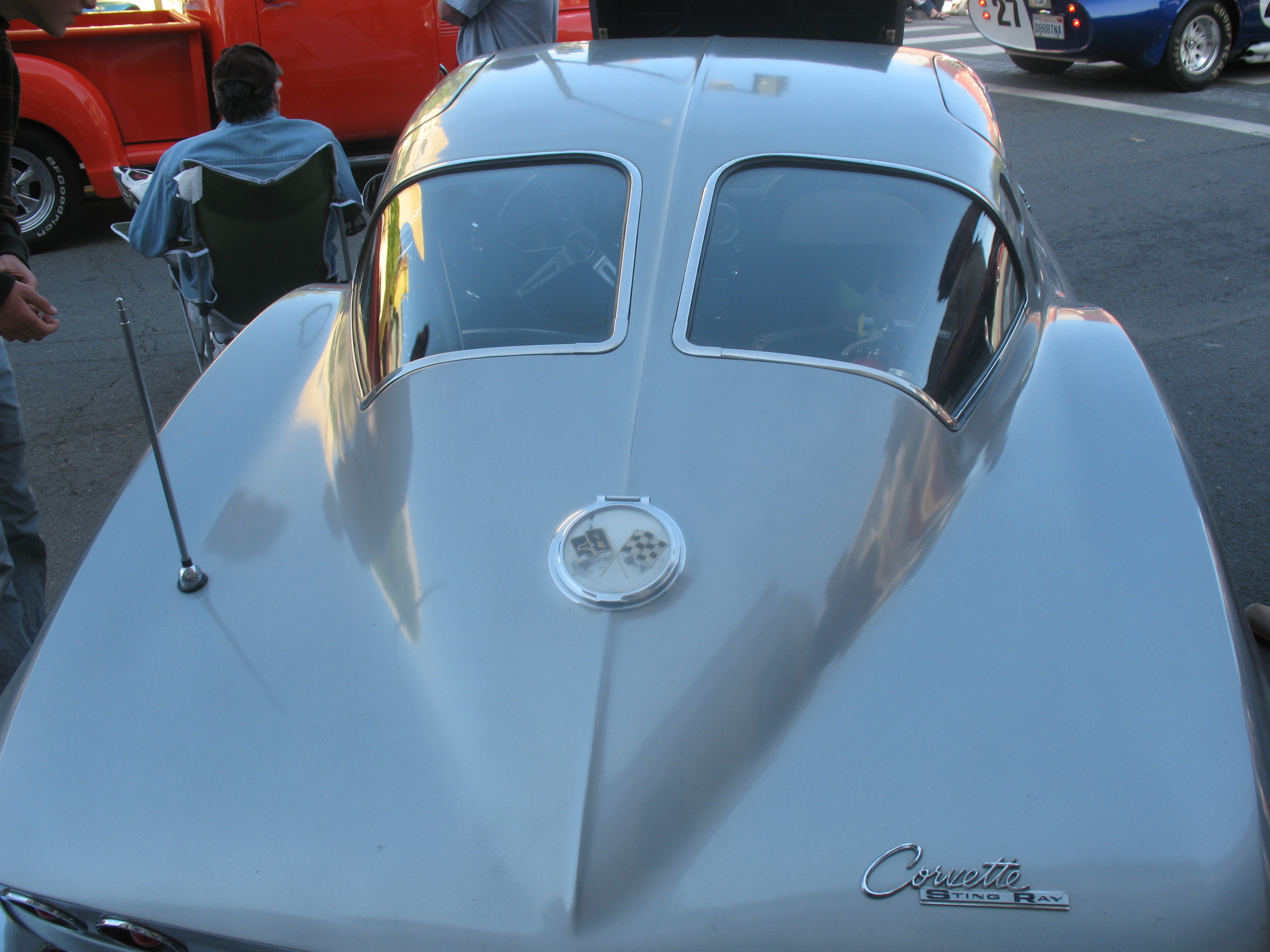
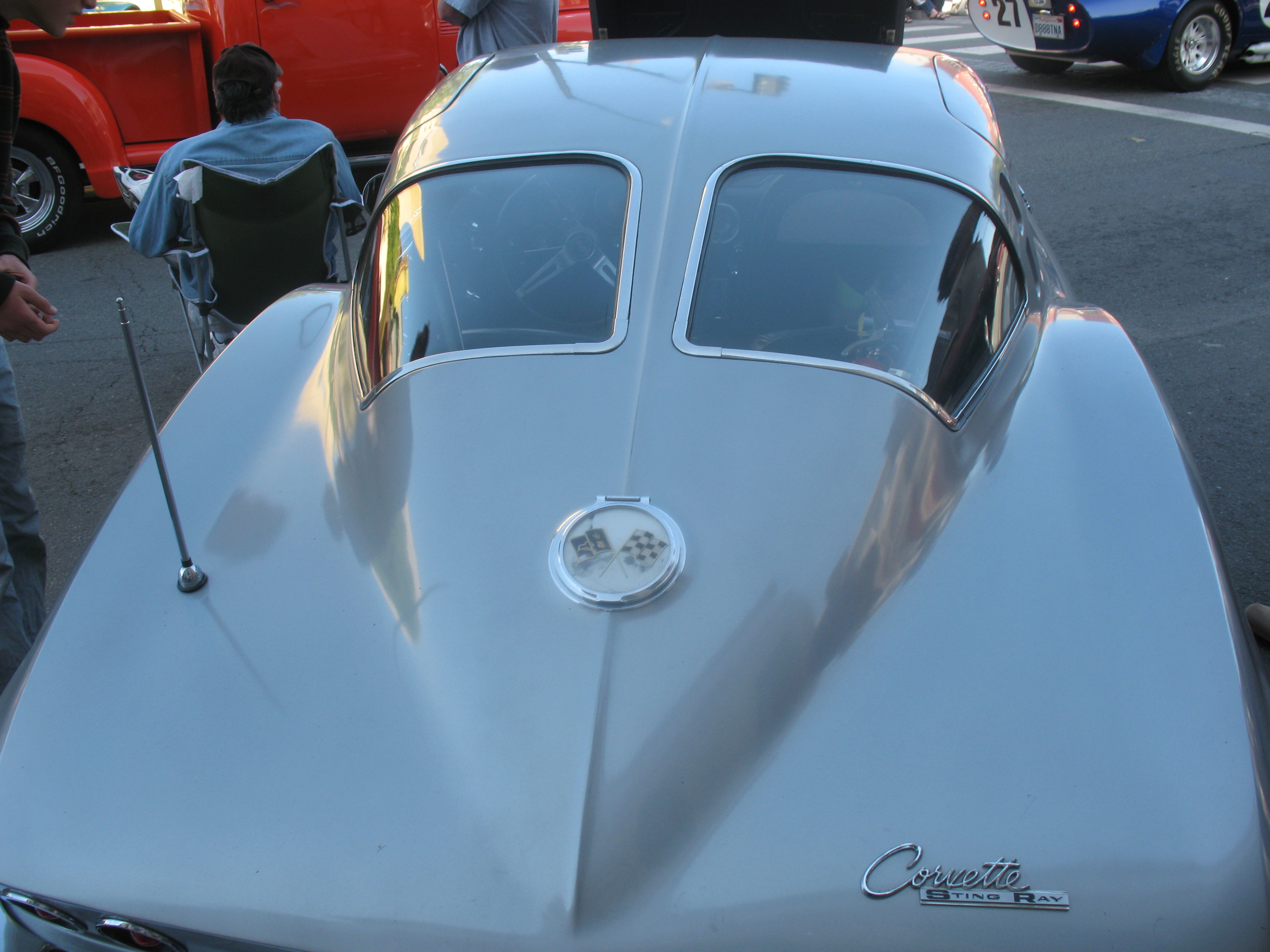
I saw the “Epic, Awesome ’63 Corvette! ” (Even better, a Fuelie!) And, yes, it was cool.

­­­­­­­­­­­­­­­­­­­­­­­In 1963, the Corvette was redesigned.  After almost 10 successful years of the first generation, the aging Chevy Corvette was in need of a redesign.  So, Chevrolet had their chief designers, Bill Mitchell and Larry Shinoda, design a new Vette.  The distinctively designed Corvette was made fun of by critics (now it is one of the most sought-after Corvettes ever made!  Ironic.). 

­­­­­­­­­­­­­­­­­­­­­­­

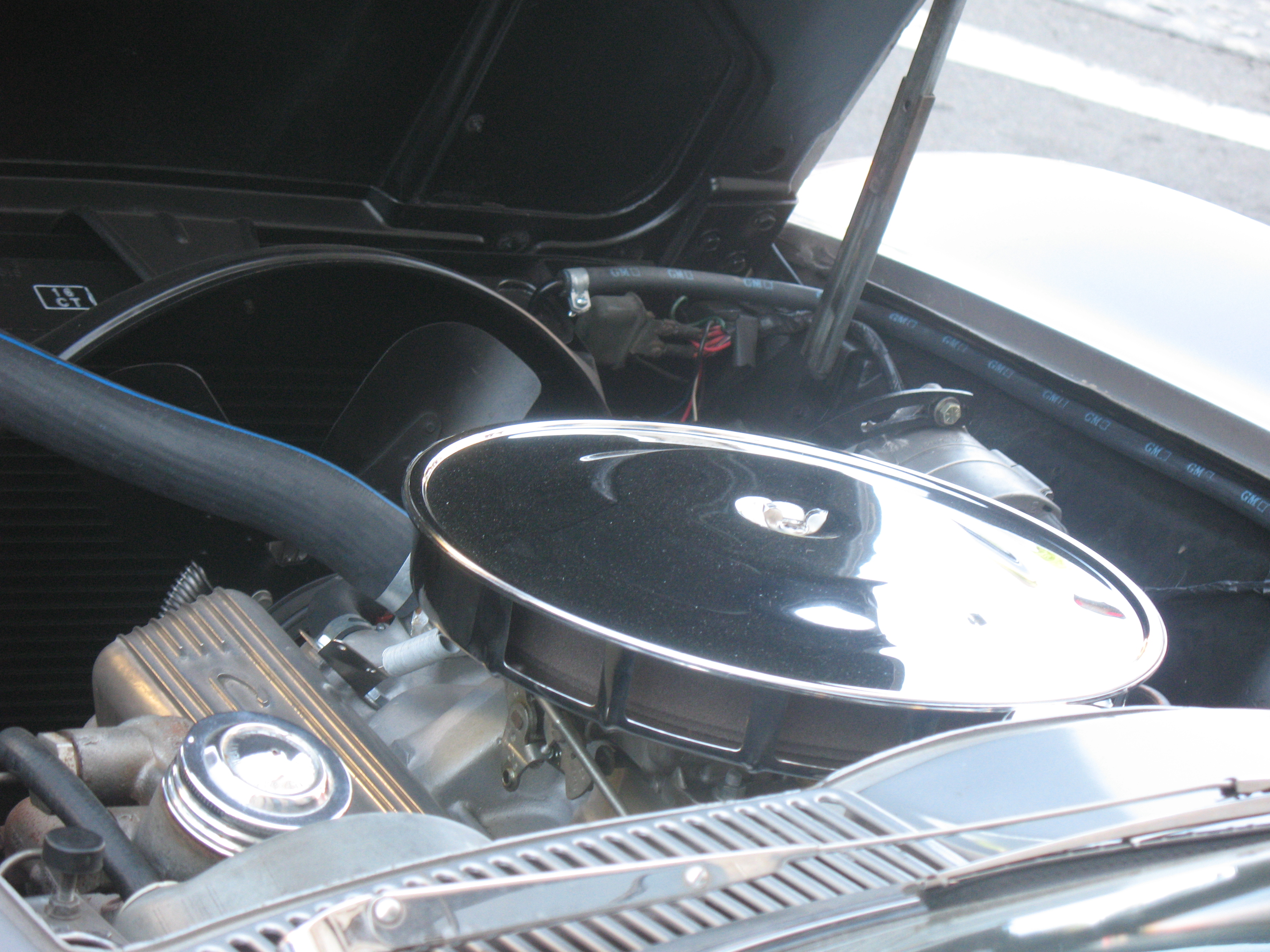
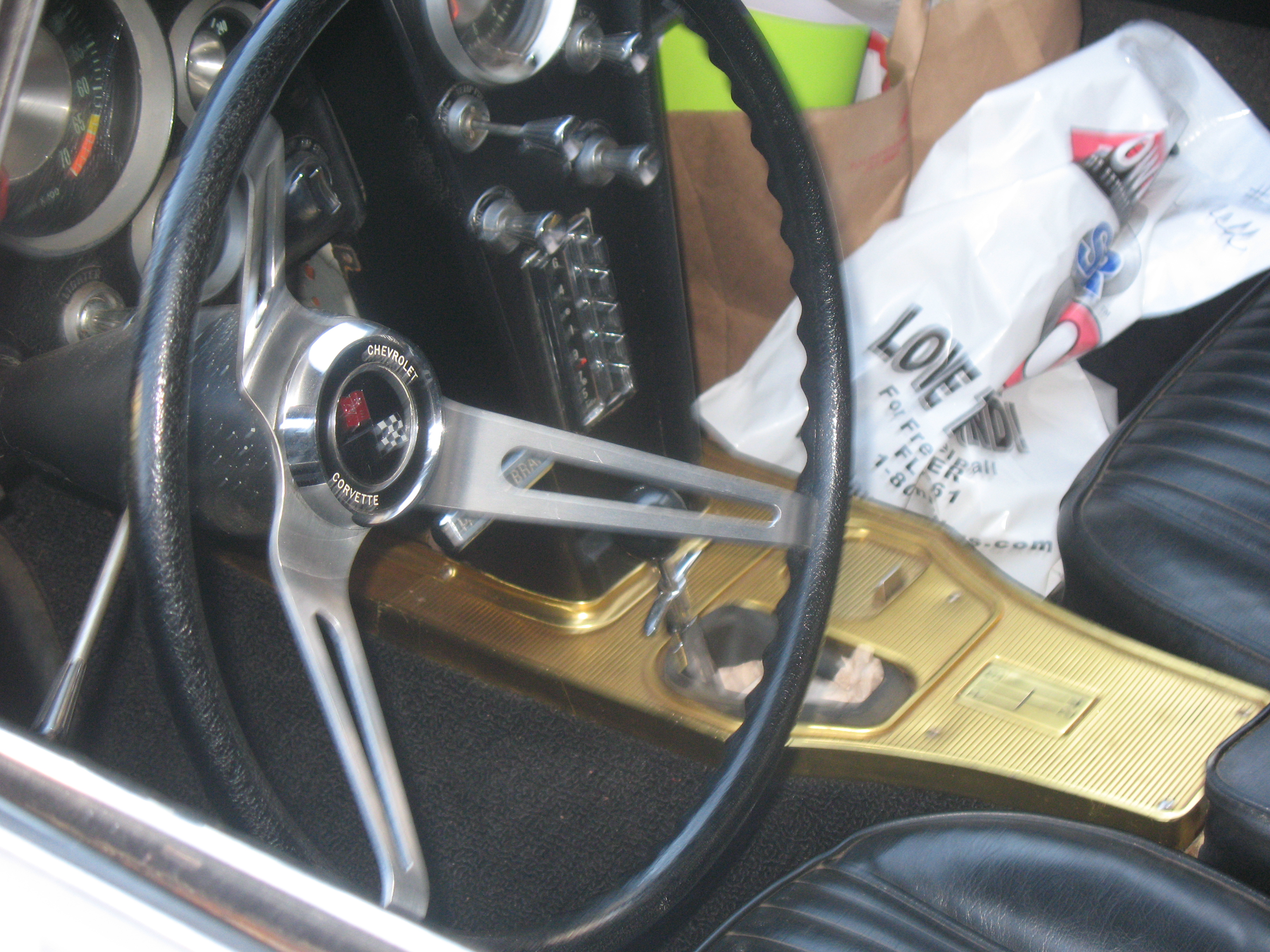
The Corvette Sting Ray had a two-seater cabin like other Vettes, but it had a two-piece rear windshield.  The 1963 Corvette Sting Ray had engine choices ranging from a 327 cubic inch V8, to a 396 cubic inch V8, and the best, a 427 cubic inch V8.  The 396 was offered from 1964-1966.  The 327 had a very rare “Fuelie” option.  Very few Fuelies were ever made, and these pictures are actual ones I took at the American Graffiti salute (look at my previous post, “Where Were You in ’62?”) of a 1963 Corvette Sting Ray Fuelie.  The second picture may look like it has a carburetor, but it is only a massive cold-air intake! 

This particular Sting Ray has the optional AM/FM radio option, along with the standard four-speed manual.  The sloping rear deck was meant to reduce drag, and increase styling.  Larry Shinoda had the rare talent of designing beautiful cars that were very aerodynamic.  The fuel-filler is behind the rear deck. (They did this because of the fuel tank being underneath the cargo area.) 

The Fuelie Sting Ray made 250 bhp (brake horsepower), a lot less than the 375 bhp carbureted version!  Even though bigger disc brakes were available on the Fuelie, many people chose the carbureted version because of its cheaper price (the Fuelie option cost $538).  The Fuelie could be optioned with any of the normal options available on Corvettes.

Talk about a beautiful car…

Trivia moment!  Did you know that the ’63 Vette Sting Ray Fuelie could go up to 152 mph!  VROOM!

Where Were You in ’62?

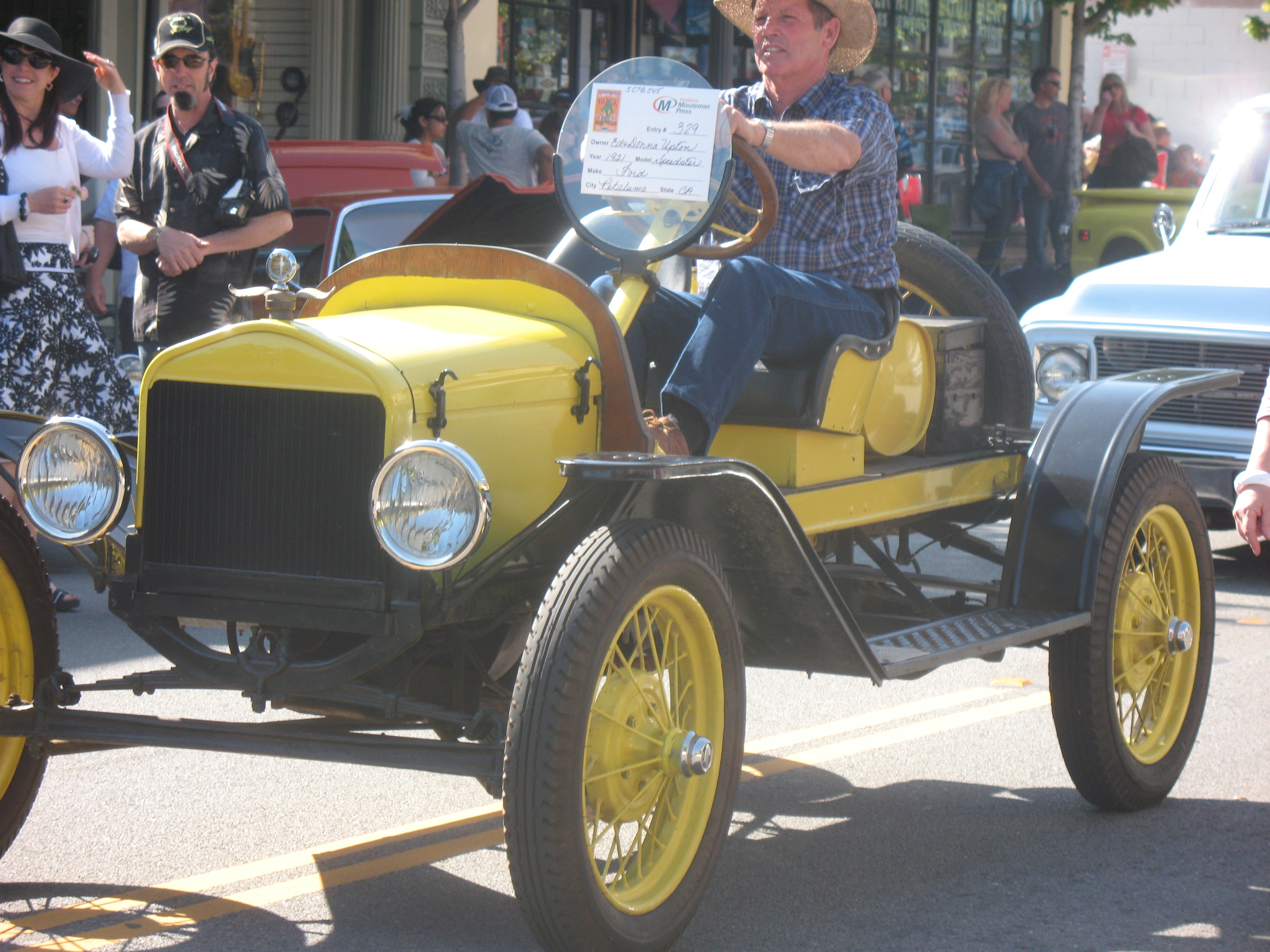
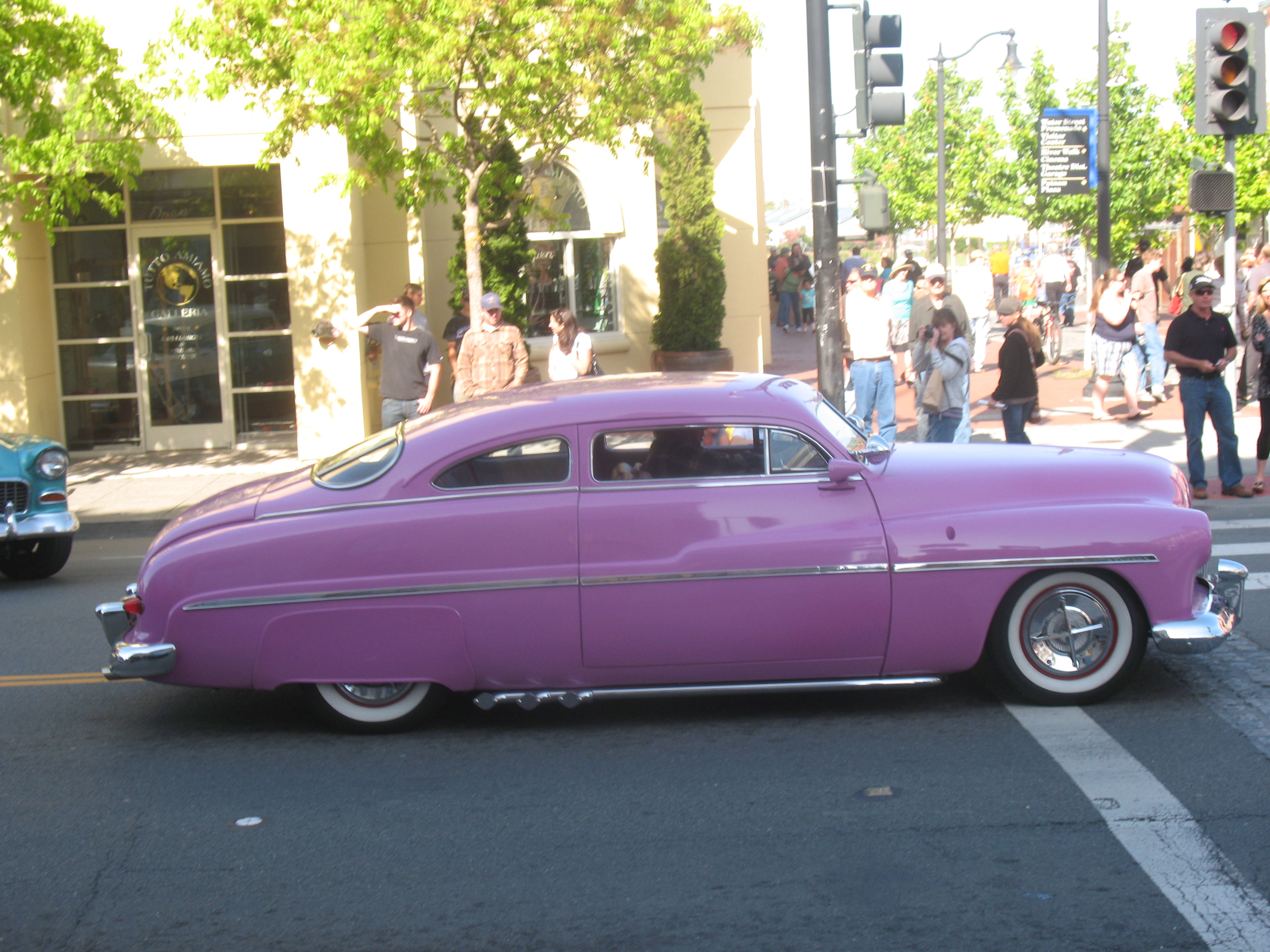
That is the theme of the movie, “American Graffiti”®.  I literally went back in time, when I went to an American Graffiti® tribute parade on Sunday.  I saw so many cool old muscle cars from the ‘50’s and ‘60’s, my eyes popped like popcorn, and my brain melted and oozed through my ears!  The rumbling El Caminos roared down the road, the Mustangs trotted down the street, and the belching T-Buckets and hotrods were hot enough to kill you! 

My favorite truck was a Ford Model A pickup that had no roof!  It had ghost flames, a Chevy 400 small-block V8, and an umbrella!  Not just any umbrella!  It was also the gearshift!  Ha Ha!  At one point, the umbrella dislodged itself from its position in 2nd gear, and flew onto the windshield!  It was a good thing that it shoved the transmission into neutral!  Even though it stalled the truck, it was funny!  The driver was as cool as ever.  He just had his passenger get out and fix the umbrella.  Then, the truck started up again.    

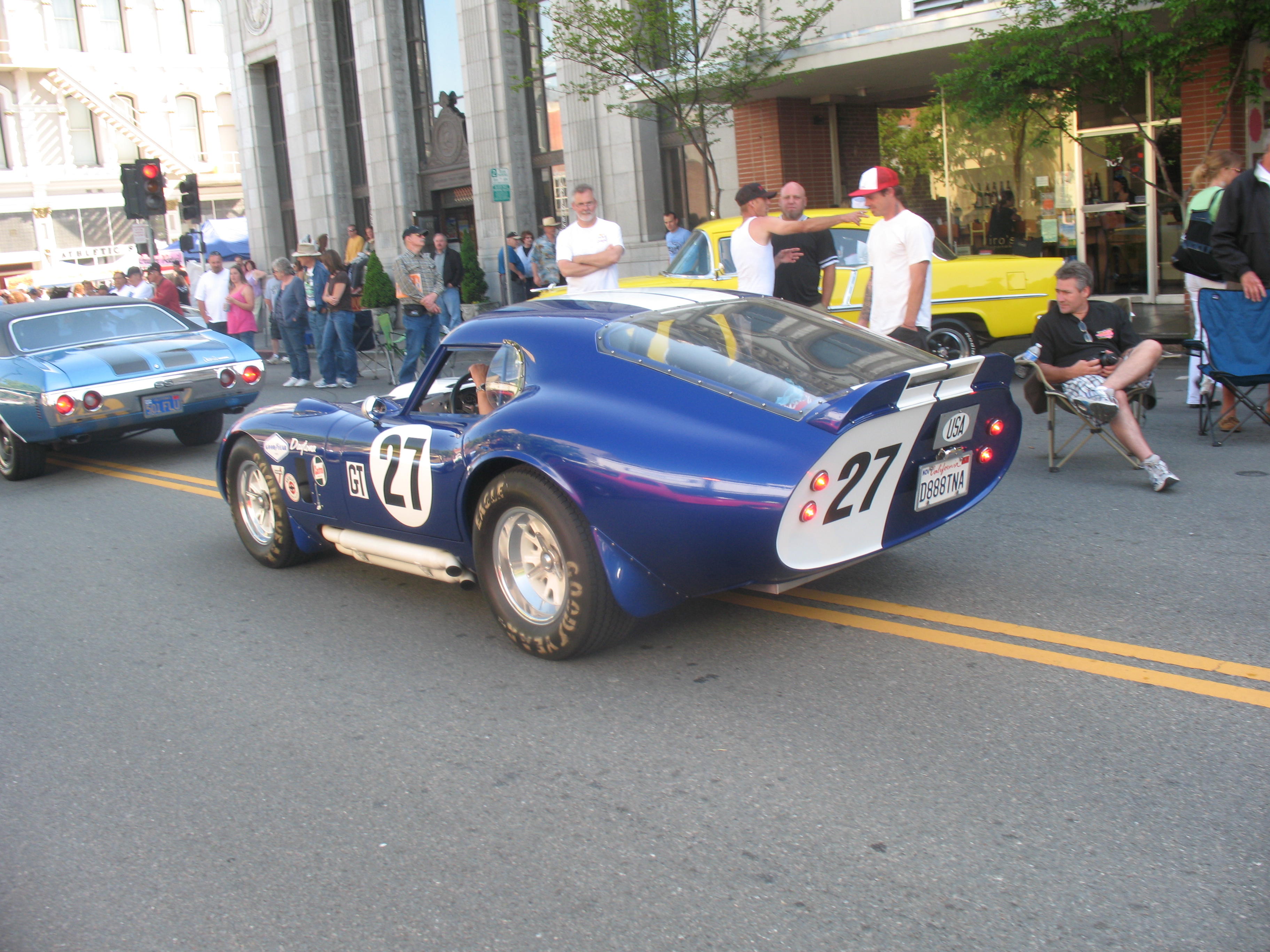
But, the car that I really wanted was a Shelby Cobra!  The body is made by Shelby American in Las Vegas, and then transported to a facility in Fresno, where the engine and all the other parts are put in.  My friend’s dad signed up to (possibly) win a red Cobra that was stripped down.  I want the other one, which is white and blue.  They both have 427 engines, mated to a Tremec 5-speed manual.  The red one makes about 460 horsepower, the other makes 550.  They know this because they dyno-test the engines.  When the Shelby rep turned on the blue and white one, it sounded a bit slow at first, but then became faster, until it was idle speed.  Of course, idle speed is at a mere 2000 rpm.  The red one only has 875 miles on it, but that’s because it only comes out of the trailer, into the trailer…  And the occasional parade…  The other, meanwhile, has about 6548 miles on it.  That’s because it was driven to Vegas to be signed by Carrol Shelby!  The rigs that they used to tow the Cobras were a 2010 Dodge Ram 2500 with a twin-turbo Cummins diesel!  Maybe it could win a drag race in towing…  The other was a 2004 Ford Excursion with the Powerstroke diesel.  The Excursion was stock, except for a Borla exhaust system. 

But, back to the point.  There was an old Chevy business coupe that had the radio on.  This might seem normal, except for the fact that there was a song playing that sounded like somebody was murdering a cow with a butter-knife!  It sounded like:  Moowuocuouaouw…  And, the owner had stopped the car because of a stalled T-Bucket!  So, it went on for about 5 minutes! 

All these old cars were working fine, but a newer car wasn’t.  On the way out of Petaluma, there was a young man in a Honda Civic hatchback.  He was in the middle of the intersection when it stalled!  He kept jamming the tranny into reverse, 1st gear, reverse, 1st gear…  Well, you get the idea. 

Heading home on Highway 101, we saw a lot of the classics coming back from the parade.  Many of them were loud, and I saw many drivers wearing earplugs.  It was like a whole second parade!  

Here is the website.  Even though the cruise ended three days ago, I still thought that you might want to look around on the website.  http://www.americangraffiti.net/index.html

I NEED that Cobra NOW!  It is awesome!  Al the summer jobs in the world might not be enough to pay for it!  I could dog sit from here to eternity, and not have enough money!  But, then again, they’d probably charge a ridiculous price for it!    

Trivia moment!  Did you know that the Cobra 427 was the fastest car of its day?  It could accelerate from 0-60 mph in 3.9 seconds!  VROOM!

Lean back for the most luxurious post yet (or ever)

LATE POST (BUT WORTH THE WAIT!) 

It all began when William Lyons was born in Blackpool, England, on September 4th, 1901 to a music store shopkeeper.  So was born the founding father of Jaguar.  In his early days, he daydreamed of motorcycles, and when he turned 18, owned an “oil-bath” Sunbeam motorcycle.  (So-called because if you revved the engine, you would get an oil-bath!)  But, what he really wanted was a Harley-Davidson or a Brough Superior (the Rolls-Royce of motorcycles).  It was almost a coincidence that the future business partner of William Lyons lived across the street.  The name of this neighbor was William Walmsley.  Walmsley had a motorcycle and Swallow sidecar. Lyons bought a Swallow sidecar to match his own Norton motorcycle. Lyons became friends with Walmsley, who was 10 years Lyons’ senior.  With some financial help from their parents, they started the Swallow Sidecar Company.  The Swallow sidecars looked very good hooked up to a Brough Superior.

 In the mid-1920’s, their business flourished, and they started a small coach-building (car making) business.  Many cars only came in black, and it was appealing to see a two-tone Swallow going down the street.  The cars became so popular that they had to move to the Midlands area ofEnglandin 1928.  They found a large supply of workers that were unemployed, so they hired them.  During this time, production went up from 12 cars a week to 50.  The Swallow’s looked much better compared to theAustin100’s that they were using.  They also re-bodied whatever cars they could get their hands on.  Many of the design themes thatLyonsused for designing Jaguars are shown in those early cars. 

 Walmsley and Lyons became well-known when they started buying chassis’ from Rubery Owen (a chassis manufacturer), and engines from Standard 16.  Of course, they manufactured their own bodywork, which was designed byLyons. 

 One funny story is of Lyons designing the roofline of their car, the S.S.1, so low that a driver of average height wouldn’t be able to fit in!  But,Lyonswent to the hospital right before the car went into production.  When he came out, he saw that Walmsley had raised the roofline a few inches. 

 Lyons remarked that the passenger compartment looked “rather like a conning tower.” 

 The Motor magazine said of the S.S. 1 “…the S.S.1 is a new type of automobile in the sense that it is a car built for the connoisseur but is relatively low priced.  All the attributes of sport models are incorporated in a refined manner, and this, coupled with a striking appearance, is bound to attract motorists of modest means.”  There has been a lot of discussion over what the S.S. means. 

 William Lyons said “There was much speculation as to whether S.S. stood for Swallow Standard or Swallow Special.” – it was never resolved. 

 Walmsley and Lyons enjoyed immense success with the S.S. 1 and 2.  But, Lyons wasn’t happy with the handling of the Standard 16, which was the base for the cars.  So, Lyons wanted a new engine.  Walmsley left S.S. cars, leaving Lyons in charge. Lyons could design cars and be a good businessman, but he couldn’t be an engineer.  So, he did the next best thing, he hired engineers.  He only hired trained and self-motivated engineers and workers. Lyonswas very impressed by what Harry Weslake was saying about engine performance.  If you put the cylinder head on the top of the engine, instead of on the side, performance from the engine would rise.  So,Lyonstried it out with an engineer, and found that horsepower rose to 103.3 horsepower, from 70! 

Lyons, having achieved success, designed the S.S.100.  It was described by Phillip Porter as “The SS 100 was the company’s first genuine sports car and to many people it remains the epitome of the stylish pre-war sports car, Lyonswas at his flamboyant best. The beautiful, flowing feline shape suggested speed and when the new 3.5 liter engine was added to the range, a car of vivid performance was the result.”  Once again, the fiendish feline ruled the roads. 

Many automakers were killed by the Great Depression, and S.S. almost went under. Lyons needed steel for his saloons (sedans), and barely managed to get by on the little resources he had. 

 During WWII, Lyons and S.S. helped out with the war efforts.  They made key aircraft components for bombers and fighters.  All engineers were on “fire-watch” (the factory was a large German target), and they would work on cars and talk.  In addition, all the workers left to go serve in the Army, leaving the engineers and Lyons to build and design by themselves.

 The war meant change for S.S. and Lyons:  The name of the line was changed to Jaguar Cars, Ltd, because there was a very unpleasant connection to the German Secret Police, with the name SS. 

During the post-war years, all British manufacturers were encouraged to export products to North America.  Jaguar found a willing market there, and Lyons once said to his Export Manager, John Morgan “ I’m not going to accept crazy marketing plans forAmerica because I don’t believe in it.  It’s a volatile market.”

 Jaguar engineer Bill Heynes assembled a team of engineers to design a new engine.  Some of the engineers in the team included:  Claude Baily and Harry Weslake. 

The 1950’s were the golden years of Jaguar.  Jaguar enjoyed great sales and racing wins.  In 1951, William Lyons agreed to start racing Jaguars.  He did that,  because, if a Jaguar won, sales would increase.  That they did.  Jaguar wonLe Mans in 1951,1953,1955, and 1957.  The 1957 win was overshadowed by a tragedy.  The Jaguar stopped on the track, and a Mercedes-Benz 300SLR crashed into the back of the Jag.  The SLR went skidding into an Austin-Healy 100, and flew into a mound, where it blew up.  The axle and engine block flew into the crowd, killing 83, and injuring 120.  Unbelievably, sales stayed the same. 

 Lyons had Heynes design a racing suspension for the XK120.  Malcolm Sayer designed the body shell.  The car that came out was called the “C-Type.”  Sayer did such a good job that he was hired by Lyons.  He then went on to design the flowing D and E-Types. 

 1955 brought a period of sadness forLyons.  His son, John, died in a car accident on the way to Le Mans. Lyonswas devastated.  Shortly after, a fire swept through the factory.  Many photos show scrapped XK120s.  Jaguar simply cleaned up the factory and went back to work.  Shortly after the fire, Queen Elizabeth toured the factory and knighted William Lyons.  He was then Sir William Lyons.  Some people found him hard to be around after the knighting. 

 In 1960, Sir William Lyons bought Daimler because of their bigger factory inCoventry.  He tried to keep producing Daimlers for a while, but failed.  A funny story happened at the 1959 New York Auto Show;  Lyons is at the ’59 Motor Show inNew York. He was approached by a Jaguar XK140 owner who told him that the heater in his car didn’t work properly. At that point, Lyons, the customer and Tony Thompson, head of US Jaguar sales, marched downstairs to the garage to settle the matter. Thompson recalls the incident: “So we went down to his car and the man said, “look, the heater doesn’t work”.

Sir William replied, “the heater does work”.

The car was started up and the car had, if you remember, a Smiths heater with two little doors on it, and a control on the dash. I smoked soLyonsasked me to light a cigarette. He held the cigarette beside the heater and the smoke very gently wafted away.

“Look,” he said, “it works perfectly”.

“But, Sir Lyons,” the man replied, “temperatures get to 15 below zero.”

“Young man,” he said, “you just put on an overcoat”.

Each and every Jaguar has a personality.  The XK6’s design can be traced back to the Mark VII of the 1950’s.  The XK can be traced to the E-Type of the 1960’s.  By the end of the ‘50’s, Jaguar needed a replacement for the aging XK150.  So, Sayers designed the E-Type.  The flowing, curvy lines made instant Jaguar lovers out of ordinary people.  This was the car that put Jaguar ahead of the competition for many years. 

 The motoring world changed for good in 1968, when Jaguar introduced the XJ6.  The XJ6 was Sir William Lyons’ last creation, and possibly his best.  Over 200,000 were sold in the first two years!  As production of the E-Type would be coming to a halt soon, Sir William Lyons had a V12 developed.  The Series III E-Type was huge success.  When the E-Type ended production, the engine served service in the XJ.  There was an XJ6 or an XJ12.  The XJ12 was very fast and loved by many.  The press promptly named it Car of the Year. 

 In 1972, Sir William Lyons officially retired, and Jaguar had to continue without him.  His house, Wappenbury Hall was half an hour from the factory, and he would often go to watch Jaguars being built. 

 His dream coupe was to be a coupe version of the XJ.  Even though it was produced 2 years after he retired, he drove many test hours in it.  His dream coupe was the XJS, it had large styling influence by Sayer, but it lacked the true Jaguar look. 

 When interviewed in 1980 by Andrew Whyte, these were some ofLyons’ reflective thoughts: “I’ve been retired officially for over eight years now, of course, but I do like to take an interest,” Sir William admits.

“It’s been my whole life after all. Many of the people who worked for me are still there. They know the standards that must be set to remain successful in the motor industry. I think there are enough determined people there, still, to keep the essential Jaguar character in the cars, yet satisfy tomorrow’s legislation worldwide. Our aim from the very start was to give the motorist pleasure. Now, more than ever, I feel that motoring should be a joy and not a chore. I still enjoy it. . . .My favorite car? Well, that’s not too difficult to answer. I was determined that the XJ specification should be right. I believe it was. I don’t think I would have changed anything much if I’d been starting again, certainly not the overall appearance-a few details here and there, maybe-but I really do feel we established something universally pleasing. It does seem to be standing the test of time, doesn’t it?”

Five years after that interview, Sir William Lyons passed away at Wappenbury Hall.  Even though he has been dead for over 20 years, his legacy remains.  If somebody tells you that their XK120 is a “true Jaguar”, then you can retort “no, it’s aLyons AND Jaguar.  Beat that.” 

As Ian Callum (the Jaguar Design Director) said of his award-winning XK, XJ, and XF, “I know that Sir William Lyons would be proud of Jaguar right now.  From what I’ve learned from Heynes and Sayer, he’d probably choose the XJ…” 

TIMELINE FOR JAGUAR.  (Look for the funny story involving carpets at the bottom!) 

 1922:  Swallow Sidecar Company was created by William Lyons and William Walmsley.

1935:  The first Jaguars are made.  They are the SS90 and SS100 sport saloons.

1943:  The Jaguar XJ6 engine is made by engineers on fire-watch during WWII.
1949:  The Jaguar XK120 is created.  It then became the XK140 and XK150.

1951:  Sir William Lyons allows Bill Henyes and Wally Hassan to complete the I6 engine.  Also, a Jaguar XK120 wins the 24 Hours ofLe Mans.

1953:  Jaguar’s winning streak continues, with yet another win atLe Mans.

1955:  Yet another win atLe Mans!   William Lyons’ son, John Lyons died heading toLe Mans.  But, William Lyons became Sir William Lyons.  He was knighted by Queen Elizabeth for his services to the British industry. 

1956:  You guessed it!  Another win!

1957:  Jaguar wonLe Mans, but there was a major crash involving a Mercedes-Benz 300SLR and Austin-Healy 100.  The accident also killed 83 people and injured 120.

1958:  Jaguar comes out with the rare and beautiful Mark IX.

1961:  The Jaguar E-Type rumbles into production.

1966:  An E-Type wins the Rally Monte Carlo.  The Jaguar XK13 is made.  It is a one-off race car designed forLe Mans.  Unfortunately, race rules change; forcing Jaguar to store the XK13.

1968:  The Jaguar XJ is produced.  It is a large luxury car with an in-line-six cylinder.  It is also the last car designed by Sir William Lyons. 

1972:  The Jaguar XJ receives V12 power, and was the fastest sedan in the world, let alone a luxury one.  Given a long stretch of straight blacktop, one can reach 140 mph! 

1975:  Malcolm Sayer designed the replacement for the iconic E-Type.  The new car was called the Jaguar XJ-S.  It was built on the same platform as the XJ sedan, it was simply a coupe version with a V12 engine. 

1985:  Sir William Lyons passes away at Wappenbury Hall (LyonsMansion).  He is remembered by many for his thriftiness, attention to detail, and shrewd businessman. 

1988:  The Jaguar XJR-9 is unstoppable at the World Sports Car Championships:  It won six out of eleven possible wins.  It also took home the driver and team trophies.  It also got Jaguar to the winners circle atLe Mans, the first time since 1957. 

1990:  Ford Motor Company steps in and buys Jaguar for $2.56 billion!  That may seem unconceivable, but one can only expect that for a luxury car manufacturer. 

1992:  Ford brought the Jaguar XJ220 to market.  The prototypes had been seen with 6.2 liter V12s under the hood, but Ford had Jaguar use a 3.5 liter V6.  The XJ220 was driven by a 542 horsepower, 3.5 liter V6.  It could go up to 217 mph!  It wasn’t even legal to drive one in theU.S. 

1996:  Jaguar used a Ford V8 in its Jaguar XK8, making that Ford V8 the first V8 in Jaguar history.  The XK8 soon exceeded sales expectations, by being the fastest-selling Jaguar in history. 

2000:  Ian Callum achieved his lifetime ambition to become a Jaguar designer.  More than 30 years before, he had seen an XJ6 in a showroom, and been intrigued. 

2008:  Elegance is Redefined:  The XK is the first new Jaguar of the millennium, bringing with it a 4.2 liter V8 and six-speed automatic transmission.  The XKR version is supercharged, and brings 420 horsepower and more speed and macho with it.  Also, the XF is introduced.  The XF is designed to compete with the BMW 5-Series.  Even though the XF’s V8 is underpowered, it is a serious competitor.  The supercharged R version is as fast, as or faster than the XKR.  Also, Tata Motors of India bought Jaguar and Land Rover. 

2010:  The Jaguar XJ is redesigned, bringing stealthiness and power with it.  It has a 5.0 liter, 385 horsepower V8 and six-speed automatic.  The XJL Supersport has a supercharged 5.0 liter, 510 horsepower V8.  It also has a six-speed automatic.  All Jaguars are updated to a 5.0 liter V8 with 385 horsepower.  There are supercharged versions with 470 and 510 horsepower, respectively.  Also, the Jaguar XKR GT2 RSR is a one-off race car for ALMS GT2.  It has a 4.7 liter, 525 horsepower V8 with a six-speed automatic. 

2011 and beyond:  Jaguar unveiled the C-X75 concept car at the 2010 Paris Auto Show.  It shows a glimpse of what future Jaguar sports cars may look like.  It is powered by an electric motor and four small turbines. 

There are some funny stories involving Sir William Lyons and/or Jaguars.  Here is a funny story:

One time, Sir William Lyons was visiting the Piccadilly showroom, when the sales manager came up to him.  ‘Excuse me, Sir William.  The carpets in the showroom are becoming very worn, and threadbare in places.  May I order new carpets?’ 

 ‘Certainly not,’ repliedLyons, ‘there is plenty of wear left in those.’ 

 That was the end of the conversation.  On a subsequent visit a month or two later, however,Lyonshappened to look down and noticed – new carpet! The unfortunate fellow was summoned.

‘I thought I told you not to replace the carpet. I thought I told you that the existing ones were perfectly satisfactory. When I give an order, I expect it to be obeyed . . .’

Lyons carried on in this vein until the fellow managed to interrupt long enough to explain that they weren’t new carpets.

‘What I have done, Sir William is to turn them round. Half of each strip was under the show cabinets at the side of the room, and therefore not worn. So now that I have reversed them the worn area is under the cabinets.’

Lyonswas silent for a few moments, as he looked around him. The young man held his breath.

‘Remarkable,’ mutteredLyons. ‘Remarkable.’

There was another pause.

‘Right, my man. I want you at Wappenbury Hall (Lyonsmansion), nine o’clock on Monday morning. You can do the same thing for me at home.”

Hold Onto Your Socks for the Most Exciting Post Yet!

GMC has had a very interesting history.  GMC has been making high-quality trucks for the past 110 years, and has been a supplier of trucks to the U.S. Government.  GM is a large automotive corporation with companies underneath GM.  The companies are:  GMC, Chevrolet, Buick, Isuzu, and Opel.  Pontiac, Saturn and HUMMER all are in the history books now. 

On December 22nd, 1901, Max Grabowsky started the “Rapid Motor Vehicle Company”, which made some of the earliest commercial trucks ever built.  Those trucks used one-cylinder engines!  Fuel efficient, yes, 0-60, 6 hours…   I’d rather push a wheelbarrow…  My lawn tractor has a bigger engine!  In 1909, General Motors bought the company, and renamed it “General Motors Truck & Coach Builder.”  In 1912, there were 22,000 trucks made by GM, 372 of them were GMC Trucks.  Out of those 372 GMC Trucks, 6 of them were chosen to be part of the GM display at the New York International Auto Show. 

In 1916, a GMC Truck crossed theUS in only thirty days. Quite a feat for a truck in 1916.  Ten years later, a two-ton GMC Truck drove fromNew York CitytoSan Franciscoin five days, thirty minutes!  WOW!  Those trips were taken as publicity stunts for GMC!  GMC hired people to drive those trucks across theU.S.

During WWII, GMC produced over 600,000 trucks for the U.S.military.  During the war years of WWII, GMC bought a controlling part of Yellow Coach; a bus maker.  In 1943, GMC purchased the remaining bit of Yellow Coach for about $100,000.   Because of increased competition in the bus market, GMC has been out of the bus business for over20 years. 

Being virtually identical to Chevy trucks, the only differences are: different grilles, more features, and better options.  Even though GMC’s are typically sold at Buick dealers, you can also find many GMC’s at a Chevrolet dealership near you.  Even though Chevy trucks usually sell better, GMC’s do sell in very large numbers. 

GMC’s lineup currently includes:

Sierra 1500

Sierra 2500

Sierra 3500

Canyon

Acadia

Yukon

YukonXL

Terrain

Savanna.

The Sierra 1500, when equipped with the right options, can tow up to 10,000 pounds.  It can also haul up to 1 ton.  There is a luxury version of the 1500 that is called “Sierra 1500Denali.”  It comes with: GM’s Quadrasteer (a system that uses all four wheels to steer), AWD, Navigation, Six-Speed Automatic, and a 6.2 liter, 403 horsepower V8. 

The Sierra 2500 shares only the GM 6-Speed Automatic with the 1500.  The 2500 has the option of GM’s “Duramax” Diesel engine, mated to an Allison Six-Speed Automatic Transmission with an overdrive.  The 2500 also can be equipped with a 6.0 liter, 360 horsepower gasoline V8 mated to a GM Six-Speed Automatic.  Recently, the “Denali” trim line was added to the model lineup for the 2500 and 3500’s alike.

The 3500 comes with the “Dually” option.  The “Dually” is has 4 rear wheels, instead of 2.  The “Dually can only come with the Duramax and Allison.  The 3500 can tow up to 17,500 pounds with a bumper trailer or 5th wheel trailer. 

The Canyon is GMC’s light-duty pickup truck.  It comes standard with a 2.9 liter, 185 horsepower four-cylinder and five-speed manual.  The other two engines that it can be optioned with are a 3.7 liter, 242 horsepower 5-cylinder, or a 5.3 liter, 300 horsepower V8.  The only automatic transmission is a four-speed automatic. 

The Acadia is GMC’s replacement for the aged Envoy SUV.  The Acadia is part of GM’s new “Lambda” SUV platform.  TheAcadiais GMC’s version of the Chevy Traverse and Buick Enclave.  TheAcadia, Enclave and Traverse come standard with a 3.6 liter, 288 horsepower V6.  That engine is mated to a Six-Speed automatic.  TheAcadiacan be optioned with AWD and 8 seats. 

TheYukon and Yukon XL are GMC’s versions of the Chevy Tahoe and Suburban.  They come with the same engines and transmissions.  The popular engine/transmission choice is the 5.3 liter, 315 horsepower V8 with the 6-Automatic.  They can be optioned with 4WD or 2WD. 

The Terrain is GMC’s first compact SUV.  It comes standard with front-wheel-drive and a 2.4 liter, 182 horsepower four-cylinder.  A six-speed automatic is standard across the whole trim line.  If you need to tow, but don’t want to have to step up to the Acadia, then the 3.6 liter, 264  horsepower V6 is a good choice.  You can then tow 5,000 pounds with the V6. 

The GMC Savanna is GMC’s only van.  That doesn’t mean, however, that the Savanna is badly optioned.  You can choose between rear-wheel-drive and AWD.  The Savanna’s top engine choice is a 6.6 liter, 365 horsepower Duramax Diesel V8.  That engine gets to enjoy a six-speed automatic with an overdrive.  You can choose between many packages and options.  The top two packages/options are the: Ambulance Package with all the Ambulance options and the Camper Package, which has any option that a hardcore recreation family can enjoy. 

As you can see, GMC offers a lot for the money; it just depends on what truck, SUV or van you want to buy.  Here is a list of the awards given to GMC’s over the years:

IntelliChoice Best Value Award 2008

Vincentric Best ¾ ton truck award 2011

2011 USNews good truck award

Internetautoguide.com Best truck award (2500 model)

Truck Trend Best Truck 2011 Award (tied with Chevy Silverado)

Coulter Motor Company Best Truck/SUV/Van maker award.

As you can see, GMC has a lot of awards under its belt.  (I hope that their pants don’t fall down [that is with the belt on]). 

GMC has also published a book; GMC; the First 100 Years.  

http://www.gmc.com/

GMC has also published a book; GMC; The First 100 Years