It will be sorely missed. The Aston Martin V12 Vantage was one of the cars that really helped Aston Martin get back on its feet after almost 10 years of toil, and bad, unloved cars. It’s certainly not a car for wimps. It’s got a 5.9-liter V12, tons of power, a manual transmission, rear-wheel-drive, and an exhaust note that sounds like it just came out of a Jaguar E-Type with the V12. All of this adds together to create the ultimate high-class hooning machine. Plus, it’s got stunningly good looks, and an interior that rivals a Bentley Mulsanne.
It will be sorely missed, but you can expect the next generation V12 Vantage to be incrementally better. It’s gotten four years of great reviews and racing success, so it should come as no surprise that the next generation should be much better. If the new Vanquish is any indication of what is to come, than I can’t wait to see the next generation V12 Vantage!
Note: for the uneducated auto linguist, hooning means to drive in a goofy, unsafe manner.
For those of you who remember seeing the little Dodge Omni’s tuned by Shelby in the 1980s will remember that their name, the Omni GLH fitted them. Very well. Before his death, Carroll Shelby bought a Ford Focus ST. Why? It reminded him of the old Dodge/Shelby Omni GLH-S’ from the disco days. He brought it to the factory, where they immediately started tuning it. This magical 2014 Ford Shelby Focus ST will cost $14,995 (on top of buying a $25,000 Ford Focus ST), but those dollars might be well-spent. The car gets: GT500-spec brakes, a Ford Racing suspension, Borla cat-back exhaust, an upgraded interior, new wheels and tires, and your choice between three graphics packages. Power is still the stock ratings, but Shelby is working on a 30-60 horsepower/torque upgrade that will still allow the car to use pump gas. All the while still being emissions-legal in all 50 states. Many enthusiasts will ask why it’s not called the GLH, but the reason is that there is still too much of a connection to Mopar for that. Sources at Shelby tell us that we can expect to see a new Shelby debut at the 2014 Detroit Auto Show, and it won’t be based off of a Mustang! Secretly, I am hoping for a Transit Connect panel van tuned to produce a lot of power and looks. Drool over the picture of the Shelby Focus ST. It’s definitely NOT a sleeper! That is, unless you live in a town with a LOT of hot rods…
The Chevrolet Corvette has long stood as a performance and luxury icon for GM. In recent years, the luxury part of the Corvette has slipped. A lot. But, Chevrolet decided to fix that with the C7 Corvette Stingray. Unfortunately, Corvette redesigns don’t come around that often. There have only been seven generations of Corvette in 61 years. The performance part was, is, and always is, a part of one of the most iconic cars in American history. The 2014 Chevrolet Corvette Stingray is a car that redefines the word “Americana.”
The engine of the Corvette is all-new. Aluminum and other lightweight metals are abundant in the engine. It’s also a lot more powerful and efficient. It makes 455 horsepower at a thundering 5900 RPM, and 460 lb-ft of torque at a lower 4600 RPM. Power is amped up to 460 horsepower and 465 lb-ft of torque at the same revs if you opt for the $1,195 Dual-Mode Performance Exhaust. The aforementioned exhaust system essentially bypasses the rear mufflers with a pair of exhaust butterflies. Think of them as flaps that open when Sport Mode is engaged. The rest of the time, they remain closed. The efficiency part isn’t just restricted to the exhaust butterflies. While cruising, it can operate as a 3.1-liter V4, and produce 126 horsepower and 221 lb-ft of torque. That, according to the chief engineer of the Corvette Stingray, is 10 times the power needed to maintain 50 mph, and get the Corvette Stingray up to 90 mph.
Another thing to brag about: Preliminary EPA reports are 17 city/29 highway for the seven-speed manual. The EPA has not released figures for the automatic transmission. These figures rank the Stingray as the least thirsty 450-plus horsepower car currently on the market.
The eDiff in the Corvette Stingray is also noteworthy. When it is open at 60 mph, and the wheel is cranked in either direction, the car will immediately go into a dramatic, smoky drift that would make Ken Block proud. This differential can be programmed in many different ways, and make any driver proud of how well this car performs.
Many people have previously complained about how bad the seats were/are in the Corvette C6. Chevrolet completely redesigned the seats. The base bucket seats are perfectly fine for blasting along a country road at high speeds, but owners who plan to take their C7 to the track should wait it out for the expensive $1,995 Recaro seats.
The Corvette Stingray Z51 (package) is a hoot and a half to drive, but those who are on a budget are probably wondering about the base car. The vinyl interior almost perfectly matches the look of the cowhide interior, but the smells are different. The design team took no chances, and completely redesigned or changed every single part in the interior of the Corvette. All Corvette Stingrays come standard with the big touchscreen. But, it doesn’t do as much as the one in the Z51 model. Because there is no eDiff or fully adjustable magnetic shocks, there isn’t nearly as much to change. The base 9-speaker Bose audio system has a hard time being louder than the raspy thrum of the V4. The 12-speaker system with the big bass box does.
Overall, the 2014 Chevrolet Corvette Stingray is a vast improvement over the C6. It’s more powerful, it uses lighter materials (yet a model that Motor Trend tested weighed 69 pounds more – options), it’s more fuel-efficient, and it looks better. You can’t go wrong with this car. I need one. Plus, Callaway, a tuning firm based out of Ohio is building an FIA GT3-legal C7 as we speak. Expect private teams to be competing against Chevy at Le Mans and the 24 Hours of Nurburgring.
Since Zagato, an Italian design firm that has been design partners with Aston Martin for over 50 years, it seems fitting that Zagato coachbuilt a couple of centennial-edition Aston Martins.
Sources from inside Aston Martin and Zagato have confirmed that two examples of an Aston Martin centennial special will be built. One is based off of a 2013 Aston Martin DB9 Volante Convertible (no, Starbucks didn’t come up with the name!) and will be delivered to Peter Read; an Aston Martin enthusiast and collector in the U.S. The other is based off of a 2013 Aston Martin DBS Coupe, destined for an unnamed entrepreneur in Japan.
The designs of the cars were inspired by the 2002 DB7 Zagato, a car so popular that all 99 examples were spoken for before it even debuted at the 2002 Paris Auto Show! The same team that developed the 2002 Aston Martin DB7 Zagato helped Andrea and Marella Zagato, Peter Read, and Aston Martin develop the car.
When you look at the renderings of the cars, it takes a trained eye to find the Aston Martin underpinnings, but it’s almost impossible to miss the signature elements of Zagato and Aston Martin. The double-bubble roof, squared-off tail, and clean, sharp lines tell you that you’re looking at an Aston seconds before the winged badge comes howling into view.
When you look at the front of the cars, one cannot help but notice the design cues from the 1980’s Aston Martin V8 Zagato.
Peter Read, the owner of the 2013 Aston Martin DB9 Volante Convertible summed up the design team’s vision best. “The DB9 Spyder Zagato Centennial perfectly merges Aston Martin and Zagato’s DNA by combining the elegance of design, typical of Zagato, with the soul, power and prestige of Aston Martin, all developed over the last 100 years.”
As with all Zagato specials, no mechanical changes were made. This means that both cars will come with Aston Martin’s wonderful 5.9-liter, 510 horsepower V12.
I want both of these cars to be mine. My readers might have to start an auction of their cars to afford my rides…Unfortunately, all Zagato Aston Martins are highly collectible, rare vehicles that stay in collections for many years. Then, they sell at auctions for prices close to $1 Million.
Let me know in the comments section if you think that the 2014 Mercedes-Benz S550 can become the car that can rule the uber-luxury class. I think it can, but then again, Mercedes usually does!
The Mercedes-Benz S-Class can sometimes go seven or eight years beforeinstituing a major refresh, redesign, or mechanical overhaul. But, it usually leads in terms of sales and looks. The 2014 Mercedes-Benz S-Class upholds that tradition, and it will likely be sold in droves – for a while. Then, all of the competing automakers will make newer, nicer, and possibly better cars. This segment is competitive. Currently, the S-Class, Lexus LS460, and Cadillac XTS are the segment sales leaders. The S-Class is likely to blow all of it’s competitors out of the water. It is just that good.
It is loaded with features that will make your jaw drop. This car isn’t yet another ordinary businessperson special with a cave-like interior. It will drive itself. Really, it will! It won’t drive itself completely, but it is semi-autonomous! It uses stereo cameras to guide it along the road. The name is awesome, as well: Traffic Jam Assist. No, it won’t send all of the rubberneckers to the grave. Only their own stupidity will do that. To activate this marvelous system, simply hold the brake pedal down while stationary, flick the Distronic (MBZ speak for cruise control) lever down, and give it gas. It will take you up to 37 mph. The cruise control is then set for up to 37 mph. It will follow the car ahead of you simply, smartly, and efficiently. It will do that until your speed increases or you take control of the steering wheel and pedals. Above 37 mph, it will still guide itself. Kind of. It will handle itself up to 125 mph, and it can bring itself to a complete stop at any speed if need be. Those stereo cameras are also able to read the lines in the road, and keep the plump S-Class in between those lines without any driver input. Above 37 mph, if you keep your hands off of the steering wheel for more than 10 seconds, then a loud BEEEEEP will sound, along with a flashing graphic instruction, until you place your hands on the wheel. But, that’s just Mercedes-Benz’s lawyers telling you to be a good driver. As long as you don’t take the S550 on any places where there aren’t any lines in the road (i.e. tracks and gravel roads), this car will take a person places where he/she has never gone before, all by itself.
There’s other zany technology stuffed into this car. Take the badly named Magic Body Control that is an optional active suspension feature. If you choose to order this, then the four-wheel air suspension goes away, and is replaced by oil-over-coil shocks. The “magic” part of that is that those same stereo cameras scan the road ahead to see if there is a pothole, a speed bump, or some roadkill. Given the right situation, the Magic Body Control is effective in a way that is quite simply effective, in a spooky sort of way. The result is one of the smoothest rides out there, this side of a Citroen or an old Buick Roadmaster. When you put the car in “Sport” mode, Magic Body Control is switched off, so you can hurtle around curves and crash and bang over the smallest road imperfections. But, that’s what makes the car so enjoyable to drive.
In the unlikely event that you will be in an accident, you will survive just about any crash. For those of you riding in the backseat (the place to be), there are inflatable seat belts. When the rear door is opened, the seat belt buckle receiver visibly rises. This is probably because most customers (think China) don’t wear their seat belts in the back seat. Once they buckle up for safety, the buckle will retract a few inches into the seat, therefore cinching the seat belt across their hips so they do not slide under the seat belt in a crash. Speaking of accidents, there’s a feature that will make any safety-conscious parent happy. It’s called Pre-Safe Plus. It actively and automatically prepares the car for a rear-end collision. What the car does when it’s about to be rear-ended (it has seven rear-facing cameras), it tightens all of the seatbelts (even if they’re not in use), applies the brakes completely, and, BAM. Applying the brakes for a full-ABS stop seems counter-intuitive, but it’s safer to not be moving when you’re hit. It can also “see” pedestrians and other cars. It reacts differently to both. When it sees a car cutting in front of it, the brakes are applied for a full-ABS stop. When it sees a pedestrian, the brakes are applied much earlier and gentler.
Even though it’s got enough technology in it to make a computer scientist have a heart attack, one of the best advances is in the interior. It’s truly the first German interior to really stand out from the British luxury brands (Bentley, Rolls Royce, Jaguar). Leather and wood gracefully snake their way throughout the stellar cabin. The interior designer said that these designs were influenced by swan wings. Let’s call this new technique “swanning,” okay? If You own the outgoing generation of the S-Class, you will know about those four rectangular vents on the dashboard. Six neat, circular vents have replaced them. Combine that with the clock, and the seven circles (vaguely) resemble the pearls on a woman’s necklace. I don’t ask. The head designer of MBZ’s interiors said that from now on, all vents in a Mercedes-Benz car will be round. I find it odd that the car that will be starting the round vent trend still has rectangular vents in the back. One other fun interior flourish are the speaker grilles for the Burmester audio system. They are covered in an impossibly complex pattern of tiny holes of varying sizes. If you have trypophobia, don’t look at it. For me, it becomes ever more fascinating when I look at the pictures.
The mechanical parts of the car are relatively unchanged. The seven-speed automatic is still their, as is the 5.5-liter, twin turbo V8. Power, however is better. It has been uprated from 429 horsepower to a more powerful 455 horsepower. Torque is the same at 516 lb-ft of torque.
Overall, the 2014 Mercedes-Benz S550 is the car to be measured against for full-size luxury. It’s powerful, it’s loaded with technology that will take it’s competitors years to catch up with, it’s beautiful, and it’s got German engineering. And German reliability. I want one. I won’t ask my readers. I know the answer. And it’s not yes.
Are you getting tired of your Winnebago? Tried the Newell Coach? Not enough? Try the essence of luxury with the eleMMent Palazzo! It is 40 feet long, it costs a cool $3.12 USD, AND it’s on sale in Dubai! The master bedroom alone is almost as big as my room, and it has a 40-inch HD plasma TV. It comes with a built-in fireplace that can actually BURN REAL WOOD! In the unlikely event that that didn’t blow your mind, the rooftop cocktail bar complete with underfloor heating, a refrigerator, a fully stocked bar, and an ice might. Plus, it can reach a top speed of 93 MPH!
The manufacturer says that oil-rich sheiks are buying them like crazy! While it would be nice to tour the world in the Palazzo, I think that I’ll go with something that my faithful readers can afford…http://www.newellcoach.com/newell-coaches/coach-1482/
The Newell Coach that I have in mind is barely half the price of the Palazzo. That’s affordable, right?
For those of you who have owned a Japanese sports car, you know that they have the perfect balance of performance, practicality, and speed. My dad drove a 1970 Datsun 240Z, one of the most sought-after Japanese cars – ever! It was fast, barrels of fun, reliable, and easy to drive (if one didn’t mind the light, loose rear end). It was fast in the curves, but it could win in a straight line, as well. He could get 1/4 mile times in the 11.5 second range. He would pass Ferrari’s, Porsche’s, Lamborghini’s, and just about every other super car of the early 1980’s. But, he would be smoked by the time he reached 1/2 of a mile. He was topped out by then. He didn’t mind.
One of our family friends owns a 1967? Datsun Fairlady Roadster. It’s a sight to see! It looks like a Triumph, but it’s way better! It seats the same amount of people, yet it weighs almost 300 pounds less. It’s also infinitely more reliable, and faster.
I have compiled a list of the top 25 Japanese sports cars that enthusiasts give the thumbs-up to. Enjoy my list.
1969 Toyota 2000GT: The Toyota 2000GT was Toyota’s answer to the Porsche 911 and Jaguar E-Type. It was the unspoken answer. James Bond drove one in You Only Live Twice. To this day, that chase scene is one of the best in movie history. The Toyota 2000GT looked like a Jaguar E-Type Coupe that sat two. However, it’s high price and exclusivity prevented it from becoming the Japanese Jaguar E-Type.
1970 Datsun 240Z: The Datsun 240Z was designed to be an affordable, faster, better-looking competitor to the Chevrolet Corvette and Porsche 911. The Datsun 240Z was powered by a 2.4-liter inline 6-cylinder engine making somewhere close to 200 horsepower. It weighed about 2500 pounds, so it went everywhere in a hurry. It could keep up with Ferrari 250 GTO’s on the track all day long, and shame a Camaro Z/28 in a drag race. This car was a rocket. Today, 240Z’s sell for about $25,000 for a good example. But, don’t buy one at an auction – Barrett-Jackson sold one in Monterrey for $155,000 in 2012.
1985 Toyota MR2: The Toyota MR2 was one of the smallest sports cars of the 1980s. It was also like looking at a race car. It had a mid-mounted 1.6-liter 4-banger that pumped out 125 horsepower. It revved to 9000 RPM, and had a cam for every 3000 RPM. It had a top speed of 154 mph, and it was stable in almost every condition. It tipped the scales at 1900 pounds.
1999 Toyota Supra: The Toyota Supra was the last true Toyota-built sports car. It was also a massive change in technology and direction for Japanese sports cars. It was powered by a 3.0-liter inline six cylinder engine that was boosted by twin turbos that ramped power up to a raspy 220 horsepower. It was fast, and it looked like it came out of rally-car racing. It had a massive rear wing, a raspy engine note that turned into a bellowing howl at redline, and meaty tires that wouldn’t look out of place on a Dodge Viper. This puppy wants to play.
1986 Toyota Celica AE86: The 1980s were the peak of lightweight sports cars. The Toyota Celica AE86 was no exception. It was based off of the AE86-generation Corolla economy car (that generation was the only generation of Corolla that was fun to drive!). It was light, insane, relatively powerful, good-looking, and fun to drive. My dad wanted one (he ended up buying a Honda Accord). So did most teens and young adults. That’s how good the Celica AE86 was. It left a lasting impression on everybody who drove it.
1996 Nissan Silvia S15: The Nissan Silvia S15 was the last generation of the wildly popular Nissan Silvia. It boasted a powerful 250-horsepower six-cylinder engine that was helped out by a massive turbocharger. At full throttle, it sounded like a F/14 Tomcat fighter jet. Tuners adored it. Paul Walker, star of the Fast & Furious series movies, owns a 580-horsepower S15 Silvia.
1990 Mazda MX-5 Miata: The 1990 Mazda MX-5 Miata turned the world around. Safety standards in the U.S. were so strict that it was almost impossible to build a light roadster. Mazda had the RX-7 (but it was powered by a rotary engine), but it was too heavy and large. Mazda built the Miata out of forged aluminum, which brought the car’s weight down to 2000 pounds. Other automakers were building cars that weighed 3500 pounds, because they thought it was more expensive to build cars out of forged aluminum. Mazda proved them all wrong. The 1990 Mazda MX-5 Miata is still one of the most amazing cars in the world to drive.
1993 Mazda RX-7 CSL: The Mazda RX-7 is one of the few cars to be powered by a rotary engine. The RX-7 CSL was a lightweight version of the popular RX-7. It was faster, and all models were built for Japan (right hand drive). Except for one. The only Mazda RX-7 CSL to have left-hand drive is at Mazda USA’s headquarters in California.
2007 Toyota MR-S: The Toyota MR-S is viewed to be the last sports car that Toyota built. Yes, Lexus and Scion build sports cars, but Toyota doesn’t anymore. Anyways, the Toyota MR-S paid homage to the MR2 of the 1990s, with a mid-mounted engine and front-wheel drive. While it may look like a chick magnet, it is one fast chick magnet.
2000 Acura Integra GS-R: The Acura Integra was one of the best-selling Acura’s ever. It had a high-revving I4 engine, a five-speed manual transmission, it was practical, and it was fast. All of that was put together into a tidy, sleek package. The final iteration of the Integra introduced the world to something called VTEC. While VTEC is standard on all four-cylinder Honda’s and Acuras, altered valve timing and valve lift was F1 stuff in 2000.
2006 Mazda Mazdaspeed 3: The Mazda 3 was already a popular economy car, but Mazda knew that they could get far more out of the car. They turned to their in-house tuner, Mazdaspeed. Mazdaspeed turbocharged the engine, put big, aluminum rims, sticky tires, a big rear wing, and torque steer. Torque steer is what Mazdaspeed is associated with nowadays.
2000 Mazda RX-8: The Mazda RX-8 may have ended production in 2011, but that doesn’t stop it from being on this list. It had suicide doors (now only seen in pickup trucks), a rotary engine, and good looks. It also happened to be heavy and under powered. Nothing stopped people from loving, however.
1998 Nissan 240SX: The Nissan 240SX was popular here in the States. Not only did it have stunning looks, but it had performance to match it. Unfortunately, the only engine we got here was a 2.4-liter four-banger from the Frontier pickup truck.
1986 Nissan Pulsar GTI-R: This car could not be built again. It was a subcompact hatchback that could barely squeeze two adults into the tiny cabin. The GTI-R took performance to a whole different level. It was built to satisfy World Rally Championship homogilation rules. Only 5,000 baby Godzilla’s were built, but they were fast. Fast as a bat out of hell. It had a turbocharged engine, AWD, and lots of bodykit add-ons.
2009 Nissan GT-R: The Nissan GT-R has been around for over 40 years in some form or another. Godzilla was Motor Trend’s 2009 Car of the Year. It packed a twin-turbocharged 3.8-liter V6. Nissan has come out with various iterations of this generation of the GT-R. The most recent is the 2013 Nissan GT-R Track Pack (the fastest stock Nissan to date).
1988 Honda CRX Si: The Honda CRX was one of the fastest econoboxes of the 1980s. It was light, extremely fun to drive, and stylish. Plus, it was based off of the wildly popular Civic. The CRX Si was the final CRX. In the U.S., it came with a less powerful I4 than Japan’s. That ushered in the era of Honda shade-tree mechanics.
2003 Nissan 350Z: The Nissan 350Z brought back affordable, quick, sportiness to the world. It was about the same size of the 300SX, but it didn’t have two turbochargers. It had a powerful naturally-aspirated V6 that garnered praise from automotive journalists around the world. The engine was so sweet that Nissan still uses it for many of their V6 cars.
2000 Acura Integra Type-R: Yes, I know that there are two Acura Integra’s on this list. They deserve to be. Especially this one. The Integra Type-R was the last Integra made. It got the Type-R treatment (lower weight, more power, more looks, more chassis-stiffening). It was also the most stolen Acura to date.
2000 Honda S2000: Most people celebrate their 50th birthday with lots of friends and family. Honda built a very special car. The Honda S2000 was a track-oriented beast of a car. It had a 237-horsepower engine, rear-wheel-drive, and perfect balance. A manual transmission helped a lot, as well.
2009 Subaru Impreza WRX STi: Subaru took the hum-drum Impreza, turned it into a rally-rocket with a turbocharged engine, a manual transmission, and lots of bodywork. Then, Subaru’s rally team got their hands on it. They built the raucous Impreza WRX STi. STi stands for Specially Tuned Impreza. It is fast, practical, and barrels of fun. It’s the equivalent of a bouncy ball coming out of a gumball dispenser. Unfortunately, it’s ending production. Buy one while you can.
2010 Mitsubishi Lancer EVO MR/GSR: This is possibly the most radical Mitsubishi ever. It has a 291-horsepower turbocharged I4. It also has a dual-clutch transmission pulled from rally cars. AWD is standard.
Datsun 510: The Datsun 510 closely resembles a BMW 2002 Tii. Why? Why not? Japanese automakers used to build their cars in a similar fashion to their European competitors. It came with fully independent suspension, a Positraction rear end, a five speed manual, and a high-revving four-banger. It was a hoot to drive.
Acura NSX: The first widely produced Japanese exotic car sent Ferrari, Lamborghini, Porsche, and Chevy scrambling for the drawing board. It changed the definition of super car. In my eyes, it’s the most influential Honda ever. If that wasn’t a big enough slap to Ferrari, Lamborghini, Porsche, and Chevy, F1 driver Ayrton Senna assisted in the development of the car.
Scion FR-S/Subaru BRZ: The Scion FR-S and Subaru BRZ may only have 200 horsepower, but they are so perfect at what they do that it’s not even funny. They are rear-wheel-drive beasts on winding roads and tracks. Just don’t drag race anything other than a Smart Car. You’ll lose. Badly.
1993 Honda Prelude: The Honda Prelude was one step behind the Acura NSX in terms of looks, performance, and just about everything. It had front-wheel-drive, VTEC (shhh!), seating for four, and stunning good looks. It revved to 10,000 RPM in some versions, and power was always there. It is still a collector’s item for Japanese car fans. I can only wonder why…
The short answer? Probably not. Kia and Ford both revealed concept cars at the 2013 Shanghai International Auto Show. Ford brought back the Escort nameplate, and Kia came up with something, er, imaginative. The Kia Horki is certainly imaginative.
The Horki is based off of the 2014 Kia Forte platform, which would allow for development costs to go down significantly. We probably won’t see the stylish Horki on our shores – when it comes into production, it will be for China only. Kia combined two Chinese words for harmony and driving. They came up with Horki.
Like Hyundai’s Genesis and Equus brands, the Horki will be a sub-brand of Kia. The Horki brand will officially debut to Chinese customers in the second half of the calendar year of 2015. I can hedge a safe bet that one of the first Horki models will be based off the flashy Horki compact sedan shown at the Shanghai Auto Show.
The concept car looks like no production Kia. It has slim, pulled-back headlights, and a grille that’s completely different from U.S. cars like the Optima, Forte, Rio, or Cadenza. The well-defined shoulders of the car stunning taillights are different from the 2014 Forte. Of course, this is a concept car. A stunning one, at that.
Whether Kia’s and Ford’s plans to offer cars that are offered exclusively in China will pay off, only time will tell. They could update global vehicles (GM, Honda, Toyota, and Ford already do that), but costs to do that are high.
Tell me what you think of the Horki. WordPress is being funky, and not allowing me to copy and paste images! Sorry about that! For now, just go onto Google Images, and search for the Kia Horki concept car. Then, come back to my blog, and tell me what you think of the Horki!
Sorry for the delay in posting. I had a post ready to go, but forgot to publish. Finals are here, and my brain is tuned to non-car related matters. If any figures of authority read this, may they be pleased by my studious attitude!
A few weeks ago, the Guinness Book of World Records stripped Bugatti of their title of the World’s Fastest Production Car. According to the Guinness Book of World Records, the Bugatti Veyron Super Sport that was used for the record attempt had been modified in a way that would be unavailable to the public.
Bugatti had put a speed limiter for 258 mph for customers on the grounds of safety (I don’t know how THAT logic works!), but the Veyron Super Sport that broke the record went 267.883, in other words, 268 mph.
Bugatti never kept the fact that ALL Veyron Super Sports came with a 258 mph speed limiter. In fact, they’d even told the Guinness Book of World Records in 2010, when they were about to attempt the record.
Doubts of the legality of the record started when Hennessey Performance Engineering got their Venom GT super car up to 265.7 mph and claimed that it was the fastest production car ‘actually’ available to the public.
Fast forward three years to April 15, 2013. Guinness Book of World Records officials reinstated the Veyron Super Sport as the fastest production car on the grounds that a change to the speed limiter does not affect the car or its engine.
The full statement, first sent to the Sunday Times, states: Following a thorough review conducted with a number of external experts, Guinness World Records is pleased to announce the confirmation of Bugatti’s record of Fastest production car achieved by the Veyron 16.4 Super Sport. The focus of the review was with respect to what may constitute a modification to a car’s standard specification. Having evaluated all the necessary information, Guinness World Records is now satisfied that a change to the speed limiter does not alter the fundamental design of the car or its engine.”
The fact that the Hennessey Venom GT came within 3 mph of the Veyron Super Sport makes me wonder how long it will be before the record is broken. Of course, the record could be broken by an even faster Veyron! Bugatti’s 2013 Veyron Grand Vitesse got the title of the World’s Fastest Convertible at 254 mph! There’s also talk from Bugatti of an even-faster, more-powerful Veyron in the works. This ultra-Veyron would have about 1,600 horsepower and go about 280 mph. That math was done by somebody other than me! This Veyron-in-the-works would need about 400 more horsepower than the Super Sport to go faster. It would also need tires that can handle the high speeds. The tires used for the Veyron Super Sport cost almost $3,000 a piece to make. They only last 12 minutes at full throttle or 1 mile at 268 mph. They wouldn’t be able to handle going 280 mph for more than a second or two. Currently, the only tires that can handle these speeds are stock cars, INDY cars, and F1 tires. Guinness Book of World Records requires that the tires used for the land-speed record attempt are street-legal, and used on the vehicles sold to the public.
I’m pretty sure that I’ll be getting some comments from you wonderful readers telling me that I am one lucky guy. I know that I am, thank you very much! You’re probably wondering why I’m so lucky. Allow me to explain.
In the beginning of March, my uncle set me up with one of his friends who was going to be lapping his 1970 Datsun 240Z at Sonoma Raceway. Emails were exchanged, and then we got to the track early. We saw the Z (pictures will be near the bottom of this post!), and went into that garage. The team mechanics were going through the checklist. I’ll be monkey’s uncle if I tell you that car didn’t sound amazing! It sounded wonderful! At idle, it had a burble that popped, hummed, whistled, and belched at the same time. Since it has such a high idle speed (2000 RPM, average), it’s kind of loud. At full throttle, it sounds like a Lamborghini Aventador, a Ford Mustang Shelby GT500, a motorcycle, and a Corvette ZR1. Life couldn’t be much better.
The owner and driver of the Z, David Martin, showed up, and we said hello. After a few minutes of talking, we went down to pit row and watched as David’s instructor, Ken, told him to do 10 warm up laps. We sat on the concrete barrier wall, and watched classic race cars go flying around the track. One team had a large trailer with about five classic Porsche 911’s and a couple of new ones. Next to us was a portable shade tent that was keeping a Can-Am Ferrari and a 375 America from 1956 from the harsh effects of the sun. The 375 was beautiful, and extremely fast. The Can-Am Ferrari was scarily fast.
In one of the garage stalls near us was a team with a 2005 Ford GT super car. They had a guy sitting there with a laptop computer analyzing everything about the car. When I say everything, I MEAN everything! The Can-Am Ferrari (don’t ask what it was – I don’t know!) was faster than the Ford GT, which knocked out 1 minute, 30 second laps.
At lunch, we talked with David’s instructor, Ken. Ken used to race everything from F1 to stock cars. His story is sad, but I can tell you something good about him: He’s one of the best drivers I’ve ever seen! After lunch, we had to wait for a bit because a car blew its engine on the final turn, and all the oil spilled out. We waited. And waited. And waited. Finally, cars were allowed back on the track. David waited until other cars had gone through where the oil slick was. Then, he headed out, but he went much slower those laps.
At about 2:00 PM, it was time for us to go. Sadly, track day was over. We said our goodbyes, and headed home. I think that you will enjoy the history of David’s Z. I’ll also share with you some pictures of him and his Z.
Here’s the history:
In 1974, Brad Fisselle made the decision to step up from the SCCA (Sports Car Club of America) Professional Division to IMSA (International Motor Sports Association). he formed a full team and company, which was named Transcendental Racing. Transcendental Racing built, developed, tested, and raced their new creation. Their creation? A 1970 Datsun 240Z prototype for the IMSA Camel GT Series. In 1975, Brad had his first three professional victories and was awarded IMSA’s Most Improved Driver award, becoming the only man to win these coveted awards in both IMSA and the SCCA. He then went on to win eight out of the eleven races that his team entered in for the IMSA GTU series. During this time, Brad Fisselle beat the Datsun factory team many times.
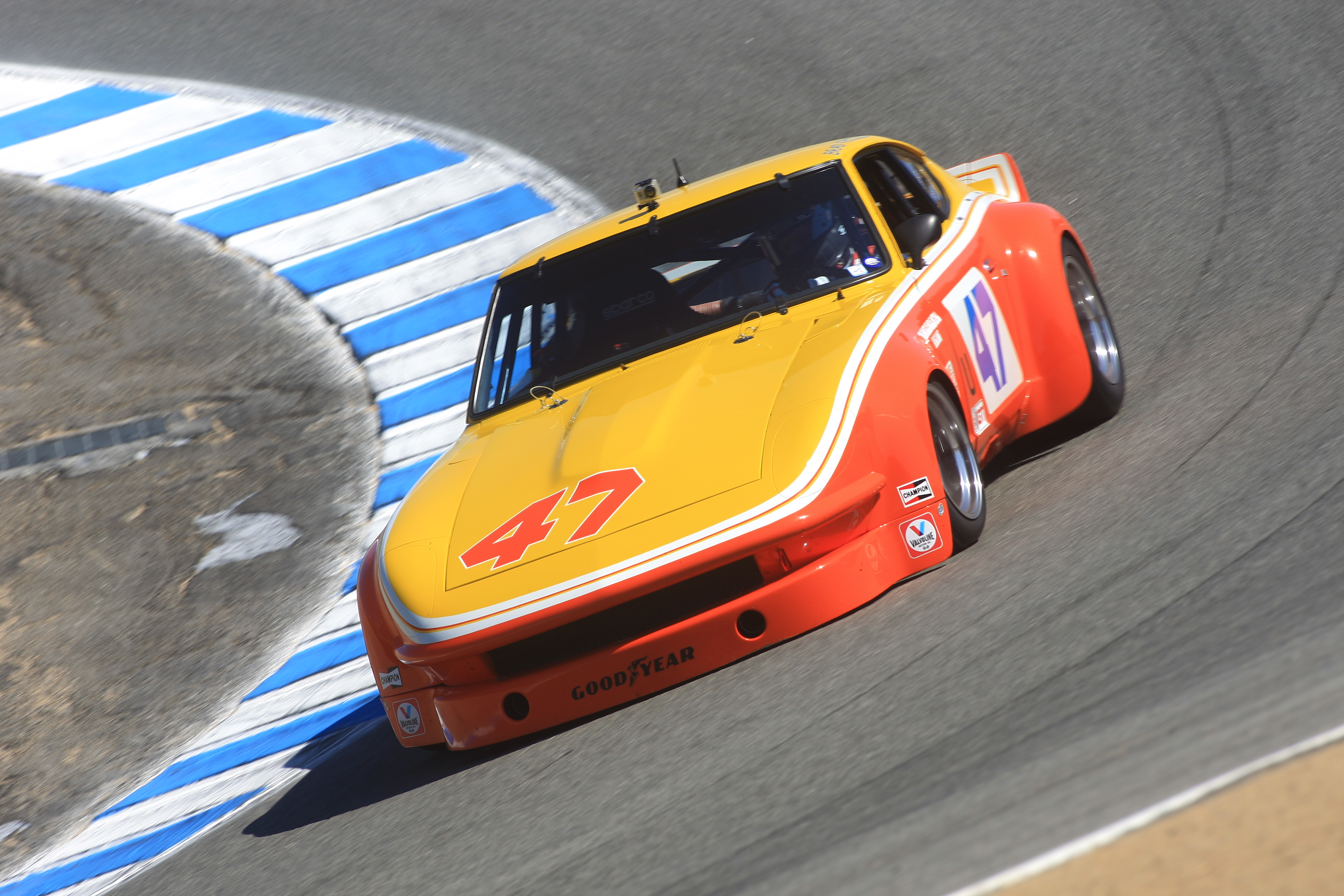
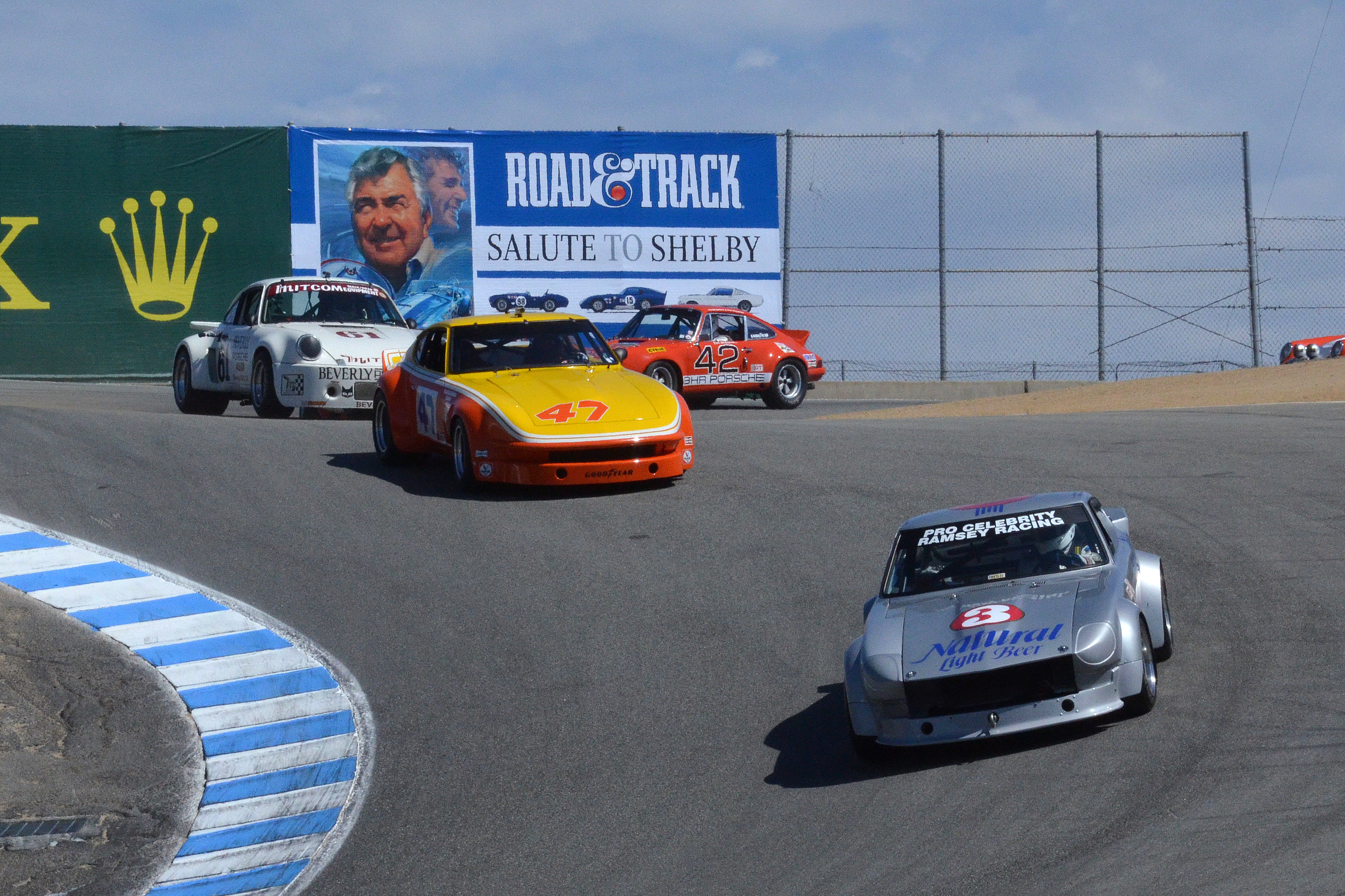
This Datsun 240Z is the 1976 IMSA GT/U Championship car. The chassis of this car was the first 240Z imported to the United States in 1970. My dad had one of the original 240Z’s as his father did all the legal work for Datsun! Mac Tilton designed the suspension and built some of the specialized parts. The chassis, roll cage and body were all constructed by Dave Kent with assistance from Yoshi Suzuka. Yoshi was also responsible for the design of the aerodynamics on the car. John Knepp of Electramotive built the engine. Many of these businesses are long dead. In it’s day, this Datsun 240Z was the fastest and most technologically advanced car in IMSA and SCCA.
Sometime in the early 1990’s it was decided that a full restoration was needed. The car was starting to fall apart, and didn’t look as good. The team’s original captain, Joe Cavaglieri was hired for this task. The car was stripped down to the chassis, and rebuilt from the tires up to 1976 IMSA GTU specifications. Using development parts from the NISSAN GTP program, modern electronics, and new piston and cam designs the engine produces 400hp. Considering that this comes from a 2.0-liter inline six-cylinder, that’s quite impressive. No turbochargers or superchargers have ever been near this car.
In the day the team was the one of the very best in IMSA, the preparation of the car was always at the highest level, more like that of a top Indy Car team than a GTU team. The restoration was done with that same mindset. The car is absolutely perfect both cosmetically and in performance. The fit and finish, attention to detail and superb craftsmanship exhibited in this restoration is spectacular. Right now, the car is capable of winning a podium position at any classic car race, or winning a Best-in-Show at Pebble Beach. Since the completion of the restoration, the car has competed in the Mitty at Road Atlanta and the Monterey Historic Automobile Races plus two club events and one test day.
Here is a list of the championships that the car has competed in:
IMSA GT/U (Grand Touring Under 2.5L) 1975 Season Mid Ohio 2nd GTU (Pole Position) Laguna Seca 2nd GTU Mosport 1st GTU Mid America 1st GTU Talladega 1st GTU
1976 Season (IMSA GT/U Champion): Road Atlanta 1st, GTU 15 OA, Laguna Seca 2nd, GTU 10, OA Ontario 4th, GTU 12, OA Lime Rock, 1st GTU, OA Mid Ohio 1st, GTU 5, OA Daytona 250 1st, GTU 9, OA Sears Point 2nd, GTU 9, OA Talladega 1st, GTU 5, OA Pocono 1st, GTU 5, OA Road Atlanta 500 1st, GTU 8, OA with John Morton Daytona Final 1st GTU.
I’ll stop keeping the pictures from you, and share them with you.
This is David at the 2012 Rolex Reunion at Mazda Raceway Laguna Seca at the infamous Corkscrew S-Bend.This is the same race, but on a different lap. This is also at the Corkscrew.
I’d like to give many, many thanks to David Martin of Red Car Winery and the Martin Group for letting me hang around and watch him. I’d also like to say thanks to his awesome mechanics and instructor, who were kind enough to talk to me about racing throughout the day! Thanks to my amazing uncle who originally set me up with David! Thanks to David, his team, and my uncle, for letting me come with my dad so we could have an awesome day watching an awesome person drive an awesome car! Clearly, I had a great day. Told you I was lucky.


 The Unmuffled Auto News