What are Bore, Stroke, Porting, and Relieving?

You hear car guys throw around the terms, “bore” and “stroke” all the time.  Most of us don’t know what that means.  I do.  Here’s what they mean, and how to identify them.

Bore:  Cylinder bore is the measurement of the diameter of the cylinders in an engine.

Stroke:  Stroke is the amount of movement a piston can move up and down.

A bored engine happens when you machine out the block.  For example, taking a 400 cubic-inch Chevy V-8 and boring out the cylinder walls to make the engine displace, say 500 cubic inches.

A stroked engine is simple to build.  You just pull out the current internal moving parts, and put in bigger ones.  Because bigger is better.  An infamous example of this is Chevy’s 302 cubic-inch V-8 from 1967-1969.  Chevy took their garden-variety 283 cubic-inch V-8 engine block, and put the bigger 327 cubic-inch V-8 internals in.  Voila.

An easy way to put into perspective just how thirsty an engine can be is to remember that a 302 cubic-inch engine will theoretically inhale and exhale 302 cubic inches of air and fuel in two revolutions of the crankshaft.  If you punch that engine out (slang for stroking it) to 347 cubic inches, then you’re going to have a more powerful engine.  That 347 stroker engine is popular with drifters – it’s based off of Ford’s capable 302 cubic-inch V-8.  A 347 cubic-inch engine is 14.9% larger than a 302.  So, that 350 horse 302 will have 402 horsepower.

Just stroking an engine for more power won’t solve your problems entirely.  A cam (or more nowadays) pushes on the intake and exhaust valves.  If you’ve got a bigger crankshaft and pistons, upgrade the cam!  You’ll have a far more reliable engine.  Upgrading the cylinder heads is also smart.

The nice part about stroking an engine is that the engine remains the same size externally.

Porting:  A ported engine refers to enlarging the intake and exhaust ports of an engine.  This makes for better and more airflow.

Porting is common in drag racing, especially with the use of nitrous oxide (yes, the same stuff that is used to push out whipped cream from the can).  It just makes more room for the air to go in and out.

Relieving:  No, the engine is NOT using the bathroom!  That would be relieving itself.  A valve seat is where the valve is attached to.  It’s usually a small mound of metal, but it doesn’t need to be.  Relieving just removes the extra metal to make more room for bigger valves.

Here are some pictures of the different kinds of engine enlarging.

This is a bored Chevy big-block V-8 engine block.  It’s been bored out from 454 cubic inches to 489 cubic inches.  That’s 35 cubic inches more air and fuel this engine will hork down.

This is a stroked Chevy small-block V-8 engine.  It displaces 383 cubic inches, rather than 350.  Instead of 350 horsepower, it makes 425 horsepower.  You can buy this engine from Summit Racing.

This is a close-up of a beautifully-ported Ford 302 cubic-inch V-8 from a 1987 Mustang GT LX 5.0.  The larger port is the exhaust port.  The small hole is the valve seat.

This is a relieved Ford 221 cubic-inch flathead V-8.


Why Legislation A.B. 550 Matters to Car People

California has recently proposeda new legislation.  While that might not mean all that much to us, it should.  Legislation A.B. 550 would allow for the owner of a motor vehicle subjected to the rigorous California smog check program to pay a $200 smog abatement fee instead of having to go to the trouble of smogging the car.

This bill would require the payment to go to the Air Quality Improvement Fund.  The measure will be considered by the Assembly Transportation Committee.

Currently, the smog check program requires an inspection of all motor vehicles when the car is initially registered, then biennially upon registration renewal, transfer of ownership, and various other circumstances.  You can find all of that on the DMV’s website.

The law currently exempts all cars manufactured prior to 1976, and certain other vehicles.

What’s so special about A.B. 550 is that it would allow the owner(s) of a motor vehicle that is required to take a smog test to pay a 200 dollar smog abatement fee IF the car meets the following criteria:

  • The motor vehicle is 30 model years or older
  • The motor vehicle was manufactured during or after the 1976 model year
  • The motor vehicle fails a smog test
  • The motor vehicle fails a subsequent smog test after necessary repairs were performed

This could mean a lot to hot rodding.  Newer cars are easier and cheaper to insure, parts are more plentiful and cheaper, and, since newer cars have the necessary smog equipment, hot rodders can start to build killer smog-legal street cars.

It’s extremely important to me and many others in the automotive industry that we (as in auto enthusiasts) contact the California Assembly Transportation Committee to voice your opinion of A.B. 550.

Here’s how to do it.  Email Steve McDonald at stevem@sema.org a copy of your letter. Also, send this to your automotive enthusiast friends! The more people who voice their opinions, the more likely the bill is to pass.

Here is a (very) long list of the committee members’ contact information:

Assemblymember Jim Frazier (Chair)
Phone: (916) 319-2011
Email: assemblymember.frazier@assembly.ca.gov

Assemblymember Katcho Achadjian (Vice Chair)
Phone: (916) 319-2035
Email: assemblymember.achadjian@assembly.ca.gov

Assemblymember Catharine B. Baker
Phone: (916) 319-2016
Email: assemblymember.baker@assembly.ca.gov

Assemblymember Richard Bloom
Phone: (916) 319-2050
Email: assemblymember.bloom@assembly.ca.gov

Assemblymember Nora Campos
Phone: (916) 319-2027
Email: assemblymember.campos@assembly.ca.gov

Assemblymember Kansen Chu
Phone: (916) 319-2025
Email: assemblymember.chu@assembly.ca.gov

Assemblymember Tom Daly
Phone: (916) 319-2069
Email: assemblymember.daly@assembly.ca.gov

Assemblymember Bill Dodd
Phone: (916) 319-2004
Email: assemblymember.dodd@assembly.ca.gov

Assemblymember Eduardo Garcia
Phone: (916) 319-2056
Email: assemblymember.eduardo.garcia@assembly.ca.gov

Assemblymember Jimmy Gomez
Phone: (916) 319-2051
Email: assemblymember.gomez@assembly.ca.gov

Assemblymember Young O. Kim
Phone: (916) 319-2065
Email: assemblymember.kim@assembly.ca.gov

Assemblymember Eric Linder
Phone: (916) 319-2060
Email: assemblymember.linder@assembly.ca.gov

Assemblymember Jose Medina
Phone: (916) 319-2061
Email: assemblymember.medina@assembly.ca.gov

Assemblymember Melissa A. Melendez
Phone: (916) 319-2067
Email: assemblymember.melendez@assembly.ca.gov

Assemblymember Adrin Nazarian
Phone: (916) 319-2046
Email: assemblymember.nazarian@assembly.ca.gov

Assemblymember Patrick O’Donnell
Phone: (916) 319-2070
Email: assemblymember.odonnell@assembly.ca.gov

Thanks for listening to my rambling about how this could turn the hot rodding hobby around.  If the bill passes, there will be people who abuse the system, but they already do that.  I wouldn’t worry that much about it.

I think these cars that are only slightly customized could greatly benefit from A.B. 550:

This bone-stock 1976 Camaro could benefit from an LS-motor swap.  Chevy Performance even offers an LS3 E-Rod engine that is smog-legal in all 50 states.  You just install the engine and slap on a couple of stickers that let the smog guys know.  These second-generation Camaros are popular among hot rodders, and one could throw on aftermarket suspension pieces and nobody would notice.

This is a simply tasteful C-10 stepside.  The wheels go well with the dark blue/black paint on the truck.  The big visor over the windshield is a cool touch from the 1950s.  It would be even better if the owner could put a thundering big-block with EFI on it.

This 1985 Fox-Body Mustang is an early Saleen Mustang.  It looks better than the flashier late-model Saleens.  It was a performer in the day, but my Mazda3 could beat it to 60, through the quarter mile, and in just about everything but looks.  If somebody bought a Fox-Body, got a body kit (Saleen rip-off body kits are common in drifting), put in an EcoBoost V-6 found in the Taurus SHO, this would look amazing, and go like stink.  If there was an aftermarket suspension kit on it, even better.  This would be a holy terror at autocross and track day events.  Plus, it would be a fun daily driver.  OK, I’m going to rein myself in now…

The last car on this little list is one I really want.  It’s a Chevy C3 Corvette.  Let me explain. It has stunning good looks, and would be quite the performer with a modern LS engine under the hood.  It’s already been done, and that’s the car in the picture.  It’s got an LS3 E-Rod under the hood, and even though it’s a 1972, one could very easily do the same thing to a 1976 or later model.

A Real Life Mario Kart Crash!

This crash is the definition of insane.  It happened fairly recently too.

The Derek Bell Cup at the 73rd Goodwood Member’s Meeting, which is essentially a place where really rich car guys get together and race their vintage race cars for a trophy.  It sounds like a whole lot of fun.  There was one moment that I still can’t get over.  It was one of those “Oh my G-d HOW the hell did that happen?” moments.

For the record, the Derek Bell Cup is for Formula 3 cars.  It is not for every other class of car!

This bonkers crash happened on the second flat-out lap of the qualifying session.  Paul Waine’s beautiful red De Sanctis-Ford hit Michael Scott’s equally beautiful 1969 Brabham-Ford BT28 at the legendary Madwick corner.

Waine’s airborne #10 Ford was credited with a still-impressive 17th place for qualifying, but had to retire from the rest of the event.  Scott’s Ford somehow got through another six laps before qualifying in 20th place.  Scott then went on to finish 13th in the actual race.

The De Sanctis-Ford was an Italian effort that took much inspiration from the Brabham cars of the late 1960s, and was powered by a Ford engine.  What seems illogical to me is the fact that the De Sanctis family ran a Fiat dealership.  Nonetheless, 1969 was a disappointing year for them.

The Brabham-Ford cars were extremely successful F3 (Formula 3) cars throughout the 1960s and 1970s.

Here’s a link to the video of the crash.  https://www.youtube.com/watch?v=EWVPL8oEFJs

Another saddening crash was Jochen Mass, who slammed a priceless Mercedes-Benz 300 SLS into a Lister.  Both cars were racing in the Salvadori Cup, and from footage I’ve seen, it looked like the Lister wanted to enter the pits when Mass tried to help.  It looks like Mass locked up the brakes in the 300 SLS, and by the time he let up on the brakes, it was simply too late.  Cars of that era aren’t known for their braking prowess (they were in the day), so it is a sad surprise.  Like any race car worth it’s racing slicks, I’m sure that both cars will be repaired and racing again in no time at all.

Jochen Mass Took Out A Lister With A Mercedes 300 SLS

Here’s an action shot:

Why You Should Road Trip in 2015

Gas is cheap.  You’re going to see more classic and high performance cars out on the road because of this.  Most of us like to drive.  It’s fun.  Road trips with family or friends are a lot of fun.  You don’t need an exciting, fancy car to road trip.  You could go through California in a Kia Rio and still have fun.  Here are some tips to make the most out of a road trip.  You probably know most of these, but some you probably won’t.

  • Have travel companions.  Whether it’s your spouse, sibling(s), friends, co-workers, or a boyfriend/girlfriend, other people make road trips more fun.   Even your dog can make it more fun.
  • Know basically where you’re going.  Unless you have some sort of deadline, or specific place to be, know where you’ll end up within the next couple of days.  Let people know where you’re going, and when you expect to be there.  Let them know when you arrive.
    • That being said, explore some.  Don’t stay on the interstate.  Take some backroads, explore local towns, and have a good time.  If you’re travelling around, say California, and you want to end up in Palm Springs by the weekend, let somebody close to you know, but explore some.  The California desert has plenty to offer.
  • Tell people where you’re going, and when you get there.  Don’t be a total loner when it comes to road trips.  Call your parents/siblings/significant other/friends/whoever you know well.  It’s a simple 2-minute call.
  • Try out the local delicacies.  Most small towns have something that the locals enjoy. For example, Gilroy, California, is the garlic capital of the world.  Try garlic-themed food there.  You get my point.  Try what the locals all recommend.  It’s usually in the specials section of the menu.  Or, you can ask the wait staff what they recommend.
  • Check out museums if there are any where you stop.  It’s a simple, quick Google search. You’d be amazed at what you can find.  Most of the museums are quite interesting.
  • Talk to the locals.  Chat the people who seem nice up.  They might tell you where the good places to eat are, or where a fun or scenic road is.  It’s worth your time, and most people will be nice enough to talk to you.
  • HAVE FUN!!!!!  That’s what most road trips are meant to be.  Make it memorable.  Do burnouts, donuts, drifts, or go off-roading if you want.  Just make sure you won’t cause trouble when you do it.


Travis Kvapil’s Car Found

Last night, I reported on Travis Kvapil’s car being stolen early yesterday morning.  Well, it’s been found.

The theft of the car forced Kvapil and his team to withdraw from Sunday’s race at Atlanta Motor Speedway.

The truck and trailer that were stolen, along with the car, drove out of the parking lot of the hotel about 5:30 a.m.

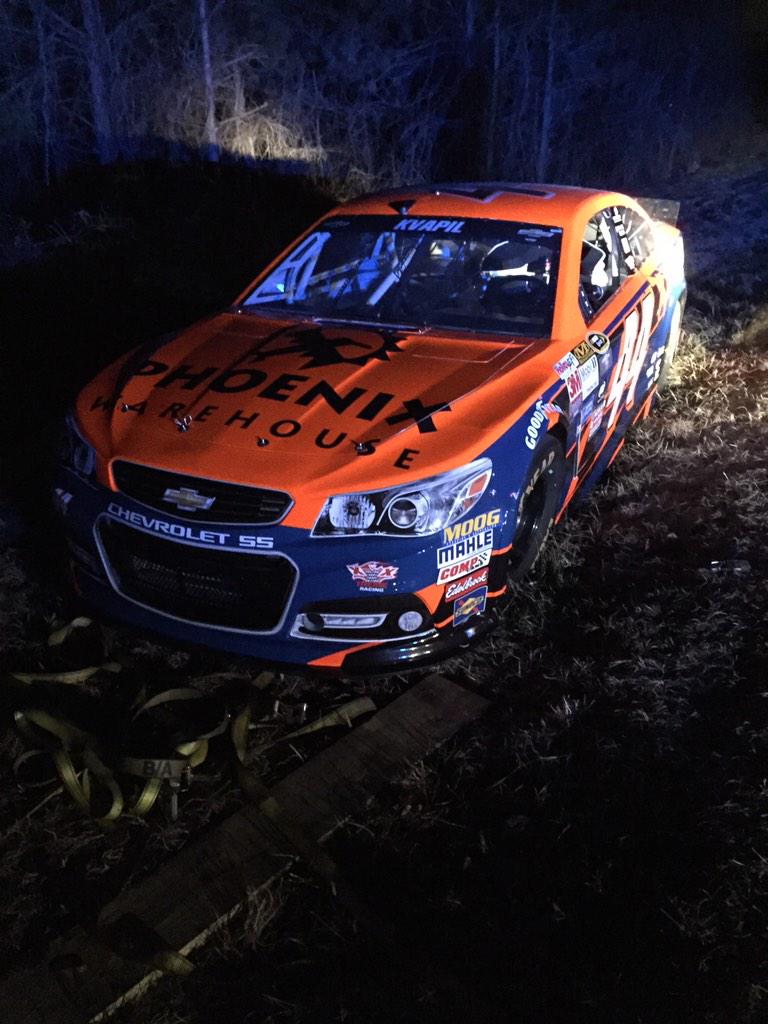
The car was found about 20 miles outside of Atlanta, off the road leading into a suburb. The car appears to be undamaged.  The truck and trailer are yet to be recovered.

View image on Twitter

Even though the car has been found, Kvapil still cannot race this weekend – he missed the mandatory Friday inspection, and was forced to withdrwa from the race.  Bummer.

Have You Seen Travis Kvapil’s NASCAR Stock Car Recently?

Travis Kvapil, a NASCAR Sprint Cup Series driver, was forced to withdraw from this weekend’s race after his car and hauler were stolen from his hotel near Atlanta.

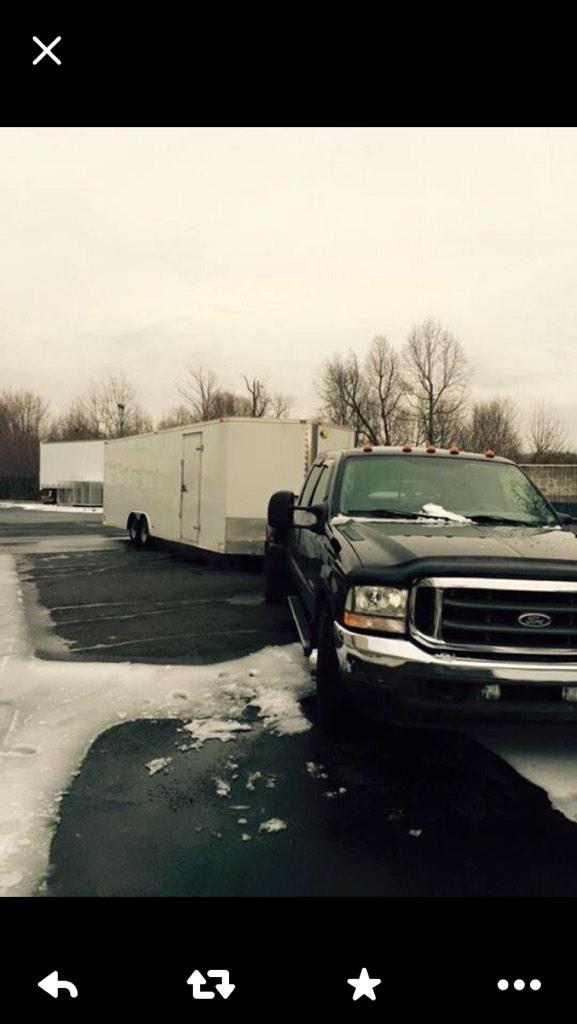
A trailer with his red number 44 Chevy SS stock car was hitched to his black 2004 Ford F-350 dually.  The truck and trailer were parked outside of his hotel room in Morrow, Georgia, about 15 miles outside of Atlanta.

Surveillance camera video shows the truck and trailer being driven out of the parking lot at around 5:30 a.m, officials said.

The trailer is all white with no markings.  The thief probably didn’t realize that the racecar was inside.  They probably thought that it was lawn equipment or something else that could be easily sold.

The 2015 Chevy stock car is valued at $250,000, according to a police report.  Also inside the trailer was a spare engine valued at $100,000, as well as tools valued at about $18,000.

A spokesman for Kvapil said that the team has withdrawn from the race this weekend, due to the lack of a back up car.

If you have any information on the stolen car, please call the Morrow Police Department at (770) 961-4006.  If you see the truck and trailer on the road, both have New Jersey plates.

The F-350 is a black crew cab dually.  The trailer is a plain white bumper hitch dual-axle trailer.

View image on Twitter

Here’s a picture of Kvapil’s car:

kvapil-876.jpg

If you see the truck and trailer on the road, call 9-1-1.  They’ll tell you what to do.

If you see the stock car on the road, good luck catching up to it!  It can hit about 200 mph, and will withstand a crash far better than whatever you drive.  It’s also pretty hard to miss. Oh, and it’s really loud!  That being said, you probably won’t see it out on the road, especially back east!  Those big slicks won’t do it any favors in the snow…

Why Gearhead Shirts are Important

You can always recognize a car person by their t-shirt, sweatshirt, or polo shirt.  I won’t even go into the different kinds of car t-shirts you can find – that would be an undertaking in insanity.

Ed Iskendarian is the guy who started the whole car t-shirt craze way back in 1949.  He’s still alive today.  Almost 67 years later, the car t-shirts are a mainstay of automotive culture.  It’s automotive anthropology.  You might not realize it, but you’re an automotive anthropology student if you have a car t-shirt.

Here are the main kinds of car t-shirts you will see:

Car Show T-Shirt:  Most car t-shirts typically have two or three cars drawn on it, along with the name of the event, maybe a palm tree, diner, or gas station, and the date of the event.  The name of the event is usually in cursive on the front, with the drawing on the back.  These t-shirts tell other car people you’re a park and polish kind of person.  You’re probably not the person you’ll see ripping around an autocross – you might see them cruise the main boulevard of town once in a while on a nice day.

Retro Style T-Shirts:  This is dangerous ground.  Anything with pinstriping, vintage lettering, iron crosses, or distressed lettering could mean that you really do live the vintage lifestyle with cars – all the power to you then!  It could also mean that you just jumped onto that Von Dutch bandwagon.  Tread lightly.

Race T-Shirts:  Any race car driver worth their car will have a race shirt.  These usually aren’t t-shirts (sometimes they are), but rather bowling shirts that have the logo of the team, name of the car, and primary sponsors.  Wearing one of these means you know your stuff.  You’re either a racing insider, fanatic, or you know somebody who is.  Most big-time racers will sell t-shirts that look like their race shirts.  They will usually have other merchandise, like sweatshirts, baseball caps, beanies, etc.  Just be careful if you’re a racer wearing your own merchandise in public.  It’s like a band member wearing a band t-shirt while on stage.

Old Race Track T-Shirts:  When you wear something like an Orange County International Raceway shirt, and it’s threadbare and faded, it’s obvious you bought that shirt AT Orange County International Raceway, and would never consider buying a reproduction shirt.  Instant cred among any car nut.  It’s not nearly as much cred as the guys who got a Lions Drag Strip leather jacket when they won a race at Lions.  This also applies to old event shirts, or ancient speed parts shirts.

Wrecked:  It doesn’t matter what style of t-shirt you’re wearing (it doesn’t even need to have to be a car t-shirt), but if it’s got oil stains, holes from welding, it’s got that hands-on cred.  Wearing that shirt in public and not caring if you smell like you rubbed that shirt in coolant says you’re hard core.

What do I have?  Well, I have a couple of car show t-shirts, a race t-shirt, a lot of vintage-style t-shirts, and a couple of wrecked shirts.  I’m still looking for a race track t-shirt.  I’ll find one…eventually.

These t-shirts, or other car apparel make great gifts for other automotive enthusiasts.  Hint, hint!

The Top Car-Killing Movies!

Just about everybody knows that breaking stuff is fun.  When directors get gigantic budgets and a car chase to shoot, sometimes they go overboard.  These movies destroyed the most cars – the numbers are crazy!

  • Ronin (1998):  Yes, Ronin was a good movie.  One of the many cool parts about it?  Director John Frankenheimer was a former amateur racer.  He enlisted former French Formula 1 driver Jean-Pierre Jarier and 300 OTHER stunt drivers to film the insane chase through Paris.  The result?  An epic eight-minute chase sequence that deserves a spot in the car chase hall of fame.  Oh, and they destroyed a mere 80 cars.  That’s nothing compared to other movies on this list!  Watch it here:  https://www.youtube.com/watch?v=CVaNBrYLvFg
  • Bullitt (1968):  Yes, it is riddled with some funny errors – the 1968 Dodge Charger loses five hubcaps from four wheels over the course of the chase!  However, it is still one of the greatest car chases ever produced.  People are still making their own versions of it almost fifty years later.  The iconic Highland Green big-block Mustang fastback reached speeds well over 100 mph on the hilly streets of San Francisco, sometimes even with the legendary Steve McQueen behind the wheel!  More than 80 cars were destroyed during the filming of the movie.  https://www.youtube.com/watch?v=0vNvc9n1ikI
  • Gone in 60 Seconds (1974):  Director, producer, stunt driver, and star of the original Gone in 60 Seconds H.B. Halicki was given a tiny $150,000 budget, but the movie has now grossed more than $40 million.  He drove the original “Eleanor” – the tastefully customized 1973 Mustang (to this day, one of the best-looking Mustangs ever) throughout the chase scene.  Somebody else from the crew would drive the car throughout the rest of the movie (cameraman, actor, etc.).  Many of the bystanders were members of the public – there was no money for extras.  Some of the crashes were completely unscripted, which makes the movie that much better.  When Halicki clipped another car at 100 mph and spun into a lamppost, he ended up in the hospital.  The crash ended up in the film.  Gone in 60 Seconds destroyed 93 cars.  https://www.youtube.com/watch?v=GMz3g1x75pU
  • The Blues Brothers (1980 and 2000):  The 1980 version of the film held the record for the most cars violently destroyed until the 2000 remake, which smashed the record (pun intended) by a whopping ONE car!  For the 1980 film, 60 used police cars were bought for $400 apiece, fitted with reinforced frames.  Almost all of the cars were unusable by the end of filming.  The 1980 version destroyed 103 cars.  The 2000 version decimated 104 cars.  This is the 1980 version:  https://www.youtube.com/watch?v=LMagP52BWG8 and this is the 2000 version:  https://www.youtube.com/watch?v=LDEFL2fLGIE
  • G.I. Joe (2009):  Yes, it is an awful film by every account.  It also happened to briefly hold the record for most cars destroyed in a movie (112 cars).  It beat The Blues Brothers (2000) by eight cars.  Maybe blowing up stuff isn’t as exciting as we all thought it was as kids.  That being said, enjoy the gratuitous automotive destruction at https://www.youtube.com/watch?v=E0GBhbu-0aQ
  • A Good Day to Die Hard (2013):  Sometimes, it’s best to leave the best alone.  Some movies don’t need a sequel, let alone four.  Die Hard is one of said movies.  Sadly, 25 years after Bruce Willis “killed” Alan Rickman (the guy who played Snape in the Harry Potter movies, kids), we are talking about the fifth and worst Die Hard yet.  Willis and the cast somehow destroyed 132 cars and badly damaged an incredible 518 cars PAST their 132 dead brethren.  That being said, the car chase is good.  https://www.youtube.com/watch?v=gWNie0rdXlI
  • The Junkman (1982):  Have you ever heard of The Junkman?  I hadn’t either until now.  It’s the crashiest film you’ve never heard of.  Directed by H.B. Alicki, the crash-hungry director of Gone in 60 Seconds, it reportedly killed more than 150 cars.  https://www.youtube.com/watch?v=aIh_IbxIrr8
  • Fast Five (2011):  All in all, over 1000 cars have been destroyed since the first Fast & Furious.  That’s more than one a minute in total film time.  260 cars were destroyed in Fast Five.  However, Fast & Furious 6 used about 400 cars, with few surviving.  https://www.youtube.com/watch?v=F-4zZBGfF98
  • Matrix Reloaded (2003):  Somehow, the folks behind Matrix Reloaded managed to kill 300 cars loaned to them by GM.  https://www.youtube.com/watch?v=wSPAPeO17Zk
  • Transformers 3 (2011):  By definition, every one of the 532 cars destroyed were ready for the junkyard – they were all donated to director Michael Bay because of flood damage.  They needed to be scrapped by law anyways – why not destroy them violently? https://www.youtube.com/watch?v=wSPAPeO17Zk

Well, that’s my list!  I hope that you enjoyed it, as well as the chase scenes.  I recommend you watch this song while listening to “Rockin’ Down the Highway” by the Doobie Brothers.  It seems fitting.  https://www.youtube.com/watch?v=Drg50H3nNAk

What Era of Motorsport Was the Best?

This idea is simple:  What era of motorsport was/is the best?  What drivers were/are the best?  What motorsport was/is the best?  What cars were the best?  What track was the best?

For me, I can’t choose just one.  1960s Top Fuel drag racing was the best of the 1960s.  There were plenty of big names competing against smaller names, many of whom have been lost to the sands of time.  Some of those names we are familiar with – Don “Big Daddy” Garlits, Don “The Snake” Prudhomme and Tom “The Mongoose” McEwen (anybody who’s ever had a large collection of Hot Wheels has/had models of their cars).  Their cars were spectacularly fast (Garlits was the first to break 200 mph in his Top Fuel dragster), and they always put on one hell of a show.  I’m going to say that Lions Drag Strip in Long Beach, CA was the best.  While I never visited it (it closed in 1972), it is rumored to have been one of the best drag strips ever.  If you’re into Facebook, look up “THE GLORY DAYS OF DRAG RACING.”  It’s a closed group, but they will let you in.  It’s got a lot of great vintage photos.  Read their rules before posting something.

Another great one for me was 1980s Formula 1.  Ayrton Senna, Alain Prost, Mario Andretti, and the late Clay Regazzoni.  It was a fierce era of turbocharged cars with well over 1,000 horsepower duking it out on the fastest tracks on the planet.  BMW had cars with 1,400 horsepower and manual transmissions (yes, you had to take your hand off of the steering wheel in a tight corner in a powerful car to shift).  Ayrton Senna and Alain Prost simply dominated the sport until the tragic death of Senna in 1994.

Finally, I’m going to say that 1980s-current off-road racing is great.  I mean, who doesn’t like watching Ivan “Ironman” Stewart bombing around Baja in his Toyota trophy truck?  Or for those American car fans, how about Robby Gordon and his HUMMERs from a long time ago?  To me, it’s the most entertaining form of motorsport, and I’ve been hoping to travel to Baja to watch the Baja 1000 for a while.

Here are some of my favorite pictures to prove it.

Hilariously Cheap Winter Beaters!

So, we all remember that big post I did a while back on the best cars for winter, right?  Well, these cars will fit into almost everybody’s budget.  They’re sure to put a big smile on your face, and you’ll miss them because of the fun factor – not for being collectible.

Any Subaru (preferably turbocharged):

Subies come in all shapes and sizes.  The older they get, the cheaper they get.  They also come with less amenities than your couch.  That being said, any Subaru from the last 20 years will likely only need basic work done to it (tires, alignment – if you’re lucky.  All Subaru engines need a new head gasket at some point).  It will take you through all kinds of weather, and the AWD will save your butt all over the place.  Plus, they are fun to drive, and they don’t need tire chains in the winter!

This is a Subaru in it’s natural element…

If you can’t swing the WRX, go for something older.

This is the Subaru SVX.  It was Subaru’s much-maligned sports car of the early 1990s turbo hype.  It wasn’t very successful on the racing circuit, but you can stuff a late-model Subaru engine into one without too much work.  It looks funky, but it will be the only sports car from the 1990s that is driving around your town in the winter.

Long-bed, full-size pickup trucks:

They come in all shapes and sizes.  You can get them with a regular cab, extended cab, or crew cab.  They come with engines in all shapes and sizes.  If you get a heavy-duty version, you can get a job as a snowplow driver with it.  You just go to the dealer and have them install a snowplow kit, go to the local chamber of commerce, and become a snowplow driver.  Snowbelt towns are always in critically low supply of snowplow drivers (for very good reason), but they lure folks in with benefits (hot drinks) and reasonable pay.  You can pick them up for next to nothing, but make sure that it is in good running condition.  Oh, and it should be 4X4.  If it’s a GM pickup, you can yank the engine out and put it into that poor project car in your garage that just needs an engine.  It will run forever, and you can go to any junkyard in the country and find parts for it.

1980s Chevrolet Camaro:

You know/remember them well.  The IROC-era Camaro’s that had little more than big wheels and body kits on top of pitiful engines.  Well, most states don’t require smog for cars like that.  That means you can go straight to nelsonracingengines.com and get yourself a 2,000 horsepower, twin-turbo Chevy small-block V-8.  Oh, and get a set of studded tires.  You’ll never be stuck again.  Or, you can just get a crate naturally-aspirated small-block Chevy engine for a few thousand.  You can throw on a better set of suspension, have good summer tires in the garage, and go autocrossing and bombing around the roads in the summer.  Sounds like a good package to me.  Oh, and you can get them for a few grand.  You’re thinking what I’m thinking.

This is stock.

This is not stock.

Jeep Wrangler:

It’s a Jeep.  Need I say more?  It will take you anywhere and everywhere without complaining.  You don’t buy a Jeep and keep it stock.  It’s got one of the largest aftermarkets in the world.  You can build a rock-crawler, a dune-basher, an autocross machine, and a dragster.  Oh, and everything in between.  Lift kits can range from about $1,000-5,000.  That leaves you plenty of money for tires, wheels, interior doodads, engine/transmission upgrades, and various other items.  What I’m saying is you can do anything to a Jeep, and somebody else will have done it before you.  There is no first.  Just make sure that the heater works.  Oh, and getting one with the bullet-proof 4.0-liter I6 is a good choice.

This is stock.  Notice how small the wheels and tires are?  Yeah, that will have to change.

This is an infamous Willys.  Look up “LSX Willys” on YouTube for proof.  It’s the ONLY Jeep in the world to beat a Corvette ZR1.  I think all that it needs is a set of studded snow tires and a fearless driver.

That’s all I have for you today.  If you have a hilariously cheap winter beater that you drive all of the time in the winter, tell me in the comments section.  I might even do a part II!