Travis Kvapil, a NASCAR Sprint Cup Series driver, was forced to withdraw from this weekend’s race after his car and hauler were stolen from his hotel near Atlanta.
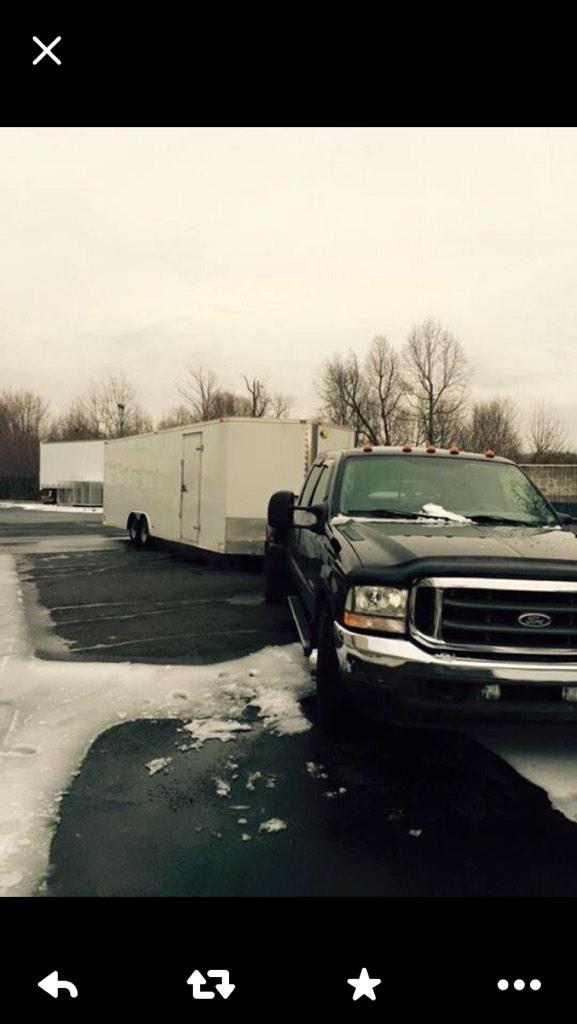
A trailer with his red number 44 Chevy SS stock car was hitched to his black 2004 Ford F-350 dually. The truck and trailer were parked outside of his hotel room in Morrow, Georgia, about 15 miles outside of Atlanta.
Surveillance camera video shows the truck and trailer being driven out of the parking lot at around 5:30 a.m, officials said.
The trailer is all white with no markings. The thief probably didn’t realize that the racecar was inside. They probably thought that it was lawn equipment or something else that could be easily sold.
The 2015 Chevy stock car is valued at $250,000, according to a police report. Also inside the trailer was a spare engine valued at $100,000, as well as tools valued at about $18,000.
A spokesman for Kvapil said that the team has withdrawn from the race this weekend, due to the lack of a back up car.
If you have any information on the stolen car, please call the Morrow Police Department at (770) 961-4006. If you see the truck and trailer on the road, both have New Jersey plates.
The F-350 is a black crew cab dually. The trailer is a plain white bumper hitch dual-axle trailer.
Here’s a picture of Kvapil’s car:
If you see the truck and trailer on the road, call 9-1-1. They’ll tell you what to do.
If you see the stock car on the road, good luck catching up to it! It can hit about 200 mph, and will withstand a crash far better than whatever you drive. It’s also pretty hard to miss. Oh, and it’s really loud! That being said, you probably won’t see it out on the road, especially back east! Those big slicks won’t do it any favors in the snow…
While this happened a while ago, I’ve been having fun with lots of other posts. Anyhow, here goes.
Huntington Beach, CA police had an eventful night on September 10. Officers responded to a call of a suspicious military vehicle around 7:45 p.m. They found an elderly man driving a surplus military transport truck through town. Early on, officers heard several loud pops. These turned out to be backfires.
This elderly man led police on a chase for a short distance, reaching speeds of up to 10 mph. Yes, 10 mph!
When the man arrived at his business, the police arrested the man for failure to yield to an emergency vehicle.
The unnamed man was released later that evening.
Maybe driving something this large through town ISN’T such a good idea…
NASCAR is just about the highest form of motor sports in the U.S. I know that some of you will disagree with this but hear me out or forever hold your peace. Think about it this way – Formula 1 has only had a few Americans compete in it over the past 60-some-odd years. NASCAR is the American version of Formula 1.
There have been some gigantic fights in NASCAR over the years, but the one that really kicked it off was Bobby and Donnie Allison getting into a fistfight with Cale Yarborough in 1979 at Daytona. There have been some other big fights, notably the Jeff Gordon and Denny Hamlin pit crew fight a few years back. The most recent just happened to be a series of fights between Denny Hamlin, Brad Keselowski, and Matt Kenseth.
Is NASCAR still NASCAR or is it WWE? Look at the picture and decide for yourself. Here’s the lowdown on what happened.
A restart with 63 laps to go sent Brad Keselowski and Matt Kenseth bashing eachother for the lead. Keselowski thought Kenseth was pushing him and didn’t leave a line toward the wall for Kenseth, who was, in fact, trying to pass him. Kenseth was forced into the wall and bounced into Keselowski, damaging both cars. While that’s not uncommon in NASCAR, what happened next was.
A restart with six laps to go gave Kenseth, who was a lap down due to his damage, a free pass, which means that he was no longer a lap down. You’re thinking score for Kenseth, right? Not exactly. On his way around the track, he somehow managed to “accidentally” drive around Keselowski’s nose (not his facial nose – his car’s!), damaging the car.
On the restart with two laps to go, Keselowski bashed Denny Hamlin in turn 1. Hamlin felt Keselowski’s push, and was enraged when he fell to 11th because of this. Keselowski lost his momentum (and his Top 10 spot), and fell to 16th place due to the now-extensive damage to his car.
You’re probably thinking, “Okay, that’s normal.” What happened next was more than abnormal.
After the race, Hamlin jammed on his brakes directly in front of Keselowski to show his immense displeasure. As a result of this, Keselowski floored the gas and tried to spin Hamlin. It didn’t work. He simply went right around Hamlin, clipping Hamlin’s rear bumper in the process.
Keselowski then proceeded to drive into pit row as he chased down Kenseth, who was unbuckling his safety belts (a common practice among drivers after a race as they come near their pit box). He T-boned Kenseth, and then inadvertently hit the rear bumper of Tony Stewart. Stewart, who wasn’t going that fast, stopped his car, jammed it in reverse, and rammed into the front end of Keselowski’s car, destroying the front end. Keselowski, who was frantically trying to get away from Stewart, backed into Danica Patrick’s car.
Keselowski then untangled his car from the small pileup and drove past everybody and went into his garage. Hamlin followed him, making contact as Keselowski made his way into the garage, and stuck both cars together. Keselowski floored the gas in reverse so he could get away, leaving a massive, smoky burnout mark in the garage. He then drove across some equipment of the team’s that was laying on the ground to get to his car hauler.
The now-furious Hamlin climbed out of his now-stopped car first, and started storming towards Keselowski’s baby-blue Ford, which just so happened to be parked right in front of his black Toyota. A Hamlin crew member led him away from the cars and handed him a towel to dry his face off. However, as Keselowski climbed out of his car, Hamlin walked over to Keselowski’s car and threw the sweaty towel at Keselowski, hitting him in the helmet. Hamlin then ran over to the stunned Keselowski and put him in a bear hug and started to wildly shake him. After a few moments of scuffling among drivers and crews, Keselowski walked to his hauler.
Let’s not forget about Matt Kenseth. Kenseth wanted blood. He followed Keselowski and attacked him from behind as Keselowski was about to enter his hauler trailer. Crew members of Kenseth intervened after Kenseth put Keselowski in a headlock. Keselowski’s crew chief, Paul Wolfe, put Kenseth in a chokehold and started to drag him away. Kenseth crew members immediately separated the two brawling drivers. During this encounter, Keselowski said, “You hit me under yellow. You hit me under yellow. You hit me under yellow.”
Here’s what Kenseth had to say about the incident. “(Keselowski) was doing something with Denny. The race had ended, and he’s running into cars on the cool-down lap. I mean, the race is over, and he comes down pit row and drives into the side of me. That’s inexcusable. He’s a champion, and he’s supposed to know better.”
After composing himself inside of his hauler for a few minutes, Keselowski gave a few words to USAToday. “When we restarted fifth with no right front on it, we fell all the way back to 16th and ruined our day. That gave us a big Chase hurt, which is unfortunate. Then, for some reason, after the race the 11 (Hamlin) stopped in front of me and tried to pick a fight. I don’t know what that was all about, and he swung and hit at my car, so I figured if we’re going to play car wars under yellow and after the race, I’ll join too. Those guys can dish it out, but they can’t take it. I gave it back to them and now they want to fight, so I don’t know what’s up with that.”
What Keselowski should have done would have been to take the high road and forget about it. Why give attention to angry people like that? Just let it roll off and forget about it.
Hamlin called Keselowski “Out of control. He’s desperate, obviously, and it’s either four or five of us are wrong or he’s wrong because he’s pissed off everyone…that was unfortunate. Matt was nearly out of his car, and he just plowed into Matt and then ran into Tony and then went into the garage and cleared out transmissions and did burnouts in the garage. Just acting like a dumb*** instead of a champion.” Hamlin also added Keselowski “Will probably try to wreck everyone” at Talladega next week. “He’ll just be out of control like normal. We’ll do what we’ll have to do to get in, and that’s the big picture.”
NASCAR’s vice president of competition, Robin Pemberton, said the sanctioning body had called Keselowski into the hauler. “We asked Brad to come in and talk to us a little bit and get his take on what went on in the closing laps of the race and the post-race incidents, so we’ve got that and we’ll talk to some other people,” he said, adding Joe Gibbs Racing mechanic Jesse Sanders was also called to the hauler for his role in the altercation.
Kenseth was angry about what Keselowski did to him on pit row (for good reason). “I don’t know if he was mad at me,” Kenseth said. “I had my HANS (safety device) off and my seat belts off and everything. He clobbered me at 50 mph. … If you want to talk about it as a man, try to do that, but to try and wreck someone on the racetrack, come down pit road with other cars and people standing around with seat belts off and drive in the side of me.”
Keselowski’s crew chief, Paul Wolfe, blamed Hamlin for the entire incident. “I think Denny started the whole thing after the checkered flag,” he said. “Started pushing Brad around, and at some point we’ve got to stand our ground and not let that happen. From there, I guess some people got frustrated and the fight broke out.”
Kevin Harvick, the winner of the hotly-contested race showed that maybe NASCAR’s new Chase for the Sprint Cup Series Championship format had added pressure to the races, and that every moment matters. When asked if NASCAR might send hefty penalties to the drivers involved, he replied, “You’re crazy; they love it.”
NASCAR announced today that both Tony Stewart and Brad Keselowski were both being penalized for their actions following the race.
Keselowski has been fined $50,000, and been placed on probation from driving for the next four races for violating the following penalties:
Section 12-1: Actions detrimental to stock car racing.
Section 12-4.9: Behavioral penalty – involved in post-race incidents
Stewart has been fined $25,000, and has been placed on probation from driving for the next four races for violating the same penalties. I disagree with NASCAR giving a penalty to Tony Stewart. In my eyes, Stewart did nothing more than what most drivers do – back into their car as a warning. Yes, he did ruin the front end of Keselowski’s car, which there was no need for at all. He would have been better off leaving it alone and going on to his pit. I feel that NASCAR was unfair in their penalty assignment, and should have given a penalty to Matt Kenseth. Kenseth’s actions, as well as the rest of the drivers involved, were highly unprofessional and childlike. His actions were foolish and will most certainly hurt him in the future. I feel that Keselowski’s fine and probation are completely deserved, and he needs to seek treatment for this. I understand that drivers in NASCAR are highly impulsive, but playing bumper cars with big-boy toys that can kill people is unacceptable and foolhardy. All of these drivers need to have more than a slap on the wrist and a fight among themselves. They need to talk it out to each other in a civil manner a couple of days after the incident, and I hope that we will see apologies from all drivers involved in this blemish on NASCAR in the near future.
Well, maybe there are more. There are plenty of good automotive racing games out there for the XBox. But, I think that Forza Horizon 2 is the only reason why you need an XBox One. I’m going to be quiet and let you watch the launch trailer and debate on whether to mail me an XBox One, Forza Horizon 2, Forza Motorsport 5, and pre-order Project CARS while you’re at it. I’ll probably never do another blog post again. I’m not OK with that, but I will do a live feed of my progressions through the ranks of Forza on my blog…
Here’s the launch trailer of Forza Horizon 2. http://www.youtube.com/watch?v=xMRQh6wFWHw
Why should you send my Forza Motorsport 5? Well, everything from pure race cars to trucks to sports cars to luxury cars to economy cars and everything in between is represented in truly stunning details. Each vehicle is able to go around most of the tracks around the world, again in stunning details. Each car drives exactly like it would in the real world on the exact same track. It’s just up to the driver to have fun and beat their friends. The Rolls-Royce Wraith is now available in a variety of color schemes. Rolls-Royce offers somewhere between a zillion and infinity paint options, but Forza only offers 12. The Roller won’t be a slouch anywhere. It’s got a 624-horsepower twin-turbo V-12, and power goes to the wheels via a satellite-aided transmission. Yes, the transmission actually sends a GPS signal to a satellite to help make sure that the transmission is always in the right gear at the right time. One cool part is the interior looks the same as it would in real life. We’re dealing with a headliner that looks like the night sky, folks.
Send me a copy of Forza Horizon 2 if you’re not kind enough to send an XBox One – that’s what eBay is for! You can even send me Forza Motorsport 5. I won’t complain. If you want to see a Rolls-Royce raising hell on a properly manicured British lawn, watch this video. http://www.youtube.com/watch?v=I-pzol0sxro
Cars are stolen a lot. It’s an unfortunate reality, but it’s life. It’s just pretty much unheard of when the same person steals the same car twice. But, that’s what apparently happened recently in Fontana, CA.
I don’t know what his motives were, but Earnie Hooks stole a certain black 2014 Ferrari 458 Italia Spider. According to police, Hooks was intoxicated when he pulled up to a roadside checkpoint. When the police ran the plates, they found out that the car was reported stolen.
Hooks managed to evade the police (given the car at his disposal, probably not too hard to pull off) and later abandoned the car, which was found and taken to impound. However, about 3 a.m. the next morning, a special somebody broke into the impound lot and stole the car…again. He was found five days later in Studio City, still driving the stolen Ferrari. The LAPD arrested him, and Hooks somehow found the gall to plead not guilty to both the charges of car theft and resisting arrest.
Here’s the Ferrari after Hooks was arrested. I guess that if you’re going to steal something, go for the nicest possible car in sight…
Here’s Hooks. I don’t know where he got so banged up, but my best guess is during his arrest.
All I can say about this is wow. For somebody to steal a Ferrari while drunk, evade police, BREAK INTO the impound lot, steal the car, and drive it around Los Angeles for 5 days and not be noticed is pretty amazing. Don’t do this, kids.
We’ve probably seen at least one of the hundreds of thousands Russian dashcam videos that have gone viral on YouTube of just HOW crazy Russian drivers are. I’ve seen a fair share of them. Chevrolet’s software designers must be Russian because of what was just introduced on the 2015 C7 Corvette Stingray.
While there are some great valets out there, there are others that like to “circle the city for parking.” This can make sports car owners quite reluctant to hand the keys over. A good number of sports cars offer a performance-reduction setting for just this situation, but Chevrolet is going the whole 9 yards, and including the 2015 Corvette’s Performance Data Recorder as a Valet Malfeasance Recorder. Valets of the world, beware.
Do YOU really want a valet to go 147 mph in YOUR brand-new Corvette? I didn’t think so either. Most valets won’t ever get a car going that fast, especially in a crowded parking lot or city street. But, never say never.
Should you turn on the unimaginatively named Corvette Valet Mode, and some good things happen to your baby. Every interior storage area is locked, the infotainment system is disabled (that way you won’t sit down and get an earful of Snoop Dogg), and a 720p camera in the headliner (right in front of the rear view mirror) turns on. That high-definition camera is paired with a microphone to record audio. The car’s GPS receiver is turned on to provide vehicle telemetry and location, and 8 gigabytes of SD card storage can capture up to 200 minutes of driving – plenty of time for even the slowest of valets to “find a parking spot.”
That link is a YouTube video of the Corvette Valet Mode.
Should you want to see what happened after you handed the keys over to the valet, you can immediately review the “parking adventure” on the infotainment screen, or download it to your computer later. An overlay shows speed, RPM, current gear, and g-force. That’s pretty much the same thing you’ll get when you turn on the Performance Data Recorder. What Corvette Valet Mode can’t do right now, however, is let you know if the car is being abused (i.e. burnouts, drifts, general hoonage) or let you stream the video remotely to your phone or tablet. However, I think that the streaming part will come soon, as GM has a perfectly good OnStar system, and now has introduced 4G LTE connections.
What I think that the point really should be is this: Corvette Valet Mode doesn’t reduce engine power – an odd oversight, AND a feature that would certainly alleviate more concerns about abuse than watching a video of your Corvette hitting a telephone pole at 40 mph.
Is Corvette Valet Mode useful? Maybe. Chevrolet is pitching this as a baby monitor for a cherished toy that you spent your hard-earned money on. But it doesn’t alert you when your baby is crying, unlike an ACTUAL baby monitor. It may give you some insights when you step outside of the hotel/casino/restaurant and find your Corvette smashed-up against a brick wall.
There’s no denying that last week’s tragedy at Canandaigua Motorsports Park in upstate New York is horrific. For those of you who don’t know, Tony Stewart, a very good sprint car and NASCAR driver, had an on-track collision with a fellow sprint car driver, Kevin Ward, Jr. Ward’s car spun out, hit the wall, and suffered a flat tire. Ward then proceeded to climb out of his car and stride down the track pointing his finger at Stewart. As Stewart’s car went by, Ward was struck by the rear right wheel of Stewart’s car, sending him flying a good 20 feet down the track. Health officials said that Ward was killed on impact. The result? A massive internet phenomenon where just about every internet user has become an “expert” on sprint cars overnight. While I’m not a sprint car expert either, I do find them fascinating. The reason for this post being almost a week behind the tragedy is that I wanted to put some time behind the incident to gather more information and let everybody cool off.
Here’s what happened – Tony Stewart grew up driving sprint cars until his mid-20’s, when he became heavily involved in NASCAR and IndyCar. He still drove sprint cars for fun. After he got out of IndyCar around 2005, Stewart went full-time into NASCAR. He went into NASCAR’s prestigious Sprint Cup Series, where he won three Cups. He has won many, many races in NASCAR, sprint cars, and IndyCar. He may have a reputation for having a temper, but he’s calmed down in the last few years. According to those who know him and have interviewed him, the man has a heart of gold, but can act impulsively. When Danica Patrick came to Stewart-Haas racing, Tony personally started coaching her. He’s been a driving force in sprint car safety measures ever since he suffered a severely broken leg last year in a sprint car race in Iowa. His broken leg was so bad that it forced him to go around in a mobility scooter for a good 4 months. He had to miss the rest of the NASCAR season, making him ineligible for the Chase for the NASCAR Sprint Cup.
This year, Tony’s been back with an eye on the prize. He’s already gotten one pole at a race, and started in the Top 5 4 times. But, the death of Kevin Ward, Jr. last weekend shook him. He was scheduled to race the next day at Watkins Glen International Raceway for the Cheez-it 355, but decided not to race after the tragedy the night before. On Thursday, he released a statement saying that he will not be racing at Michigan International Speedway, and that Jeff Burton will continue to drive his No. 14 Chevrolet SS for the indefinite future.
Tony Stewart and Greg Biffle both grew up driving sprint cars on dirt tracks. Many drivers like Stewart have humble beginnings on short tracks, or start off in go-karts. Mostly in NASCAR, it’s the former. For Tony Stewart, driving sprint cars is just a fun hobby that he does for fun occasionally. However, he does have a couple of drivers driving sprint cars under his direction from Stewart-Haas Racing. It’s like Ivan “Ironman” Stewart (no relation to Tony Stewart), who is still an off-road motorsports legend. Ivan grew up riding motorcycles, and he enjoys riding them across the country with friends when he’s not helping Toyota Racing Development (TRD) with new off-road race trucks. Back to Tony Stewart. The tragedy obviously shook him to his core, and I think that he just needs to take a break from racing all together for a while to reorient himself. I don’t think that he will ever recover from accidentally killing a fellow driver, especially a 20-year-old. I don’t think that anybody can.
In the aftermath of the tragedy at Canandaigua Motorsports Park, NASCAR has released new on-track protocols for drivers following a wreck. In a nutshell, drivers are not supposed to exit their car after a wreck unless instructed to by a safety official. Drivers are prohibited from going onto the track or towards other cars under all circumstances unless it is a safety vehicle. The reason for this is that some NASCAR superspeedways like Daytona, Talladega, Michigan, Charlotte, Texas, and Homestead-Miami are big enough for cars to reach speeds in excess of 200 mph. When a caution happens in NASCAR, drivers are only supposed to let off the gas and coast until the pace car comes on the track. If a driver exited their car at Daytona and started striding towards another car, the result could be disastrous. Drivers are safer inside of their cars. NASCAR Sprint Cup Series cars are built to withstand multiple impacts of 200 mph or greater, and still allow the driver to live. The driver might have an injury like a broken leg or arm, but they will be far better off than dead. These rules might seem foolish, but they are really only common sense. There is no logical reason for a driver to approach another car on foot.
Now, let’s talk about sprint cars. These little things that look like they belong on a WWII fighter plane are tricky and super cool. Sprint car racing is different than midget car racing. Midget cars are essentially go-karts with semi-powerful engines (usually a Ford flathead V8 or a GMC “Jimmy” inline-six-cylinder) and dirt or asphalt tires. They are freakishly fast and unsafe. Sprint cars are the next step up from that. These cars define insanity.
There are a couple of different classes of sprint cars: The craziest class is World of Outlaws, started in 1978. These cars use a 410 cubic-inch naturally-aspirated V8 (6.7 liters) that can produce anywhere from 900-1,100 horsepower. These cars do not have a starter, transmission, clutch, or battery. This means that these cars must get a push from a start truck to get going. They simply use a driveshaft directly from the engine to the rear axle. Their left rear tire is 335 millimeters wide (that’s as wide as the rear tires on a SRT Viper!), and their massive right rear tire is 380 millimeters wide. The class that Tony Stewart races in is called the United Racing Company. These sprint cars use a 360 cubic-inch V8 (5.9 liters) that is based off of a Dodge/Plymouth design. That’s where the similarities to the Big 3 end. These engines are capable of producing anywhere from 700-900 horsepower. Again, these cars don’t use transmissions, clutches, batteries, or starters.
In recent years, sprint car safety has greatly increased. Roll cages are now mandatory, as well as fully tubbed chassis’. Fuel tank bladders prevent fuel leakages, and alcohol-infused fuel is now used. Six or seven-point safety harnesses are now standard, and drivers are now required to wear a 2-layer fire suit and Nomex gloves. Full helmets, arm restraint devices, right headrests, and a 1/8 inch-thick rock/debris screen on the front of the roll cage. Plus, World of Outlaws and United Racing Company require head and neck restraints (HANS devices).
Winged sprint cars are much safer than non-winged sprint cars, due to the fact that the aluminum wings are capable of absorbing a good deal of impact. When crashes happen, they are often violent, and debilitating injuries in non-winged sprint cars are commonplace. The safety of winged sprint cars was shown in 2013 when Tony Stewart’s sprint car flipped and hit a safety fence before hitting the ground upside down. Tony was able to walk away from the crash with only a severely broken leg (okay, maybe hop away).
Any sprint car is capable of reaching speeds of 140 mph or more. With winged sprint cars, the wings add hundreds of pounds of downforce at speed, making the car easier to control. Surprisingly, sprint cars are easier to control at higher speeds, thanks to the added downforce. Sprint cars are mainly steered with the throttle, which is why they are almost always sideways. They are built to turn left 99% of the time, and side visibility is almost nothing. NASCAR Sprint Cup Series driver Greg Biffle also grew up driving sprint cars, and he has said multiple times in interviews that sprint cars need to have better side visibility. The wings on the sides go down to about head level of the driver, and shorter drivers have no problem with visibility. What needs to happen with sprint cars is simple:
Drivers should NOT exit their car unless it’s on fire. This would alleviate any repeats of the Ward/Stewart tragedy. When a car spins out or hits the wall, a caution is called. Drivers let off the gas, but they still are travelling pretty fast. Tony Stewart was going about 40 mph when he hit Kevin Ward, Jr. Even if he was in a street car, Ward would still be dead. Safety officials can be anywhere on a track like Canandaigua in seconds. Watch the video, and you’ll see that the safety truck was at the site where Ward was killed in under 10 seconds. The truck was heading out to help Ward’s car get back to the pits when the accident happened.
The wings on the side NEED to be raised about 6-10 inches higher for better visibility. It won’t make the cars more unstable. Look at Can-Am McLaren’s of the 1960’s and 1970’s – their wings got higher and higher. It actually HELPED the car’s stability and downforce! Sprint cars could benefit from that. Plus, it will make the cars safer, as there will be more space between the wall/catch fence/ground and the driver.
Drivers need to wait until after a caution to talk to race officials about who was at fault in the accident. It was clear in the Ward/Stewart incident the lap before Ward was killed that Ward bumped Stewart’s car and hit the wall as a result. Ward was clearly at fault in the accident, but Stewart also used his car to shove Ward’s away from his so that both cars didn’t spin. It’s a simple maneuver, yet it proved to be ultimately fatal. Race officials know who did what when, and they will assign points and/or penalties accordingly. I know that drivers become furious when their car is wrecked, but walking towards the car that wrecked yours is simply not a smart or good way to take your anger out.
I think that in the coming months, many sanctioning bodies of various motorsports will enact rules telling drivers to not exit their vehicles until told to do so by safety officials. Let me be perfectly clear: Crew chiefs and spotters are NOT safety officials. They are there to make sure that you stay out of accidents and win a race. They are not a track safety official telling you to get out of the car. I know that humans make mistakes, but Kevin Ward, Jr.’s mistake proved fatal. There’s no taking back what happened that night, but we can prevent it from happening again. It’s sad, and my thoughts go out to Kevin Ward, Jr.’s family and to Tony Stewart. I can’t even begin to fathom how sad Tony Stewart must feel about what happened that night.
I have attached the video of Tony Stewart killing Kevin Ward, Jr. Please do not watch this video if you felt at all uncomfortable reading this post. I had trouble watching the video, but I feel that it is important for you to see it. Viewer discretion is advised when watching this video. https://www.youtube.com/watch?v=X5JNNXXdqM4
Owners of any given car can auction their car(s) off for any given reason. You can auction the car off to get profit from an investment, to raise funds for another car, health reasons, etc. Sometimes, however, it’s not the owner’s choice for the cars to be auctioned off. Especially if the cars were purchased through illegal means. David Nicoll amassed some very rare classic American muscle cars during his time as president of New Jersey’s Biodiagnostic Laboratory Services (BLS for short). Now, Nicoll is facing somewhere between 17-22 years in federal prison for bribery charges. His small collection of classic American muscle cars will be crossing the auction block on September 12 at a U.S. Marshal’s Service public auction in Lodi, New Jersey.
David Nicoll purchased his car collection literally through the blood of hours. During his time as president of BLS, the FBI and the U.S. Attorney’s Office say that Nicoll received $33 million dollars in payments from a medical blood test bribery scheme that he personally oversaw for 7 years, and which netted well over $100 million dollars in total revenue. Per the prosecution, BLS would bribe physicians to send their patients for medical tests which were often unnecessary, to be paid for by insurers. Not one to be sly and frugal with his illegal gains, Nicoll was an extravagant spender. It’s on FBI and IRS record that he spent $154,000 at a gentlemen’s club, over $400,000 in sports tickets, $700,000 on an apartment for his “female companion,” and over $5 million dollars in cars.
But, we’re not here to discuss fraud and extravagant spending on things like housing, clubs, and sports. We are here, my friends, to talk about his fabulous taste in classic American iron.
Nicoll did not spend those ill-gotten $5 million dollars on chrome-clad Lamborghini Aventador’s or diamond-enrusted Rolls-Royce Ghosts. His collection did, however, include a few Ferrari’s. Instead, the bulk of that money was spent on some of the finest, rarest, and most expensive classic muscle cars ever created. The inventory list of the A.J. Willner auction looks like a “best of 1967-1970.” For sale are a: 1967 Shelby GT500, a 1969 Chevrolet Yenko Nova, a 1969 Chevrolet Yenko Camaro, a 1969 Chevrolet Yenko Chevelle, a 1970 Plymouth HEMI Superbird, a 1970 Chevrolet Chevelle SS 396 L78/L89 Convertible, and a 1970 Ford Mustang Boss 429. Here’s the scoop on these cars:
1969 Chevrolet Yenko Nova. This is quite possibly one of the most coveted and valuable cars to be crossing the block. It is a Rally Green 1969 Chevrolet Yenko Nova. One of only 37 ever produced and believed to be only one of seven original Yenko-built Nova’s remaining, the Yenko Nova was said to be the fastest of the Yenko supercar trio because of it’s light weight. It was able to get to 60 mph in just 4 seconds. That’s about how long it takes a modern Porsche Boxster to get to 60. Just like the other two Yenko supercars, the Nova is powered by Chevrolet’s answer to the 426 HEMI – the powerful L72 427 cubic-inch (7.0 liters) V8 Chevrolet big-block V8. Nicoll purchased the car for $580,000, but classic coveted muscle car sales have been a series of peaks and valleys for the past few years. The pre-auction estimate is about $475,000 or so, as another Yenko Nova sold for that in 2012 at the Indianapolis Mecum auction. We shall see what the car will fetch at auction.
1969 Chevrolet Yenko Camaro: While “mass market” is a relative term for classic Yenko supercars, the Yenko Camaro and Chevelle were produced in slightly higher quantities. Yenko only produced 201 Camaros and 99 Chevelles. FBI records show that Nicoll spent about $365,000 on his Le Mans Blue Chevelle. The amount spent on his Camaro was not disclosed.
1970 Plymouth HEMI Superbird: Nicoll didn’t limit his purchases to just Chevy’s – he bought a Tor Red 1970 Plymouth HEMI Superbird. He bought the most valuable cars from the Big 3 (sorry, AMC!). On the Mopar front is an extremely rare 1970 Plymouth Superbird with the 426 HEMI dressed in a stunning coat of Tor Red. Plymouth only produced 135 Superbird’s with the 426 HEMI, and this car is one of even fewer HEMI ‘Bird’s with the 4-speed manual.
1967 Ford Mustang Shelby GT500: I’m not exactly sure of what the color is, but it looks like it is Lime Gold Poly. Even if it’s a different color, it doesn’t make it any less stunning. The GT500 is powered by Ford’s powerful 428 cubic-inch Police Interceptor V8 (7.0 liters) putting power down to the wheels through a Ford C4 3-speed automatic transmission.
1970 Ford Mustang Boss 429: This particular Boss 429 is finished in Grabber Green. It is powered by Ford’s NASCAR-intended 429 cubic-inch V8 (7.0 liters) “semi-hemi” engine. It puts the power down through a four-speed manual transmission. It is quite possibly the most valuable Mustang ever created, with only 859 ever produced.
Those with a good deal of money wanting a bone-stock, amazing muscle car will almost certainly want to be in Lodi, New Jersey on September 12, 2014, for the U.S. Marshal’s Service Auction through A.J. Willner Auctions. You can view the cars at A.J. Willner’s website at http://www.ajwillnerauctions.com/auctions/us-marshals-seized-vehicle-collection
Blancfleet, a New York City-based supercar-rental company, is really, really cool. While most of us can’t afford to buy a supercar, let alone drive one for a day or more, Blancfleet makes driving one for an extended period of time possible by using a timeshare program very much like ZipCar. Blancfleet founder Charles Polanco says that “Blancfleet aims to become the next ZipCar,” though your average ZipCar drop-off point likely won’t have a Nissan GT-R, Pagani Huayra, or Bugatti Veyron Grand Sport Vitesse. Many supercar rental companies charge fees that would give even Bill Gates a nightmare. Blancfleet, however, uses crowdfunding to get the large fees one normally sees down to (relatively) sane levels. As Blancfleet stated in May, the company actually BUYS the cars, rather than leasing the cars from the automaker for a certain period of time. Most other supercar rental companies lease the cars for three years so they can get the new versions when they come out. Blancfleet allows each car a certain amount of rental hours per year, and money made from these hourly rental periods is used to pay for the cars (just like ZipCar).
ZipCar has become wildly popular with urbanites who don’t want the hassle of having to own a car. With ZipCar, you rent a car for a certain amount of hours, go to a designated drop-off and pick-up point, and the car is waiting for you. ZipCar users pay the fee either electronically or on-site through a ZipCar representative. Paperwork is filled out online once unless something personal changes. ZipCar is marginally more expensive than renting a car through, say, Hertz, because the insurance costs are built into the rental fee.
Back to Blancfleet. Blancfleet knows that it can be extremely difficult to obtain insurance to rent a supercar. The potential damage that could happen to any given supercar in the Blancfleet fleet could easily eclipse the average price of a house or condominium. For the renter of the car, liability insurance can only cover so much, except in rare instances. The massive deposits required by many other supercar rental firms mean that even a scratch on a given rented supercar could cost the renter thousands of dollars. To make the rental process more attractive, Blancfleet self-insures all of it’s cars – all costs are mushed into the rental fee, and the risk of damage is spread through the hundreds of people who have crowdfuned Blancfleet. This means that renting a supercar through Blancfleet is far less expensive than renting it through the Hertz Dream Car fleet.
Of course, renting a supercar and cheap don’t exactly rhyme. If you want to drive around New York City in a Bugatti Veyron or cruise the streets of Fort Lauderdale in a Pagani Huayra, you’ll have to cough up $1,325 and $1,040 an hour, respectively. That is, once enough people pledge enough hours to afford the car’s $1 million+ dollar price tags. However, you could have a LOT of time in a $83-an-hour Nissan GT-R, or even a $204-an-hour Ferrari 458 Italia. Both the GT-R and the Ferrari are already in Blancfleet’s fleet. But, the important thing is that you’ll be able to rent a Pagani Huayra or Bugatti Veyron – that is, if you skip the bills for a month (or three). Plus, you’ll feel like a million bucks driving it around! Or, you could just stop daydreaming and head over to Blancfleet’s website at https://blancfleet.com/Home.aspx and sign yourself up for a rental period. Just let me know when you do. Sign-up looks to be pretty straightforward and quick, so do it NOW!
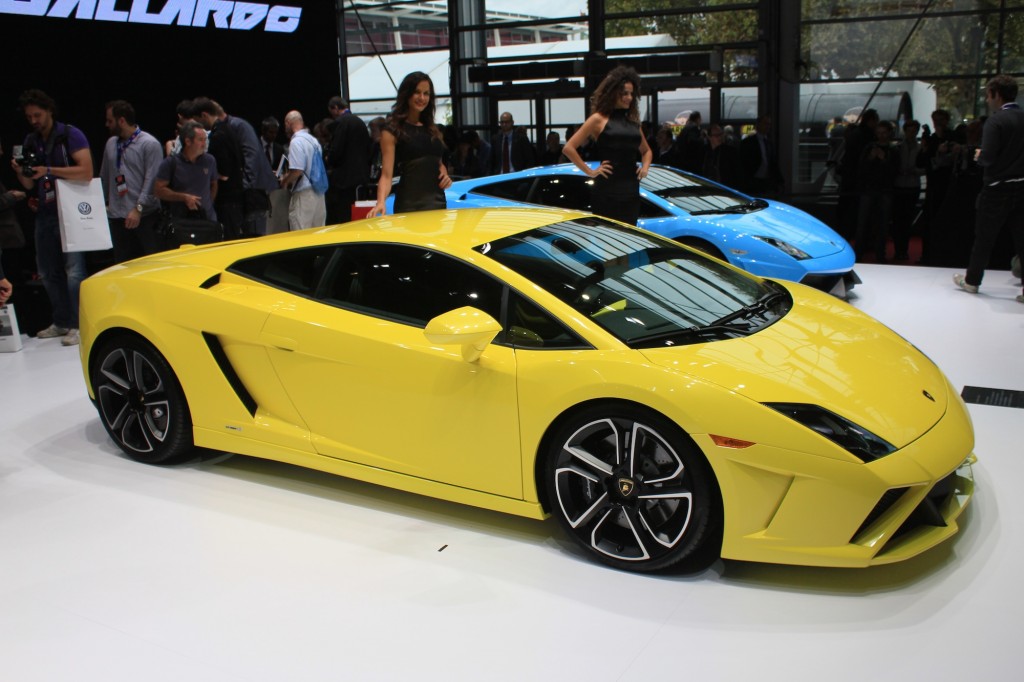
The current Blancfleet fleet includes: Mercedes-Benz S550, Tesla Model S, Lamborghini Gallardo, Mercedes-Benz G550, Land Rover Range Rover Sport, Mercedes-Benz SLS AMG, Porsche 911, and a Nissan GT-R. Prices for the cheapest vehicle – the GT-R start at $83 an hour. Blancfleet has not yet bought the Veyron or the Huayra, but is planning to do so soon. Until then, you’ll have to settle for something equally as cool – the Tesla Model S.
Blancfleet is currently only based in New York City, but is currently building a Blancfleet drop-off and pick-up office in Fort Lauderdale.
It should be worth mentioning to you that copious amounts of drool may ensue while reading this article. If you’re a numbers junkie, read ahead. If you’re an experience junkie, read ahead. If you’re a looks person, read ahead. Well, you got it. There’s something for everybody in this car, and this article! The 2015 Ferrari LaFerrari is the most powerful production Ferrari ever made. Yipe. It’s also the first hybrid Ferrari ever made. Yowza. It’s carbon-fiber tub (where the driver and passenger sit) is made from the same carbon fiber as the frighteningly fast Ferrari F1 cars, and it’s formed by the same team that makes the F1 cars. Wow. It’s name translates to “The Ferrari.” As emissions regulations around the world get harder, supercar manufacturers are forced to turn to alternative different forms of power. McLaren’s powerful P1 hypercar uses two turbochargers, an electric motor, and an already powerful 3.8-liter V8. Stuttgart fired back with an equally impressive salvo that is the 918 Spyder, which uses an insanely powerful naturally aspirated V8 with two electric motors. The LaFerrari is just as, if not more impressive. It’s pretty darn hard to beat a Ferrari V12 for power, reliability, and sound. All three of said cars are spiritual and literal successors to simply amazing hypercars from about 10-15 years ago. The P1 is the successor to the legendary McLaren F1 of the late 1990’s. The 918 replaces the controversial Carrera GT, the car that Paul Walker and Roger Rodas died in late last year. The LaFerrari replaces the stunning Enzo, named for Enzo Ferrari, the founder of Ferrari. But, we aren’t going to be talking THAT much about the LaFerrari’s rivals. The seats are bolted directly to the carbon fiber tub, which means that they are not adjustable. Ferrari tailors seat padding for each and every customer and their passenger. A small lever does move the pedals fore and aft. The flat-bottomed steering wheel adapted from the Ferrari 458 Italia Speciale telescopes and moves up and down. The LCD screen that is the speedometer and tachometer has a 9000 RPM redline, but the engine will briefly go to 9250 RPM. The V12 engine is pulled from the F12 Berlinetta, which means that it displaces 6.3 liters, and puts out a shriek like nothing of this world. It trades low-end power for a higher redline (the F12 stops revving at 8250 RPM, and the LaFerrari stops revving at 9000). It also makes 58 more horsepower (731 versus 789). The 161-horsepower electric motor that is bolted to the back of the equally fabulous seven-speed twin-clutch automatic transmission kicks in at low speeds and when the engine hits redline. There is no EV mode, as Ferrari estimates that the range from the batteries is under 6 miles, and Ferrari has no plans of adding more batteries or EV range. With a combined 950 horsepower, this car is more far more powerful than the 903-horsepower P1 or the 887-horsepower 918 Spyder. This means that the Launch button looks pretty dang tantalizing. Ferrari claims 0-60 in under 3 seconds, but won’t allow any major automotive media publications to gather data. A nice touch is the small plaque at the bottom of the steering wheel, which allows owners to put whatever they want onto it. The steering should be quick, as Ferrari says that the steering wheel will turn just under two turns lock-to-lock. That’s on par with an F1 car. Yet another Ferrari first is the electromechanical steering. That basically means that an electric motor boosts the steering in addition to the power booster. The rear wing moves up and down, yet Ferrari claims that it shouldn’t impede driver rearview visibility too terribly much. The flaps at the front of the hood lift up when the brakes are applied. Combine those two flaps with the rear wing, and the car can generate up to 800 pounds of downforce at 125 mph. The LaFerrari also has an active exhaust system. This means that there is a series of flaps inside of the mufflers to mute the noise when you’re not digging into the throttle. When you get into the throttle, the valves stay open for more noise. Another bonus – the electric motor’s high-pitched whine is drowned out by the wail of the V12! Yet another added bonus is the fact that every single piece of electronics in the LaFerrari don’t interfere with the driver, which means that the driver can drive as fast as they want to (on a track!) without having to fight all of the nannies. That’s a problem with most new cars. Give a driver a car with nannies that they have to fight, and it can lead to a horrible driving experience.


 Or this?




 The Unmuffled Auto News