The Vehicles That Forever Changed the Automotive Landscape

These are not the best cars ever made.  Rather, they are the cars that have shaped modern cars.  I hope that you enjoy my list.  Please share any corrections if you feel necessary.

  • Ford Model T:  This was the car that made the production line possible.  It was also the car that made cars affordable to the American public.  Ford produced well over 15 million of them before production ended in 1927.  They are fairly simple to own, and they can keep up with city traffic if you want.  With so many built, there are many clubs and associations for the Model T all over the country.  Just look up “Ford Model T club <insert your area here>” on Google.  I can practically guarantee you that there is at least one club that you can join if you are the new owner of a Model T.  People drive them all over the place on tours.  You can take one into Alaska if you so please.  There are always plenty for sale anywhere between $10,000-40,000.  If you want to daily drive one, all you need is a good arm to crank-start it, and some adjustments to the timing.  Just retard the timing a big, be gentle with the gas, and you’ll have a car that gets up to 35 mph.  That’s plenty good for most city driving.
  • 1916 Cadillac Type 53:  Every single modern car owes a lot to this Caddy.  It was the first car EVER to come from the factory with an electric starter and a modern control layout, both of which we take for granted today.  The Type 53 wasn’t popular with Americans or the world, mostly because of it’s price (about $3,000).  However, the Austin Seven copied the Caddy and set the die for all cars to come.  Yet, I still credit the Cadillac.
  • 1932 Ford:  This was the first affordable car available to the American public with a V-8 engine.  It had a flathead V-8 making a whopping 85 horsepower.  Today, that’s comparable to a car making 500 horsepower from a V-6 (not unheard of).  Anyhow, it was affordable to some Americans.  It became known as “The Deuce,” as did the third-generation Chevrolet Nova.  It was the fastest affordable car of it’s day, which is why it was the escape vehicle of choice for Bonnie and Clyde.  It’s unclear how many were made, but it’s estimated that well over 1.5 million were sold.  Remember that Ford was selling these cars in 1932, right before the peak of the Great Depression!  It became one of the most popular cars to hot rod.  I want one, and we can call ourselves lucky that there are reproduction steel bodies, chassis (yes, that is plural and singular), and used engines aplenty.  How’s that for cool?  You can build your very own reproduction Deuce for about $20,000.  It’s going to be so much more fun than that Corolla you’ve had your eye on.
  • Willys/Bantam/Ford Jeep:  WWII veterans say that the Jeep was the vehicle that won WWII.  They are right.  It can still embarrass most purpose-built vehicles on a dirt road or in mud.  It was the first 4X4 to be sold to the American public en masse, and it proved to be popular.  After WWII, Willys decided to market the Jeep as an alternative to a tractor for farmers.  Chrysler still rakes in hundreds of millions on new Jeep Wranglers every year.  It’s truly an iconic vehicle.
  • 1948 MG TC:  This little wood-framed British roadster is what allowed such amazing cars as the Lotus Elise, Mazda Miata, and even the mighty Shelby Cobra to be.  Every single great American racing legend – Carroll Shelby, Phil Hill, Richie Ginther, and many others got their start in an MG TC.  On a winding road, this little car that only made 55 horsepower and 64 lb-ft of torque would simply run away from any American car, regardless of power output.  Much of what we hold dear as an automotive enthusiast was started by this little car.  It’s influence on every single sports car from 1948 on is immeasurable.  It’s still fast enough to embarrass a modern Chevy Camaro Z/28 on a windy road.  That’s pretty damn fast for a car that makes 450 less horsepower.
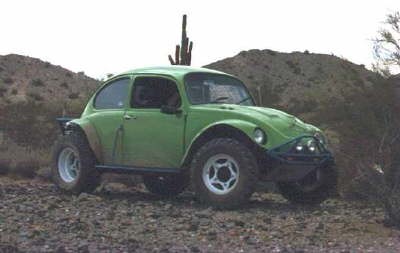
  • VW Beetle Type 1:  It’s the single most-produced car in history.  It’s an elegantly simple design that has stood the test of time better than most cars produced at the same time.  It was the foundation for the legendary Porsche 356, Meyers Manx dune buggy, and VW Transporter bus.  It was FWD, came as either a convertible or a coupe, had a tiny rear-mounted four-cylinder engine, and cost far less than any new American car on the road.  It became extremely popular with people of all ages and demographics.  Many new parents went out and bought a Beetle, and it would serve millions of families around the world faithfully for 20 years or more without major problems.  Most new cars can’t say that.  In the hippie movement, it became extremely popular.  Once the off-roading community got their hands on one, the legendary Baja Bug was born.  It is still fast enough to keep pace with a modern Trophy Truck in the horrible dirt roads of Baja, or the sand dunes of Pismo Beach.  Almost every desert town in the world will have at least several Baja Bugs running around.  It’s fast, sturdy, and capable, yet can be driven around town without complaining.  And the best part is you can build yourself one for about $5,000!  That’s not including a starter vehicle, by the way!  My grandparents owned one.  You probably know somebody who’s owned one.
  • Toyota 2000GT:  This was the car that put the Japanese automotive industry on notice with the world.  It was a more expensive alternative to the Jaguar E-Type, Chevrolet Corvette, Ford Thunderbird, Porsche 911, and the like.  It’s achingly gorgeous, and only a handful were built.  It’s also achingly expensive.  Toyota proved that they could hang with whatever Europe happened to build.  James Bond drove one.
  • Lamborghini Miura:  It’s not the quintessential Lamborghini – that goes to the equally-amazing Countach, but it set the standard for supercars.  It came around because Ferrucio Lamborghini wanted to build a better Ferrari.  When Lamborghini was going to debut the Miura concept car at the Geneva Motor Show in 1965, they didn’t even have a body!  They had a chassis with a V-12, a transmission, and wheels.  That was it.  However, the Miura looks absolutely stunning.  It’s one of the most beautiful cars ever built, and every single supercar owes a lot to the Lamborghini Miura.
  • Citroen DS:  When it debuted in 1955, it was the most technologically-advanced car in the world.  It had hydraulic suspension, a streamlined fiberglass body shell, four wheel disc brakes, a twin-cam V6, and many other technological innovations.  It was one of the first truly modern cars.  One can compare it to the Tesla Model S.  That’s how revolutionary it was.
  • 1955-1957 Chevrolet 210/Bel Air:  The Tri-Five Chevrolet’s are some of the most beautiful cars ever produced.  My personal favorite is the 1957 Chevrolet Bel Air coupe.  The 1955 Chevy became forever immortalized with Two Lane Blacktop and American Graffiti.  Yes, the sinister ’55 is the same car in both movies!  The 1955 Chevrolet introduced the revolutionary Chevrolet small-block (Mouse motor) V-8 to the world.  The 1957 Chevy Bel Air with the 283 cubic-inch V-8 and Rochester mechanical fuel injection became legendary on NASCAR tracks and dragstrips around the country.  It was as fast the Jaguar E-Type 10 years later.  I’m still wanting one!
  • Austin Mini:  Alec Issigonis sketched it on a bar napkin.  He never knew that it would become one of the most popular vehicles of the 20th century.  Let’s forget that it’s a cultural icon for a moment.  It was the first FWD car to come with a transversely-mounted engine (the engine was mounted sideways), which means that it’s the template for most FWD cars on the road today.  It became a motorsports icon in everything from endurance racing to rally racing.  It also became iconic in several movies – The Italian Job, The Bourne Identity, Mr. Bean, and Goldmember.  It’s also a major cultural icon.
  • Ford Explorer:  This was the vehicle that kicked off the SUV craze of the 1990s-today.  It was based off of the lowly Ranger pickup, but had a comfortable interior and the second generation had good looks.  It’s still a best-seller today.  It’s popular with the off-road community because it’s a Ranger with more space for people.  My parents owned one.  You probably know somebody who’s owned one.
  • Shelby Cobra:  Yeah it’s an obvious one for this list.  Carroll Shelby took a British roadster, and put a small-block Ford motor from the Mustang into it.  Then, he went hog-wild and put a big-block Ford into it.  That catapulted the Shelby Cobra into automotive fame.  Anybody who knows something about cars knows of the Shelby Cobra.  It could hang with anything.  It could beat a Chevrolet Corvette with the coveted L88 big-block V-8 in the curves and straightaways.  It dominated endurance and road racing for a glorious 3 years before Shelby stopped production of it.  It also dominated the NHRA Pro Stock drag racing class for a few years.  Today, there are at least 20 different companies who will sell you a Cobra replica.  Get a Factory Five replica.  It’s Shelby of North America licensed, and it comes with modern mechanical parts, yet can still hang with a modern hypercar.  
  • Chevrolet El Camino:  In it’s first generation, it was quite a looker.  Chevy didn’t sell too terribly many of the Impala-based ute, but you’ve probably seen a few driving around your town/city.  The second generation proved to be much more popular.  It was based off of the massively popular Chevelle, and you could get one with the rare, coveted LS6 V-8.  I remember reading an article about an owner of an LS6 Elco (a nickname for the El Camino), and he said that he has to drive it around with sandbags in the bed to keep it from spinning out.  That’s what happens when you have a massively-underrated 450 horsepower and no weight over the rear tires.  If you could get it to hook up, it would go through the 1/4 mile in 13 seconds flat at 125 mph.  That’s about as fast as a modern sports car.  I’ve heard driving one isn’t any different than driving a Chevelle, except for throttle modulation.  Flooring it from a stop, even with the still-powerful 327 cubic-inch V-8 will give a glorious burnout.  I want one.
  • 1968-1970 Dodge Charger/Charger 500/Daytona:  The second-generation Dodge Charger is one of the most beautiful cars ever built.  It’s got muscular elegance.  It had curvy “Coke Bottle” styling, and a plethora of engine choices.  The base engine was the “poly” 318 cubic-inch small-block V-8 that stayed in production in one form or another from 1959-2004.  The next step up was the 383 cubic-inch “Commando” big-block V-8.  After that, it was the 440 “Super Commando” big-block V-8.  One rung above that was the 440 Six Pack – a 440 with three two-barrel Holley carburetors.  The top of the ladder was the mighty 426 HEMI “Elephant Motor” big-block V-8.  The Charger 500 was designed for NASCAR, so it had a rear window flush with the body, along with other small aero modifications.  The Daytona was truly legendary.  Only 503 were sold to the general public, only 70 of which had the 426 HEMI.  The rest had the 440 Six Pack.  It was designed for NASCAR superspeedways, and it truly dominated.  It looked comical with it’s 19-inch long nose cone and nearly two-foot tall rear wing.  The only reason the wing was so high is that anything shorter and the trunk wouldn’t close! The Charger was catapulted into fame by The Dukes of Hazzard for one generation, and for the millenials, they were captivated by the supercharged 1968 Charger used in Fast & Furious.
  • Datsun 240Z:  This little Japanese sports car wasn’t a smashing success, but it certainly left it’s mark on sports cars.  It was light, looked drop-dead gorgeous, had a reliable, powerful engine, and a five-speed manual transmission.  Very few cars at the time had a five-speed.  All of that combined meant that it was a serious threat on a windy road.  Today, they are becoming collector cars, which is a shame, as they are built to be driven.  That’s not to be said that you can’t find a cheap one – you still can.  Hot rodders who are enamored by Japanese cars, but love the power of an American V-8 put a Chevy small-block V-8 and some suspension bits in, and have one hell of a ride.  My grandparents and dad owned one.
  • Audi Quattro:  This AWD notchback with a turbocharged 5-cylinder engine was so successful on the rally circuit that AWD was banned from the sport for about 10 years.  Stock, it’s not at all reliable (except for the first two years of production), but upgrading the engine internals will give you a strong, reliable, fast, and cool daily driver.  It’s truly an all-weather car.  I chose this car because of the impact that it had on rallycross and rally racing.  Any car with AWD past 1985 would have been much worse if it weren’t for the Audi Quattro.  My uncle owned one.  He should have kept it and given it to me.
  • Ford Mustang:  This was the car that started the ponycar craze.  No matter how much Ford hypes it as a muscle car (and Chevy with the Camaro), it IS NOT and never will be.  It is a pony car.  The Dodge Challenger is a muscle car.  Sorry Ford, but I’m just stating the truth.  Don’t shoot the messenger.  That being said, Ford introduced a whole new type of car to America.  Buying a Mustang with the base six-cylinder engine meant that you were carefree but had to watch your cash.  Getting it with the V-8 meant that you were carefree, but who cared about money – you only live once!  Getting it as a convertible only reinforced that.  The Shelby GT350 Mustang of 1965 was part of a deal with Hertz where you could rent the car on Friday, drive it to the racetrack on Saturday, race and win, go again on Sunday and win, and then drive it back to the rental lot.  It was somewhat streetable, but it really did well on the racetrack.  Carroll Shelby originally didn’t want to do it – he told Lee Iaccoca that “Lee, you can’t make a racehorse out of a mule.”  Yet that so-called mule became a massive racing success.  It’s still in production 50 years later.  Many American moms went from a station wagon to a Mustang and never looked back.
  • Pontiac GTO:  Originally offered as a package on the mid-size Tempest in 1963, the GTO took the thundering 389 cubic-inch V-8 from the Le Mans and shoved it into the considerably smaller Tempest.  It was a smashing success, so Pontiac decided to turn it into it’s own model in 1964.  It was much more popular that way, and the ultimate model was the 1969 Judge Ram Air IV.  It came with the then-new 455 cubic-inch V-8 and a functional Ram Air hood (the Ram Air package came in four stages), a Muncie M-22 “Rock Crusher” transmission, and bodywork that let you know that you really were king of the street.  It was truly stunning, especially in green.  It went dormant for 20+ years before appearing as a rebadged Holden Monaro in the US.  It wasn’t very popular.  It’s probably because Ford launched the retro-styled S197-generation Mustang right around the same time.  The 2004-2006 GTO looked nothing at all like any other GTO.  It didn’t look very good.  Nowadays, the modern “Goat” is popular with hot rodders who want to have all of the modern conveniences and glorious power.  Some even take the body off of the GTO and put on a classic car’s body.  Voila, you have a car that looks like a classic, but handles and drives like a new car.  Plus, they are easy to put bigger engines in.  Drifters are starting to find them.  Beware.
  • Lexus LS400:  This big Lexus was the car that sent Germany scrambling back to the drawing board.  The LS400 competed with the Mercedes-Benz S-Class and BMW 7-Series.  The German cars were stodgy cruisers that were heavy, large beasts on the street, but smooth on the highway.  The Lexus took that trademark Japanese agility and feeling of being a smaller car, threw in a buttery-smooth engine and transmission (the ads showed a champagne flute on the hood while the engine revved.  The champagne never overflowed – or came close to that!), a sumptuous leather interior, and made it a fun car to drive.  Lexus kept it in production from 1989-2000 in one basic form or another.  It sold well, and is a completely bulletproof car in terms of reliability.
  • Chevrolet S-10:  OK, I am a bit biased on this, but hear me out.  The Chevrolet S-10 replaced the dismal LUV pickups of the 1970s in 1982.  It came with an underpowered 4-cylinder engine or a more powerful 2.8-liter V-6.  In 1988, Chevy added their new 4.3-liter V-6 to the S-10.  It literally doubled the towing and hauling capacity, as well as making it a far more enjoyable truck to drive.  My S-10 is a 1989 Tahoe model.  That means that it was top of the line.  It has a cloth interior, an AM/FM radio, air conditioning, and it has fuel injection (the 1988 model had a carburetor).  You could get it as a regular cab or an extended cab.  Bed sizes were a 5-foot bed or a 6.5-foot bed. That’s not huge, but for somebody in a crowded city who needs a pickup, it’s perfect.  You could get it in 2WD or 4WD.  Mine is 2WD.  It was wildly successful, and you can still see a lot on the road.  Some people are taking modern Chevy LS3 E-Rod engines (smog-legal V-8’s) and stuffing them into an S-10.  They’re quite the sleeper.
  • Porsche 911 Turbo:  When it first debuted in 1975, it was a total animal of a car.  Lift off of the gas going into a corner, and you’d hit the guardrail with the backside of the car.  You had to keep your foot in it.  It made an underrated 276 horsepower (think closer to 350), had no ABS, a clutch that was so stiff that some had to literally push their leg down to depress the clutch, and a 5-speed manual transmission.  It was a total monster of a car that dominated the racing circuits, but was completely and totally unstreetable.  But, put one on a windy canyon road, modulate the throttle, and you had a recipe for speed.  Porsche still makes it.  However, it now makes a ridiculous 520 horsepower, and is truly the ultimate all-weather supercar.
  • Ford GT40:  This was the car that dominated endurance racing during the 1960’s.  It was the result of Enzo Ferrari refusing to sell his company to Ford in 1964.  Henry Ford II decided to beat Enzo Ferrari at his own game on his own turf.  Talk about owning a bully.  The GT40 was aerodynamic, muscular-looking, and was built for racing.  Ford built about 20-40 for the street (it’s unclear how many).  The first models came with a Shelby-tuned 289 cubic-inch V-8 that made 300 horsepower via a tri-power (three two-barrel carburetor) setup and forged internals and an Isky cam.  This engine was so durable that when Ford disassembled the engine after the season was over, it looked brand-new.  Later models came with Ford’s mighty 427 cubic-inch FE-Series “Cammer” engine.  This engine was the same one in the Shelby Cobra.  It made about 500 horsepower.  Both engines were mated to a four-speed manual.  The GT40 simply dominated the 24 Hours of Le Mans and 24 Hours of Nurburgring.  It was insanely fast, and it could be heard from over a mile away.  It beat Ferrari at their own game for years, before the FIA changed the rules, and both Ferrari and Ford had to comply.  Ford pulled out of Le Mans endurance racing for 20+ years and let Ferrari dominate.


Yes, that is a young Harrison Ford standing next to one of the most iconic hot rods ever.  It’s a 1932 Ford Hi-Boy (the body was lifted off of the frame so the frame could be tweaked).  It has a Chevy 283 cubic-inch small-block V-8 with crackling sidepipes.  This was the car that made me appreciate the little deuce coupe.
This is a fuelie 1957 Chevy Bel Air.  It became known as the “Black Widow” because it only came in black with white tape stripes, a black-and-white interior, and the red center caps on the wheels.
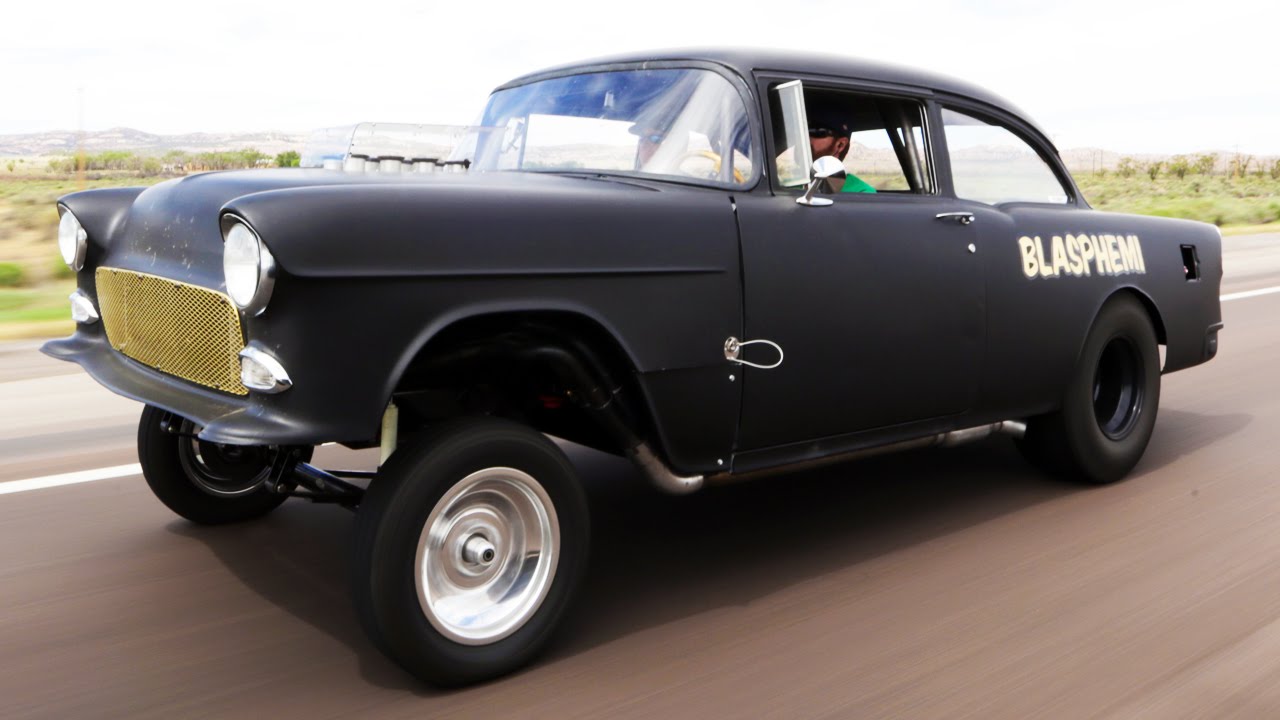
This is a gasser.  Gassers got their name because of the drag racing class they were in (B/Gas or blown/gas).  They had big engines with no supercharger, or smaller supercharged engines.  Look up “Roadkill Blasphemi” on YouTube for the build and cross-country blitz of one of my favorite cars – “Blasphemi.”

This is probably the ultimate Shelby Cobra.  It’s called the “Super Snake” because it has twin superchargers on top of an already-powerful engine.  Bill Cosby almost bought one, but took it on a test drive and thought he was going to die.  Carroll Shelby bought it.  Only two were made, but it was incredibly fast.  It’s rumored that in testing the car hit 210 mph – in 1966!  To me, it’s the ultimate factory hot rod.

This is a 1969 Dodge Daytona replica made by a host of the /DRIVE Network, Mike Musto.  It’s one of my favorite cars ever.  He took a 1969 Charger and turned it into a Daytona.  It’s the ultimate cross-country cruiser.  Just looking at it sends shivers down my spine.

The only stock part about this Mustang is the roof, A-pillar, and C-pillar.  It’s the latest creation from the brilliantly mad folks at RTR and Hoonigan.  Ken Block had it built.  It’s got a stroked NASCAR-spec engine that makes 850 horsepower that goes to all four wheels.  That’s right, this car is AWD.  You need to watch “Gymkhana 7” if you haven’t already.  It’s simply amazing.


What Era of Motorsport Was the Best?

This idea is simple:  What era of motorsport was/is the best?  What drivers were/are the best?  What motorsport was/is the best?  What cars were the best?  What track was the best?

For me, I can’t choose just one.  1960s Top Fuel drag racing was the best of the 1960s.  There were plenty of big names competing against smaller names, many of whom have been lost to the sands of time.  Some of those names we are familiar with – Don “Big Daddy” Garlits, Don “The Snake” Prudhomme and Tom “The Mongoose” McEwen (anybody who’s ever had a large collection of Hot Wheels has/had models of their cars).  Their cars were spectacularly fast (Garlits was the first to break 200 mph in his Top Fuel dragster), and they always put on one hell of a show.  I’m going to say that Lions Drag Strip in Long Beach, CA was the best.  While I never visited it (it closed in 1972), it is rumored to have been one of the best drag strips ever.  If you’re into Facebook, look up “THE GLORY DAYS OF DRAG RACING.”  It’s a closed group, but they will let you in.  It’s got a lot of great vintage photos.  Read their rules before posting something.

Another great one for me was 1980s Formula 1.  Ayrton Senna, Alain Prost, Mario Andretti, and the late Clay Regazzoni.  It was a fierce era of turbocharged cars with well over 1,000 horsepower duking it out on the fastest tracks on the planet.  BMW had cars with 1,400 horsepower and manual transmissions (yes, you had to take your hand off of the steering wheel in a tight corner in a powerful car to shift).  Ayrton Senna and Alain Prost simply dominated the sport until the tragic death of Senna in 1994.

Finally, I’m going to say that 1980s-current off-road racing is great.  I mean, who doesn’t like watching Ivan “Ironman” Stewart bombing around Baja in his Toyota trophy truck?  Or for those American car fans, how about Robby Gordon and his HUMMERs from a long time ago?  To me, it’s the most entertaining form of motorsport, and I’ve been hoping to travel to Baja to watch the Baja 1000 for a while.

Here are some of my favorite pictures to prove it.

Hilariously Cheap Winter Beaters!

So, we all remember that big post I did a while back on the best cars for winter, right?  Well, these cars will fit into almost everybody’s budget.  They’re sure to put a big smile on your face, and you’ll miss them because of the fun factor – not for being collectible.

Any Subaru (preferably turbocharged):

Subies come in all shapes and sizes.  The older they get, the cheaper they get.  They also come with less amenities than your couch.  That being said, any Subaru from the last 20 years will likely only need basic work done to it (tires, alignment – if you’re lucky.  All Subaru engines need a new head gasket at some point).  It will take you through all kinds of weather, and the AWD will save your butt all over the place.  Plus, they are fun to drive, and they don’t need tire chains in the winter!

This is a Subaru in it’s natural element…

If you can’t swing the WRX, go for something older.

This is the Subaru SVX.  It was Subaru’s much-maligned sports car of the early 1990s turbo hype.  It wasn’t very successful on the racing circuit, but you can stuff a late-model Subaru engine into one without too much work.  It looks funky, but it will be the only sports car from the 1990s that is driving around your town in the winter.

Long-bed, full-size pickup trucks:

They come in all shapes and sizes.  You can get them with a regular cab, extended cab, or crew cab.  They come with engines in all shapes and sizes.  If you get a heavy-duty version, you can get a job as a snowplow driver with it.  You just go to the dealer and have them install a snowplow kit, go to the local chamber of commerce, and become a snowplow driver.  Snowbelt towns are always in critically low supply of snowplow drivers (for very good reason), but they lure folks in with benefits (hot drinks) and reasonable pay.  You can pick them up for next to nothing, but make sure that it is in good running condition.  Oh, and it should be 4X4.  If it’s a GM pickup, you can yank the engine out and put it into that poor project car in your garage that just needs an engine.  It will run forever, and you can go to any junkyard in the country and find parts for it.

1980s Chevrolet Camaro:

You know/remember them well.  The IROC-era Camaro’s that had little more than big wheels and body kits on top of pitiful engines.  Well, most states don’t require smog for cars like that.  That means you can go straight to nelsonracingengines.com and get yourself a 2,000 horsepower, twin-turbo Chevy small-block V-8.  Oh, and get a set of studded tires.  You’ll never be stuck again.  Or, you can just get a crate naturally-aspirated small-block Chevy engine for a few thousand.  You can throw on a better set of suspension, have good summer tires in the garage, and go autocrossing and bombing around the roads in the summer.  Sounds like a good package to me.  Oh, and you can get them for a few grand.  You’re thinking what I’m thinking.

This is stock.

This is not stock.

Jeep Wrangler:

It’s a Jeep.  Need I say more?  It will take you anywhere and everywhere without complaining.  You don’t buy a Jeep and keep it stock.  It’s got one of the largest aftermarkets in the world.  You can build a rock-crawler, a dune-basher, an autocross machine, and a dragster.  Oh, and everything in between.  Lift kits can range from about $1,000-5,000.  That leaves you plenty of money for tires, wheels, interior doodads, engine/transmission upgrades, and various other items.  What I’m saying is you can do anything to a Jeep, and somebody else will have done it before you.  There is no first.  Just make sure that the heater works.  Oh, and getting one with the bullet-proof 4.0-liter I6 is a good choice.

This is stock.  Notice how small the wheels and tires are?  Yeah, that will have to change.

This is an infamous Willys.  Look up “LSX Willys” on YouTube for proof.  It’s the ONLY Jeep in the world to beat a Corvette ZR1.  I think all that it needs is a set of studded snow tires and a fearless driver.

That’s all I have for you today.  If you have a hilariously cheap winter beater that you drive all of the time in the winter, tell me in the comments section.  I might even do a part II!


What Happens When You Put 50 Party Horns Into an Exhaust Pipe?

Well, it’s pretty shrill…and funny.  It sounds like, well, a bunch of party horns going off at once.  If you watch this without busting a gut, there’s something wrong with you.  It’s going to be the funniest 15 seconds of your life…guaranteed (or you get something back).  https://www.youtube.com/watch?v=iELnlCZPR5Y

I’m very tempted to do this to my car, as it has dual exhaust pipes.  Yup, that means I’ll have 100 party horns.  Maybe somebody with a Top Fuel dragster will do this, but they’ll need fireproof party horns!

Out and About

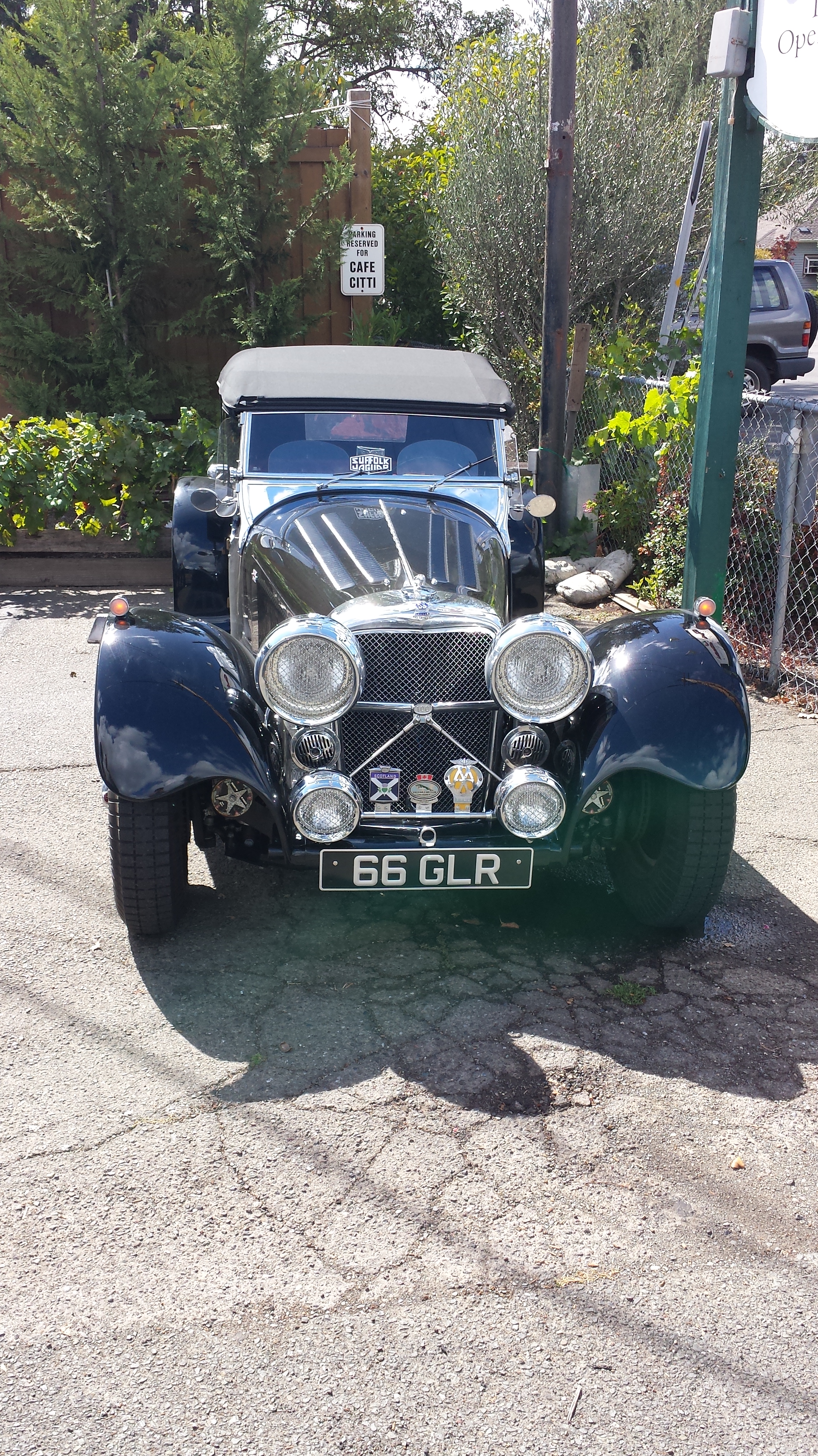
A little while ago, I saw this wonderful old Jaguar at a local restaurant that is a favorite amongst the Sonoma County locals.  I just had to post this picture.

20140925_140831

I hope that you enjoy it as much as I did.  This picture truly doesn’t do justice to the car…it’s beautiful.  Not exactly fast, but it’s not meant for outright speed.  It’s meant to put a big smile on your face, whether you are driving it or just looking at it.

Why Supercars Aren’t Cheap to Maintain

Supercars are constantly redefining how crazy cars can be.  Think about the 1990s.  The McLaren F1 was the fastest car in the world until the Bugatti Veyron.  The Lamborghini Diablo wasn’t nearly as fast, but it was just as raw and pure of a driver’s car.  However, the car that one can argue defined the 1990s supercar wars was the Ferrari Testarossa.  It wasn’t the fastest, the most terrifying, or most exhilarating.  What it did do, however, was pave the way for supercars as we know them now.  Yes, that means being completely unaffordable to the general population and outrageous repair costs.

This blog post is by no means meant to make supercars from the 1990s and first decade of the 2000s seem like horrible messes of cars that are best left to be stared at in museums.  Drive these cars.  It’s what they’re meant for.  Grab they keys and floor it if you get the chance.  Just remember to set aside a LOT of money to repair them.  Oh, and find a really good mechanic.  Just because they say that they service European cars does NOT mean that they will service your Lamborghini Diablo.  They will, but they will likely do it badly and cause further damage to something that is expensive.  Ask them if they service your supercar.  They can usually point you to somebody who will if they can’t.

Many jobs require special tools for that car and that car only.  Your Craftsman toolset will do irreversible damage to your car.   Doing a simple task such as changing the oil, which might take an afternoon in your mom’s Toyota Camry, can turn into a five-day knuckle-bashing fest on a McLaren F1.  Let’s not even start on the Ferrari Enzo.

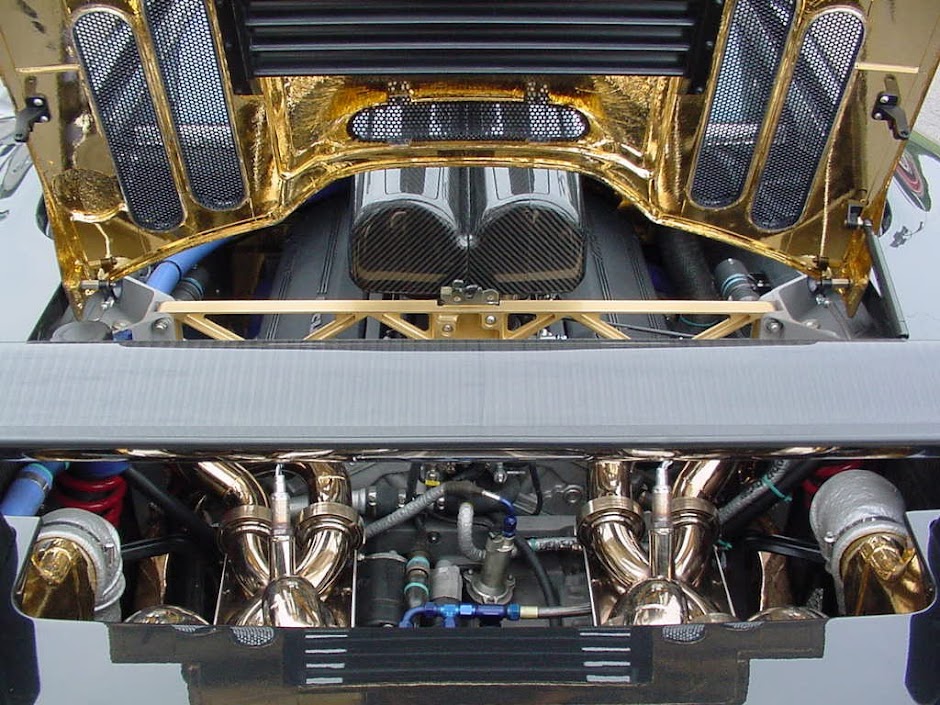
Yes, that’s a stock McLaren F1 engine bay!  The gold throughout the engine bay is actual gold leaf.  The exhaust is titanium, and no, the blue connectors are not for nitrous.  They are for fuel delivery.  That engine bay looks like a lot of fun to access!  No wonder it takes five days to change the oil…

McLaren estimates annual repair costs to be about $30,000, which doesn’t seem too bad until you find out that an oil change is $8,000.  You can even ship your F1 to McLaren’s factory in Woking, UK for repairs, where McLaren employs two full-time F1 technicians for F1 repairs alone!  That’s what Ralph Lauren does for his THREE F1’s.  Yeah, that blazer you bought is going to good use.  McLaren suggests replacing the tires in pairs ($3,000 per tire!).  McLaren scrubs in every set sold, for free.  That means that they custom-make the tires for free!  Service can take up to 6 weeks – not including transit to the UK.  It’s ten days door-to-door by air, seven weeks by boat.  The bright side?  The car is appreciating so quickly that repair costs will never catch up to their now-astronomical price.  Chumps.

This is the floor of the customer service department of McLaren’s Woking factory.  It might not be so bad to come here after all…

That being said, the McLaren F1 is one of the most amazing cars to ever come out of a factory.  It was the fastest car in the world for almost 20 years, and the driving experience is supposedly second to none.  It’s also going up in price really quickly.  Get one now if you want.  Yeah, your kids only need a semester at Stanford anyways!

This is a Ferrari Enzo engine bay.  Not exactly pretty, but it gets the job done!  I’m a fan of the massive intake manifold and massive shocks.  Those two gold tanks are gas reservoirs. An astute commenter corrected me – they are not fuel pumps, as I originally thought! They are gas-filled reservoirs that keep the fluid in the shocks, called damping fluid, under constant pressure. Given the massive speeds the Enzo can easily hit, a single small bump in the road could prove catastrophic, so these reservoirs are necessary.

When you buy an Enzo, you’d better have every single piece of paper detailing EVERYTHING that was done to it!  If you don’t, be sure to spend far more than the service cost off of the asking price!  When something goes wrong, it goes from a relatively inexpensive fix to a SNAFU in seconds.

Oil or shop fluids will irreversibly damage at least one $6,000 carbon-ceramic brake rotor, so a set of factory covers protects them during service.  I’m not joking!

Each authorized dealer must buy a $10,000 special tool kit and this scissor lift to work on an Enzo.  The massive V12 takes 12 quarts of oil.  That’s a lot.  Most cars take around 7.

Oh, and a word for the wise – warm up the Enzo’s big V12 with the $60,000 carbon fiber engine lid open, and the carbon fiber intake body will expand enough that the lid won’t close until the engine cools off.

This is a Porsche Carrera GT engine bay.  This car has long been the source of heated controversy, which only heated up after the tragic deaths of Paul Walker and Roger Rodas almost a year ago (they died on November 30.  I will do a one-year memorium post on that day).

Like every other Porsche, the Carrera GT gets an oil change every 15,000 miles.  No, it’s not based off of a semi truck engine, but good guess!  The entire car was a shelved endurance racing project from the 1990s, so it was built to be reliable.

An oil change is $3,000 because:

  1. A set of four ramps ($1,100) is required to get the car over the hoist arms on the lift.  Yes, it’s that low.
  2. The rear-heavy car has to be attached to the lift so it doesn’t tip or fall off of the lift.  A $550 set of 3/4 inch aluminum plates bolt onto the car for that purpose.  Most owners leave them installed.
  3. Two engine-oil filters – one replaceable and one reusable screen.  Strip the drain plug in the aluminum cover, and you’re down $6,800.

Replacing the ceramic clutch is $25,000, including labor.  By comparison, a $30,000 full brake job is a steal by comparison.  You can see how these mechanics live well.  When the Carrera GT was new, dealers had to buy a special $10,000 table and $8,000 jig to hold the car’s engine during service.

Overall, maintaining a supercar isn’t easy or cheap.  Should you buy one of these cars, make sure that there is a piece of paper detailing everything done to the car.  You’ll thank me later.

The Best Holiday Gifts for the Car Enthusiast!

The holidays are rapidly approaching.  We’ve all got at least one car enthusiast in the family.  Here’s what to get them (or you!).

Calendars

Hemmings Motor News has always had a great selection of calendars.  There’s pretty much a calendar for every car lover here.  You can’t go wrong.  http://www.hemmings.com/store/calendars

Calendars are helpful in many more ways than sitting up on the wall.  Write down schedules, birthdays, etc. on the best calendars for car lovers.

Books

This is going to be a really good, long list that I really want.  Maybe I’ll see some around the holidays…(I know, more of my shameless begging)

  • Miller’s Time: A Lifetime at Speed
    • Don Miller went from street racing to being the guy who stood next to Roger Penske for over 30 years.  He’s set records at the Bonneville Salt Flats, been in Victory Lane at Indy multiple times, built cars from nothing more than a pile of steel tubing and a welding machine, and taken a kid from ramshackle dirt tracks to a Winston Cup title.  If you’re ready for racing honesty and humor, GET this book!  You can get it for about $30 on Amazon, and you might be lucky enough to get a signed copy!
  • Getting Started in the Collector-Car Hobby
    • This book from the fabulous Hemmings Motor News staff details many important aspects of the collector-car hobby for a newbie.  It’s only $6.95, and that family member or friend will be thanking you when they get that cool old car!
  • Ayrton Senna – McLaren
    • I’ve heard great things about this book.  It details the racing life of a legend through the people who knew him best – his teammates, mechanics, engineers, and management staff for his McLaren team.  His dream was to help underprivileged children in his home country of Brazil.  The Ayrton Senna Foundation, established shortly after his tragic death in 1994, has helped over two million kids in Brazil.  This book has been written with the full support of his family, something rare in the racing world.  A portion of the money used to buy this book will go to the foundation to help more children.  You can find a new one on Amazon for about $40, and you’ll help Brazilian children, and enjoy a good book.
  • MotorBinder
    • This book offers an astonishingly cool peek into the golden age of motorsport – when amazing ingenuity, drivers with no fear, and no such things as crowd control existed in race cars.  It’s a beautiful anthology of pictures, mostly taken at California tracks, but also at Nassau and Indy, as well as other famous race tracks.  It focuses on the action and personalities of such legends as Sir Phil Hill, Carroll Shelby, Roger Penske, Sir Stirling Moss, and Bruce McLaren, among others.  Many of the pictures have never been seen before, many of which were taken by the San Francisco Chronicle motorsports editor, Gordon Martin.  It’s $69 on Amazon, and truly amazing.

Of course, there are far more books than these, but these are the ones that I would recommend in a heartbeat.

Clothing

OK, talk about a HUGE list!  Everybody always wants cool clothing.  I’m going to try to keep this list sane, but I make NO promises!

  • Hemmings Motor News Polo Shirt
    • Polo shirts are nice.  They make you look classy, but casual.  Car enthusiasts love them.  Here’s one that will strike a conversation with any car lover.  http://www.hemmings.com/store/wearabledetail?category2=HBPOLO
  • Hemmings Muscle Machines Youth T-Shirt
    • Here’s one for the kiddos.  It’s the same as the Hemmings Muscle Machines T-Shirt for adults, just pint-sized.  It features brightly-colored cars from America’s fastest decade, and it’s sure to be a favorite among them.  I promise.  http://www.hemmings.com/store/wearabledetail?category2=MUSMY
  • Hemmings Work Shirt
    • You should NEVER work on your classic without a work shirt.  They are durable, easy to wash, and can be sharp enough to go out in public in.  Here’s one you’ll wear with pride.  http://www.hemmings.com/store/wearabledetail?category2=HWKST
  • Hemmings Motor News Hats
    • Hemmings Motor News has a nice selection of ball caps.  There’s one for everybody.  Here’s my personal favorite.  http://www.hemmings.com/store/wearabledetail?category2=blkh
  • Roadkill “Original Vintage Tee”
    • I have this t-shirt.  I love it.  I get a lot of thumbs ups from fellow car nuts.  And a lot of questions (i.e. Why would you wear a shirt that has the name of dead animals on the side of the road?).  Get it while supplies last.  http://www.musclecarmagswag.com/index.php?route=product/product&path=66&product_id=129
  • Roadkill Dickies Jacket.
    • Roadkill is sponsored by Dickies.  Freiburger is always wearing a Roadkill Dickies jacket.  You can join him and other Roadkill fans by buying this Roadkill Dickies Jacket.  It’s expensive, but it’s cool and I want one.  http://www.musclecarmagswag.com/index.php?route=product/product&path=66&product_id=113
  • Super Chevy Men’s Racing Shirt
    • Racing shirts are cool.  I should get some.  This is one I want.  Hint, hint.  http://www.musclecarmagswag.com/index.php?route=product/product&path=59&product_id=58
  • Mopar Muscle Garage T-Shirt
    • Show off your Mopar allegiance with this t-shirt.  I’m a fan of different cars, but I’ll always have a soft spot for Mopars.  This is a cool t-shirt styled like something from the 1970’s, but with a modern twist.  http://www.musclecarmagswag.com/index.php?route=product/product&path=60&product_id=89

OK, that’s it for clothing…you’ll find something for me in this list, right?

Diecasts

Diecasts are different than the cheapy DIY cars you can get at Michael’s.  Those things don’t fit together well and take forever to build.  Getting a diecast means that it’s made out of high-quality materials, and comes in a box ready and waiting for you.  How nice is that?

  • Hemmings 60th Anniversary Gas Pump Island
    • Limited to just 1250 units, this 1:12 scale model has six separate pieces that will make a great addition/start to a diecast collection.  It’s got a base/pump island, a tall Hemmings sign, two sandwich boards showing scaled-down versions of real Hemmings signs, two Gilbarco gas pumps with Hemmings 60th Anniversary logos, and a Hemmings oil can display.  This is cool, and what makes it even better is that the gas pumps are also coin banks!  The hose nozzle unlocks the coin door on the bottom.
  • Ford GT White 1/12 Diecast
    • The Ford GT was really the American supercar of the first decade of the 2000s.  Ford took the supercharged 5.4-liter V-8 from the F-150 SVT Lightning pickup, and tuned the engine up to 550 horsepower.  It’s really, really cool.  While prices of the real thing are going up and up, diecast prices aren’t!  http://www.ebay.com/itm/FORD-GT-WHITE-1-12-DIECAST-MODEL-CAR-BY-MOTORMAX-73001-/150302163215
  • Mercedes-Benz SLR McLaren
    • This was Germany’s answer to the Ford GT, Ferrari Enzo, and Porsche Carrera.  It was diabolical.  It looks demonic in black, and you can own one…kind of!  http://www.ebay.com/itm/HUGE-MOTORMAX-1-12-MERCEDES-BENZ-SLR-MCLAREN-DIECAST-MODEL-CAR-BLACK-/351062371729

Miscellaneous Items

This is the random (but still cool) stuff.  It’s stuff life water bottles, shot glasses, tool kits, etc.

  • Hemmings 60th Anniversary Wall Clock
    • It’s pretty amazing that the “Bible of the Hobby” has been around for 60 years.  What better way to remember that by looking at a cool clock?  http://www.hemmings.com/store/detail?product_id=1883
  • Car Quiz for the Classic Car Aficionado
    • Think you and your family/friends know a thing or two about classic cars?  You’ll love this game!  Give everybody a run for their money!  http://www.hemmings.com/store/detail?product_id=1199
  • Hemmings Aluminum Water Bottle
    • Sometimes it’s nice to have the nice feel of aluminum in this world of crinkly plastic.  Get this solid Hemmings water bottle.  http://www.hemmings.com/store/detail?product_id=1679
  • Hemmings Fleece Blankets
    • Stadium blankets are useful for more than just going to the game.  They’re great for spontaneous picnics, and car shows.  These navy blue blankets have the Hemmings logo embroidered into them.  They roll up courtesy of nylon straps with handles for easy carrying.  http://www.hemmings.com/store/detail?product_id=1054
  • Hemmings Flashlight, Pen Set, and Tire Pressure Gauge
    • Keep this in your glovebox, and you’ll be prepared for map reading in the dark, jotting down important numbers, and checking tire pressures.  Plus, it comes in a nice case.  http://www.hemmings.com/store/detail?product_id=1391
  • Roadkill Shot Glass
    • This is a sharp-looking shot glass.  You can drink your favorite adult beverage from a shot glass with your favorite car show on it.

Of course, there’s plenty more in terms of miscellaneous car odds and ends.  Just go to a local car dealership and mosey around (do it when you take your car in for service).  See what you can find.  You’ll be surprised.  Ask the sales staff.  They’ll be happy to help!

Going to a car show is also a good place.  Bring cash and/or credit cards (sometimes they only take cash).  At big car shows, manufacturers will often have merchandise like a thermos, a bag, and random stuff like that.  Chat them up.  They’re often stressed, tired, and are happy to talk to you about anything related to that brand.  They really open up, and they are very knowledgeable about the technologies in the various cars on display.

The World’s Hardest Car Quiz!

No, I haven’t passed it yet.  I recommend taking it…over and over again.  My best score to date on this has been 60%.  And I thought I knew a lot about cars.  Go figure.  Try to take the quiz and pass – it’s harder than you’d think (even if you ARE a natural test-taker!).

http://www.carwow.co.uk/world-hardest-car-quiz

Tell us your score(s) – we won’t make fun of you for failing (I’ve done that a few times with this quiz)!

The whole point of this quiz is to have fun…so do that!

The Best All-Weather Cars for the Holiday Season Part 1

The holiday season is a time when many of us travel (sometimes by plane, sometimes by car – I highly recommend by car!) to see our families.  If you’re in the market for a new (or used) car to see your family in, here are my recommendations of 2014.  Some of these cars are new, and some of them are old.

  • 2014 Chevrolet Suburban:  Chevy’s biggest SUV offering has been redesigned for 2014.  It’s got handsome styling, more space, more efficient engines, and it’s just a very good choice if you need the space.  Just one engine/transmission choice is available – GM’s 5.3-liter EcoTec V-8 and the antiqued 6L80 six-speed automatic transmission.  The engine itself is a solid engine, but the transmission favors high gears for better fuel economy.  It’s got four (yes, four) USB ports up front alone, power-folding second AND third row seats, and enough legroom for tall people.  The Suburban can tow up to 8,500 pounds, which is probably more than most people will ever need.
  • 2014 Ford Expedition:  Ford’s gigantic competitor to the Chevy Tahoe, Suburban, and GMC Yukon/XL/Denali twins is a solid choice.  It’s got a torque-filled 3.5-liter EcoBoost V-6, lots of space for whatever you should find to throw into it, and good value.  However, nothing about it is cutting-edge.  The styling is essentially a warmed-over version of the ugly previous generation, and one can make a good point that it’s a styling regression.  The continuously variable dampers in the suspension likely gives amazing ride quality.  It can tow a lot – up to 9,000 pounds if properly equipped.  That should be enough to take the snowmobiles and off-road machines.
  • Tesla Model S P85D:  This is the real performance car for the family that you want to buy.  Forget the Mercedes-Benz S63 AMG 4Matic.  The P85D’s benchmark was the McLaren F1.  Yes, the first supercar out of England that can still beat a Ferrari.  Twenty-two years ago, the McLaren F1’s 0-60 time of 3.2 seconds was out of this world.  Launching the F1 was an exercise in possible death.  The Model S is as well, but the only noise you’ll hear is your own screams.  While the P85D weighs a substantial 197 pounds more, it’s really not that burdened by the extra weight.  One could say that the P85D was the car that was a long time in the making.  The P85D gets to 60 in an astonishing 3.1 seconds.  The Model S will hold it’s ground through the 1/4 mile, where it’s lack of a second gear will show up.  Because of the extra motor in the front of the car, the Tesla Model S can now be AWD.  That’s a good thing for those of you in the snow belt.  You can laugh at your friends who have to keep their Hellcats inside all winter…and pick them up.

Why Driving a Surplus Military Truck May Not Be a Good Idea

While this happened a while ago, I’ve been having fun with lots of other posts.  Anyhow, here goes.

Huntington Beach, CA police had an eventful night on September 10.  Officers responded to a call of a suspicious military vehicle around 7:45 p.m.  They found an elderly man driving a surplus military transport truck through town.  Early on, officers heard several loud pops.  These turned out to be backfires.

This elderly man led police on a chase for a short distance, reaching speeds of up to 10 mph.  Yes, 10 mph!

When the man arrived at his business, the police arrested the man for failure to yield to an emergency vehicle.

The unnamed man was released later that evening.

Maybe driving something this large through town ISN’T such a good idea…