An Amazing Car!

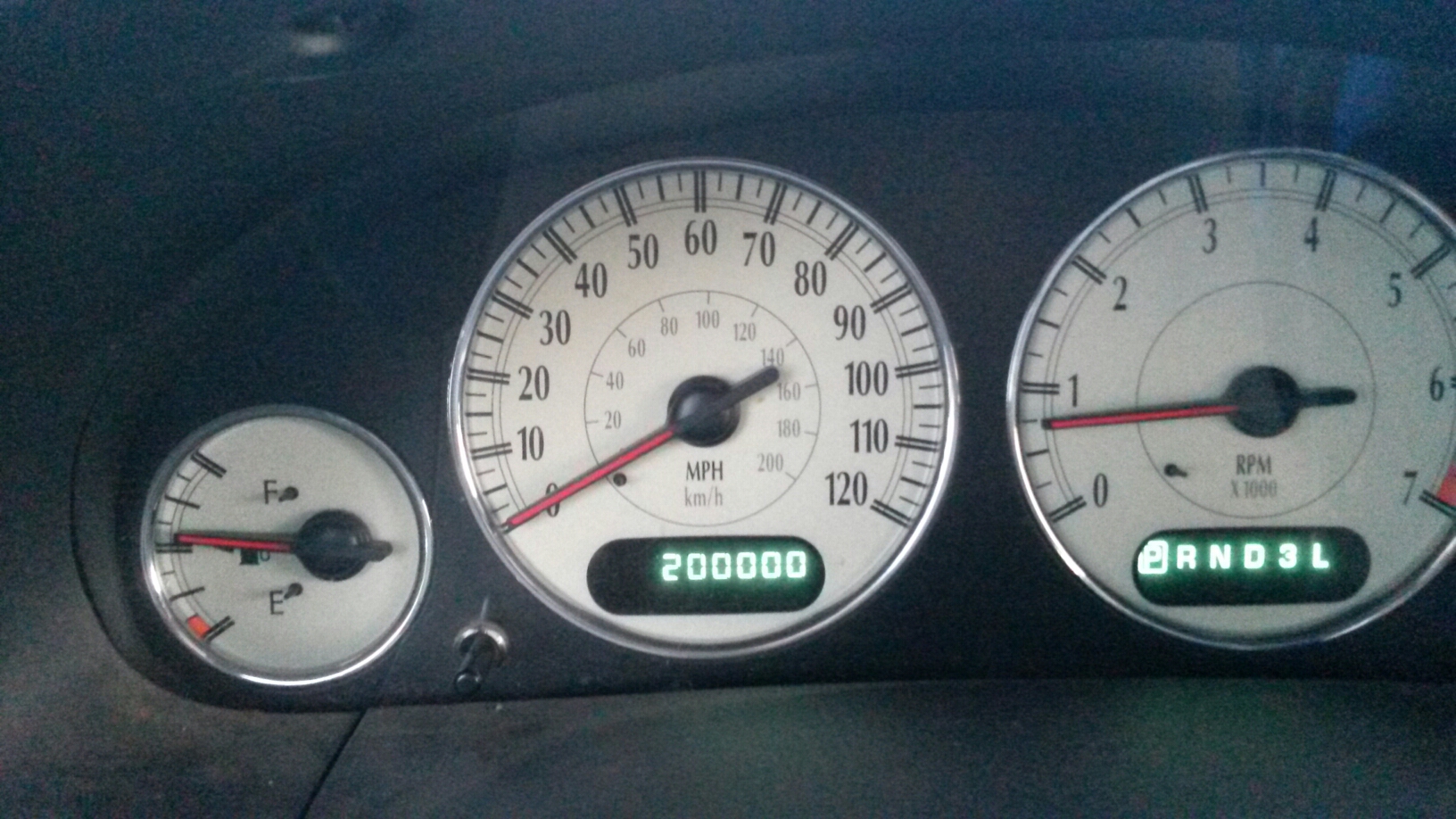
Just the other evening, I was driving home, and my 2003 Chrysler Town & Country LXi’s odometer rolled over for the second time.  For those of you who don’t know what that means, it means that the car hit 200,000 miles.  100,000 miles is a milestone for any car, but 200,000 is impressive.  I think that it’s a good time to reflect on some nice memories that the old minivan has provided me.

I’ll never forget the day we bought it in 2003.  Most people have some sort of memory about buying a new car.  I was a little tyke back then, and it had been raining that morning while the negotiations for the car were going on.  When they handed us the keys and the minivan was ours, there were three rainbows!  That’s a good sign.  I remember that it was simply beautiful driving it home.

Another amazing memory really isn’t just one memory.  Rather, it’s a series of memories from the summer of 2007, when I traveled the country with my mom and sister (my dad joined us for the return trip).  It was a lot of fun, and something that I would gladly repeat any time.  Just throw me the keys…

Yet another memory was when I had first received my learners permit from the DMV, and my mom took me to a large parking lot and let me drive around.  It was just the beginning of my (hopefully) long driving career.  I didn’t really know how to do stuff like park, but what better way to learn than do it in your own car?

Now that I have my driver’s license, an amazing old minivan filled with even more amazing memories, what could go wrong?  I’ve loved every moment I’ve been in this old minivan, and I hope to enjoy many more.

20140505_195535


20140505_195537

Dodge Revives Classic Shaker Hoods and Scat Packs!

While it’s been a couple of months since the 2014 SEMA show in Las Vegas, I only recently heard about the legendary Shaker Hoods and Scat Packs returning to Mopar!

Since the 2014 Dodge Challenger looks like it’s 1970 ancestor, it seems fitting that the Challenger should have the legendary Shaker Hood.  Like the original Challenger, the 2014 Challenger can also be fitted with a hood that has the air scoop directly attached to the engine.  This Shaker Hood isn’t just a useless piece of retro jewelry, either.  It provides cooling air to the thirsty HEMI engine under that beautiful hood.

What makes the Shaker Hood even more accessible to enthusiasts who want a 2014 Challenger is the fact that it comes as its own special model!  It’s called the 2014 Dodge Challenger R/T Shaker, and it comes with it’s unique graphics, a period-correct Satin Black Shaker Hood, plus the optional Super Track Pack performance package and a few other cosmetic changes.  It also comes with a spectacular creamsicle-orange color that is a must!

Also returning for 2014 is the Scat Pack.  The last time the Scat Pack was seen on the 1968 Challenger, Charger, and Dart.  Back then, it was called the “Scat Pack Club” package, and it collectively referred to all of the performance models, and it also encouraged camaraderie among enthusiasts and owners.  This time around, however, Dodge is using the moniker as a performance package for, you guessed it, the Dart, Charger, and Challenger.

Each Scat Pack package is available in three stages, with each stage offering additional performance enhancements for the mighty 5.7-liter HEMI V8 on the Charger and Challenger and the turbocharged 2.4-liter four cylinder on the Dart.

These performance enhancements include enhanced ECU tuning, and freer-flowing intake and exhaust systems.  The V8 cars come with more serious modifications:  Not only do they come with what’s mentioned above, but they get new Iskendarian camshafts, and ported-and-polished cylinder heads – in the upper levels.  The Dart has to make do with brake and suspension enhancements.  All three Scat Pack cars come with cool graphics and custom interiors done up with Katzkin leather.

The Challenger R/T Shaker and the Scat Pack Challenger, Charger, and Dart will arrive in dealers by mid-May 2014.

Bugatti Veyron Grand Sport Vitesse Black Bess Headed to Beijing Auto Show

Bugatti’s recently gotten into the habit of making special-edition Veyrons.  The special-edition Veyrons are a six-part series of limited-edition Veyrons offered to the public.  The one I am talking about, “Black Bess,” is installment number five in the series.

The “Black Bess” Veyron pays homage to the Bugatti Type 18 “Black Bess.”  Like the original Type 18 Black Bess, the new Veyron Black Bess is painted black with gold accents throughout the exterior.  I’ve got to say it looks pretty darn good.  Some of these gold accents, believe it or not, like the grille and rear badge, are made out of legitimate 24-karat gold!

Inside the Veyron Black Bess, it’s got beige leather seats, contrasting brown leather trim, and a red steering wheel.  All three of those are homages to the original Type 18 Black Bess.  The inspiration for the Veyron Black Bess is notable everywhere, especially on the  interior door panels, which feature hand-painted scenes of the Type 18 Black Bess in action.  Each of the six Veyron Black Bess’s will feature different artwork to ensure that no two are alike.

As for the Type 18 Black Bess, it got it’s name from it’s original owner, French aviation pioneer, Roland Garros, who named it after a British race horse of the era.  The Bugatti Type 18 was one of the original supercars.  It had a 5.0-liter inline-four-cylinder engine making around 100 horsepower.  That gave it a 100 mph top speed, and all seven Type 18’s had (or still have) an impressive racing pedigree.

The Bugatti Veyron Grand Sport Vitesse Legends Black Bess  made it’s debut at the 2014 Beijing International Auto Show alongside the original Black Bess on April 21.

The World’s Craziest Go-Kart!

Go-karts are fun little vehicles.  Some of them can go up to 70 mph – in just a few seconds!  Others can climb up hills.  Most don’t have Chevy big-block V8 engines, though.  Dirt Every Day, a fun off-road show on the Motor Trend Channel has a go-kart with a 454 big-block.  I’m pretty sure that that just elevated the host, Fred Williams, to the crazy-maybe-stupid category.

In the previous episode of Dirt Every Day, Fred had an off-road club of college kids called the Poly Goats come and demolish a 1986 Pace Arrow motorhome.  For those of you who don’t know what makes it so special, I have one number for you: 454.  Nothing else needs to be said.  The Poly Goats made mincemeat of the Pace Arrow.  By the end of the episode, it was a bare chassis with a 454 cubic-inch V8, a Turbo 400 transmission, and a beefy rear end.  That’s a good start for a monster go-kart.

However, Fred needed to build and install all of the necessary components to ensure that this crazy contraption starts, stops, turns, and shifts.  However, every go-kart needs to be safe, so Fred turned to his good friend, Frank, who is an engineer.  Frank helped Fred out by giving him tips about the rollcage.

After Frank, some of the Poly Goats come to help Fred get the crazy kart good to go.  After a long day wiring the pedals, steering column, and shifter, fabricating the wide wheel set, and wiring the engine up, the go-kart is good to go.  Fred wisely decides to not drive the go-kart around his neighborhood.

The next morning, Fred trailers both his mini go-kart and his recently built monster go-kart out to a remote ranch for some off-road hoonage.  He is going to have a shootout.  Instead of him driving both go-karts, he has a couple of Poly Goats come and assist him.  They are brave souls.

One of the contests is where the contestants have to see who starts their engine first.  The big go-kart wins by a mile.  The next contest is a timed obstacle course where the drivers have to go around one or two trees depending on kart size, moving around bottles, and going in between cattle skulls.  The tiny go-kart wins.  Then, a drag race, as drag races have proven to be popular on the Motor Trend Channel.  The big go-kart wins.  You just don’t expect a tiny gas-powered go-kart to win against something with a 454.  Then, Fred decides to have a tug-o-war competition.  Yeah, we all know who won there.

After all of the contests, Fred takes the monster go-kart off-roading.  It looks like a lot of fun.  Don’t do this at home, kids.

10 Cars That You Just Have to Love, Even if They Were Lemons

Lots of cars are reliable.  Lots of cars aren’t reliable.  A lot of British and German cars fall into the not-so-reliable category.  My uncle can attest to that with the fact that his 2001 Jaguar XK8 has spent about half of its life in the shop.  On the other side of reliability, another one of my uncles had an Audi Quattro for something like 10 years, and he never had any reliability issues.  My dad’s had trouble with his 2003 GMC Sierra 2500 HD with the Duramax diesel engine.  My 2003 Chrysler Town & Country is just a few hundred miles away from hitting 200,000 miles, and it’s been one of the most reliable cars that I’ve ever seen.  Anyhow, the basic premise of this blog post is to tell you the top 10 cars that we all love, even if they were (or still are) lemons.

  1. 2001-2005 Porsche 911 and Boxster:  The 996-generation Porsche 911 was the first Porsche to ever have a water-cooled engine.  For Porschephiles, that’s the equivalent of the Pope converting to Buddhism.  The 2001-2005 Porsche 911 and Boxster had a teeny, weeny, little problem with their engines where the faulty intermediate shafts could fail, turning a fine sports car into a very expensive paperweight.  Even after enough owner complaints, Porsche started fixing the problem, but only on a case-by-case basis, which meant that many owners were left out to dry unfairly.  It’s easily one of the largest black spots in Porsche history, which is a true shame, because these cars were otherwise some very nice drives.
  2. 2001-2003 Subaru WRX:  The first Subaru WRX to be offered in the U.S. had a massive problem with the transmission.  The five-speed manuals were extremely fragile, and the tuner-friendly engine often meant that the tiny boxer four-cylinder engine was tuned to within an inch of its life.  All Subarus have problems with their head gasket, but the 2001-2003 WRX often gave its head gasket up before it even reached 100,000 miles.  I can forgive all of this, because aside from these two problems, it’s a reliable daily driver that’s a LOT of fun.  The purity of these WRX’s means that your inner Swedish rally driver fantasies can come true.
  3. 1993-1995 Mazda RX-7:  One of the last rotary-powered cars (the last was the Mazda RX-8), the Mazda RX-7 was a true driver’s car.  However, apex seal failure hangs over every owner’s head like a cloud.  Apex seal failure means a complete engine rebuild or replacement if the car is not maintained at the proper intervals.  The massive amounts of premium fuel and oil going into the engine didn’t help matters, either.  Still, the 3rd-generation Mazda RX-7 is an amazing driver’s car.  Plus, many owners say that there’s  truly nothing like spooling up the second sequential turbocharger.  Mazda had made the RX-7 with two turbochargers – one for the lower rev range only, and the other for the upper rev range only.  It’s been a long, long time since the last RX-7 was built, and I really hope that Mazda gets their act together and builds an RX-9.
  4. 1999 Ford Mustang SVT Cobra:  This was a one-model-year special put on by Ford, and it was supposed to be a drag racing special for the street.  However, it didn’t  take long for enthusiasts, mainly drag racers, to figure out that it was making WAY less than the 320 horsepower that Ford advertised.  Ford traced the problem to aluminum residue in the intake and exhaust systems.  Ford did well by fixing the problem free of charge.  However, the public snafu on Ford’s part caused Ford to drop production of the SVT Cobra after just one model year.  The upside is that there are no other reliability problems with the SVT Cobra Mustang.  Because it’s a single-model-year special-edition Mustang, it’s got potential to be a future classic.  Don’t be intimidated if you see one for sale with lots of modifications – Ford designed this car to be tuner-friendly.  Just make sure that there’s good documentation of the car.
  5. 2008-2010 Nissan GT-R:  Like many supercars, the Nissan GT-R came with launch control.  The difference was that the launch control function could potentially blow up the transmission and void the warranty, leaving the unlucky owner with a $20,000 repair bill.  Nissan settled a class-action lawsuit in Decemer 2010, and the launch control was dialed back on 2011-up models.  It’s impossible not to love the GT-R and it’s mind-altering ability to be an absolute freight train on race tracks of any kind, just avoid the hard launches.
  6. 2001-2006 MINI Cooper S:  Anybody who was (or is) an owner of the 2001-2006 MINI Cooper S felt more like a beta tester for a video game than anything else.  Here’s the relatively short list of, uh, ‘bugs:’  Electric power steering pumps that could catch fire, supercharger failure after just 80,000 miles, and head gaskets that seemed to be timed to blow up as soon as the warranty expired.  Despite it being a sub-$20,000 car new (and used), it’s got maintenance costs of a 2001-2005 Porsche 911 or Boxster (see #1 on this list for reference).  If you can forgive those faults, the handling is some of the best this world has ever seen.
  7. 2010 Ferrari 458 Italia:  Most mid-engine Ferrari’s have a wholly undeserved reputation for spontaneous combustion.  However, with the 2010 Ferrari 458 Italia, the argument was valid.  The adhesive bonding between the wheelwell and the engine heat shield would melt and catch fire.  Reports vary, and if Ferrari is to be believed, only 11 cars were affected by this.  All 1248 Ferrari 458 Italias sold until that point were recalled.  Ferrari still claims that this only happened during hard driving, but asking owners of Ferraris to not drive their car hard is laughable.  After the concerns of owners becoming BBQ, the Ferrari 458 Italia once again ascended to its rightful place as the best mid-engine car the world has ever seen.
  8. 2003 GMC Sierra 2500HD:  These things are supposed to be bulletproof, right?  Think again.  The fuel injection systems on the Duramax diesel-engine trucks are notorious for the fuel injectors cracking.  My dad has a 2003 GMC Sierra 2500HD, and the engine’s been rebuilt something like 4 times.  If you buy one of these vehicles, make sure to get it with the LQ4 6.0-liter V8.  The Allison 1000 heavy-duty transmissions will go over 150,000 miles without trouble.  Just DON’T get it with the Duramax!  Not only are engine rebuilds expensive, but they are frequent.  If you buy one, make sure you find one with good documentation, as many of these were used for hauling and towing, both of which put phenomenal stress on the engine and transmission.
  9. 1996-2005 Volkswagen Passat:  This was the infamous era of VW unreliability.  The B5-generation of the Passat had steering problems – the rack-and-pinion assembly was prone to stripping, which means no steering.  When it stripped, it would burn out the power booster, which means that other parts are brought into the mix.  Volkswagen made a lot of these cars, and some of them are good.  Other family sedans are good choices.
  10. 2003 Land Rover Freelander:  This is quite possibly one of THE most unreliable vehicles EVER!  It was quite simply bad.  The engine was bad, the cheap interior fell apart after just a few thousand miles, and forget replacing parts for it.  The replacement parts were usually just as bad as the stock parts.  Avoid this car at ALL costs!


The Differences Between Circuit Racing, Drag Racing, and Oval Racing

My mom recently asked me what the differences were between circuit racing, drag racing, and oval racing.  For those of us who aren’t race freaks, this may prove helpful.  I know that it will prove helpful for my mom.

Drag racing is for all essential purposes, putting a big, powerful motor into a lightweight car, and adding other go-fast goodies to it, and then going to the drag strip and winning.  Ok, I wish it was that simple.  Many of the fast drag racing cars that you see going hundreds of mph down a straight 1/4 “drag strip” are purpose built.  The fast, cool cars that everybody loves are the Top Fuel dragsters.  Those are the long, huge-engined cars that blast down the drag strip in just 5 seconds.  But, there are also street-legal drag racers that are almost as quick.  Hot Rod Magazine puts on an event every year called Hot Rod Drag Week.  The fastest cars there in the Unlimited class consistently run low 7-second passes.  It’s truly mind-boggling to watch a steel-bodied 1965 Chevrolet Nova II blast down the drag strip at 6.94 seconds.  I have attached a video explaining the history of street legal drag racing, and I found it informative and fun.  https://www.youtube.com/watch?v=TccUZOHuJuI

Circuit racing can mean two things.  One is oval racing like NASCAR or IndyCar, which is not how I view it.  The other is what they call “road-racing.”  Road racing is essentially a twisty track paved with concrete, not sticky asphalt.  It’s usually very fast, and it requires a lot of effort and concentration to wrangle a car around said track.  Formula 1 runs many road courses every season, and NASCAR runs two road courses (Sonoma Raceway and Watkins Glen).  But, the most well-recognized road race is the 24 Hours of Le Mans, as well as other endurance races.  Road racing is taxing on the engine, transmission, suspension, and the driver.  Darrell Waltrip (yeah, he’s the guy with the world-famous “Boogity, boogity, boogity) once said of Sonoma Raceway, “Floor the gas, upshift, mat the brakes, downshift, repeat.”  That can be said for many road courses around the world.  It’s not easy.

Oval racing is sometimes called circuit racing.  I don’t know or care why.  I just know that oval racing is NOT circuit racing.  If you find out or know why, tell me.  Anyhow, oval racing is NASCAR and IndyCar.  It’s extremely fast, and it’s taxing on the driver.  With NASCAR, pit stops are often between 8-20 seconds!  Famous oval tracks are Daytona International Speedway, Talladega International Superspeedway, Bristol Raceway, and Darlington Raceway.  Not only are all of those oval circuits fast, but they can have deadly consequences if you can’t get out of the way.  Dale Earnhardt Sr.’s 2001 death at the Daytona 500 was a shock to the racing community, but it only highlighted just how deadly NASCAR is.  Speeds reaching 200+ mph are common on these oval tracks.  Bill Elliott once hit 210 mph at Talladega, which is a record that stands to this day.

Since I’m onto the different kinds of racing, I might as well do other kinds of racing.

Top-speed racing is kind of the thing nowadays.  Standing mile events are common in several states, but the big top-speed races are at the Bonneville Salt Flats and El Mirage (El Mirage is a large dry lakebed in Southern California).  The fastest run at Bonneville was 763 mph back in 1997, with Andy Green driving Thrust SSC.  Not only did that break the sound barrier for the first time in a car, but Green is planning to hit 1,000 mph with Team Bloodhound SSC next year.  Back to top-speed racing.  It’s fast, and can be deadly.  I have attached a Roadkill episode showing Freiburger and Finnegan chasing a top-speed record at Bonneville in a 1981 Chevrolet Camaro.  It’s fast, funny, and surprisingly informative.  https://www.youtube.com/watch?v=JEcbwvNaxE8

Drifting is where you take a RWD car, pull the handbrake, and break the rear end loose.  Professional drifters include Vaughan Gittin, Jr., Ken Gushi, Tanner Foust, and Ken Block, just to name a few.  Drifting originated in Japan in the mid-1970s, and it’s become a popular sport ever since.  Typical drifting machines are RWD vehicles with either a GM LS-Series engine, or a turbocharged Toyota engine.  Drifters are people who like to make lots of tire smoke and dial in a lot of opposite lock into the steering.  Drifting a RWD car should be simple:  If it’s a new car, defeat the traction and stability controls.  Then, find a big, open space (without curbs or trees!), floor it, pull up on the handbrake, and the rear end will hopefully break out.  If and when it does, steer INTO the drift!  Steering away from the drift will spin the car and make you look like an idiot.  Steer into the drift, and apply more steering and throttle as needed.  If you feel uncomfortable, tap the brakes enough to get the rear end of the car to step back into line a bit.  Also, make sure that you don’t have expensive tires on.  Drifting eats up the treads surprisingly quickly, and you probably know that Pirelli P Zero Corsas aren’t exactly cheap.  I have attached yet another video done by the Motor Trend Channel talking about turbos vs. V8s and drifting.  It gives a unique perspective into drifting, and it’s got a TON of tire smoke!  https://www.youtube.com/watch?v=3H8ItG5SK9o

Rallying can mean a couple of things.  One is where you are given directions and you drive your car on public roads to a destination.  The kind of rallying that most of us are familiar with is WRC and GRC (World Rally Cross and Global Rally Cross).  Those rally machines look stock, but don’t be fooled!  Ken Block and Tanner Foust are both professional drifters and rally drivers.  They both happen to be very good.  Ken Block’s Ford Fiesta looks like a stock Fiesta with aggressive tires, and a wild paint job, and a loud exhaust note.  It’s got a lowered, heavy-duty suspension, a 650-horsepower twin-turbocharged four-cylinder, and a six-speed manual.  It is FAST!  Ken also is a cool, nice guy who loves dogs.  Especially Alaskan Huskies.  His two Huskies’ names are Yuki and Bentley.

Autocrossing is often sanctioned by the SCCA (Sports Car Club of America), and it involves weaving a car in between traffic cones.  It’s fast, and it’s demanding on the suspension and tires.  Yet, people flock to it year after year.  It also is hard on the driver.  Some cars happen to be extremely good at autocrossing, and the Meyers Manx dune buggy in the late 1960s-1970s was very good.  It was light, fast, and it stuck to pavement like nothing else.  Nowadays, the Mazda Miata is the go-to choice for autocrossers.  I’ve attached the most recent Roadkill episode, where Freiburger and Finnegan attempt to beat a Kia Rio5 with all of their cars that still run.  I won’t spoil which cars win for you.  I’ll let you watch and laugh as they spin and throttle the Crusher Camaro, I’ll even let you watch and grimace as Finnegan blows up the parking assist pin in his wife’s 1969 Chevrolet El Camino, and watch as God-knows-what comes flying out of their 1968 Dodge Charger.  https://www.youtube.com/watch?v=II3z353OZWA

I think that I’ve covered just about everything here.  If you find anything else that you can think of, let me know in the comments section.  I will do another blog post on the different types of racing.  I would love to, as it would help me immensely.

Ford Wins 12 Hours of Sebring for the First Time Since 1969!

The last time Ford won the 12 Hours of Sebring was back in 1969.  That was when a Ford GT40 MkI beat out a Ferrari 312P.  That was at the tail end of Henry Ford II and Enzo Ferrari’s decade-long motor sports rivalry.

Now, 45 long years later, Chip Ganassi Racing’s Ford Daytona Prototype brought the glory back to Dearborn after 12 chaotic and dramatic hours.

The skilled drivers, Marino Franchitti, Scott Pruett, and Memo Rojas, managed to get the Ford Daytona Prototype across the finish line a mere 5 seconds ahead of Ryan Danziel and the Extreme Speed Motorsports HPD ARX-03B.  They managed to do this after a late restart bunched the field up.

The win makes Chip Ganassi the only team owner ever to have race titles from the Daytona 500, Indianapolis 500, Rolex 24 Hours at Daytona, and the 12 Hours of Sebring.

As for the GT classes, cars from Stuttgart took the win.  Andy Lally, John Potter, and Marco Seefried won GT Daytona in the No. 911 car.  Amazing pit stops helped Jörg Bergmeister, Patrick Long, and Michael Christensen drive the CORE Autosports Porsche 911 RSR to victory in the GTLM class.

With the Prototype Challenge class, former NASCAR Nationwide Series champion Colin Braun helped put the CORE-ORECA Chevrolet FLM09 best reigning class champion Bruno Junquiera.

With the highly anticipated Chevrolet Corvette C7.R, fuel pump issues and 2 spins dropped the leading Vette to 6th, which disappointed driver Oliver Gavin.  Ben Keating and the SRT Viper GT-D retired within the first hour after a truly spectacular fire.

The revolutionary Nissan DeltaWing led its class for several laps, but retired after Lap 104, thanks to a collision on that lap, in addition to a botched pit stop and multiple mechanical issues.

A Spectator’s Guide to the Bonneville Salt Flats at Bonneville Speed Week

The Bonneville Salt Flats are one of the world’s fastest places.  The sound barrier was broken there in 1997.  Multiple records have been set there over the years.  It’s also the only racetrack where the ground underneath you can give you sunburns…and taste bad!  I’m hoping to the 2014 Speed Week (August 9-15) with my dad.  I thought it would be smart to tell you what to do and bring as a spectator.  Enjoy.

  • The Bonneville Salt Flats are in the high desert of Utah.  The Salt Flats are located just 5 miles away from Wendover UT, and West Wendover, NV.  West Wendover is a casino town, and Wendover is a pretty neat little town.  Wendover Air Field is located at the edge of Wendover, and it’s the same air field that the Enola Gay took off from with both atomic bombs both times.  There’s a small museum honoring the brave flight crew and the Manhattan Project.
  • Bring a cooler with a LOT of ice and water bottles!  Fill up your cooler with at least 15 water bottles.  That might seem like a lot of water, but temperatures can go as high as 120 degrees.  There is a gas station on the frontage road leading to the Salt Flats that sells gas, water, snack food, and sandwiches.  It is advised to fill up with water and/or gas here.  Vendors sell food and water on the Flats, but they have been known to run out in the past.  Bring your own snack food and a LOT of water and hydrating drinks (people say that Gatorades, Vitamin Waters, and iced tea are also good things to bring).
  • Sun protection is REALLY important here.  The Bonneville Salt Flats have never heard of shade.  Bring your own.  Be imaginative – bring beach umbrellas, sun hats offering head and neck protection, and snow-worthy sunglasses.  The reason for the sunglasses being that tough is that the salt is so reflective that you can get snow blindness.  Vendors do sell heavy-duty sunglasses, but they are overpriced ($20).  Veterans of the salt say to bring skiing sunblock – the reflectiveness of the salt, plus the Sun beating down on you can make your skin look like a tomato.  Running long-sleeved shirts are also a good investment – they mean that you don’t need to worry about your arms, and they help keep your torso relatively cool.
  • Spectators are encouraged to walk the pits and talk with the racers.  Last year, the pits were over 3 miles long and 4 city blocks wide!  They are expected to be larger this year.  Bring a bike or some other form of two-wheeled transportation.
  • Camping chairs are a good investment.  The salt is way too hot to sit on.  The salt will leave burns a mile long on you!  It will also go into your pores and hurt like crazy to get out!  Since there are no grandstands, bring camping chairs with cup holders and an umbrella stand.  You’ll thank me later.
  • Radios are good to bring.  Racer/race information is broadcast on the 1610 AM radio frequency.  Racers also communicate with race officials or their pit crews with CB radios.  If you don’t have a radio, you should get one.  Otherwise, you won’t know anything about a racer or how fast they went!  There is no PA system except for a driver’s meeting on the first day that everybody is invited to.
  • Tarps and shoes:  The salt gets everywhere, and it corrodes whatever it gets on.  Bring a heavy-duty tarp and smooth-soled shoes are a good investment.  I don’t mean VANS, I’m thinking shoes like sneakers.
  • Binoculars are a good thing to bring.  Those tiny birdwatching binoculars you have won’t cut it.  Their field of vision is too small to track a vehicle going 200+ mph down the course.  Spectators can be anywhere from the start line to the final mile marker (Mile 6), but they are always 1/4 of a mile away from the cars for safety reasons.  Get big binoculars with a wide field of vision.  Because many cars are going in excess of 200 mph (some even go 400+!), this is too fast to track with the human eye, according to veteran spectators.
  • Optional entertainment is a good thing to bring, as Bonneville Speed Week isn’t meant to be fast-paced, even though the cars and motorcycles go bloody fast!  Bring the day’s newspaper, a good book, a new magazine, etc.  Some people bring iPads, but it’s hard to read or do whatever on something that reflects the Sun into your eyes.  Taking a nap or working on your tan is also a good idea.
  • Cameras are a must.  Make sure that your camera has a good zoom feature that can capture a car at least 1/4 of a mile away.  Also, make sure that you have something to download the hundreds of pictures you took that day onto.
  • Be prepared to meet lots and lots of nice people.  Lots of the racers are ex-engineers, ex-JPL employees, etc.  When you ask some of the racers what they worked on, and they give you, “If I tell you, and then I kill you” response, they aren’t joking.  Don’t go further than that with them!  Many racers are nice people who will go out of their way to show you their car, offer you a drink, or just chat with you for hours on end.  While there are some people who aren’t people people, there’s a LOT of nice people people.
  • The engines from the cars are very, very loud.  Think Top Fuel on steroids kind of loud.  This is because the engines are large and they have no restrictive exhaust systems on them.  The high-octane racing fuel will burn your eyes if you are too close.
  • Vendor food is good.  If you can name it, vendors offer it.  The food is good, but everybody says the Enola Gay Cafe is the best.  I don’t doubt them.  It’s even got folding tables and chairs for you to sit in!  It starts cooking at 6:00 AM (many racers arrive before then to work on their cars), and stops cooking at 5:00 PM (when everybody leaves the salt).  Many vendors sell t-shirts and other souvenirs.
  • How to get to Bonneville from Wendover is important.  Here are directions on how to get there from the main drag in Wendover, UT.  https://www.google.com/maps/dir/Wendover+Blvd,+Wendover,+UT/Bonneville+Salt+Flats+International+Speedway,+Bonneville+Speedway+Rd,+UT+84083/@40.7604641,-113.9657532,12z/am=t/data=!3m1!4b1!4m16!4m15!1m5!1m1!1s0x80ac2f5b4f0db3a7:0xb33345362043f07d!2m2!1d-114.0355344!2d40.7375496!1m5!1m1!1s0x80ac308e73f0ed1b:0x6c5d8e3c50acde7!2m2!1d-113.895972!2d40.762569!2m1!6e4!3e0.  As you can see, it’s pretty easy.  Also, the volunteers who put on Speed Week have an entry/exit road marked with cones.  Stay inside of the cones.  Going out will mean your car will bury itself into the slushy salt and it will take lots of digging and tugging from multiple pickup trucks to extricate you.
  • Salt Corrosion is one of the worst fears among those of you living back East.  Salt is extremely corrosive, and the Bonneville Salt Flats are no exception – they will turn your car into vehicular swiss cheese!  Think twice about taking your brand-new Ferrari onto the Salt.  If you do, there is a truck stop just off of the I-80 that has a large carwash.  It is recommended that you take your car, rental car, motorcycle, whatever you are driving there, and wash EVERYTHING off!  With your bikes, a garden hose or compressed air will do just fine.  I’ve already talked about shoes, so I won’t go too far into that – just make sure that you can’t find any on them when you get into the car – it tracks everywhere, and it is difficult to get rid of.
  • Where and what to stay in is always a good thing to ask yourself when going on a trip.  There is a Best Western and other small hotels in Wendover, UT.  West Wendover has a Super 8 and multiple casinos.  All of these are booked solid through August 20th.  Same thing with the RV parks.  The mud flats outside of the Salt Flats are your only choice right now, unless you want to stay in Park City, or Salt Lake City.  Both of those are 110 miles away from the Salt Flats.  The mud flats are what they sound like.
  • Clothing is always good to have on hand.  Do NOT wear blue jeans – the tiny rivets in them will leave small, painful burns all over your hips and legs!  If you wear shorts, put sunblock on.  Make sure that your belt buckle cannot touch any skin – it will hurt!  Make sure your shirts are lightweight, light-colored long-sleeved running shirts.  Make sure your hats have a big brim that protects your face and neck.  Skiing sunglasses (not skiing goggles, alien) are also good.
  • Where to eat in Wendover is a good thing to know.  Long story short, follow the racers.  Many of the racers have been coming to the Salt Flats for years, and they know where the best places to eat are.  The Mexican restaurant at the truck stop is a good place to eat, as well as Mildred’s Custom Burgers.  Following the racers is a good idea, but waiting for them to finish eating isn’t.  Waiting for a table can take hours.  Neither restaurant knows what reservations mean, so driving quickly to get ahead of the hordes of hungry racers is smart.  But, sitting at a table inside (where all the racers are) is nice.  The racers talk about their day on the Salt, and previous experiences on the Salt.  Listening to their banter and chatting with them is smart.  Just be thoughtful of those waiting for your table.
  • What to do in Wendover/West Wendover is also good to know.  Wendover Air Field is now a small airport, but it was where the Enola Gay took off from both times with the atomic bombs, and there’s a small museum honoring the brave crew and the Manhattan Project.  The hangars look like they are right out of WWII, but inside, there is a multitude of cool helicopters, planes, and other stuff.  West Wendover has not one, but five casinos!  Wendover has a small movie theater that offers an air-conditioned escape from the boiling desert heat.  There are a few National and Regional Parks (Bonneville is a National Park) in the area.  There is even a 9-hole golf course that takes advantage of the desert to lure golfers onto rocky hills.
  • Gas stations are always a good place to get drinks and gas.  Buy at least 15 water bottles at the gas station on the frontage road leading to the Salt Flats.  The Wendover Truck Stop I have talked about, as well as the small gas station on the way to the Salt Flats.  Don’t ever underestimate Bonneville – it gets hot, and always keep drinking!  Dehydration is a bad thing under the best of circumstances, but you could be dead by the time the helicopter from Salt Lake City arrives.
  • What to do after the racing ends is good to know.  The Bonneville Salt Flats close about 5:00 PM, and they open at 5:00 AM.  Bonneville is on BLM (Bureau of Land Management) land, and it is fenced off and gated at 5:00.  When racing is winding down, go back to your car and pack up and head out.  It gets crazy getting out of there at 5:00!  Go into Wendover for a burger or Mexican food.  The racers enjoy an ice-cold beer or two, but don’t let that discourage you!  Go up and talk to them!  They are cool folks!
  • When to get to Bonneville to set up to watch racing:  Bonneville opens up at a bright-and-early 5:00 AM, but most racers get there about 6:00 AM.  The courses open up at 7:00, and the quickest runs happen from 7:00-9:00 AM, as the air is cooler and less humid there.  You have to pay a small amount of money as an entry fee every day as a spectator (racers pay for it when they register their car for Speed Week), but it’s really not much.  Getting there earlier is better.
  • Bring a lot of cash.  Some vendors don’t take credit cards, and the Bonneville volunteers collecting entry fees don’t take credit cards or checks.  Plus, cash is good to take wherever.  You can use it to tip, donate to the Wendover Air Field museum, or even donate to the Southern California Timing Association (SCTA).

I’ve also attached one of my favorite Roadkill episodes, where they attempt to set a landspeed record.  https://www.youtube.com/watch?v=JEcbwvNaxE8

Also, take a peek at the SCTA’s website.  http://www.scta-bni.org/Bonneville.html

The colors, excitement, people, cars, and the beauty are just some of the reasons why people return to Bonneville year after year.  It’s called Salt Fever.  Catch it!  Come to Speed Week 2014 and hopefully you can meet up with me and my dad!  Plus, getting to Bonneville is a beautiful road trip in itself.  Enjoy the trip to Bonneville and your time there!

Ferruccio Lamborghini – a Biography of the Man Who Wanted a Better Ferrari

When you see a Lamborghini for the first time, you are probably wondering if an alien owns it.  It looks otherworldly.  This blog post is going to delve into the story behind the man who created Lamborghini Automobili, Ferruccio Lamborghini.  I hope you find his life as interesting as I do.

Ferruccio Lamborghini was born on April 28, 1916 to Antonio and Evelina Lamborghini in the beautiful region of Northern Italy.  Not much is known about his childhood, other than the fact that his parents were viticulturists.  What we do know is that Ferruccio Lamborghini was fascinated with farming machinery, rather than the farming lifestyle.  Following his passion for mechanics, Ferruccio went to the Fratelli Taddia technical institute in Bologna.  In 1940, Ferruccio was drafted into the Italian Royal Air Force for WWII.  He started off as a vehicle mechanic at the Italian garrison on the island of Rhodes.  He eventually became supervisor of the vehicle maintenance unit there.  When the island fell to the British in 1945, Ferruccio was taken prisoner.  He was unable to return home until 1946.  Upon his return, he married, but his wife died in 1947 while giving birth to their son, Antonio Lamborghini.

After that, Ferruccio opened a small garage near Bologna.  In his spare time, Ferruccio modified an old Fiat Topolino that he had purchased, one of the many that he would own over the years.  He took his extensive mechanical abilities to the tiny city car and turned it into a thundering, two-seat, open-top, 750-cc, roadster.  He entered the car in the 1948 Mille Miglia.  His participation in the tiny Topolino ended after 700 miles, when he ran the car into the side of a restaurant in the town of Fiano, in the province of Turin.  As a result of the crash, Lamborghini lost all enthusiasm for racing, a bitter sentiment that would last until the late 1960s.

In 1949, Ferruccio started Lamborghini Trattori, a small tractor company that would eventually become the European equivalent of John Deere.  His increasing wealth allowed him to buy more expensive, faster cars than the tiny Fiats that had provided with reliable, albeit slow, transportation for many years.  In the early 1950’s, he owned such cars as Lancia’s and Alfa Romeo’s, and at one point, he owned enough cars to drive a different one for every day of the week.  He added a Mercedes-Benz 300SL Gullwing, a Jaguar E-Type coupe, and two Maserati 3500GT’s.  He once said of the latter, “Adolfo Orsi, then the owner of Maserati, was a man I had a lot of respect for: he had started life as a poor boy, like myself.  But I did not like his cars much.  They felt heavy and did not really go fast.”

In 1958, Lamborghini traveled to Modena to buy a Ferrari 250GT, an early Ferrari with a Pininfarina body.  He went on to own several more 250GT’s, including a Scaglietti-designed 250 SWB Berlinetta and a 250GT 2+2.  He thought that Enzo Ferrari’s cars were good, they were too noisy and rough to be proper road cars.  He categorized the 250GT’s as repurposed track cars with poorly done interiors.  Ouch.

He found that Ferrari’s had bad clutches, requiring frequent, expensive trips to Modena to replace them.  Ferrari technicians would squirrel the cars away for hours on end to perform the service, which immensely dissatisfied Lamborghini.  He had expressed his dissatisfaction about Ferrari’s after sales service multiple times before, which he perceived to be extremely substandard compared to other auto manufacturers.  He brought this to Enzo Ferrari’s attention, but was rudely dismissed by the pride-filled Ferrari.  He eventually successfully modified one of his personal 250GT’s to outperform stock 250GT’s, he decided that he was going to start an automobile manufacturing venture of his own, with an aim to create the perfect touring car that he felt nobody could build for him.  His belief was that a grand touring car should have attributes lacking in Ferrari’s, namely high performance without compromising tractability, ride quality, or interior appointments.  Being a clever businessman, Lamborghini knew that he could triple the profits if he used tractor parts from his tractor company.

The 1970’s OPEC Oil Crisis caused a large financial crisis for Lamborghini.  Lamborghini Trattori, which exported about half of it’s tractors, ran into trouble when the South African importer cancelled all of their orders.  The Bolivian military government cancelled a large shipment of tractors ready to ship from Genoa.  Since all of the Lamborghini Trattori employees were unionized, they could not be fired or laid off, which put immense financial strain on the company.  Lamborghini sold his entire share of the company (72%) to SAME, a rival tractor company, in 1972.

Not long after that, the entire Lamborghini franchise found itself in dire straights.  Development at Lamborghini Automobili slowed as costs were cut.  So, Ferruccio started negotiations with Georges-Henri Rossetti, a wealthy Swiss businessman and close friend.  Ferruccio sold Rossetti a 51% share in the company for US$600,000, which was enough to keep Lamborghini Automobili alive.  He continued to work at the factory even though he had no official controlling share in the company.  Rossetti rarely involved himself in Lamborghini Automobili’s affairs.

The 1973 OPEC Oil Crisis didn’t improve financial matters, either.  Consumers flocked in droves to smaller, more practical cars with better fuel economy.  By 1974, Ferruccio had become so disenchanted with the automobile manufacturing business that he severed all connections with the automobile manufacturer that bore his name.  He sold his remaining 49% share of the company to Rene Leimer, a friend of Rossetti.

After departing the automotive world, Lamborghini started an industrial valve and equipment manufacturer, as well as a heating and air conditioning company, Lamborghini Calor.

In 1974, Lamborghini exited the industrial world and retired to a 740-acre estate named La Fiorita on the shores of Lake Trasimeno, in Central Italy.  Returning to his farming roots, Lamborghini took delight in hunting and making his own wines.  He even designed a personal golf course.  At age 58, he fathered Patrizia Lamborghini.

At age 76, Lamborghini died on February 20, 1993 at Silvestrini Hospital after suffering a heart attack 15 days earlier.  He is buried at the Monumental Cemetery of the Certosa di Bologna monastery.

Bullfighting is an integral part of the Lamborghini identity.  In 1962, Lamborghini visited the Seville ranch of Don Eduardo Muira, a renowned breeder of fighting bulls.  He was so impressed with the raging bulls that he decided to adopt a raging bull as the emblem of Lamborghini Automobili.

After producing two cars with alphanumeric designations, Lamborghini once again turned to bullfighting for inspiration.  Don Eduardo was filled with pride when he learned that Lamborghini had named a car after his family and their legendary line of bulls.  The fourth Lamborghini Muira was unveiled to him at his ranch.

The Lamborghini Islero was named for the bull that killed the legendary bullfighter Manolete in 1947.

The Lamborghini Espada was named after the Spanish word for sword, and sometimes used to refer to the bullfighter himself.

The Lamborghini Jarama had a special double meaning – it was intended to refer to the historic bullfighting region of Spain, but Ferruccio was worried that there would be confusion with the also-historic Jarama motor racing track.

After naming the Lamborghini Urraco after a bull breed, Lamborghini broke from tradition and named the Countach, not for a bull, but for a rather rude expression used by Piedmontese men to describe a beautiful woman.  I don’t know why either.  Legend has it that designer Nuccio Bertone uttered the word in surprise when he saw the Countach prototype.  The Lamborghini LM002 SUV and Lamborghini Silhouette were the other exceptions.

The 1982 Lamborghini Jalpa was named for a bull breed.

The Lamborghini Diablo was named for the Duke of Veragua’s bull that fought an epic battle against El Chicorro in 1869.  It also means “devil” in Spanish.

The Lamborghini Murcielago was named for the legendary bull whose life was spared by El Lagartijo for his ferocious performance in 1879.  It also means “bat” in Spanish.

The Lamborghini Reventon was named for the bull that killed the young Mexican bullfighter Felix Guzman in 1943.

The 2008 Lamborghini Estoque concept car was named for the estoc, the sword traditionally used by matadors.

The Lamborghini Aventador was named for a bull that was bred by the sons of Don Celestino Cuadri Vides.  The bull was killed in a particularly gruesome fight, and after the fight, the left ear was cut off of the bull and given to the matador for good luck.

The Lamborghini Gallardo was named for one of the five ancestral castes of the Spanish bullfighting breed.

The Lamborghini Huracan is named for a bull that fought in 1879.  Huracan also means “hurricane” in Spanish.

All of Lamborghini’s companies are still around in some form or another today.  Lamborghini Trattori is still a subsidiary of SAME.  His son, Tonino (Antonio) Lamborghini designs a line of clothing and accessories under the Tonino Lamborghini brand.  His daughter, Patrizia Lamborghini, runs the private winery on his estate.

A museum near the factory honoring Lamborghini, the Centro Studi e Richerche Ferruccio Lamborghini, opened in 2001.  The museum is located just 25 km (15.2 miles) from the factory in Sant’Agata Bolognese.  Tonino may even be there to greet you, as you have to write ahead to get in, as conferences often happen and the museum is closed to the public.

The Top Movie/TV Show Cars

Many movies have cars that we love.  Famous cars with famous actors – it goes together.  Le Mans had a Porsche 917 and a Ferrari 512LM with Steve McQueen doing all of the driving in the 917.  It also had a Porsche 911 Carrera S that went for $1.75 Million dollars at auction last year.  The Ronin remake had Robert De Niro, a Mercedes-Benz 450SEL 6.9, a BMW M5, and a nitrous-huffing Audi S8.  Vanishing Point had Barry Newman, a 440-powered Dodge Challenger R/T Magnum, and a Jaguar E-Type V12 Convertible.  Well, you get the idea.

While I know that last weekend was Oscars weekend, I still thought that the cars from famous movies deserve a proper recognition.  Enjoy my list.  I have also attached videos of the cars in the movies that they were in.  I hope you enjoy the list and the videos!

  1. 1968 Dodge Charger “Bullitt”:  While it’s a shame that I haven’t seen Bullitt yet (one of these days!), I’ve seen the epic car chase scene on YouTube countless times.  I know.  It’s not the same.  The 1968 Dodge Charger from Bullitt is undeniably one of the most iconic cars ever to be used in a movie.  Anybody, I repeat, ANYBODY, can watch the chase scene and then see a 1968 Charger in real life, and say, “I saw a car that looks similar to that one in Bullitt!”  The two cars that really defined the words “muscle car” tore up the streets of San Francisco for real (no CGI, just a couple of sped-up shots).  Both the Ford Mustang GT with the 390 cubic-inch V8 and the Dodge Charger R/T with the 440 cubic-inch V8 needed some modifications for the chase scene.  Ex race-car builder Max Balchowsky modified both cars for film use.  The Highland Green Mustang needed a TON of mods for the chase scene.  The Charger, however, only needed heavy-duty shocks and springs to cope with the jumps.  Both cars used prototype Firestone tires, but it’s possible to see different width tires multiple times on the Charger.  According to Balchowsky, the Charger with it’s big 375-horsepower 440 cubic-inch V8 outgunned the 325-horse 390 cubic-inch V8 Mustang (pun not intended) so much that it required the stunt driver to slow down the car so that McQueen’s ‘Stang could keep up.  Score for Mopar!  While (spoiler alert!) one of the cars met a fiery demise at the end of the movie and was subsequently scrapped, some say that the other Charger is still around…somewhere.  I’d sure like to think so!  http://www.youtube.com/watch?v=-Lbs_nYW3-o
  2. 1955 Chevrolet 150 “American Graffiti”:  Arguably one of the most iconic cars for hot rodding, let alone movies, the 1955 Chevrolet 150 from American Graffiti remains the benchmark for modified ’55 Chevy’s.  Three 1955 Chevrolet 150’s were used for the filming of the movie.  Two of said cars were used in 1971’s Two Lane Blacktop.  Transportation supervisor Henry Travers picked the two cars up from the Universal Studios lot and painted them black.  One car was a fiberglass shell, and it was used to film exterior shots and the actors inside the car.  The other car, the stunt car, was used for the climatic drag race crash.  Travers, who drove the car stunt Chevy for the Paradise Road finale couldn’t roll the car as directed by George Lucas – the car had to be heaved onto it’s roof by the crew.  A third, non-running 1955 Chevy was picked up, spray-painted black, and a fake B-pillar was welded on to resemble to other two cars.  It was burned to film the crash’s aftermath.  The burn car was returned to the junkyard – it would have been impossible to get the car in running condition!  Only the main camera car remains today.  It has traded hands a few times and some dubious modifications have been made to it.  In 2012, it was sold privately to a private buyer who plans to restore the car to it’s original American Graffiti appearance.  Prior to the deal, the buyer apparently barely avoided acquiring his own burn car, built by George Barris.  http://www.youtube.com/watch?v=QOgqUHk-zDY
  3. 1976 Mercedes-Benz 450SEL 6.9 “Ronin”:  While the chase scene from Bullitt deserves lots of ink, the multiple chase scenes from the 1998 remake of Ronin make the leaping American stallions chase scene look about as exciting as a segway tour of Los Angeles.  John Frankenheimer, the same speed junkie who directed the 1966 movie Grand Prix, directed Ronin.  He hired a gaggle of stunt drivers, including F1 champion Jean-Pierre Jarier and sports car champion Jean-Claude Lagniez, and let them loose throwing muscular German sedans around Paris, Monaco, and parts of Souther France at opposite lock drift angles and mind-blowing speeds – on closed-off public roads.  An Audi S8 and BMW rightfully grab a lot of attention in the movie, with Frankenheimer cleverly using right-hand-drive cars with fake left-side steering wheels so that the actors including Robert De Niro and Natascha McElhone could “drive” while one of the Frenchmen terrified them just a couple of feet away.  Not to be outdone are the guys from Mercedes-Benz who sent a 1976 Mercedes-Benz 450SEL 6.9, arguably the first German muscle car.  Robert De Niro “drives” for a while, while French actor Jean Reno actually drove.  The absolute mayhem begins with a Rockford pulled off in the Benz, and then De Niro and Reno chase down the bad boys who happen to be driving a Peugeot 406.  The Peugeot and and Benz hurtle through the French countryside at speeds well over 100 mph, and then De Niro stands up in the sunroof and blows the 406 to smithereens.  Post-explosion, the 450SEL 6.9 hurtles into the seaside village of Villefranche-sur-Mer, an outskirt of Monaco, where a good half of the movie was filmed, where it hurtles through tiny city streets trashing market stalls and cafe tables in search of whatever is locked inside of that mysterious locked case everybody wants.  http://www.youtube.com/watch?v=YMaG5WAmHvY
  4. 1980 Lamborghini Countach “The Cannonball Run”:  If you can, keep your eyes ON the car, not IN the car!  It sounds easy, but Tara Buckman and Adrienne Barbeau are inside.  When Hal Needham and Brock Yates (arguably one of the most iconic auto journalists ever) thought up the plot for The Cannonball Run, a highly fictionalized version of the illegal cross-country Cannonball Run races of the 1970s, they knew that only one car could keep a teenager’s eyes off of Buckman and Barbeau – a 1980 Lamborghini Countach.  The entire opening sequence of the movie focuses entirely on the Countach.  The V12 shrieks up and down through the gearbox, and the two ladies stopping just long enough paint an “X” across a 55 mph speed limit sign before the car screams off onto the American prairie highway again.  The car taunts a police cruiser by coming up extremely close in the rear view mirror, pulling alongside, and then disappearing into the horizon.  No wonder this movie, which Yates himself calls “a pretty lousy picture!” grossed more than $72 million dollars – in the U.S. alone!  Of course, Burt Reynolds and Victor Prinzim are the official stars of the movie with their fake ambulance, but don’t tell that to any teenage boy who saw the movie in the 1980’s.  After filming, the car was used by Hawaiian Tropic as a promotional vehicle for 28 years.  Then, a private collector in Florida bought the car in 2009, and restored the car to factory condition.  http://www.youtube.com/watch?v=nh9L6LrpmTQ
  5. 1970 Porsche 911S “Le Mans”:  Most of Le Mans focuses on a frenzy of screaming prototypes, howling sports cars, furious air wrenches, and cheering crowds of adoring fans.  Not for the opening sequence, though.  Before reaching the Le Mans circuit, McQueen’s character, troubled racer Michael Delaney, gently pushes his 911S across the French countryside and a quiet village.  Soon, he will strap into a howling Porsche 917 for 24 hours of 240+ mph battle against a Ferrari 512LM.  But, for now, it’s just the man and his steed.  The Slate Gray 911S stands out in it’s timeless, understated elegance.  Kind of like McQueen himself.  It’s no wonder that he took the machine back with him to California to join his rapidly growing sports car and motorcycle collection.  Since he owned a nearly identical 1969 model, the 1970 911S was soon sold to a Los Angeles-based attorney who kept the car hidden away for the better part of 30 years.  The car changed hands two more times before going up for auction at RM Auctions Monterey, where it fetched a tidy $1.375 Million dollars, the most EVER paid for a 911 at auction.  http://www.youtube.com/watch?v=_JlyQsWXrqA
  6. 1966 Jaguar XKE V12 Convertible “Vanishing Point”:  Most people my age today probably wouldn’t understand the tagline from Vanishing Point: “Tighten your seatbelt.  You never had a trip like this before.”  But in 1971, the phrase fell on plenty of knowing ears and cars.  Enter Barry Newman as Kowalski, Congressional Medal of Honor Winner, ex-cop, ex-istentialist, as well as ex-race-driver.  His mission is the stuff of any Hollywood movie legend, or any car buff’s legend – drive the car from Denver to San Francisco in record time.  Hollywood being Hollywood, Kowalski encounters everything from rattlesnakes to sun-hardened old-timers, pre-“Bette Davis Eyes” Kim Carnes music, and deranged religious prophets.  But, his most memorable meeting was against a goggles-wearing, giggling desert rat hell-bent on some hoonage in his Jaguar XK-E V12 Convertible.  Said Jag driver literally begs for it – he even bangs his car into the Challenger to get Kowalski’s attention.  Since this is Hollywood, Kowalski takes the bait.  Big time.  It’s wire rims against mag wheels, Dover Sole versus Alaska Salmon, tea cakes versus beefcake.  A one-lane bridge looms ahead.  Kowalski gives the big 440 full throttle, fender swipes the Jag, and the Jag flies off the road in a splendid, um, horrifying fashion.  After several barrel rolls and a gigantic drop, the Jag ends up on it’s side in a mud-caked riverbed.  Since the driver of the Jag was a stunt driver, he’s OK.  Kowalski gives him a quick check, and is back on his way.  I can’t say the same for the Jag – it ended up as a total write-off.  http://www.youtube.com/watch?v=bBTup5WH0a0
  7. 1963 Apollo 3500 GT Thorndyke Special “The Love Bug”:  When was the last time you saw The Love Bug?  It’s a cute movie, and the support vehicles are, well, spectacular.  In any given racing scene, cute little Herbie the Love Bug is surrounded by all sorts of cars you’d expect to see at a period SCCA road race, from Triumph TR6’s to Shelby Cobra’s to MG TC’s.  The most memorable supporting vehicle is the black and yellow car driven by that crook Peter Thorndyke in the final El Dorado race.  Thorndyke drives everything from a Jaguar E-Type to a Ferrari 250GT (a replica car that long ago disappeared) Tour de France on his way to campaigning the Thorndyke Special.  The Thorndyke Special is, for all of it’s Italian looks, is an Apollo 3500GT.  It may have Italian styling, but it was made in Oakland California.  The Apollo cars started life in Italy, where the bodies and chassis’ were made by Intermeccanica.  They would then be shipped to Oakland, where the engines and transmissions would be installed.  Most of the engines were 350 cubic-inch Buick V8’s mated to either a Muncie M-22 “Rock Crusher” transmission or a Buick three-speed automatic.  42 cars were built between 1962 and 1964, when the company ran out of money and closed.  Max Balchowsky specifically modified two cars for the movie with their well-known paint scheme.  At least one car still exists today, with the restoration in Toronto, Canada started many years ago.  http://www.youtube.com/watch?v=KCmUQo2r33g
  8. 1969 Lamborghini Muira “The Italian Job (1969)”:  For us car lovers, the opening scene of the 1969 The Italian Job starring legendary British actor Michael Caine is beautiful and haunting.  An orange 1969 Lamborghini Muira P400 is making its way through the beautiful Swiss Alps with the actor Rossano Brazzi behind the wheel, cigarette dangling like they are in commercials.  He’s wearing driving gloves, a perfect suit, and designer sunglasses.  Matt Monro crooning “On Days Like These” accompanies the scream of the 3.9-liter V12 of the Muira.  What could go wrong?  Everything, as the Muira enters the tunnel at high speed, and comes out crumpled in the bucket of an earth mover at the other end.  A roadblock set up by the bad guys takes the blame.  And, the once-raging Muira is dropped over 100 feet into a river.  Was the orange Lambo actually destroyed?  Yes and no.  Two Muira’s were used for the scene.  The running and driving one was not wrecked, as it was a press car for Lamborghini; that honor goes to a crash-damaged frame of a Muira with new bodywork and no engine.  Rumor has it that when the crew came down to the river the next morning, not a single piece of the wrecked Muira was to be found.  Creepy.  http://www.youtube.com/watch?v=KQIRbV_noi8
  9. 1964.5 Ford Mustang GT Convertible “Goldfinger”:  While the Aston Martin DB5 seems to get all of the credit (rightfully so – it’s AWESOME!), the first Ford Mustang ever in a movie co-starred with the Brit.  Tilly Masterson’s gold 1964.5 Ford Mustang GT Convertible was a preproduction model, and was run off of a Swiss mountain after Bond’s tire slicing hubcap sticks out.  Ford REALLY wanted the Mustang to be part of Goldfinger, and had originally specified for a fastback to be used in the film.  Unfortunately, the fastback Mustang would start production too late in 1964 for filming purposes.  Ultimately, the Goldfinger Mustang fastback was built with special gold metallic paint, and it featured a roof panel with 007-inspired switches.  It was used as a promotional vehicle for both Bond and Ford for many years, and it still survives in private ownership.  As for the Mustang GT Convertible used in the film, it is believed but unknown by either Ford or anybody that it was sold after the film and repainted and currently with somebody.  Who that somebody is beats Ford and everybody else.  I’d sure like to know.  Other Ford vehicles were used in Goldfinger:  A 1957 Ford Thunderbird was used by Secret Service agents, a 1964 Lincoln Continental was driven to the junkyard and crushed by Oddjob, Goldfinger’s lethal assistant, and a 1964 Ford Ranchero was used for Oddjob to drive away from the junkyard with the crushed Continental in the bed.  http://www.youtube.com/watch?v=lLuNstLjP1c
  10. 1967 Ford Mustang GT500 “Gone in 60 Seconds”:  The menacing-looking 1967 silver-grey Ford Mustang GT500 from the 2005 remake of Gone in 60 Seconds is a 1967 Ford Mustang GT Fastback.  It has body panels and GT500 badges to make it look like a GT500.  It had a hopped-up 390 cubic-inch V8 made up to perform and sound like the 428 cubic inch Cobra Jet V8 found in the GT500.  Three cars were made for filming, and one was scrapped.  The other two survive in private ownership.  http://www.youtube.com/watch?v=QMv-X0tG2KQ