The World’s Fastest Electric Car!

Don Garlits is a drag racing legend.  It’s why he’s known as “Big Daddy.”  Garlits has set records, not only for the amount of wins, but also for eclipsed times, trap speeds, etc.  He’s been active in the drag racing world for the better part of 60 years.  Many credit him for actively starting to make Top Fuel drag racing safer.  He’s learned the hard way on how unsafe old nitromethane dragsters are.  His favorite engine is the 426 Hemi that propelled him to many a victory.  Now, at age 81, he’s trying to set yet another record.

The eerie silence of electric vehicles is a bit creepy to some.  Nowhere is it more apparent than a 1/4 mile dragstrip.  Top Fuel dragsters make 8,000 horsepower, shake your body to the core, and easily hit 150 decibels.

Big Daddy’s Swamp Rat 37 isn’t what he usually drag races.  This is evidenced by the fact that he went 323 mph six years ago.  He regularly drag races a 2009 Dodge Challenger Drag Pak (Dodge’s equivalent of the Ford Mustang Cobra Jet and Chevy COPO Camaro, except it’s got a 600 horsepower Viper V10 under the hood).  Anyhow, Swamp Rat 37 isn’t nearly as quick as other cars he’s sailed down the 1320 feet of a quarter mile in.  But, his new record proves that electric dragsters aren’t slow, either.  According to Wired, Garlits and Swamp Rat 37 just went 7.258 seconds at 184.01 mph at Brandenton Motorsports Park in Florida.  That’s a little bit short of the 200 mph Garlits is aiming for, but he still went 24.16 mph faster than the previous record.

Very few electric cars make supercars look slow, though the Tesla Model S does come close – very close.  However, Big Daddy’s dragster makes every supercar look slow.  Swamp Rat 37 has six 7.5-inch DC electric motors.  Total output from those motors is 1,500 kilowatts, equivalent to about 2,000 horsepower.  Power for those motors is provided by four lithium-ion battery packs that store 420 volts and 3,600 amps.  It’s a little bit more powerful than sticking your finger into an electrical outlet.  Since he’s living his life 1320 feet at a time, there’s no such thing as range anxiety.

Big Daddy built up to full power over the course of several runs, turning in a 10.9, an 8.75, and on his fifth run, he hit 178.42 mph.  His sixth run was the record-shattering run.  For me, the most striking noise is not the whir of the electric motors, but the tires.  The noise of the tires is always drowned out by the thundering engines used in Top Fuel dragsters.  For some,  this may devalue electric dragsters forever, but Big Daddy has shown the world that there’s potential in everything.

Enjoy the video of Garlits setting the record.  http://www.youtube.com/watch?v=Ea4igN8Thtg

The World’s Craziest Go-Kart!

Go-karts are fun little vehicles.  Some of them can go up to 70 mph – in just a few seconds!  Others can climb up hills.  Most don’t have Chevy big-block V8 engines, though.  Dirt Every Day, a fun off-road show on the Motor Trend Channel has a go-kart with a 454 big-block.  I’m pretty sure that that just elevated the host, Fred Williams, to the crazy-maybe-stupid category.

In the previous episode of Dirt Every Day, Fred had an off-road club of college kids called the Poly Goats come and demolish a 1986 Pace Arrow motorhome.  For those of you who don’t know what makes it so special, I have one number for you: 454.  Nothing else needs to be said.  The Poly Goats made mincemeat of the Pace Arrow.  By the end of the episode, it was a bare chassis with a 454 cubic-inch V8, a Turbo 400 transmission, and a beefy rear end.  That’s a good start for a monster go-kart.

However, Fred needed to build and install all of the necessary components to ensure that this crazy contraption starts, stops, turns, and shifts.  However, every go-kart needs to be safe, so Fred turned to his good friend, Frank, who is an engineer.  Frank helped Fred out by giving him tips about the rollcage.

After Frank, some of the Poly Goats come to help Fred get the crazy kart good to go.  After a long day wiring the pedals, steering column, and shifter, fabricating the wide wheel set, and wiring the engine up, the go-kart is good to go.  Fred wisely decides to not drive the go-kart around his neighborhood.

The next morning, Fred trailers both his mini go-kart and his recently built monster go-kart out to a remote ranch for some off-road hoonage.  He is going to have a shootout.  Instead of him driving both go-karts, he has a couple of Poly Goats come and assist him.  They are brave souls.

One of the contests is where the contestants have to see who starts their engine first.  The big go-kart wins by a mile.  The next contest is a timed obstacle course where the drivers have to go around one or two trees depending on kart size, moving around bottles, and going in between cattle skulls.  The tiny go-kart wins.  Then, a drag race, as drag races have proven to be popular on the Motor Trend Channel.  The big go-kart wins.  You just don’t expect a tiny gas-powered go-kart to win against something with a 454.  Then, Fred decides to have a tug-o-war competition.  Yeah, we all know who won there.

After all of the contests, Fred takes the monster go-kart off-roading.  It looks like a lot of fun.  Don’t do this at home, kids.

1957 Chevy Bel Air Returned 30 Years After Being Stolen!

How often is it that you get your car back after it’s been stolen?  What about if it was stolen 30 years ago?  What about if it was a cool ’57 Chevy Bel Air?  What about if it was stolen and returned almost a year before it disappeared for 30 years?  That’s what happened to Santa Rosa, California resident Ian “Skip” Wilson.  When California Highway Patrol investigator Mike Maleta informed him that there was a 1957 Chevrolet Bel Air in a shipping container bound for Australia that might be of some interest to him.  Since U.S. Border Protection and Customs does routine checks of shipping containers bound for wherever, it may be no surprise to Customs agents.  Once they found out the car was stolen, it was handed over to the CHP to build a case.  Then, Ian Wilson received a call from Mike Maleta, a CHP investigator about the car.  The VIN matched what Ian gave Maleta, and the car was on its way to Ian’s house after a few days.  This isn’t the first time the car was stolen – it was stolen back in 1983, but returned to him without the engine and transmission.  He had bought the car back in 1975 for $375, and he hadn’t started re-rebuilding the car when it was stolen from his driveway in 1984.

The white-over-yellow hardtop now is a sparkling creamsicle orange with a Chevy 350 V8/Turbo 350 transmission setup.  It’s got disc brakes and rack-and-pinion steering.  A brand-new black leather interior complements the paint beautifully, and the slightly chromed 17-inch wheels also look sweet.  The rebuild is extremely recent, with the odometer showing nine miles showing on the odometer.

Skip had to pay just $900 for transportation, and originally was told by the DMV that he needed 30 years of back registration to get the car registered.  The state backed off for the back registration request.

Yeah, I’d pay $900 for a basically brand-new 1957 Chevrolet Bel Air.  

Out ‘N About In Sonoma County

I am going easy on you, what with the holiday rush.  So, here’s a picture heavy/text light post.  Look at what great cars I get to see as I go about my daily life.

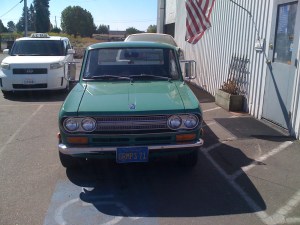
The photos of the Datsun pickup are of our mechanic’s 1973 Datsun 1/4 ton that he inherited from his grandfather.  IMG_0705

IMG_0703It’s a pretty cool truck with a nice leather interior.  It’s got American Racing Torqthrust wheels that give it a shiny aftertaste.  It’s a nice little hauler/daily driver!

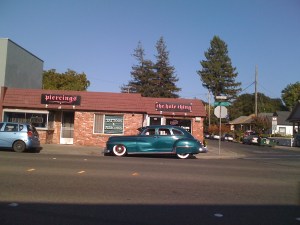
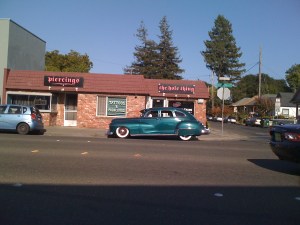
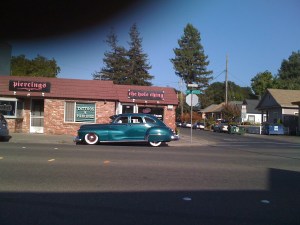
IMG_0694A couple of weeks ago, my mom was driving by a smoke shop and happened to see this lovely 1930s Cadillac.  I like the Chevy Aveo trying to look cool in the picture!IMG_0693IMG_0691In Santa Rosa, CA, there is an avid fire truck collector/restorer.  I happened to be driving by and there was an early Ward LaFrance fire truck from the 1960s!  They don’t get much nicer than this one!  IMG_0709

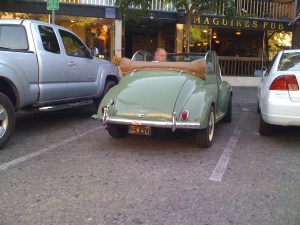
IMG_0708We also saw a lovely 1942 Ford Tudor Convertible (I know that they didn’t make any Tudor convertibles, but the owner seems to think so…)

IMG_0710

While volunteering for community service at an event at John Ash & Co, I happened to see this lovely 1952 Chevy delivery van.  It’s driven most days, from what I’ve heard.  Go to the event in style and have a lot of space left over!  Booyah!

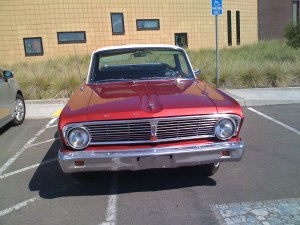
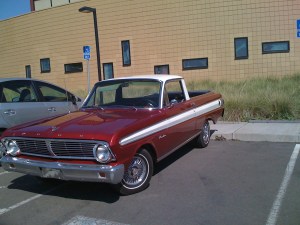
Photo0112My mom snapped the pictures of this lovely Ford Ranchero when she was at “work.”  IMG_0715

IMG_0714

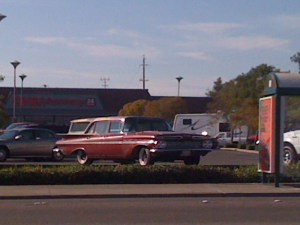
Yet another beauty we saw was this pristine 1960 Chevrolet Impala wagon.  IMG_0713

IMG_0712

For those of you who enjoy old Ford pickups, this one’s for you.  My mom and I were going to pick my sister up and we saw this beautiful old Ford F-2 from around 1955 driving along.  From what I could see, it’s used a lot.

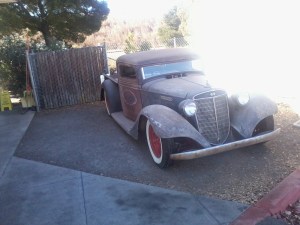
Photo0120When my dad and I were at a regatta, we saw quite a few lovely old trucks.  I’ll start off with this old Dodge rat rod.  I’ve seen it a lot, but it’s usually being driven too fast for me to take a picture!  It’s pretty cool.

Photo0099

We also saw this ancient Chevy Cameo pickup from Oregon.  It’s loaded with a lot of miscellaneous items, but it’s a hard-working old pickup that earns it’s oil changes.  Photo0101

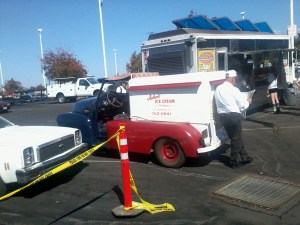
While there, we also happened to see this period-correct Ford F-1 ice cream truck.  The owner was raking in the cash, and the truck got a lot of thumbs-up!  Photo0100

The El Camino peeking its nose into the picture with the ice cream truck is driven daily, and looks amazing.  It was marketed as a truck that drove like a car.  This one is from the late 1970s, and is all original!  Photo0098

I hope that you had a bountiful holiday season, and wish you a happy New Year.  Since New Year’s day is on a Tuesday, I’m going to take a mini-vacation from the blog, and will be back next week.  Thanks for being such loyal and wonderful readers.  You can look forward to more interesting and wonderful posts in 2013.  I happen to have a FABULOUS one up my sleeve!  Stay tuned.

Happy New Year!

Not the Average Ride at Disney World…

Disney World has had a thrill ride with Chevy for the past 13 years.  It was called “Test Track.”  Today, it is still there, just under major renovations.  The “ride” will take guests who come into the exhibit through a three-part interactive experience that will go through the designing, testing, and marketing phases of making a new car.  Chevy and Disney hope to show guests just how hard it can be to start with a blank piece of paper and an idea.

When guests enter, they will be greeted by a good deal of touch screens.  These touch screens are design kiosks.  The guests start with a blank “canvas,” and design their own car from the wheels up.  Users can make decisions about engine size, the vehicle’s shape, and color.  These will all be displayed on the screen.  When they are done, the user will get a card that is encoded with all the necessary information about the car.

The second part of the ride will take users through the testing phase.  As Disney and Chevy said, “this is one place where Disney magic disappears, and industrial magic comes into play”.

GM industrial design manager, Jeffrey Mylenek said, “If you made some compromising design choices, it’ll be reflected in your virtual vehicle’s performance numbers.”  Even though it would be awesome to have the ride behave like their decisions about the car (i.e. big engine + tiny tires = oversteer!), that isn’t in the forseeable future.

The third part of the ride may be the best part – riders can race their cars on a test track, have photos taken of them “sitting” in their creation, or create a commercial that features their car.

The final part of the ride has about a dozen production Chevy products on the display.  It won’t be unheard of to see a real concept car there every so often.  Unfortunately, I’ll have to wait until December 6, 2012 to go on the ride (hint, hint Mom…).


My apologies for the late posting.  Candler was right on time.  I, on the other hand, was not.  Ahem.  My apologies!  Editor Mom.

If This Car Goes Into Production, I’ve Got Dibs!

Chevy is feeling a mite bit jealous of Subaru and Scion’s joint success of the Subaru BRZ and the Scion FR-S, so at this year’s Detroit Auto Show, Chevy came out with two concept cars:  The Code 130R and the Tru 140S.  Chevy threw the Code 130R and the Tru 140S into mock battle on Facebook and Twitter to see which car would win.  I am going to focus on the Code 130R, as it has a stronger chance of going into production.

The Code 130R is based on a shortened Cadillac ATS platform.  For some people, the car may remind you of an everyday man’s (or woman’s) BMW 1 Series coupe.  To me, it looks like a cross between a 1967 Chevy Camaro/BMW 1 Series.  It is just a bit bigger than the FR-S/BRZ, and has less horsepower.  But, it has a similar mission:  To introduce those new to the automobile to the joys of driving.  The concept has a 1.4 liter turbo four putting out a somewhat measly 150 horsepower and 148 lb-ft of torque.  However, the concept does have GM’s eAssist, which would give the tiny 1.4 about 15 more horsepower.  The gigantic 20-inch tires are going to need a bit more than 163 horsepower to break into a drift.  Car & Driver has heard that if the car makes it to production (very likely), it will likely have these three engines:  a direct-injected 2.0 liter four cylinder as the base engine, the 1.4 liter in the Eco model, and for those who enjoy high-powered drifts, the potent 2.0 liter turbo from the Cadillac ATS (270 horsepower).  That power will get to the wheels via a standard six-speed automatic or an optional six-speed manual.

Here’s a picture for you to drool over.

  • chevrolet-code-130r-concept-side-3

The Family’s New Car – What Will it Be?

So many people have been driving their old cars.  The economy, ya know.  Well, the old cars need CPR (or most likely, a quick and painless retirement).  I decided to research options.  So here you are, a comparison, and contrast, of  the:  Toyota Prius Plug-In, the Toyota Camry Hybrid, and the Chevrolet Volt.  I thought that this topic would interest you, so this post is going to be a bit longer than usual.

Toyota Prius Plug In:  The Toyota Prius plug-in is virtually indistinguishable from a normal Prius.  The only way one can tell the Prius Plug-In apart from a regular Prius are the silver paint on the mirrors, door handles, and tailgate, the car looks the same.  Of course, the blue-and-white PLUG-IN HYBRID stickers help.  There is also a cutout in the left fender that houses the outlet for the charging cord.  In terms of the inside, there are only a few PLUG-IN HYBRID stickers and logos.  The cargo floor is also a couple of inches higher, due to the larger battery pack.  From the driver’s seat, the car is virtually the same as a regular Prius.  The only differences are the fact that the battery pack is much heavier (it is made out of lithium-ion).  The car will take a tortoise-like 11.3 seconds to reach 60.  In three hours (from a 110-volt current), the car will be completely charged.  However, if you have a 220-volt current, you will be on your way in an hour and a half.  If you drive like a senior, you can get 13 miles of range before the car starts the normal hybrid cycle of a Toyota Prius.  If you drive faster, the range will subsequently go down.  Quickly.  You can go up to 62 in full electric mode, but that will drain the battery within minutes.  Accelerating to freeway speed or going up a hill will bring a moan that sounds like Leo when he’s tired from the engine.  Car & Driver gingerly drove the car in the city and were sustained by pure electric power 39% of the time, and got an average of 56 mpg neatly displayed on the navigation screen.  However, there are limited dealers that are authorized to sell the Prius Plug-In, so be sure to contact dealers near you.  The Toyota Prius Plug-In that I configured on the Toyota website came into a grand total of $33,208 (including an $850 destination charge/shipping tax).

Toyota Camry Hybrid:  The Toyota Camry Hybrid has crisper handling than the basic Camry.  The Camry Hybrid has a larger trunk than the previous generation (a gain of 2.5 cubic inches to 13.1 cubic inches) and the right side of the rear seat is now the only side that can accommodate long objects.  Passenger space has increased to 102.7 inches from 101.4 inches.  Toyota has trimmed about 220 pounds from the previous Camry Hybrid, thanks to the use of high-strength steel.  The low-rolling-resistance tires and a slicker drag coefficient of 0.27 makes the Camry Hybrid more fuel-efficient and faster.  The three “optitron” dials in the car’s multi-information display show:  mileage, range, and very important energy flow.  In uplevel XLE models, a leather interior and an infotainment system will run you $1160.  The eco setting accessed through the multi-information display will significantly inhibit throttle openings and will lower the air-conditioning power consumption to a dull roar.  When in pure electric mode, one can travel 1.6 miles below 25 mph.  While the Camry Hybrid won’t win a drag race against a Mustang, it will win a drag race against the basic Camry.  The Camry Hybrid rockets to 60 mph in a monumental 7.3 seconds!  The Camry Hybrid will brake shorter and sooner than the previous generation Camry Hybrid.  Stops have been measured at 178 feet, compared to the older Camry Hybrid’s 200.  Also, the new electric braking system is so smooth that you won’t feel queasy, even if you stomp on the brake pedal.  There is not enough lateral support in the front seats during hard cornering.  There is more rear-seat room, thanks to the car’s redesign and the center console and front seatbacks being redesigned.  This is especially better for the passenger in the center seat.  The Camry Hybrid LE that I configured on the Toyota website came into a grand total of $27,033.  That includes the $850 destination charge/shipping tax, which puts the car on par with the Chevrolet Volt (in terms of pricing).

Chevrolet Volt:  Changes in the battery pack in the Chevrolet Volt have made the car’s range go up to 38 miles in pure electric mode.  The EPA fuel economy for the car has gone up to 98 mpg.  The larger battery pack means that the charging time from a 120-volt current will snap up 10.5 hours of charging time.  With a 240-volt current, that time is dramatically reduced to 4.25 hours.  Any Chevrolet Volt sold in California will automatically come with a low-emissions package that will make it legal to drive in the carpool lane with only one person.  For many owners, work is just within reach of the electric range, so they can charge the car at work and come home without ever turning on the gas generator engine.  When owners DO use the gas generator engine, the cost is usually less than $100 a month.  This is mainly because of the massive amounts of technology stored in the Volt.  The regenerative braking system can eke about 8 more miles of range into the car.  The car will give owners neck-snapping performance in sport mode, and very little acceleration in eco mode.  The Volt that I configured on the Chevrolet website was $42,720, but of you add in the $10,000 discount on the Volt, the Volt will run you a mere $22,720.  Add in the $7,500 tax rebate and the Volt will run you $25,220.

The Kia Optima Hybrid is a hybrid family sedan that competes (ish) with the Camry Hybrid.  It has a lot of bang for the buck, but it has surprisingly bad fuel economy for something with a hybrid logo.  The Optima Hybrid is stylish, fun to drive, relatively fast, and did I mention that it will cause traffic jams because of its looks?  It only costs a mere $26,000 base price!

Here’s where the fun begins!  Comparing and contrasting the three cars won’t be easy.  I never thought it would be.  The Prius won’t win a beauty contest.  That goes to the Volt.  In terms of range, the Volt wins again.  In terms of being family-friendly, hats off to the Camry Hybrid.  In terms of technology, the Prius Plug-In and the Volt are tied.  The Volt wins the performance criteria.  In terms of utility, the Prius Plug-In wins again.  In terms of pricing, the Volt is REALLY trying to end up in your driveway.  The Camry Hybrid is REALLY good at making it into your driveway.  The Prius Plug-In has the potential to sell as well as the conventional Prius.  Which car would I recommend to my parents, or their friends?  I would recommend the Volt to them, as it is the most efficient, fun to drive, and has a good deal of storage space.  Plus, it wins the beauty contest (in my eyes).  It also comes with leather at no added cost, an HOV sticker, and a REALLY cool sound system.  Oh, and did I mention that it was the 2011 Motor Trend Car of the Year!.  My second choice?  The Camry Hybrid.  In years to come, the Camry Hybrid will be easy to find parts for, and it should last us a very long time.  Plus, it’s still family-friendly and it’s a winning formula that’s been proven many times over.  It’s also got crisp handling (a much-needed improvement for Toyota), and it has over 600 miles of range.  Why wouldn’t I recommend the Prius Plug-In to them?  Well, it’s not as fun to drive (important), it looks like it came out of Star Trek, and only certain dealers can service it.  That’s a BIG, BIG problem.  The Optima Hybrid lags behind the others in everything but looks.

My Baby’s Running!

Remember when I told you that I was having some technological issues last week?  Well, thanks to a different IT department (NOT the Apple Store!), everything is fixed and just itching to be published.  I now have a YouTube account called unmuffled auto news.  I just added my first video yesterday to my channel (exciting, I know!)!  So, click the link provided, and enjoy the show!

http://www.youtube.com/watch?v=Wp7JKwruHNg

Don’t you just LOVE the sound of a big old American-made V6?  VROOOM!

Still in the Middle of the Pack…

Up until it’s redesign three model years ago (in 2010), Chevy’s lackluster Equinox was frequently ridiculed  by everybody else in the segment (Toyota Rav4, Honda CR-V, Ford Escape, and many others).  Then, the compact-crossover grouping received a big, big shock:  The Equinox was redesigned (gasp!), and brought along a nearly identical twin, the chunky-yet-spunky GMC Terrain.  Unfortunately, both vehicles are so underpowered that a Yugo could get to 60 mph as quickly.  So, GMC and Chevy decided to up the ante.  The Terrain Denali and the Equinox LTZ now have the GM family’s stellar 3.6 liter V6.  The engine has 301 horsepower and a barely-adequate 272 lb-ft of torque.

On the the subject of fuel economy, you can almost laugh that off, get a Prius v and a pickup.  The Equinox LTZ with front-wheel drive gets 17 mpg city/24 mpg highway.  If you need all-wheel-drive, the LTZ with all-wheel-drive gets a scary 16 mpg city/23 mpg highway.  Oh, and the front-wheel-drive model is faster to 60 mph at 6.8 seconds (add four-tenths of a second to the chunkier all-wheel-drive model.  I won’t even start on the Terrain.)

The Equinox and Terrain now are easier to drive on bumpy roads due to some new suspension trickery – it shares the same dual-flow dampers that the larger Chevy Traverse, GMC Acadia, and Buick Enclave have.  This means that the Terrain and Equinox bob and weave a lot less on less-than-ideal surfaces.  Plus, it gives the driver a much better perception of grip when hurtling into a corner.

Overall, the relatively large Equinox still has a lot of interior noise, an upshift-happy transmission, and very bad rear visibility.  Plus, it wouldn’t hurt to lose a bit of that flab, Chevy.  But, the revised Equinox has a much bigger kick in the pants and is an effortless interstate cruiser.  Car & Driver had a chance to test the “old” 3.0 liter V6 against the “new” engine, and found that the new Equinox is a bit easier to drive.