I Just Can’t Seem to Stop Talking About Michelin!

Hi there, my injuries and whatever else that I had are pretty much gone, so hi!  Shall we get down to business and learn so more about Michelin? Sorry, I didn’t quite hear that! I thought you were ready…

In 1905, Michelin opened up it’s first official branch of business, Michelin Tyres, Ltd, in London, England.  Michelin also opened it’s first plant outside of France, in Turin, Italy.  This was just a baby-step compared to what Michelin has done over the past 100 years…

In 1907, Edouard travelled across the Atlantic for the first time, to open a plant in Milltown, New Jersey.  The plant remained in operation until 1931.  Three years later, Edouard published the first Michelin Road Map.  Just three years later (I’m beginning to notice a pattern here!), Michelin invented the detachable spare wheel (and tire), so I guess you can thank one of the world’s largest tire companies for inventing the spare wheel and tire.

In 1914, just weeks before WWI was declared, Edouard Michelin offered aircraft building services to the French government.  The first 100 planes were given free of charge to France; the rest were sold.  The total of planes that Michelin built during 1914, a whopping 1,884 units.  Two years later, Edouard got an idea into his head.  The idea was that there was a runway, very much like a concrete road, that could be used for planes to take off and land on.  Yet another useful invention.  Six days later, the world’s first concrete runway was built.

In 1923, the first low-pressure tire, the Michelin “Comfort” was invented.  It could go up to 15,000 kilometers without air needing to be added.  In 1925, Michelin bought 22,230 acres in Dautieng, Indochina, and 13,600 acres in Thuan Loi, Indochina to operate it’s own rubber plantations.

Three years later, in 1928, Edouard Michelin appointed his son, Ettienne Michelin vice-president of Michelin.  In 1929, Ettienne invented the “Micheline” railcar and the first train tire.  The following year, Edouard filed a patent for a tire with a built-in tube; the ancestor to the tubeless tire.  In 1930, Ettienne filed a patent for a tire with a built-in tube. This was the ancestor to the tubeless tire.  Just two years later, the Supercomfort tire was invented and it had a lifespan of 30,000 kilometers.  In 1933, the Bella Vista factory was built in Argentina to produce the Supercomfort tire.

In 1934, the Michelin “Stop!” tire introduced skid strips to the world.  Skid strips were strips built into the tire that helped the tire find traction on slippery roads.  The tire turned out to be a huge success.  in 1935, Michelin bought almost 95% of Citroën Motor Car Company.  Pierre Michelin (Edouard’s younger son) became CEO of Citroën, and appointed Pierre Boulanger vice president of Citroën.  Citroën also built the first prototype of what we now know as the Citroën 2CV.  Also, the Michelin run-flat tire was invented.  Today, many cars have run-flat tires for safety, as they can go for many thousands of miles with a leak and not endanger the driver and passengers in any way.

In 1940, Michelin took the name of Michelin Rubber Manufacturing, Ltd.  Five years later, the Clermont-Ferrand plant, bombed by Allied bombers in 1944, was rebuilt and modernized.  The following year, Michelin invented the radial tire.  Edouard Michelin (then almost 80) had filed one of his last patents on June 4, 1946.  Two years later, the Citroën 2CV was introduced at the Paris Auto Show.  Even though it took three years to iron out the kinks, Edouard Michelin had invented something amazing, the radial tire.  It was marketed under the name Michelin “X.”

In 1959, Michelin invented the first radial tire for earthmoving equipment (if you don’t believe me, call up the local equipment rental store and ask what type of tires they use on their largest equipment).  In 1965, the first Michelin tire testing center, the Ladoux was opened just a few minutes north of the Clermont-Ferrand plant.  Just three years later, the first Michelin Green Guide was published for a North American location; New York City.

in 1974, Michelin sold all its shares in Citroën to Peugeot.  Three years later, two new testing centers opened: one in Laurens, South Carolina, the other in Almeria, Spain.  Just two years later, Michelin was the main sponsor for Ferrari in the 1979 Formula One World Championship.  Ferrari won.

1981- Michelin invented the Michelin Air X, the first radial tire for aircraft.  This meant that aircraft no longer needed to have solid rubber tires, which meant that the aircraft could lose up to 200 pounds.  The following year, Michelin opened a new plant in Waterville, Nova Scotia, Canada.  The plant produces the Michelin Air X tire.  In 1990, Michelin bought the Uniroyal Goodrich Tire Company, North America (Uniroyal Australia had been bought in 1980).  This ensured Michelin’s future in North America.

In 1991, Francois Michelin appointed his son, Édouard Michelin II co-managing partner.  Just four years later, Michelin saw a new plant open in Manila, Philippines.  Also, the Space Shuttle landed on Michelin tires the same year.

In 1998, Bibendum (the Michelin Man) celebrated his 100th birthday.  In honor of that, Michelin started the Challenge Bibendum.  Challenge Bibendum is an online global clean vehicle and sustainable mobility forum.  The following year, Michelin developed and started producing the Delta Radial performance motorcycle tire, which rivals Michelin’s finest modern-day racing tires in technology.

In 2003, Michelin developed the XeoBib; the first agricultural tire to run at a constant low pressure.  Seven years later, in 2010, Michelin was inducted into the Sebring Hall of Fame, because of it’s 11 years of undisputed supremacy in the American Le Mans Series (ALMS).  The same year, in honor of Michelin’s first road map being published, Michelin came out with an interactive DVD road map that is almost as interactive as using SiRi on a brand-new iPhone 4S.

Today, Michelin sponsors three racing teams, sponsors tires for the Porsche 911 GT3 Cup,  has 23,000 authorized retail stores around the world, and employs well over 100,000 people.

From Bad to Worse

In the ongoing saga of this writer’s health, the editorial staff wishes it to be known that he has been recalled for major factory repairs. As soon as all repairs have been made, he will return for active use.

From: The Editorial Staff

Michelin Tires (Part 1)

The history of Michelin Tyres, Ltd can be traced back to 1829, with the marriage of Edouard Daubree and Elizabeth Pugh Parker.  Elizabeth was the niece of the man who found rubber in benzene.  She introduced rubber into the French Auvergne region, where she made play balls for children.  She started making them by hand, then by a machine that her husband invented.  A few years later, in 1832, Edouard Daubree and his cousin Aristide Barbier started a rubber factory in the small town of Clermont-Ferrand, France.  They made such things as: farm machinery, rubber balls, gaskets, valves, and tubing.  Thirty-one years later, they named the company Barbier Daubree & Co.  The same year, it was changed to E.Daubree & Co.  In 1867, J.G. Bideau, a local lawyer, invested in the company (which was then run by Ernest Daubree, who had taken over the business).  Since Bideau then owned almost 65% of the company, it was changed to J.G. Bideau & Co.

In 1889, two brothers, Edouard and Andre Michelin co-manage the company, and the                                      name was changed to Michelin & Co.  By this time, the plant was employing 52 people, and was producing about 200,000 rubber balls a year.  Two years later, a cyclist arrived at the plant, in need of supplies to repair the Dunlop tires on his bicycle.  After three hours of hard labor, the tire was off, and was patched.  The next morning, Edouard tested out the repaired tire in the factory courtyard.  After only a few laps around the courtyard, the tire failed again.  However, Edouard was enthusiastic about pneumatic tires, so he started experimenting with the idea.  A couple of months later, he took out his first patent.  We can thank Edouard for the pneumatic tire – its comfortable and long lasting ride.

A few years later, in 1895, the Eclair, built by Andre Michelin, entered the Paris-Bordeaux-Paris race, did not win, but was a milestone in automobile history – it was the first car to use pneumatic tires!  The following year, Edouard and Andre were at the Universal and Colonial Exposition in Lyon, when Edouard saw a stack of tires, which prompted him to say “Give it arms and legs, and it could be a man!”  Soon afterwards, Andre and Edouard Michelin had the French cartoonist, O’Galop draw a figure of tires with the Latin line “nunc esl bibendum”, which means “it’s time to drink!”  Andre also added the now infamous slogan “Michelin tyres drink obstables!”  To this day, Bibendum (also called the Michelin Man) has been an iconic symbol in the automotive world.

Edouard had to travel a lot on behalf of the company.  Most likely, he spent a great deal of his time in flea-bag hotels and eating in unappealing restaurants.  So, he decided to create a travel guide.  In 1900, the first Michelin Guide was published.  Within the first month of sales, more than 35,000 copies had been sold.  On the front cover, Andre Michelin’s famous words “This guide is born with the century, and will last as long as the century does.”  Michelin Guides are called by some “the traveller’s Bible.”  The Michelin Green Guides are oriented towards longer trips.  They include:  Historical background, art and architecture, cultural insights, as well as food and hotel information.  The Michelin Red Guides are oriented towards shorter trips, and they include:  Food and hotel information.  The Red Guide was published in 1900, and is often called the Red Guide, due to its distinctive red cover.  Michelin Must See Guides are oriented towards nature, and are often used for weekend getaways, and camping trips.  Overall, Michelin Guides are a nice additions to a trip.  Plus, almost 30 million copies of the Red Guide have been published.  Over 88 million copies of Michelin Green Guides, Red Guides, and Must See Guides have been published, so it shouldn’t be too much of a problem to get a new one…

For those wanting to look at Michelin’s website, here it is:  http://michelinman.com/

Stay tuned for ‘Part 2’, which will include the remaining aspect of Michelin’s extensive history, as well as their criteria for their tire development, and definitions (like, what IS a pneumatic tire?).

I Smell a Rat…

You are probably thinking of the pesky mammal that squeaks, eats any food that you left out, and is a general annoyance.  I’m thinking of the rat motors, built by Chevy in the 1960’s.  The rat motor was Chevy’s big-block V-8.  They were offered in 396 ci, 402 ci, 427 ci, and 454 ci regular production engines.  There were also the special aluminum-block 427 ci, 430 ci, 465 ci, 495 ci, and 510 ci rats, built especially for race cars.  Built in factories, they were genetically engineered rats (or at least mechanically engineered!)  Now for the interesting part…  The name was coined by drag racers and tire-smoking teenagers (NOT me), who called it the rat because it was an outsized companion to the small block “mouse” engines, and the rat’s ability to scare the Chrysler Hemi “elephant” motors. Trivia moment:  The Chrysler Hemi was called “the elephant” because it was so heavy!  So, inevitably, the Chevy rat has gone down in history without many of the nicknames it deserves.

How a Car Engine Works

Ever pop the hood of your car and wonder what’s going on?  In today’s post let’s learn about your car’s engine.

Currently, the fastest way to high performance and fuel efficiency is to use the internal combustion engine.  The combustion (explosion) occurs inside the engine, and the energy is used to propel the vehicle forward.  The internal combustion engine has many forms, such as, diesels, gas turbine, two-stroke and Hemi engines are all part of the family.

On the other hand, there is an external combustion engine. In an external combustion engine, the energy (fuel) is burned outside the engine.  This energy propels the vehicle forward.  The best example of this would be a steam engine on an old-fashioned car or train.

Most cars use the four-stroke combustion cycle.  This converts gasoline to movement.  The four strokes are:

1. Intake stroke.  The piston is at the top and moves downward.  When it is halfway down, the intake valve opens and fuel and air come in and mix in the cylinder.

2. Compression stroke. Compression (or squishing) of the fuel/air mixture by the piston.  The molecules are being crushed as the piston moves up in the cylinder.  All the valves are closed.

3. Combustion stroke.  Here comes the job of the spark plug.  The spark plug emits a spark (sent from the distributor via the electrical system) and ignites the fuel (air/gas mixture).  The resulting explosion drives the piston down.

4. Exhaust stroke. When the piston is at the bottom of it’s up/down stroke, then the exhaust valve opens and as the piston moves up, it pushes the waste gasses (CO 2 and NO 2) out the exhaust system and polluting our beautiful atmosphere.  Now the vales are all closed.  Trivia: NO 2 is nitrous oxide and is used for giving race cars a quick boost of speed.  Mostly used for dragsters.

Now the cylinder is ready to repeat the intake stroke and start all over again.  Diesel engines are different because they don’t have spark plugs.  I’ll explain that another time, so stay tuned!

Let’s Joyride in this Car

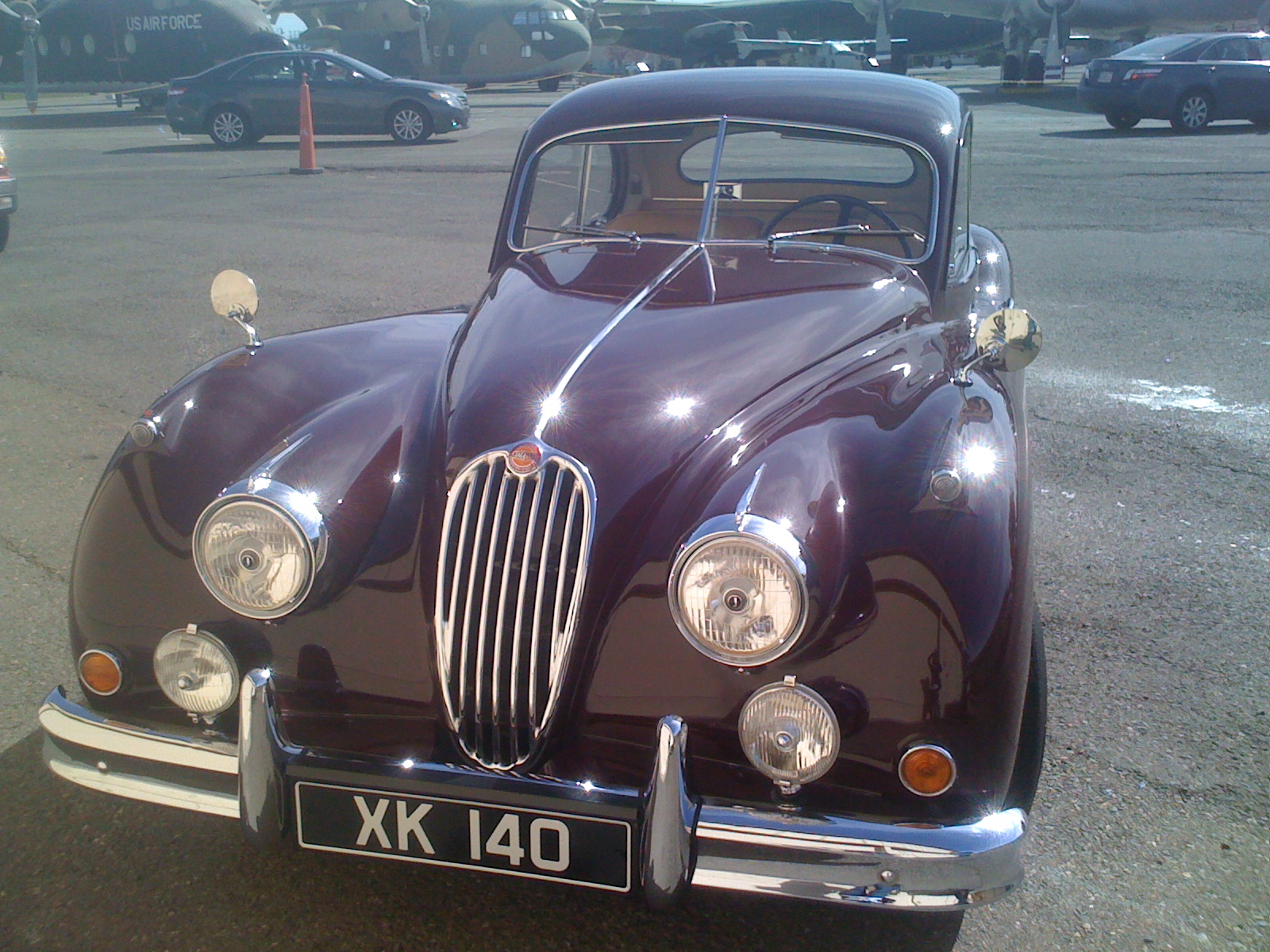
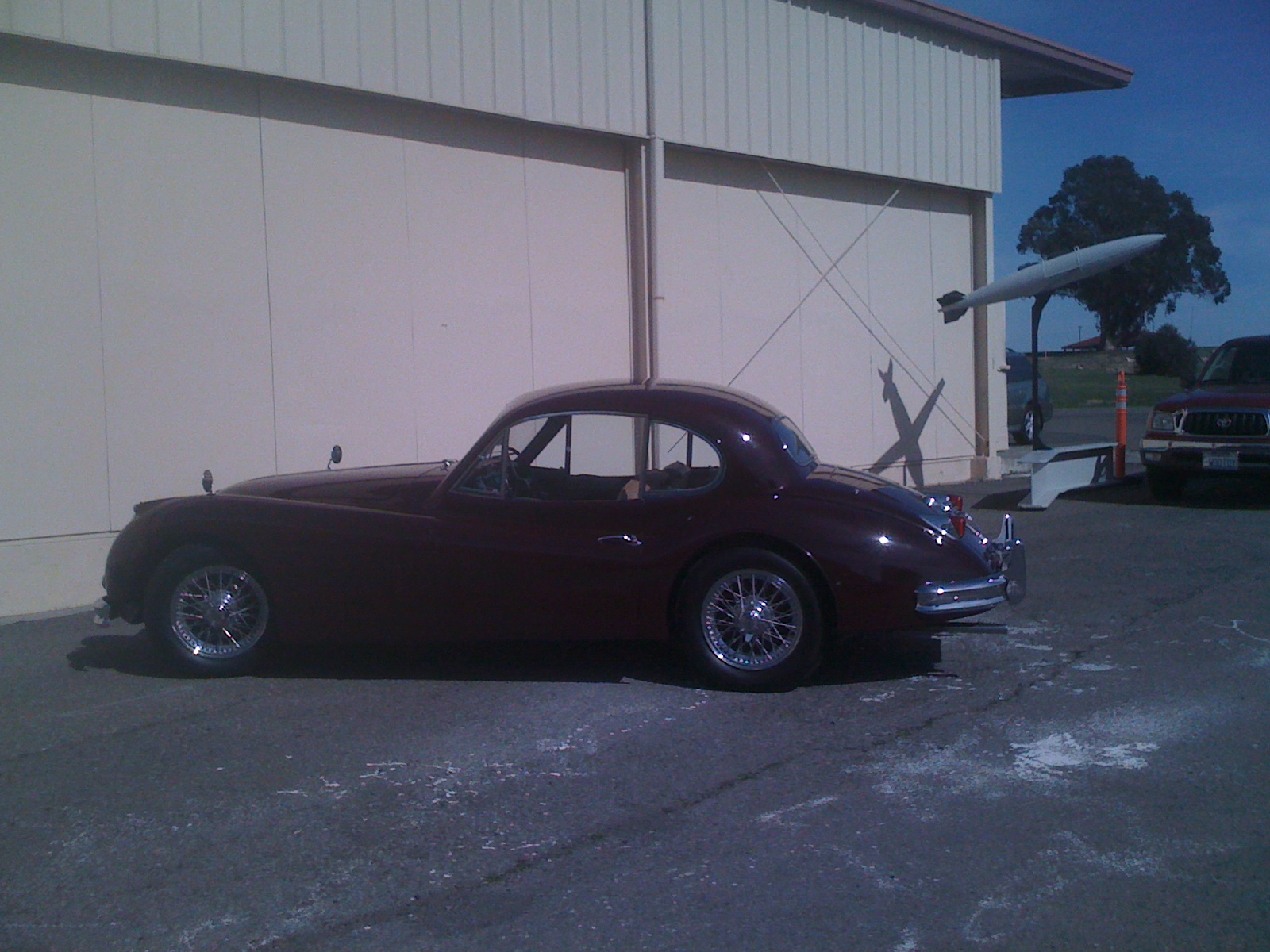
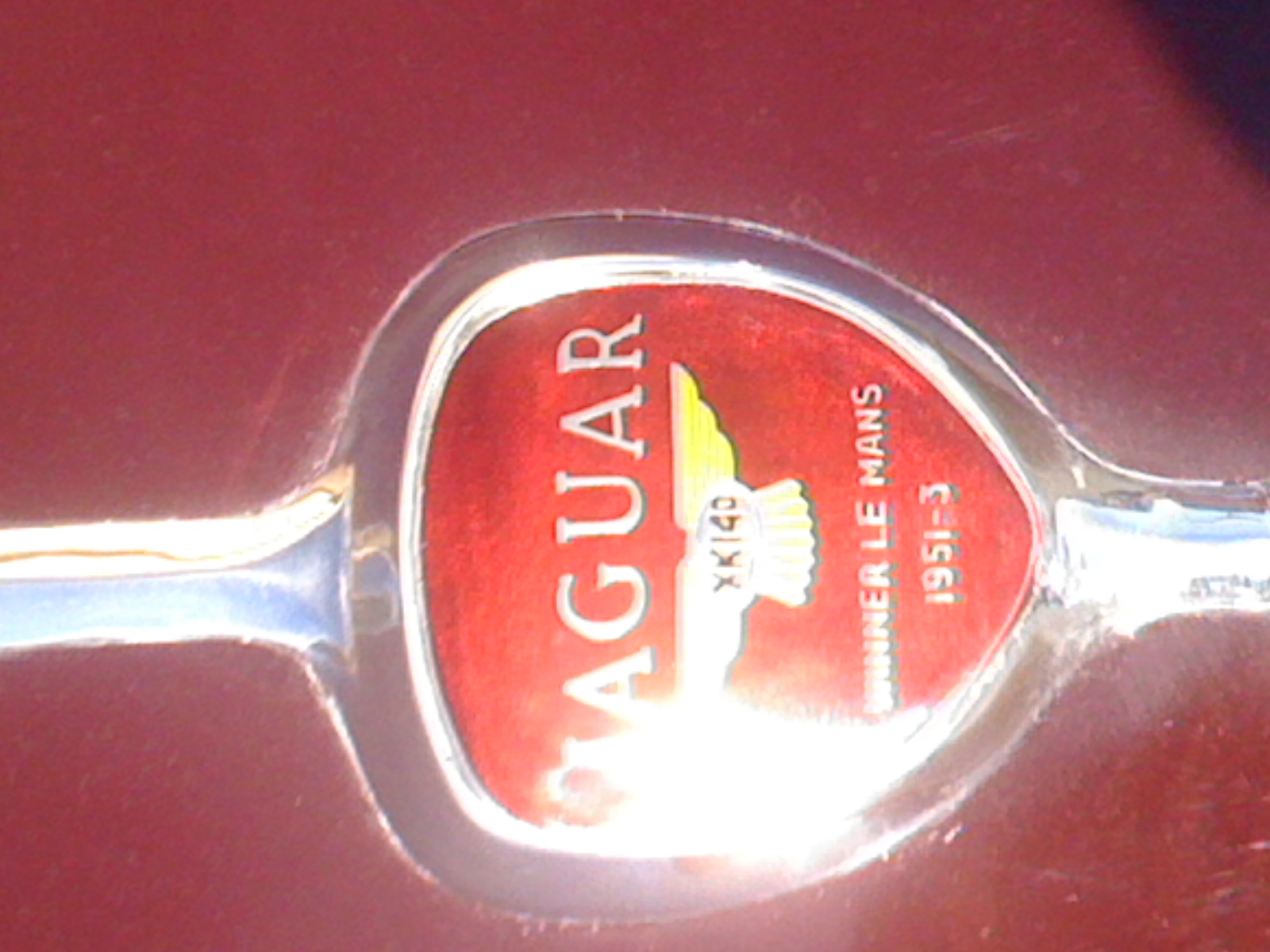
While touring a local air museum and looking at the planes parked outside, I happened to see this beauty parked outside.  I was skeptical about getting closer, but my good ol’ mom convinced me to hop a fence (well, duck it is more like it), and get closer.  Wow.  A beautiful 1958 Jaguar XK140.

The facts:

  • Very few XK140’s were made from 1957-1960.
  • Even fewer were made in this lovely shade of maroon.
  • Mostly, they were convertibles with a body-color hardtop like this pristine example.
  • This car with a 4-speed manual, 3, 4-liter inline, six cylinder and two person seating (with a small cargo shelf), probably cost a fortune to get to this level of restoration.  Maybe over $100K.

Since 2007, XK140’s have been plodding along in value.  Though the xk140 may not be as much fun to drive as an E-type, they are usually an equally affordable option to a 1950’s Corvette.  My advice to current XK140 owners is to hold on to your car.  They will go up in value.  While currently selling for about $60 grand, I would bet that in a few more years, prices will go up.

Back in 1959, these beauties sold for $3,750.  The money spent was well worth it.  Many notable people such as; Jay Leno, Dale Earnhardt, Sr, John Lennon, and Bill Cosby have all owned one at some time or another.  Sir William Lyons would have been proud to know how much these are treasured.

Lay on the Iron – Not Literally!

You’re probably thinking, “What the heck is Zoomvroom talking about now?”  Well folks, Zoomvroom is talking about a popular racing manuever.  ‘Lay on the iron’  can be roughly translated as an act during a race, where a driver will cut inside another car’s lane, thus forcing the other car to swerve away to an outside lane.  This has the byproduct of reducing the speed of the aforementioned car considerably.  Check this out in the Steve McQueen movie, Le Mans.

Note: Never, ever try this on a public road.

Don’t Go Breaking My Heart

the heart car

Don’t go breaking THIS heart!  We all know that Valentine’s Day is a PERFECT day to have a date, and while this might (NOT) be the perfect car to drive around like Granny in, it’s a crack up.  This “car” was made by special effects and design house, Asylum (that’s where THIS car belongs…).  I don’t know what type of car it’s built on, but it seems to be about the same size as a VW Beetle.  So, this might be a good hot rod for your girlfriend.  My thoughts on it include heart surgery, asI’m pretty sure it’s NOT road-legal…  Here’s a funny joke:

What do you call it when somebody attacks this car?

A heart attack!

P.S.  Happy Valentine’s Day!


NOTE:  The Editorial Assistant (aka Pop) would like to apologize for neglecting to post this last night.  Good help is impossible to find.

This is My Dream Come True!

Since 2007,  rumors have been circulating the web with this not-so-credible (but I wish were true) story.

A New York man retired. He wanted to use his retirement money wisely, so it would last, and decided to buy a home and a few acres in Portugal. The modest farmhouse had been vacant for 15 years; the owner and wife both had died, and there were no heirs.

The house was sold to pay taxes.

There had been several lookers, but the large barn had steel doors, and they had been welded shut. Nobody wanted to go to the extra expense to see what was in the barn, and it wasn’t complimentary to the property anyway… so, nobody made an offer on the place.

The NY guy bought it at just over half of the property’s worth; moved in, and set about to tear in to the barn – curiosity was killing him. So, he and his wife bought a generator and a couple of grinders… and cut through the welds.

What was in the barn? Don’t miss it!

One can only dream for this to happen.  Maybe that’s even too optimistic for a dream.  Or, if it is real, I really DON’T believe it!  I’d need somebody like the FBI and/or the CIA to look into it first.  It’s even more so with all these rare and collectible cars.  As a contributing editor to Road & Track, Tom Cotter said, “Huge collections of cars just don’t happen.  Cars are accumulated-sometimes lovingly, sometimes not-by someone with a purpose.”  After a long time cruising the web looking for the photographer who took pictures, he was able to get this credible information from the photographer:  Manuel Menezes Morais was the photographer who clicked a lot pictures for the elusive owner in 2005.  The owner most likely lives somewhere in the Sintra region of Portugal (near Lisbon), hired Morais, scanned the pictures onto his computer, put them into an email with this fake story, and sent an email to some random unsuspecting person in the car world who then was so excited that they unknowingly started a worldwide internet hoax.

Here are all the derelict cars that Morais says are NOT for sale!  Too bad, as there are some that people would pay millions for.  Morais was able to contact the owner and ask him what his favorite car in the whole collection is.  The owner told him it was the Lancia Aurelia B24.  The owner has two.  Enjoy these derelict beauties!  That is the one good thing of looking at all these fake sites with these real cars!  They ARE REALLY cool!  My personal favorite is the 1948 BMW 507 Speedster about a third of the way down.

Sigh……  If only…

The Barn...

The doors were welded shut, but an angle grinder took care of that.

Lotus Super Seven Series IV, Lotus Elan FHC, Opel GT, Alfa Bertone.

Opels & American barges.

Fiat Cabriolet (1200 or 1500), Ford Cortina MKII, Mercedes Benz 180/190.

Pre-war stuff, 1970's American barges, who knows?

Austin A40 Somerset and endless rows of other cars.

Mini (Cooper?), Datsun Z, Rover P6.

Fiat 508 Balilla Sport, Mini (Cooper?) and MG Magnette.

American, 1920's.

American, 1920's.

Ford Taunus, Mercedes Benz, BMW 02.

Alfa Bertone, Porsche 356, Mercedes Benz.

Who knows?

Pre-war Austin? Alfa Giulia, BMW 501 V8.

Some BMW's.

BMW 501 V8

BMW 501 V8

American cars.

Lancia Aurelia B20.

It's a car. An old one.

Lancia Appia.

Porsche 356, Austin Healey Sprite MkII, Volvo PV 544, Ford Y?

Porsche 356.

Lancia Flaminia Zagato.

Alfa Bertone, Giulietta Sprint, crumpled Peugeot 205.

Yep, another one.

Giulietta Sprint, Giulia Sprint Speciale (SS), Nash Metropolitan.

Alfa Giulia SS.

Lancia Flaminia Coupé.

Mini Cooper MkI.

Austin Mini Cooper S.

Alfasud 1.5, Mercedes, Chevy Master.

Lancia Aurelia.

Opel GT, Lotus Elan FHC, Lotus Super Seven Series IV, Lotus Elan DHC.

Elan +2, DKW 1000 SP?

Lotus Super Seven Series IV and Lotus Elan.

Alfa Giulietta, Lotus Europa, another Lotus Elan FHC, Matra Djet?

Alfa 1900 Super Sprint.

Datsun Z.

Austin Mini Cooper MkI

Alfa Romeo.

Fiat Topolino II, Triumph TR4, Peugeot 202.

Steyr Puch, Austin Healey Sprite MkII.

Interior of Alfa Romeo.

Unknown.

Alfa Romeo.

Bristol 404 Saloon, Lancia Flaminia Coupé.

Abarth 1300 Scorpione.

Simca Coupé De Ville.

American (inspired) design.

Lancia Flaminia Coupé, Lancia Appia, Porsche 356, Alfa Bertone.

Saab 93, Alfa Berlina, Renault Dauphine, Opel Rekord, Rover P5 Saloon

Definitely American.

Porsche 356.

Interior of Porsche 356.

Hillman California.

BMW V8, Formula racers, Chryslers, Mercedes, Austin A30.

BMW V8, Formula racers, Chryslers, Mercedes, Austin A30.

Lancia Aurelia B20 2+2.

Volvo PV 444.

Austin Mini Cooper.

Lancia Flaminia Coupé, Peugeot 504 cabriolet & 404 cabriolet.

Mini, Alfa 1900 Super Sprint, Balilla.