Why You Should Road Trip in 2015

Gas is cheap.  You’re going to see more classic and high performance cars out on the road because of this.  Most of us like to drive.  It’s fun.  Road trips with family or friends are a lot of fun.  You don’t need an exciting, fancy car to road trip.  You could go through California in a Kia Rio and still have fun.  Here are some tips to make the most out of a road trip.  You probably know most of these, but some you probably won’t.

  • Have travel companions.  Whether it’s your spouse, sibling(s), friends, co-workers, or a boyfriend/girlfriend, other people make road trips more fun.   Even your dog can make it more fun.
  • Know basically where you’re going.  Unless you have some sort of deadline, or specific place to be, know where you’ll end up within the next couple of days.  Let people know where you’re going, and when you expect to be there.  Let them know when you arrive.
    • That being said, explore some.  Don’t stay on the interstate.  Take some backroads, explore local towns, and have a good time.  If you’re travelling around, say California, and you want to end up in Palm Springs by the weekend, let somebody close to you know, but explore some.  The California desert has plenty to offer.
  • Tell people where you’re going, and when you get there.  Don’t be a total loner when it comes to road trips.  Call your parents/siblings/significant other/friends/whoever you know well.  It’s a simple 2-minute call.
  • Try out the local delicacies.  Most small towns have something that the locals enjoy. For example, Gilroy, California, is the garlic capital of the world.  Try garlic-themed food there.  You get my point.  Try what the locals all recommend.  It’s usually in the specials section of the menu.  Or, you can ask the wait staff what they recommend.
  • Check out museums if there are any where you stop.  It’s a simple, quick Google search. You’d be amazed at what you can find.  Most of the museums are quite interesting.
  • Talk to the locals.  Chat the people who seem nice up.  They might tell you where the good places to eat are, or where a fun or scenic road is.  It’s worth your time, and most people will be nice enough to talk to you.
  • HAVE FUN!!!!!  That’s what most road trips are meant to be.  Make it memorable.  Do burnouts, donuts, drifts, or go off-roading if you want.  Just make sure you won’t cause trouble when you do it.


The Cars that Deserve a Stripped-Down Track Version

Some cars are just born to be demons on the track.  The track doesn’t necessarily need to be a road course – it could be off-road also.  These are the cars that deserve to be stripped down to the basics for maximum fun.

  • Audi TT:  The Audi TT has always been a decent sports car, but it’s always cried out for more power and aggression.  This is why it deserves to have the sound-deadening materials yanked out.  Audi being Audi will never do this, but who’s to say that some very smart person won’t?  In my humble opinion, I think it is perfectly sized for rallycross, which is like autocross in dirt or gravel.  It’s awesome.  Just add a vented hood, a spoiler, more power, beefy tires and suspension, and a rollcage, and you’re good to go.  Audi has a history of legendary rally cars, so it seems fitting to me to introduce it.
  • Chevrolet Corvette:  Yes, the new Corvette ZO6 is truly a monster at the track, but it also weighs more than it should.  I love supercharged engines, but they end up with heat soak after about 20 minutes, and then what?  If Chevy put the C7.R endurance race car’s engine in, it would weigh less and have as much power.  My idea of a ‘Vette track special would borrow heavily from the C7.R parts bin, and would utilize carbon fiber and titanium.  It wouldn’t be cheap, but it would beat just about anything this side of a race car.
  • Jeep Wrangler:  Jeep needs to build a pickup again.  Several aftermarket companies will sell you a kit to turn your Wrangler into a regular cab pickup.  It’s time for Jeep to do that…from the factory.  If Jeep put the 5.7-liter HEMI V-8 under the hood, the Wrangler pickup could actually tow and haul.  Better yet, Jeep could put the 3.0-liter turbodiesel V-6 under the hood.  Now, that would be something that would sell like crazy!  It would be big enough to haul dirtbikes, an ATV, firewood, camping gear, and other important off-road items.  If Jeep offered a toolbox where you could store stuff, that would be awesome.  I’m starting to get carried away with this now.  I’m going to let your imaginations continue your dream Jeep pickup.
  • Chevrolet SS:  The Chevy SS is Chevy’s big performance sedan.  It has the LS3 V-8 from the Camaro, and it comes with a stick!  It’s a stealth tire shredder, but it’s not very fast around corners.  If Chevy put the trick suspension and computer electrickery from the Camaro Z/28 or ZL1 in, talk about a real sleeper!  It really doesn’t need more power – it just needs less weight.
  • GMC Canyon/Chevrolet Colorado:  The new Chevy Colorado and GMC Canyon are great little trucks.  The Canyon just doesn’t stand out all that much from the Colorado.  Here’s my idea:  Make a street brawler version of the Colorado available only in 2WD (jam the 5.3-liter EcoTec V-8 from the Silverado in, along with the Corvette’s 8-speed automatic), and make an off-road monster version of the Canyon that would compete with the Jeep Wrangler and Ford F-150 SVT Raptor.  It would be about the same size as the Wrangler, yet have more utility.  It would also come with the V-8, but it would be the big Duramax diesel V-8 and Allison 6-speed automatic from the heavy-duty pickups.  It would be loud, and have the perfect gearing for bombing around the desert or rock crawling, thanks to the big tranny.  
  • Jaguar F-Type:  The Jaguar F-Type is already a holy drifting terror.  If you go onto YouTube and find hotlap videos of it, you’ll see what I mean.  It’s too much engine and not enough tire.  Jaguar should start a Formula Drift team with this car.  If they put on less-sticky tires, increased the steering angle, and put in super high gearing, they would have a drifting beast.  I would buy it.
  • Ford Mustang:  It’s the first mass-produced Mustang to come from the factory with independent rear suspension.  Recent reviews haven’t been exactly kind to it, however. They say that it’s chassis is still slightly hairy.  Well, let me tell you something, grumpy overworked people:  GET OVER IT!  This is one of the best Mustangs to come out of the factory doors in recent years.  If Ford irons out the suspension kinks, the Mustang will be a much better car.  I know, I’m harshly critical too, but the Mustang desperately needs to impress.  It’s already got plenty of power from it’s 302 cubic-inch V-8, which I might add, is the second most-popular crate engine sold in America.  I would take it out and put out Ford’s 3.5-liter EcoBoost V-6, which has twin turbos, but turbos do not a car make, Fast & Furious fanboys.  The reason I would choose this engine is that it is much lighter than the V-8, can easily be tuned to make as much, if not more power, and meets smog requirements with ease.  Oh, and I can mention that it has a race pedigree in endurance racing.

Those are the cars that I think really need a track makeover.  They are all amazing cars in their own right – you should own or drive at least one of them before you die.  Let me know what you think deserves to give other cars a beating on the track.


Travis Kvapil’s Car Found

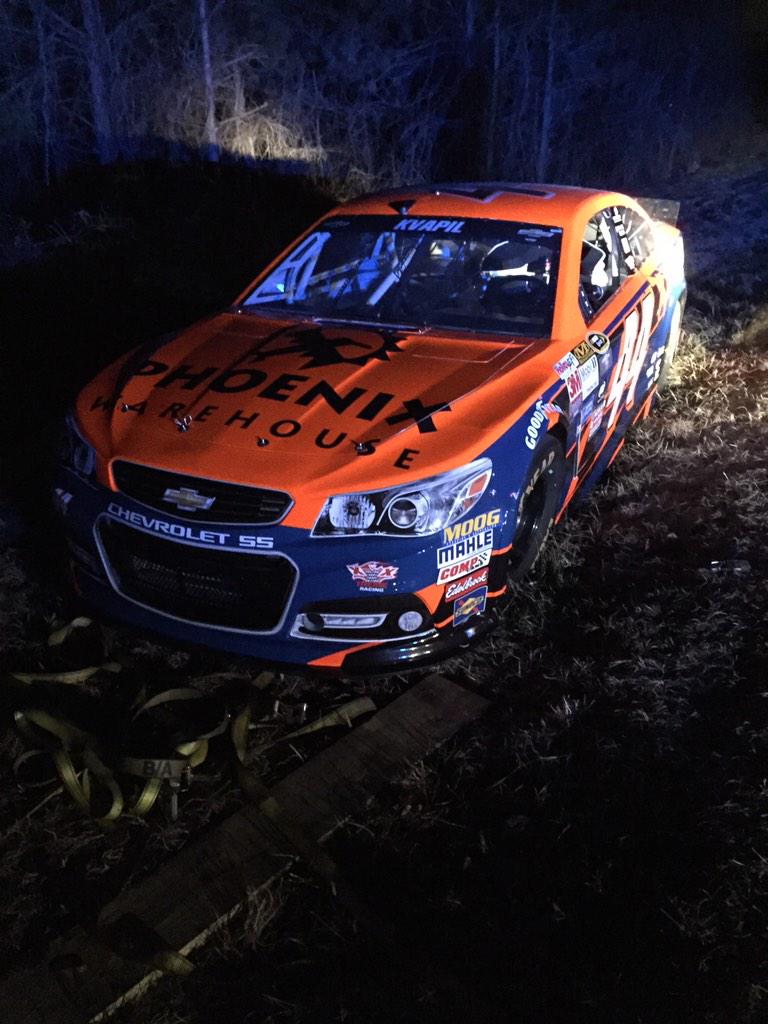
Last night, I reported on Travis Kvapil’s car being stolen early yesterday morning.  Well, it’s been found.

The theft of the car forced Kvapil and his team to withdraw from Sunday’s race at Atlanta Motor Speedway.

The truck and trailer that were stolen, along with the car, drove out of the parking lot of the hotel about 5:30 a.m.

The car was found about 20 miles outside of Atlanta, off the road leading into a suburb. The car appears to be undamaged.  The truck and trailer are yet to be recovered.

View image on Twitter

Even though the car has been found, Kvapil still cannot race this weekend – he missed the mandatory Friday inspection, and was forced to withdrwa from the race.  Bummer.

Have You Seen Travis Kvapil’s NASCAR Stock Car Recently?

Travis Kvapil, a NASCAR Sprint Cup Series driver, was forced to withdraw from this weekend’s race after his car and hauler were stolen from his hotel near Atlanta.

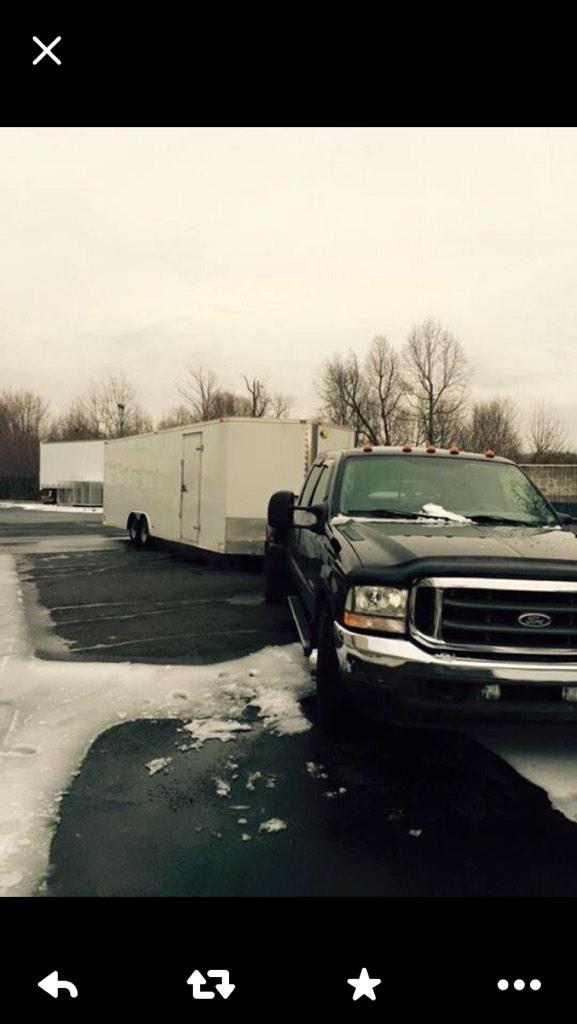
A trailer with his red number 44 Chevy SS stock car was hitched to his black 2004 Ford F-350 dually.  The truck and trailer were parked outside of his hotel room in Morrow, Georgia, about 15 miles outside of Atlanta.

Surveillance camera video shows the truck and trailer being driven out of the parking lot at around 5:30 a.m, officials said.

The trailer is all white with no markings.  The thief probably didn’t realize that the racecar was inside.  They probably thought that it was lawn equipment or something else that could be easily sold.

The 2015 Chevy stock car is valued at $250,000, according to a police report.  Also inside the trailer was a spare engine valued at $100,000, as well as tools valued at about $18,000.

A spokesman for Kvapil said that the team has withdrawn from the race this weekend, due to the lack of a back up car.

If you have any information on the stolen car, please call the Morrow Police Department at (770) 961-4006.  If you see the truck and trailer on the road, both have New Jersey plates.

The F-350 is a black crew cab dually.  The trailer is a plain white bumper hitch dual-axle trailer.

View image on Twitter

Here’s a picture of Kvapil’s car:

kvapil-876.jpg

If you see the truck and trailer on the road, call 9-1-1.  They’ll tell you what to do.

If you see the stock car on the road, good luck catching up to it!  It can hit about 200 mph, and will withstand a crash far better than whatever you drive.  It’s also pretty hard to miss. Oh, and it’s really loud!  That being said, you probably won’t see it out on the road, especially back east!  Those big slicks won’t do it any favors in the snow…

Why Gearhead Shirts are Important

You can always recognize a car person by their t-shirt, sweatshirt, or polo shirt.  I won’t even go into the different kinds of car t-shirts you can find – that would be an undertaking in insanity.

Ed Iskendarian is the guy who started the whole car t-shirt craze way back in 1949.  He’s still alive today.  Almost 67 years later, the car t-shirts are a mainstay of automotive culture.  It’s automotive anthropology.  You might not realize it, but you’re an automotive anthropology student if you have a car t-shirt.

Here are the main kinds of car t-shirts you will see:

Car Show T-Shirt:  Most car t-shirts typically have two or three cars drawn on it, along with the name of the event, maybe a palm tree, diner, or gas station, and the date of the event.  The name of the event is usually in cursive on the front, with the drawing on the back.  These t-shirts tell other car people you’re a park and polish kind of person.  You’re probably not the person you’ll see ripping around an autocross – you might see them cruise the main boulevard of town once in a while on a nice day.

Retro Style T-Shirts:  This is dangerous ground.  Anything with pinstriping, vintage lettering, iron crosses, or distressed lettering could mean that you really do live the vintage lifestyle with cars – all the power to you then!  It could also mean that you just jumped onto that Von Dutch bandwagon.  Tread lightly.

Race T-Shirts:  Any race car driver worth their car will have a race shirt.  These usually aren’t t-shirts (sometimes they are), but rather bowling shirts that have the logo of the team, name of the car, and primary sponsors.  Wearing one of these means you know your stuff.  You’re either a racing insider, fanatic, or you know somebody who is.  Most big-time racers will sell t-shirts that look like their race shirts.  They will usually have other merchandise, like sweatshirts, baseball caps, beanies, etc.  Just be careful if you’re a racer wearing your own merchandise in public.  It’s like a band member wearing a band t-shirt while on stage.

Old Race Track T-Shirts:  When you wear something like an Orange County International Raceway shirt, and it’s threadbare and faded, it’s obvious you bought that shirt AT Orange County International Raceway, and would never consider buying a reproduction shirt.  Instant cred among any car nut.  It’s not nearly as much cred as the guys who got a Lions Drag Strip leather jacket when they won a race at Lions.  This also applies to old event shirts, or ancient speed parts shirts.

Wrecked:  It doesn’t matter what style of t-shirt you’re wearing (it doesn’t even need to have to be a car t-shirt), but if it’s got oil stains, holes from welding, it’s got that hands-on cred.  Wearing that shirt in public and not caring if you smell like you rubbed that shirt in coolant says you’re hard core.

What do I have?  Well, I have a couple of car show t-shirts, a race t-shirt, a lot of vintage-style t-shirts, and a couple of wrecked shirts.  I’m still looking for a race track t-shirt.  I’ll find one…eventually.

These t-shirts, or other car apparel make great gifts for other automotive enthusiasts.  Hint, hint!

What to Do When You Witness an Accident

Car accidents can be very scary.  I know – I’ve been in a nasty one myself.  My mom and sister were very nearly in one the other day, and it got me thinking about what you should do when you witness an accident.  Here’s all you need to do:

  • Pull over to a safe spot – the last thing you want to do is block traffic, unless you absolutely have to.  Pull off into a driveway, turnout, center divider, median, etc.  Put on your emergency flashers – DO NOT PUT ON YOUR BRIGHTS!!!  They will only blind other motorists, causing further crashes!
  • Take a deep breath!  Before you call 9-1-1 or do anything else, take a deep breath or two.  Having a clear head before going into anything remotely scary and stressful is a good idea.
  • Call 9-1-1.  If you’re the only person in your car, either call 9-1-1 yourself or flag down another car and have them call 9-1-1.  If you have another person with you, have them do it.  When whoever has made the call is finished, have them come back to you.  Tell them before they call, “Call 9-1-1 and report back to me!”  Be forceful, but don’t yell.  Just say it in a firm voice.
  • Set flares if you have them.  Flares are visible, and people will slow down when they see them.  Set them strategically – about 100 feet away from the accident (if there is not debris that far).  This will give people enough time to slow down and/or stop.  Setting two flares is good – unless it is at a four-way intersection.  Set one flare for each direction in that case.
  • Go to the car(s) involved.
    • If the occupants of the vehicle(s) involved are still in the car, and cannot get out, do not attempt to open the door for them.  It may be wedged shut, but more importantly, they can be seriously injured.  Look at it this way – if their door is so badly damaged that they can’t get out, don’t try to help them!  They are probably injured, and trying to help them might cause further injury and possibly death.  If they have a spinal injury, and you open the door and pull them out, they could become completely paralyzed.  If you are trained in vehicle extrication, do your thing.  If you haven’t been, try to comfort them.  Oftentimes, a window (or more) has been shattered.  Don’t put your head in – there is loose, sharp glass that is waiting to cut you.  Come into their view of sight, and tell them that help is on the way, and you will be back to check on them in a minute.  Check on them every couple of minutes.
    • If the occupants of the vehicle are out of the vehicle, try to calm them down.  They will be likely be freaked out and hysterical.  It’s scary to avoid an accident, but it is frightening to be in one.  You have to maintain your calm.  Showing signs of being upset will only make matters worse!  Tell them that emergency response is on the way, and that they need to take a deep breath.  Take charge of the situation.
      • In the case of a multiple-vehicle accident, if all of the people involved are able to get out of their cars, get them calm before anything else.  When they are calm, have them exchange insurance, take photos, etc.  Be there to help them.
  • Introduce yourself.  Don’t tell them you are a police officer, firefighter, EMT, EMR, or paramedic unless you are one!  Misrepresenting yourself is bad in any scenario, but lying through your teeth to a scared person is just dumb.  Tell them your name, and that you are here to help.  Talk to them firmly to get your point across.  Don’t be mean or scary.  Just speak to them in a tone of voice you would use when your dog isn’t listening.  Don’t yell, but make yourself heard.  On the opposite side of the spectrum, don’t be nicey-nicey either.  That won’t work.
  • If and when you have time, take some pictures.  You don’t need a lot; just enough to have for the record if it goes to court.
  • Look for anything dripping.  If there is dripping gas, get the occupants OUT OF THEIR VEHICLE!  This can cause a fire – most cars are still running.  If a fire starts, use a fire extinguisher or get people away from the area quickly!  Try to keep the fire from spreading if it starts.  It doesn’t matter if people have spinal injuries – MOVE THEM!  It’s better to be paralyzed than roasted alive.  If it is something red or green, it’s just transmission or radiator fluid.  Neither of these are good, but they won’t easily spark a fire.  Just try to keep hot things away from them.  If there is oil, not the best thing in the world.  It’s probably not going to catch fire, but it’s still a cause for worry.
  • Get somebody to direct traffic.  Flag down another motorist or have your passenger do it.  Let a few cars through at a time.  If people don’t stop, let them go.  You won’t have enough resources to stop them and yell.  Besides, it will do no good.  All it will do is get them angry and possibly start a fight.  You don’t want that.
  • In many cases, a police officer or fire truck will respond to the scene within a matter of a few minutes.  Update them on what happened, give them your name, and ask what you can do to help.  They will be pre-occupied from the moment they get the call, but they will tell you what to do.  Sometimes, you will just stick around and watch, and sometimes you might be able to direct traffic, take cervical-spine precautions on somebody, or do something else that is useful to efforts.  Don’t leave the scene unless you are told to do so.  If you have to go, tell the fire captain/police officer/EMT or paramedic that you have to go.  They will ask you for your phone number so they can ask you what happened later.
  • Above all, keep your cool!

That’s car accident witness 100.

The Most Affordable Project Cars!

If you’re a classic muscle car fan, but don’t have anywhere between $35,000 and $100,000 to spend on that perfectly restored Chevy Camaro, don’t worry!

It’s always possible to find a project car for your budget, even if it’s not a Hemi ‘Cuda, Mustang Boss 302, or a Camaro Z/28.  But, who says it has to be one of those to be the coolest person on the block?

These are my choices that have been proven to be total street/strip demons for not a lot of money (you could buy a new Camry for the price of a well-built one).

I’ve always thought that the most important part of the hot rod building process is buying. The better the car, the less work you’ll have to do.

Obviously, there are far more choices than the cars listed below, but if you’re new to hot rodding, start with one of these!  You’ll thank me later.

  • 1979-1993 Ford Mustang:  Yes, there are always a good dozen of them at the local dragstrip, autocross, or drifting event.  But, that’s why people choose them – you can build a killer “Fox” for under $10,000.  Getting a car made after 1987 is what I would go with – they have sharper styling, more powerful engines due to better airflow and more fuel flow.  They are light, dirt cheap, don’t look too terribly bad, easy to work on, and have more aftermarket support than any other car on this list.  You can buy one from $1,500 to $5,500.  If you own one and want a massive supporting community, check out foxbodyforum.com
  • 1965-1970 Chevy Impala:  Yes, a behemoth is here.  In 1965 alone, Chevy sold a whopping 1 million cars.  Only the top-of-the-line Caprice had more options than the Impala.  They look good, but they have performance to back it up:  They had the infamous 409 cubic-inch big-block V-8, as well as the 396 cubic-inch big block V-8 and thundering, coveted 427 cubic-inch L-88 big-block V-8.  In 1970, the 454 cubic-inch big block took over from the L-88.  These big bruisers also came with a host of small block V-8s.  Though they may not be a canyon carver, there is a thriving aftermarket.  Expect to pay $1,500 to $10,000 for a non-L-88 car.  A good website is impalas.net.
  • 1971-1977 Pontiac Ventura:  The less-popular version of the Chevy Nova is a good way to get into hot rodding.  That being said, get a Nova.  While it’s a badge-engineered version of the Nova, it’s less popular and harder to find parts for.  Early Camaro suspension parts are interchangeable, but other than that, not much other Chevy stuff but engines and transmissions are interchangeable.  Paying somewhere between $3,000 and $12,000 is what you should expect.  
  • 1973-1976 Chevrolet Laguna:  This land barge is one of my favorites.  There’s a guy in Sonoma County who’s trying to sell one.  It was famous way back when for it’s wins in NASCAR (it came in right when the HEMI cars went out).  You can do literally anything to a Laguna.  The big engine bay can accommodate a big block, big headers on a small block, or a stroker engine.  The stock fenders can take very wide tires, which make it a good choice for drag racing or road racing.  Expect to pay $1,500 to $6,000 for one.  A good website is g3gm.com.  
  • 1970-1974 Ford Maverick:  When the Mustang’s rampant sales numbers killed the Falcon, Ford introduced the Maverick.  It directly competed with the Chevrolet Vega, but was more fun to drive with an optional 302 cubic-inch small block V-8.  Next to the Chevy small block, the Ford 302 small block is one of the most popular engines in America, making the modifications nearly endless.  Want to make it turn?  Turn to Global West, who makes tubular control arms for the Maverick, making it handle like a true goose (sorry for the Top Gun joke – I couldn’t help it!).  Pay between $1,500 and $3,500 for one.  Go to fordmaverick.com for a community.  
  • 1971-1977 Chevrolet Vega:  Yeah, this was next on the list.  It only seems logical to put Chevy’s offering below the Ford (it doesn’t have a V-8 stock, so it’s below the Maverick).  It was a glimpse into the future with it’s all-aluminum, overhead-cam four cylinder engine.  It also came with an electrical fuel pump and standard front disc brakes.  The suspension, punchy engine, and light weight means that it can be quite the performer with a modern engine.  If I were you, I would get the 3.6-liter V-6 offered in many of GM’s cars today.  It’s plenty powerful, and coupled with a car that weighs 2,300 pounds, will make this car a rocket ship.  Pay between $1,500 and $6,000.  Go to vega-world.com for a community.  
  • 1965-1973 Plymouth Fury:  If you want a stock big block in the 1965-1973 Fury, get a 1970 Fury Sport GT.  It’s got a 440 cubic inch big block topped with six carburetors.  That being said, you can easily drop just about any engine made by Mopar into one of these without a lot of work.  Go to stockmopar.com for a community.  
  • 1967-1973 Mercury Cougar:  Essentially just a Mustang with better styling (in my humble opinion) and a 3-inch longer wheelbase, the Cougar is an excellent cruiser.  It fits in at just about any motorsports scene, and is a crowd favorite at shows.  Pay between $1,000 and $6,000 for one.  Visit mercurycougar.net for a good website.  
  • 1968-1970 AMC AMX:  AMC’s much less popular competitor to the Camaro and Mustang never really caught on, which is a shame.  Yes, it sat two, so it really competed with the Corvette and lighter European sports cars.  They can be somewhat hard to find, due to their low production numbers.  They are more of a collector car, as their owners take pride in them.  Pay between $3,000 and $15,000 for one.  Get a more expensive one – it will be in better condition.  Go to theamcforum.com
  • 1972-1974 Dodge Challenger:  The reason I chose the 1972-1974 version is that the 1970-1971 models are more coveted and expensive.  Swapping a modern 5.7-liter HEMI V-8 under the hood is a popular, economical choice.  If you want to go over the top, shove a Viper V-10 under the hood.  Most buyers choose to restore them rather than radically modify them, so you likely won’t need to spend a lot of money on paint, trim and interior parts.  Pay $2,000 to $15,000 for one.  A good website is cuda-challenger.com
  • 1971-1972 Dodge Demon:  This car was very nearly called the Beaver.  It came as a fastback only, so you could tell it apart from the other drab cars of the era.  While it never would beat a HEMI Charger, it could hold it’s own against a big block Camaro.  The V-8s available are popular with racers today, as they can easily rev to 8,000+ RPM with very little modifications.  They are the Mopar version of the Fox-Body Mustang on this list.  Pay between $1,500 and $5,000 for one.  A good resource is valiant.org
  • 1963-1965 Mercury Marauder:  This car is the Mercury version of the Ford Galaxie.  It’s an entry-level version of the Monterey, and it only came with V-8s – the same engines as the Galaxie.  It came with a fastback roof like the Galaxie, as it helped this big bruiser win in NASCAR.  Pay between $4,000 and $15,000 for one.  A good resource is mercurymarauder.org
  • 1960-1970 Ford Galaxie:  The first-year Galaxie had all of the bling of the 1950s.  It’s a pretty car, but in 1960, it didn’t quite cut.  So, Ford redesigned it.  Halfway through 1963, Ford decided to improve it’s aerodynamics to get the upper hand in NASCAR.  This new slope-back style was called the Sports Roof or Scatback hardtop.  Ford also introduced the mighty 427 cubic-inch V-8 that is legendary in drag racing.  In 1968, Ford replaced the 427 with the 428 Cobra Jet designed for drag racing.  It also got better styling.  In terms of suspension, there isn’t much.  However, you don’t need much to go fast – a 427 Roush crate motor, drag shocks, big drag slicks, and a 9-inch rear end are all it needs for speed.  It’s not meant to be a canyon carver.   Pay between $800 and $9,000 for one.  Go to galaxieforum.com for a community.  
  • 1975-1980 Chevy Monza:  A derivative of the Vega, which was produced two years into the Monza’s production span, the Monza replaced the aging, terrible Vega.  Unlike the Vega, the Monza came with a standard V-8.  This makes it very easy to find speed parts for one.  They even have some race breeding in them, as they competed in the IMSA GT series.  You’ll also see many at the drag strip or in standing mile events, as they are fairly aerodynamic.  Pay $1,000 to $3,000 for one.  Go to v8monza.com for a community.
  • 1967-1976 Plymouth Valiant:  The first generation of the Valiant had a look right out of the 1950s.  1967 gave it a redesign that made it look relevant to the 1960s.  Finding a pre-1973 model is the best, as they don’t have the federally-mandated rubber bumpers.  Plus, they are lighter.  In 1974, it was essentially just a rebadged Dart.  This is good because there are twice the parts available.  One of the most common Valiant models you will see is the Valiant Scamp – it accounted for more than half of Plymouth’s sales that year.  Pay between $1,000 and $8,000 for one.  Again, valiant.org is a good resource.  
  • 1973-1976 Chevrolet Nova:  The Nova is a very popular choice with hot rodders because it is cheap, light, and shares parts with the first-generation Camaro.  Many Novas came with a small block Chevy V-8 stock, but they can easily accept big block Chevy V-8s.  In 1973, the government made every automaker put horrible rubber bumpers on their cars.  However, Chevy put an aluminum cover on the bumpers to minimize the horrible look of rubber.  So, the damage is relatively minimal.  The Nova is one of the most popular cars in the autocross and drag racing circuit, as they are cheap, easy to modify, and are light.  Pay $1,500 to $4,500 for one.  A good resource is chevynova.org
  • 1979-1986 Mercury Capri:  The Mercury version of the Ford Fox-Body Mustang is a love-it or hate-it affair for enthusiasts.  Mercury made multiple versions of the Capri, but they are all cheaper than the Mustang, and share the same parts.  Pay anywhere between $1,500 and $3,000 for one.  A good website is foureyepride.com
  • 1963-1969 Mercury Comet:  The first year of the Comet came with a weak 260 cubic-inch V-8.  In 1964, Mercury saw that people wanted better looks and more power.  The Comet was light, and Mercury made 50 cars that did well in the NHRA Super Stock drag racing class.  The next batch of Comets were true comets, with the powerful Ford small block and big block engines.  The sister cars to the Comet open up an aftermarket for it.  Pay $2,000 to $7,500 for one.  Go to cometcentral.com for a community.  
  • 1982-1987 Oldsmobile Cutlass Supreme:  This is the Oldsmobile version of the legendary Buick Grand National.  GM sold a lot of these cars, so finding one is easy…and affordable.  You can buy one for $500 to $3,500.  They might not be the best choices for canyon carving, but they are a cheap way into bracket class drag racing.  Go to oldsmobileforum.com for a community.  
  • 1964-1974 Plymouth Satellite:  This was the luxury mid-size Plymouth.  It was the only version of the Plymouth Belvedere to come with a V-8.  You could even get the 426 HEMI in it!  They can get pricey, but are fun cars to cruise around in.  Pay about $2,000 to $13,000 for one.  Go to bbodiesonly.com for a community.

This post took a lot of research, and I hope that you enjoy it.  Don’t take the Internet verbatim.  Even what you think is common knowledge should be double-checked.  I recommend getting books on muscle cars.  One of the best out there is the Encyclopedia of American Cars:  A comprehensive history of the automakers and the cars they built, including every major American automobile and scores of minor makes.  It’s a good read, and an even better research.  0912phr 45 O+20 Affordable Project Cars+american Cars Book


The Top Car-Killing Movies!

Just about everybody knows that breaking stuff is fun.  When directors get gigantic budgets and a car chase to shoot, sometimes they go overboard.  These movies destroyed the most cars – the numbers are crazy!

  • Ronin (1998):  Yes, Ronin was a good movie.  One of the many cool parts about it?  Director John Frankenheimer was a former amateur racer.  He enlisted former French Formula 1 driver Jean-Pierre Jarier and 300 OTHER stunt drivers to film the insane chase through Paris.  The result?  An epic eight-minute chase sequence that deserves a spot in the car chase hall of fame.  Oh, and they destroyed a mere 80 cars.  That’s nothing compared to other movies on this list!  Watch it here:  https://www.youtube.com/watch?v=CVaNBrYLvFg
  • Bullitt (1968):  Yes, it is riddled with some funny errors – the 1968 Dodge Charger loses five hubcaps from four wheels over the course of the chase!  However, it is still one of the greatest car chases ever produced.  People are still making their own versions of it almost fifty years later.  The iconic Highland Green big-block Mustang fastback reached speeds well over 100 mph on the hilly streets of San Francisco, sometimes even with the legendary Steve McQueen behind the wheel!  More than 80 cars were destroyed during the filming of the movie.  https://www.youtube.com/watch?v=0vNvc9n1ikI
  • Gone in 60 Seconds (1974):  Director, producer, stunt driver, and star of the original Gone in 60 Seconds H.B. Halicki was given a tiny $150,000 budget, but the movie has now grossed more than $40 million.  He drove the original “Eleanor” – the tastefully customized 1973 Mustang (to this day, one of the best-looking Mustangs ever) throughout the chase scene.  Somebody else from the crew would drive the car throughout the rest of the movie (cameraman, actor, etc.).  Many of the bystanders were members of the public – there was no money for extras.  Some of the crashes were completely unscripted, which makes the movie that much better.  When Halicki clipped another car at 100 mph and spun into a lamppost, he ended up in the hospital.  The crash ended up in the film.  Gone in 60 Seconds destroyed 93 cars.  https://www.youtube.com/watch?v=GMz3g1x75pU
  • The Blues Brothers (1980 and 2000):  The 1980 version of the film held the record for the most cars violently destroyed until the 2000 remake, which smashed the record (pun intended) by a whopping ONE car!  For the 1980 film, 60 used police cars were bought for $400 apiece, fitted with reinforced frames.  Almost all of the cars were unusable by the end of filming.  The 1980 version destroyed 103 cars.  The 2000 version decimated 104 cars.  This is the 1980 version:  https://www.youtube.com/watch?v=LMagP52BWG8 and this is the 2000 version:  https://www.youtube.com/watch?v=LDEFL2fLGIE
  • G.I. Joe (2009):  Yes, it is an awful film by every account.  It also happened to briefly hold the record for most cars destroyed in a movie (112 cars).  It beat The Blues Brothers (2000) by eight cars.  Maybe blowing up stuff isn’t as exciting as we all thought it was as kids.  That being said, enjoy the gratuitous automotive destruction at https://www.youtube.com/watch?v=E0GBhbu-0aQ
  • A Good Day to Die Hard (2013):  Sometimes, it’s best to leave the best alone.  Some movies don’t need a sequel, let alone four.  Die Hard is one of said movies.  Sadly, 25 years after Bruce Willis “killed” Alan Rickman (the guy who played Snape in the Harry Potter movies, kids), we are talking about the fifth and worst Die Hard yet.  Willis and the cast somehow destroyed 132 cars and badly damaged an incredible 518 cars PAST their 132 dead brethren.  That being said, the car chase is good.  https://www.youtube.com/watch?v=gWNie0rdXlI
  • The Junkman (1982):  Have you ever heard of The Junkman?  I hadn’t either until now.  It’s the crashiest film you’ve never heard of.  Directed by H.B. Alicki, the crash-hungry director of Gone in 60 Seconds, it reportedly killed more than 150 cars.  https://www.youtube.com/watch?v=aIh_IbxIrr8
  • Fast Five (2011):  All in all, over 1000 cars have been destroyed since the first Fast & Furious.  That’s more than one a minute in total film time.  260 cars were destroyed in Fast Five.  However, Fast & Furious 6 used about 400 cars, with few surviving.  https://www.youtube.com/watch?v=F-4zZBGfF98
  • Matrix Reloaded (2003):  Somehow, the folks behind Matrix Reloaded managed to kill 300 cars loaned to them by GM.  https://www.youtube.com/watch?v=wSPAPeO17Zk
  • Transformers 3 (2011):  By definition, every one of the 532 cars destroyed were ready for the junkyard – they were all donated to director Michael Bay because of flood damage.  They needed to be scrapped by law anyways – why not destroy them violently? https://www.youtube.com/watch?v=wSPAPeO17Zk

Well, that’s my list!  I hope that you enjoyed it, as well as the chase scenes.  I recommend you watch this song while listening to “Rockin’ Down the Highway” by the Doobie Brothers.  It seems fitting.  https://www.youtube.com/watch?v=Drg50H3nNAk

The Best Way to Get Into Racing

Hi wonderful readers, I’m back!  I’ve had a wonderful vacation – I hope you have too!  I have a post planned about our rental car – you’ll get a kick!  Anyhow, here’s a good post to start the new year off with.

Autocross.  It’s easy to do.  Just find a big, empty parking lot, put down a lot of traffic cones in any configuration you want, drive around it as quickly as possible, and have a friend time you.  If you spin out, so be it.  It doesn’t matter if you’ve got a Ford F-550 or a Ferrari LaFerrari.  Any car can do an autocross.

I can practically guarantee you that there is at least one big parking lot in your town/city/area.  Go to the Home Depot and get $50 worth of traffic cones.  It doesn’t matter what size they are.  Even those little ones they use at soccer games work.

Go to that big parking lot with some friends, a stopwatch (or an iPhone), some food and cold drinks, and have a fun afternoon/morning.  Take your friend’s car out for a spin, and vice versa.  Have fun.  You’ll be surprised at how well your car can handle.  Go as fast as you are comfortable with, and work up from their.  Even professional race car drivers sometimes have trouble finding a car’s limits.  You won’t – probably.

When you get bored with the course, redo it.  There are infinite possibilities for autocross courses.

Also, look online at local car clubs to see where they will be doing an autocross.  They will do cones and white chalk lines.  Go and watch.  It will be professionally done, you will meet great people, have fun, likely join the club, and learn what parts to put on your car.  If you’re interested in doing it with them, join the club.  It will probably be in your price range, and if not, they will find a way for you to be a member.

Here are good cars to use.  You can use your daily driver by simply putting on summer tires, better shocks, and other stuff.  Use the internet to find parts.  Somebody will have made an autocross warrior out one similar to yours.

  • Honda CRX:  OK, this one is going to generate a lot of controversy, but I’m prepared to take it.  It’s popular in the modified car world, which means that Honda fans don’t like it much.  It can be difficult to find an unmolested example, but there are some out there.  It’s worth the effort to track one down.  It’s light and agile – it tips the scales at about 1,800 pounds.  It came with a multitude of engines, the best of which was a 1.6-liter 4-cylinder engine sending 150 horsepower to the front wheels.  Yes, the infamous VTEC system helped.  The combination of a light body and decently-powered engine make it a perfect beginners car for the autocross.
  • Toyota MR2:  This was the last Toyota sports car until the Scion FR-S/Subaru BRZ/Toyota GT86 trio came out a couple of years ago.  When you look at it, it becomes immediately clear that this car is an autocross weapon waiting to happen.  It weighs 2,195 pounds, has an all-aluminum engine making 138 horsepower, has a limited-slip differential, and has a low center of gravity.  It’s a college kid’s version of the Porsche Boxster.  They aren’t very well loved by the general public, but autocrossers love them.
  • Mazda Miata:  Ever since it debuted in 1990, this cute little roadster that took what we love about classic British roadsters, and added reliability.  It’s been a smash hit ever since.  Each generation weighs about 2,100 pounds, and with anywhere between 89-167 horsepower available, they are a true rocket on racetracks and autocross courses alike.  It’s got perfect weight distribution, RWD, a limitless amount of aftermarket parts, and thousands of cars up for sale on eBay, classified ads, you name it.
  • Ford Focus SVT:  This is the car that started the performance Focus craze.  It’s got a 2.0-liter Cosworth-tuned 4-cylinder engine making a respectable 170 horsepower.  It’s also got the same bulletproof six-speed manual found in the Mini Cooper S of the same era.
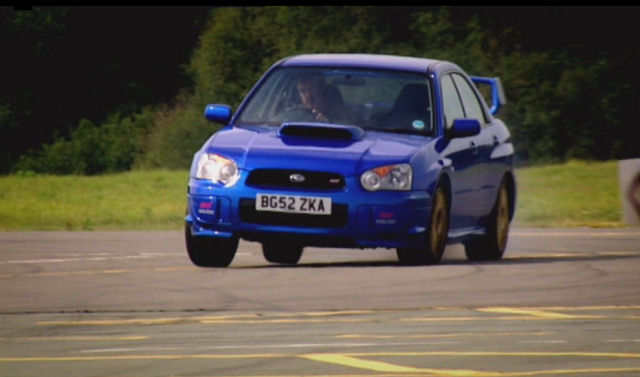
  • Subaru Impreza WRX/STi:  Unless you’ve been in a coma for the last ten years, you’ve heard of the Subaru Impreza WRX/STi.  They have an impressive history in WRC rallycross, so it only seems natural that a car that requires so much finesse on dirt and gravel would be at home on asphalt.  It is.  The 2015 STi has been described as a “305 horsepower merry go round.”  The earlier models (2003-2007) are best suited for autocross duty.  They have permanent AWD mated to a burbling 2.0-liter turbocharged 4-cylinder and a tricky 5-speed manual.  The STi models are faster, but more expensive.  Stick with the WRX for better bang for the buck.
  • BMW E30 3-Series:  This car is truly legendary in every arena of motorsports.  Rally, stock car racing in Europe, IMSA, DTM, WTCC, BTCC, you get the idea.  It came with a lot of engines, all of which are good.  The four-cylinder may be down on power compared to the inline six, but it gives a far better weight distribution.
  • Mitsubishi 3000GT:  It’s certainly fair to say that it’s one of the most underrated sports cars of the past 25 years.  You get AWD, active four-wheel steering, active aerodynamics with self-adjusting front AND rear spoilers, and electronically-controlled suspension.  It was the first real electronic sports car.  So, why aren’t people buying these?  Well, the electronic systems, which help make it a great drivers car, often fail.  They aren’t cheap to replace or fix.  Become an automotive electrician if you buy one.  If you’re willing to take the reliability risk into hand, you’re going to find yourself behind the wheel of an immensely capable car that will absolutely dominate an autocross course.
  • Chevrolet C10:  This is a wild card, but hear me out.  There are many pro-touring shops and companies out there who will build you a killer truck for about $20,000.  You can haul all of your spare tires, parts, etc. to the track.  You can even haul your other toys out to the track and dominate at the autocross.  Using a Chevrolet small-block V-8 will mean that you can squeeze a lot of power out of it for a few thousand dollars, give you reasonable fuel economy, and will be simple to work on no matter what you put on it.

Overall, autocross is a cheap, simple way to have a lot of fun with your friends on the weekend.  Taking an EVOC course through your local Sheriff’s office will help your driving skills enormously, and you will have fun doing it.  Most of the instructors autocross, so ask them which club is best.  Also, join a big sanctioning body like SCCA or NASA for autocross.  Once you start autocrossing, you’ll get hooked.

The Duntov Letter

This was the letter that forever changed hot rodding.  The most popular hot rodding engine ever would never have come around if it weren’t for this memorandum from Zora Arkus-Duntov.  He was the father of the Chevrolet Corvette and infamous Chevrolet small-block V-8.  His 1953 memorandum to Maurice Olley, Chevrolet’s Director of Research and Development changed hot rodding forever.

Duntov was new to Chevrolet, but he wasn’t new to hot rodding.  Before coming to Chevrolet, he’d developed an overhead-valve conversion kit for the also-infamous Ford flathead V-8.  His conversion kit was called the “Ardun.”  Today, it is one of the most coveted hot rodding parts ever made.  The Ardun was a cylinder head that moved the valves about a half inch above the cylinder.  It’s hard to explain.  Here’s an outside photo, and then an cutaway.

Back to the subject.  His 1953 three-page letter, simply known today as the “Duntov Letter,” he leveraged the power of hot rodding (it was referenced nine different times in the letter) in the hopes that he could do for Chevy what the flatheads and lakebeds did for Ford.

The Duntov Letter turned 61 a few days ago.

To: Mr. Maurice Olley
From: Mr. Z. Arkus-Duntov
Subject: Thoughts Pertaining to Youth, Hot Rodders, and Chevrolet
Date: December 16, 1953

The hot rod movement and interest in things connected with hop-up and speed is still growing. As an indication: the publications devoted to hot rodding and hop-upping, of which some half-dozen have a very large circulation and are distributed nationally, did not exist some 6 years ago. From cover to cover, they are full of Fords. This is not surprising then that the majority of hot-rodders are eating, sleeping, and dreaming modified Fords. They know Ford parts from stem to stern better than the Ford people themselves.


A young man buying a magazine for the first time immediately becomes introduced to Ford. It is reasonable to assume that when hot-rodders or hot-rod influenced persons buy transportation, they buy Fords. As they progress in age and income, they graduate from jalopies to second hand Fords, then to new Fords.


Should we consider that it would be desirable to make these youths Chevrolet-minded? I think that we are in a position to carry out a successful attempt. However, there are many factors against us:


1. Loyalty and experience with Ford.


2. Hop-up industry is geared to Ford.

3. Law of numbers thousands are and will be working on Fords for active competition.

4. Appearance of Ford’s overhead V-8, now one year ahead of us.


When a superior line of G.M. V-8s appeared, there where remarkably few attempts to develop these and none too successful. Also, the appearance of the V-8 Chrysler was met with reluctance even though the success of Ardun-Fords conditioned them to the acceptance of Firepower.

This year is the first one in which isolated Chrysler developments met with success. The Bonneville records are divided between Ardun-Fords and Chryslers.

In the non acceptance of G.M. V-8’s and very slow beginning of Chrysler, cost must have played a part.

Like all people, hot-rodders are attracted by novelty. However, bitter experience taught them that new development is costly and long and therefore are extremely conservative. From my observation, it takes an advanced hot-rodder some three years to stumble toward the successful development of a new design. Overhead Fords will be in this state in 1956-1957.


The slide rule potential of our RPO V-8 engine is extremely high but to let things run their natural course will put us one year behind and then not too many will pick Chevrolet for development.

It seems that unless by some action the odds and the time factor are not overcome, Ford will continue to dominate the thinking of this group. One factor which can largely overcome this handicap would be the availability of ready engineered parts for higher output.

If the use of the Chevrolet engine would be made easy and the very first attempts would be crowned with success, the appeal of the new will take hold and not have the stigma of expensiveness like the Cadillac or Chrysler, a swing to Chevrolet may be anticipated. This means the development of a range of special parts – camshafts, valves, springs, manifolds, pistons and such which will be made available to the public.

The association of Chevrolet with hot rods, speeds and such is probably inadmissible. But possibly the existence of the Corvette provides the loop hole. If the special parts are carried as RPO items for the Corvette, they undoubtedly will be recognized by the hot rodders as the very parts they were looking for to hop up the Chevy.

If it is desirable or not to associate the Corvette with the speed, I am not qualified to say, but I do know that the in 1954, sports car enthusiasts will get hold of Corvettes and whether we like it or not, will race it. Most frequent statement from this group is “we will put a Cadillac in it”. They are going to, and I think this is not good! Most likely they will meet with Allard trouble that is breaking sooner or later, mostly sooner, everything between the flywheel and road wheels.

In 1955, with V-8 engine, if I needed to they will be still outclassed. The market-wise negligible number of cars purchased for competition attracts public attention and publicity out of proportion to their number. Since we cannot prevent the people from racing Corvettes maybe it is better to help them to do a good job at it.

To make good in this field, the RPO parts must pertain not only to the engine but to the chassis components as well. Engineering-wise, Development of these RPO items, as far as the chassis concerned, does not fall out of line with some of the planned activity of our group. Use of light alloys, and brake development composite drums, disc and such are already on the agenda of the Research and Development group already.

As I stated above, V-8 RPO engine has a high power potential it is hard to beat inches, but having only 80% of cubic inches it has 96% of square inches of Pittston area of the Cadillac. In my estimation, the power output comparable to the Cadillac can be obtained not exceeding 270 ft.lb. of torque at any point. (323 ft.lb. of Cadillac)*. The task of making powertrain reliable is therefore easier. 

 These thoughts are offered for what they are worth: one man’s thinking aloud on the subject. 


Z. Arkus-Duntov
December 16, 1953

* The comparison pertains to a special type of Cadillac

As we all now know, the Duntov Letter changed hot rodding forever.  The legendary Chevy “Mouse Motor” small-block V-8 was born in 1955.  It made more than double the power of the Ford flathead V-8.  It took a couple of years to catch on, but when it did, oh my.  It stayed in production for an astonishing 45 years, before being replaced by the small-block-based LS-series engines.  It is still one of the best engines ever.  It sounds good, weighs as much as a V-6, and has found it’s way into just about every car imaginable.  Hot rodders love it.  It’s small enough to fit into a 1932 Ford engine bay.

Today it’s been replaced with the LS-series engines.  The only big-block LS motors are the LS7 (found in the C6 Corvette ZO6 and 2014 Camaro Z/28) and LS2/LQ4 (found in the C6 Corvette and GMC Sierra HD/Chevy Silverado HD).

Here is a list of the Chevy small-block motors and what cars they were used in.  I have also included what years that engine was made:

Chevrolet Small Block V-8:

  • 262 C.I. V-8 (1975-1976).  Used in Chevrolet Monza, Nova, Pontiac Ventura.
  • 265  C.I. V-8 (1955-1957).  Used in Chevrolet Bel Air, 3100-series pickups, Suburban, Corvette.
  • 283 C.I. V-8 (1957-1967).  Used in Chevrolet Bel Air, 3100-, 3600-, and 3800-series pickups, Corvette, Impala, Checker Taxi (1965-1966).
  • 307 C.I. V-8 (1968-1973).  Used in GM A-Body cars.
  • 302 C.I. V-8 (1967-1969).  Used in Chevrolet Camaro Z/28.
  • 327 C.I. V-8 (1962-1970).  Used in GM A-Body cars, Chevrolet Impala.
  • 350 C.I. V-8 (1967-2000).  Used in Chevrolet Camaro, Corvette, Chevelle, Pickup Trucks, El Camino, Nova, Pontiac Firebird, Pontiac Ventura, Chevrolet Blazer, GMC Pickups and Jimmy, Chevrolet/GMC Suburban, Cadillac Brougham, Buick Roadmaster, GMC Vandura, Chevrolet Caprice 9C1, Oldsmobile Custom Cruiser, AM General HUMMER H1, Cadillac Escalade, GMC Yukon, Chevrolet Tahoe.
  • 400 C.I. V-8 (1970-1980).  Used in GM A-Body and B-Body, GMC/Chevrolet Suburban, GMC Jimmy/Chevrolet Blazer.
  • 305 C.I. V-8 (1976-1992).  Used in Chevrolet Camaro, Chevrolet Caprice/Caprice Impala, Chevrolet Corvette (1980 CA only), Chevrolet Monte Carlo, Chevrolet Malibu, Chevrolet Monza, Chevrolet Nova, Chevrolet/GMC Trucks/Vans, Buick Regal, Buick Skylark, Cadillac Brougham, Checker Marathon, Oldsmobile Custom Cruiser, Oldsmobile Omega, Oldsmobile Cutlass, Pontiac Catalina, Pontiac Bonneville, Pontiac Firebird, Pontiac Grand Prix, Pontiac Grand Le Mans, Pontiac Parisienne, Pontiac Parisienne Safari, Pontiac Sunbird.
  • 267 C.I. V-8 (1979-1982).  Used in GM F-Body, GM G-Body, GM B-Body, Checker Marathon.

Which of these engines saw the most work?  Well, the 350 has found it’s way into just about every car made.  People have built Smart Car drag cars with them.  The 350 is a reliable engine that can have just about anything slapped onto it and be fine.  It can be built into a holy drag strip terror by simply stroking it and shoving a big cam in.

The 305 is the engine everybody complains about.  It took a 283 block, but had the crankshaft and internals of the 327.  This means that you can pick up a lot of horsepower by simply adding forged 327 internals.  It’s also extremely reliable.

The 400 was the biggest Chevy small-block to come from the factory.  All Chevy did was bore and stroke the 350.  This means that it is more powerful than a 350 with a cam, but only weighs about 20 pounds more.  Oh, and it’s externally the same size.  That helps a lot with hot rodders who want the power and reliability that they know a Chevy small-block V-8 will provide, but need the compact dimensions of a smaller engine.

The 283 is a great engine.  It doesn’t rev high, but it revved higher and better than the 265 that preceded it.  Interestingly, when you put fuel injection on top of it instead of a carburetor, it revs 1,000 RPM higher.  It also makes 283 horsepower.  Back in 1957, anybody who had a 1957 Chevrolet Bel Air with the fuel-injected 283, not only did you have a beautiful car, but you had a car that could keep up with sports cars ten years down the road.  Today, it is one of the most coveted cars ever.  I will own one before I die.

Chevrolet still lets Mercury Marine make the 305, 350, and 327 for marine applications.  They are popular in offshore powerboats.  Drag boats use heavily massaged Chevy big-blocks.  Offshore powerboat engine builders take a Mercury Marine 350, pull it apart, add a couple of turbochargers, and forged internals, and shove it into a really cool boat.

You can check out Mercury Marine at https://www.mercurymarine.com/en/us/

Chevrolet Performance still makes small blocks that they sell to the public.  You can check out their website at http://www.chevrolet.com/performance/overview.html

On another note, I will be taking a few weeks off for the holidays.  Look for a new post sometime in mid-January.  Happy holidays to my faithful readers – you are amazing!